PUBLISHER: Mordor Intelligence | PRODUCT CODE: 2115165

PUBLISHER: Mordor Intelligence | PRODUCT CODE: 2115165
Polymer Fillers - Market Share Analysis, Industry Trends & Statistics, Growth Forecasts (2026 - 2031)
According to Mordor Intelligence, the polymer filler market size in 2026 is estimated at USD 58.74 billion, growing from 2025 value of USD 56.44 billion with 2031 projections showing USD 71.74 billion, growing at 4.08% CAGR over 2026-2031.
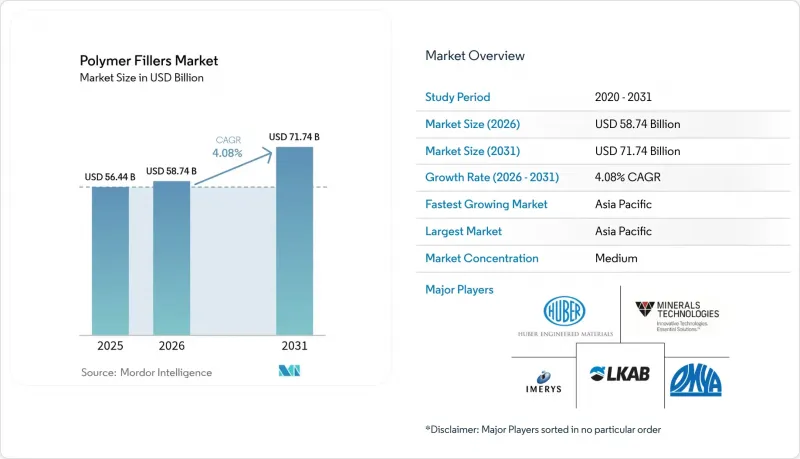
This report Segments the Industry by Product Type (Organic and Inorganic), Polymer Matrix (Thermoplastics, Thermosets, and More), End-User Industry (Automotive and Transportation, Building and Construction, and More), and Geography (Asia-Pacific, North America, Europe, South America, and Middle East and Africa). The Market Forecasts are Provided in Terms of Value (USD).
Global Polymer Fillers Market Trends and Insights
Rising Demand in Building & Construction
Infrastructure modernization and green building codes are lifting filler usage in concrete, cement, and asphalt mixes. Ground calcium carbonate lowers clinker requirements in portland-limestone cements, reducing CO2 output while retaining strength. Rubber-reinforced concretes boost compressive strength by up to 29% and flexural strength by 66%, which appeals to seismic-resistant designs. Geopolymer mixes with mineral and plant fibers improve freeze-thaw resilience, important for cold-climate projects. The polymer fillers market benefits when cellulose ethers enhance tile adhesives by improving water retention and workability, a feature keenly adopted in emerging economies. In large infrastructure bids throughout Asia and North America, contractors cite material cost savings of 10-15% when fillers replace more expensive binders.
Electrification of Mobility & Lightweighting Push
Battery-electric vehicles require composites that cut weight yet provide crash resistance, flame retardance, and electromagnetic shielding. Carbon-fiber-reinforced nanocomposites with ionic-liquid-treated nanotubes offer flexural strength near 803 MPa while meeting UL 94 V-0 flame ratings. Filler-rich polypropylene door panels formed with chemical foaming agents trim mass by over 15%, helping OEMs meet U.S. Corporate Average Fuel Economy targets. Natural fiber-reinforced polypropylene blends combine 10 wt.% flax and 20 wt.% wood flour to deliver thermal stability suitable for under-hood use. These advances fuel a 0.9 percentage-point boost in the long-term CAGR of the polymer fillers market, particularly in Europe and China where EV penetration tops 50% of new-car sales.
High Processing & Dispersion Cost of Specialty Fillers
Uniform dispersion of graphene, CNTs, or layered silicates requires twin-screw extruders outfitted with intensive kneading blocks and optimized barrel profiles. Small-and-medium compounders face capital barriers exceeding USD 2 million per line, which limits product range. Masterbatch producers must balance high filler loading with acceptable melt flow; poor flow fosters die-lip build-up and downtime. New dispersants improve milling efficiency but add 8-12 % to formulation cost, compressing margins. Oil absorption in mineral fillers further complicates viscosity control, necessitating surface treatments that raise raw-material spend. These realities trim near-term growth by 0.8 percentage points across the polymer fillers market.
Other drivers and restraints analyzed in the detailed report include:
- Surge in Electrical & Electronics Production
- Growth of Recycled-Content Polymer Compounds
- Emerging Micro-Plastics-Dust Emission Norms
For complete list of drivers and restraints, kindly check the Table Of Contents.
Segment Analysis
Inorganic fillers accounted for 67.92% of 2025 revenue within the polymer fillers market share, sustaining leadership due to their favorable economics and broad applicability. Calcium carbonate fillers can lower polypropylene part cost by up to 40% while imparting improved stiffness and dimensional stability. Silica and engineered talc supply anti-blocking and nucleating functions for food packaging films, with major producers operating mines adjacent to compounding hubs, which reduces logistics overhead. Metal oxides such as titanium dioxide remain essential for opacity and UV protection, although supply constraints have prompted price surcharges.
Organic fillers are expanding at a 5.12% CAGR through 2031, reflecting regulatory support for bio-based content. Sustainable streams like wood flour, starch, and ground eggshells provide weight reductions of 5-10% compared with mineral systems, which supports eco-labeling in consumer goods. Lignocellulosic fibers additionally raise tensile modulus in biopolymer blends, aiding compostable bag performance. Carbon-based fillers extend into conductive applications; graphene nanoplatelets dispersed at 1-3 wt.% lower surface resistivity by three orders of magnitude. As these advanced organics scale commercially, the polymer fillers market size for organic grades could exceed USD 13.25 billion by 2031.
Complete Report Scope:
- By Product Type
- Organic
- Natural (wood-flour, starch)
- Carbon-based (carbon black, graphene)
- Inorganic
- Oxides (CaCO3, SiO2, Al(OH)3)
- Hydro-oxides
- Salts
- Silicates (talc, kaolin, mica)
- Metals and Metal-Oxides (ZnO, Al2O3, Fe2O3)
- Organic
- By Polymer Matrix
- Thermoplastics
- Thermosets
- Elastomers
- By End-User Industry
- Automotive and Transportation
- Building and Construction
- Electrical and Electronics
- Packaging
- Consumer Goods
- Others (Agriculture, Healthcare, 3-D Printing)
- By Geography
- Asia Pacific
- China
- India
- Japan
- South Korea
- Rest of Asia Pacific
- North America
- United States
- Canada
- Mexico
- Europe
- Germany
- United Kingdom
- Italy
- France
- Rest of Europe
- South America
- Brazil
- Argentina
- Rest of South America
- Middle East and Africa
- Saudi Arabia
- South Africa
- Rest of Middle East and Africa
- Asia Pacific
Geography Analysis
Asia Pacific contributes 39.78% of global demand and is projected to post a 5.30% CAGR through 2031. China leads filler consumption through large-scale investments in lithium-battery materials and engineering plastics, while India's road-building program drives calcium-carbonate volumes. Regional mineral processors operate integrated mines and coating facilities, lowering delivered costs and meeting just-in-time requirements for electronics lines. Government subsidies for new-material plants in Vietnam and Indonesia further expand local supply.
North America records steady expansion as EV production and federal infrastructure packages invigorate polypropylene and talc demand. Carbon-black producers secure Department of Energy grants that back domestic battery supply chains, and recyclers scale post-consumer PVC fillers for decking boards. Extreme weather events disrupting high-purity quartz supply highlight vulnerability but have spurred risk-mitigation inventories.
Europe experiences moderate growth because micro-plastic restrictions tighten compliance costs. Yet, circularity goals spur investment in glass-cullet fillers and bio-based additives that align with EU taxonomy requirements. Established vendors pioneer low-carbon talc mining with renewable power, aiming for Scope 1 and 2 emission reductions. Collectively, these geographic dynamics shape a balanced outlook for the polymer fillers market.
- 20 Microns
- Birla Carbon
- Cabot Corporation
- Carbo Ceramics Inc.
- Covia Holdings LLC
- GCR Group
- Hoffmann Mineral
- Huber Engineered Materials
- Imerys
- LKAB Minerals
- Minerals Technologies Inc.
- Nanocyl SA
- Nippon Talc Co., Ltd.
- Nordkalk
- Omya AG
- Quarzwerke GmbH
- Sibelco
- Talga Group
- Tokai Carbon Co., Ltd
Additional Benefits:
- The market estimate (ME) sheet in Excel format
- 3 months of analyst support
TABLE OF CONTENTS
1 Introduction
- 1.1 Study Assumptions & Market Definition
- 1.2 Scope of the Study
2 Research Methodology
3 Executive Summary
4 Market Landscape
- 4.1 Market Overview
- 4.2 Market Drivers
- 4.2.1 Rising demand in building & construction
- 4.2.2 Electrification of mobility & lightweighting push
- 4.2.3 Surge in electrical & electronics production
- 4.2.4 Growth of recycled-content polymer compounds
- 4.2.5 Rapid uptake of composite 3-D-printing filaments
- 4.3 Market Restraints
- 4.3.1 High processing & dispersion cost of specialty fillers
- 4.3.2 Raw-material price volatility
- 4.3.3 Emerging micro-plastics-dust emission norms (under-reported)
- 4.4 Value Chain Analysis
- 4.5 Porter's Five Forces
- 4.5.1 Bargaining Power of Suppliers
- 4.5.2 Bargaining Power of Buyers
- 4.5.3 Threat of New Entrants
- 4.5.4 Threat of Substitutes
- 4.5.5 Degree of Competition
5 Market Size & Growth Forecasts (Value)
- 5.1 By Product Type
- 5.1.1 Organic
- 5.1.1.1 Natural (wood-flour, starch)
- 5.1.1.2 Carbon-based (carbon black, graphene)
- 5.1.2 Inorganic
- 5.1.2.1 Oxides (CaCO3, SiO2, Al(OH)3)
- 5.1.2.2 Hydro-oxides
- 5.1.2.3 Salts
- 5.1.2.4 Silicates (talc, kaolin, mica)
- 5.1.2.5 Metals and Metal-Oxides (ZnO, Al2O3, Fe2O3)
- 5.1.1 Organic
- 5.2 By Polymer Matrix
- 5.2.1 Thermoplastics
- 5.2.2 Thermosets
- 5.2.3 Elastomers
- 5.3 By End-User Industry
- 5.3.1 Automotive and Transportation
- 5.3.2 Building and Construction
- 5.3.3 Electrical and Electronics
- 5.3.4 Packaging
- 5.3.5 Consumer Goods
- 5.3.6 Others (Agriculture, Healthcare, 3-D Printing)
- 5.4 By Geography
- 5.4.1 Asia Pacific
- 5.4.1.1 China
- 5.4.1.2 India
- 5.4.1.3 Japan
- 5.4.1.4 South Korea
- 5.4.1.5 Rest of Asia Pacific
- 5.4.2 North America
- 5.4.2.1 United States
- 5.4.2.2 Canada
- 5.4.2.3 Mexico
- 5.4.3 Europe
- 5.4.3.1 Germany
- 5.4.3.2 United Kingdom
- 5.4.3.3 Italy
- 5.4.3.4 France
- 5.4.3.5 Rest of Europe
- 5.4.4 South America
- 5.4.4.1 Brazil
- 5.4.4.2 Argentina
- 5.4.4.3 Rest of South America
- 5.4.5 Middle East and Africa
- 5.4.5.1 Saudi Arabia
- 5.4.5.2 South Africa
- 5.4.5.3 Rest of Middle East and Africa
- 5.4.1 Asia Pacific
6 Competitive Landscape
- 6.1 Market Concentration
- 6.2 Strategic Moves
- 6.3 Market Share Analysis
- 6.4 Company Profiles (includes Global level Overview, Market level overview, Core Segments, Financials as available, Strategic Information, Market Rank/Share for key companies, Products & Services, and Recent Developments)
- 6.4.1 20 Microns
- 6.4.2 Birla Carbon
- 6.4.3 Cabot Corporation
- 6.4.4 Carbo Ceramics Inc.
- 6.4.5 Covia Holdings LLC
- 6.4.6 GCR Group
- 6.4.7 Hoffmann Mineral
- 6.4.8 Huber Engineered Materials
- 6.4.9 Imerys
- 6.4.10 LKAB Minerals
- 6.4.11 Minerals Technologies Inc.
- 6.4.12 Nanocyl SA
- 6.4.13 Nippon Talc Co., Ltd.
- 6.4.14 Nordkalk
- 6.4.15 Omya AG
- 6.4.16 Quarzwerke GmbH
- 6.4.17 Sibelco
- 6.4.18 Talga Group
- 6.4.19 Tokai Carbon Co., Ltd
7 Market Opportunities & Future Outlook
- 7.1 White-space & Unmet-need Assessment
- 7.2 Growing Trend of Electric Vehicles in Automotive Industry

