PUBLISHER: Mordor Intelligence | PRODUCT CODE: 2115166

PUBLISHER: Mordor Intelligence | PRODUCT CODE: 2115166
United States Printed Signage - Market Share Analysis, Industry Trends & Statistics, Growth Forecasts (2026 - 2031)
According to Mordor Intelligence, the United States printed signage market size was valued at USD 8.86 billion in 2025 and estimated to grow from USD 9.12 billion in 2026 to reach USD 10.54 billion by 2031, at a CAGR of 2.94% during the forecast period (2026-2031).
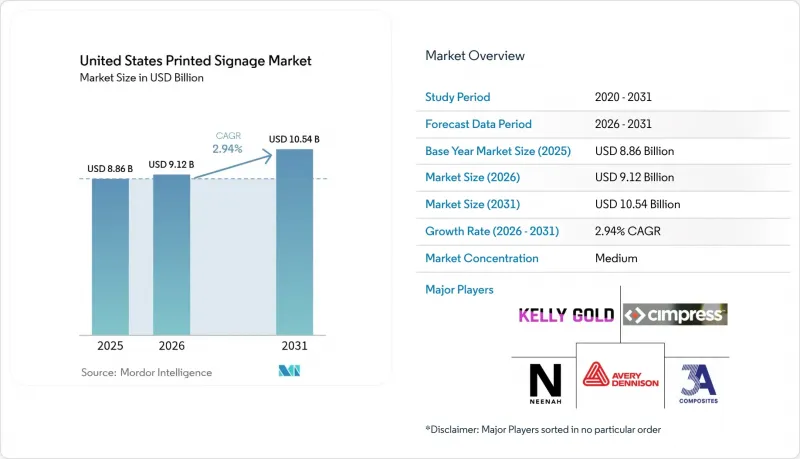
This report is Segmented by Material (Paper and Cardboard, PVC and Plastic Composites, and More), Product (Billboards, Backlit Displays, and More), Application Type (Indoor Printed Signage, Outdoor Printed Signage), End-User Vertical (Retail, BFSI, and More), Printing Technology (Screen Printing, Inkjet Printing, and More). The Market Forecasts are Provided in Terms of Value (USD).
United States Printed Signage Market Trends and Insights
Cost-Effectiveness Drives Market Resilience Against Digital Alternatives
Printed signage remains the lowest-total-cost option for static outdoor and QSR drive-through menus because it requires no electricity or network infrastructure. Digital displays consume 100-400 watts and impose service costs, whereas printed boards are maintenance-light, an advantage for operators struggling with staffing gaps as 70% of restaurants reported hard-to-fill positions in 2024. Budget-sensitive chains therefore continue to standardize on durable print packages for high-traffic sites. The result is sustained baseline demand that supports the United States printed signage market even as digital alternatives mature.
QSR Expansion Fuels Systematic Signage Demand
U.S. QSR sales surpassed USD 1.1 trillion in 2024, prompting new builds and remodels that each require full signage suites-storefront, menu boards, compliance notices, and temporary promotions. Franchisees favor printed assets for uniform color matching across hundreds of outlets and simpler procurement compared with IT-heavy digital screens. Drive-through lanes, where glare and weather challenge LCD readability, further secure printed formats. These high-volume roll-outs anchor revenue visibility for vendors across the United States printed signage market.
Digital Signage Adoption Accelerates Across High-Value Applications
Dynamic menu boards and interactive displays now integrate with cloud CMS and AI analytics, allowing price shifts and personalized ads at scale. Large QSR chains and flagship retailers view these capabilities as revenue multipliers, eroding share from static boards. However, infrastructure costs and maintenance requirements still limit penetration, preserving significant addressable volume for the United States printed signage market in cost-centric venues.
Other drivers and restraints analyzed in the detailed report include:
- Digital Short-Run Printing Transforms Inventory Economics
- Pop-Up Retail Drives Temporary Signage Innovation
- Environmental Regulations Target PVC Substrate Usage
For complete list of drivers and restraints, kindly check the Table Of Contents.
Segment Analysis
PVC and plastic composites captured 38.02% of United States printed signage market share in 2025 owing to superior weather resistance. The segment's growth is slowing as compliance costs rise, but absolute demand remains high for highway and construction signage tied to IIJA projects. Paper and cardboard's 4.18% CAGR signals rapid substitution in indoor decor and short-lifecycle retail campaigns, while recyclable rigid boards such as Neenah's Endura line win institutional contracts.
For premium outdoor installations, metal sheets retain niche appeal, and fabric substrates scale alongside pop-up retail. Emerging biodegradable films position vendors to hedge regulatory risk and safeguard margins. These shifts ensure material diversification within the United States printed signage market as buyers balance cost, durability, and sustainability credentials.
Banners, flags, and backdrops delivered 31.05% of the United States printed signage market size in 2025, sustained by versatility in events, storefronts, and civic campaigns. Their lightweight construction simplifies logistics and installation, keeping unit costs low. Backlit displays, though smaller in volume, will outpace other products at a 3.38% CAGR. Retailers deploy illuminated graphics in windows and transit hubs, seeking premium aesthetics that command consumer attention after dark.
Billboards remain indispensable where zoning impedes digital boards, especially along federally funded corridors that must feature "Investing in America" branding. Point-of-purchase displays preserve impulse-buy lift in supermarkets, blending with QR-code interactivity. Such diversification underscores the resilience of the United States printed signage market against single-product disruption.
Complete Report Scope:
- By Material
- Paper and Cardboard
- PVC and Plastic Composites
- Fabric and Textile
- Metal Sheets and Foils
- Wood and Rigid Boards
- By Product
- Billboards
- Backlit Displays
- Point-of-Purchase (POP) Displays
- Banners, Flags and Backdrops
- Corporate Graphics, Exhibition and Trade-show Materials
- Transit and Street Furniture
- Other Products
- By Application Type
- Indoor Printed Signage
- Outdoor Printed Signage
- By End-user Vertical
- Retail
- BFSI
- Transportation and Logistics
- Sports and Leisure
- Entertainment and Media
- Education and Government
- Other End-User Verticals
- By Printing Technology
- Screen Printing
- Inkjet Printing
- Toner-based (Electrophotography)
- Other Printing Technologies
List of Companies Covered in this Report:
- Avery Dennison Corporation
- 3A Composites USA Inc.
- Neenah Paper & Packaging LLC
- Cimpress plc (Vistaprint)
- Kelly Gold & Co. Signs Inc.
- Chandler Inc.
- Signs By Tomorrow LLC
- Fastsigns International Inc.
- Signarama (United Franchise Group)
- Image360 (Alliance Franchise Brands LLC)
- Allegra Network LLC
- ARC Document Solutions Inc.
- Sabre Digital Marketing LLC
- Southwest Printing Co.
- James Printing & Signs Inc.
- Minuteman Press International Inc.
- RR Donnelley & Sons Company
- Vomela Companies Inc.
- SignsNow Corporation
- Orbus Exhibit & Display Group
Additional Benefits:
- The market estimate (ME) sheet in Excel format
- 3 months of analyst support
TABLE OF CONTENTS
1 INTRODUCTION
- 1.1 Study Assumptions and Market Definition
- 1.2 Scope of the Study
2 RESEARCH METHODOLOGY
3 EXECUTIVE SUMMARY
4 MARKET LANDSCAPE
- 4.1 Market Overview
- 4.2 Market Drivers
- 4.2.1 Cost-effectiveness of printed signage
- 4.2.2 Surging demand from quick-service restaurants (QSRs)
- 4.2.3 Digital short-run printing lowering inventory costs
- 4.2.4 Growing retail pop-up and experiential stores
- 4.2.5 Infrastructure stimulus boosting outdoor advertising
- 4.2.6 Rise of recyclable/biodegradable sign materials
- 4.3 Market Restraints
- 4.3.1 Advent of digital signage
- 4.3.2 Environmental regulations on PVC substrates
- 4.3.3 Supply chain volatility of paper and aluminum composites
- 4.3.4 Labor shortages in wide-format printing shops
- 4.4 Industry Value Chain Analysis
- 4.5 Regulatory Landscape
- 4.6 Technological Outlook
- 4.7 Porter's Five Forces Analysis
- 4.7.1 Threat of New Entrants
- 4.7.2 Bargaining Power of Buyers/Consumers
- 4.7.3 Bargaining Power of Suppliers
- 4.7.4 Threat of Substitute Products
- 4.7.5 Intensity of Competitive Rivalry
- 4.8 Impact of Macroeconomic Factors on the Market
5 MARKET SIZE AND GROWTH FORECASTS (VALUE)
- 5.1 By Material
- 5.1.1 Paper and Cardboard
- 5.1.2 PVC and Plastic Composites
- 5.1.3 Fabric and Textile
- 5.1.4 Metal Sheets and Foils
- 5.1.5 Wood and Rigid Boards
- 5.2 By Product
- 5.2.1 Billboards
- 5.2.2 Backlit Displays
- 5.2.3 Point-of-Purchase (POP) Displays
- 5.2.4 Banners, Flags and Backdrops
- 5.2.5 Corporate Graphics, Exhibition and Trade-show Materials
- 5.2.6 Transit and Street Furniture
- 5.2.7 Other Products
- 5.3 By Application Type
- 5.3.1 Indoor Printed Signage
- 5.3.2 Outdoor Printed Signage
- 5.4 By End-user Vertical
- 5.4.1 Retail
- 5.4.2 BFSI
- 5.4.3 Transportation and Logistics
- 5.4.4 Sports and Leisure
- 5.4.5 Entertainment and Media
- 5.4.6 Education and Government
- 5.4.7 Other End-User Verticals
- 5.5 By Printing Technology
- 5.5.1 Screen Printing
- 5.5.2 Inkjet Printing
- 5.5.3 Toner-based (Electrophotography)
- 5.5.4 Other Printing Technologies
6 COMPETITIVE LANDSCAPE
- 6.1 Market Concentration
- 6.2 Strategic Moves
- 6.3 Market Share Analysis
- 6.4 Company Profiles (includes Global level Overview, Market level overview, Core Segments, Financials as available, Strategic Information, Market Rank/Share for key companies, Products and Services, and Recent Developments)
- 6.4.1 Avery Dennison Corporation
- 6.4.2 3A Composites USA Inc.
- 6.4.3 Neenah Paper & Packaging LLC
- 6.4.4 Cimpress plc (Vistaprint)
- 6.4.5 Kelly Gold & Co. Signs Inc.
- 6.4.6 Chandler Inc.
- 6.4.7 Signs By Tomorrow LLC
- 6.4.8 Fastsigns International Inc.
- 6.4.9 Signarama (United Franchise Group)
- 6.4.10 Image360 (Alliance Franchise Brands LLC)
- 6.4.11 Allegra Network LLC
- 6.4.12 ARC Document Solutions Inc.
- 6.4.13 Sabre Digital Marketing LLC
- 6.4.14 Southwest Printing Co.
- 6.4.15 James Printing & Signs Inc.
- 6.4.16 Minuteman Press International Inc.
- 6.4.17 RR Donnelley & Sons Company
- 6.4.18 Vomela Companies Inc.
- 6.4.19 SignsNow Corporation
- 6.4.20 Orbus Exhibit & Display Group
7 MARKET OPPORTUNITIES AND FUTURE OUTLOOK
- 7.1 White-space and Unmet-need Assessment

