PUBLISHER: Mordor Intelligence | PRODUCT CODE: 2115191

PUBLISHER: Mordor Intelligence | PRODUCT CODE: 2115191
Asia-Pacific Poultry - Market Share Analysis, Industry Trends & Statistics, Growth Forecasts (2026 - 2031)
According to Mordor Intelligence, the Asia-Pacific poultry market size is expected to grow from USD 175.50 billion in 2025 to USD 177.83 billion in 2026 and is forecast to reach USD 189.99 billion by 2031 at 1.33% CAGR over 2026-2031.
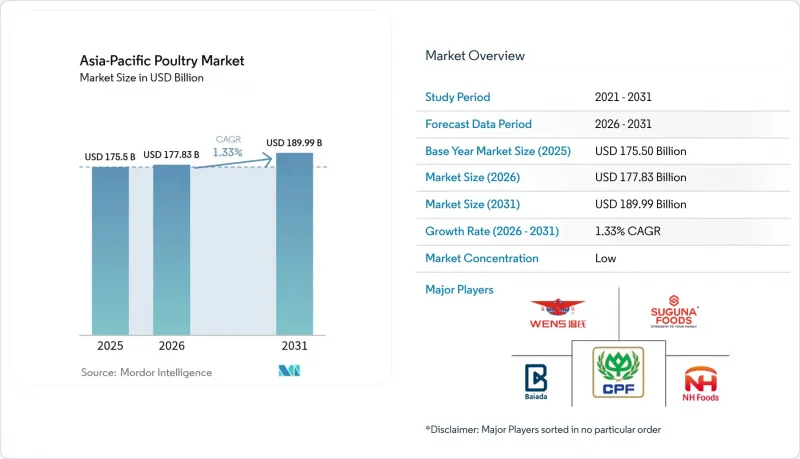
This report is Segmented by Species Type (Chicken, Duck, Turkey, and More), Form (Canned, Fresh/Chilled, Frozen, and Processed), Distribution Channel (Foodservice and Retail), and Geography (China, India, Japan, Australia, Thailand, Vietnam, Indonesia, South Korea, Malaysia, Singapore, and Rest of Asia-Pacific). The Market Forecasts are Provided in Terms of Value (USD) and Volume (Tons).
Asia-Pacific Poultry Market Trends and Insights
Rapid urbanization-driven demand for convenient animal protein
As Asia-Pacific's urban population grows faster than infrastructure can keep up, there's a rising demand for quick-preparation and shelf-stable protein sources. According to the OECD-FAO Agricultural Outlook, by 2034, poultry is set to make up 45% of global meat protein consumption, a rise from current figures. This change is largely driven by urban households favoring convenience and affordability over traditional wet-market purchases. In China, this trend is especially evident, with white broilers now constituting over 60% of the country's broiler population, thanks to their efficient feed conversion and compatibility with mechanized processing. Meanwhile, in India, processing capacity is on track to hit 267,800 birds per hour by mid-2026, marking a robust 15.75% annual growth since 2018. This surge is fueled by integrators pouring investments into automated evisceration and chilling lines, all to cater to the urban appetite. Yet, in Vietnam and Indonesia, the enduring presence of live-bird markets hampers the adoption of cold-chain logistics, curtailing the market potential for pre-packaged poultry. Urbanization is also ushering in a wave of premiumization. Consumers in tier-1 cities are now willing to shell out 20-30% more for poultry that's antibiotic-free or carries organic certifications. Processors are keenly tapping into this trend, using it as a strategy to counterbalance shrinking margins in commodity segments.
Expansion of QSR chains in tier-2 and tier-3 Asian cities
Quick-service restaurant (QSR) operators are increasingly targeting secondary cities, drawn by lower real estate costs and reduced competition, after saturating tier-1 metros. Yum China, for instance, has set its sights on operating 20,000 stores by 2026, with a notable focus on tier-3 cities. Here, KFC and Pizza Hut frequently stand out as the inaugural Western-style dining choices. This ambitious expansion not only underscores the growing appetite for Western dining but also drives a heightened demand for specific chicken cuts, like breast fillets, wings, and tenders, that align with franchise standards on size and fat content. Similarly, Jollibee's ventures into Vietnam and China underscore the importance of vertically integrated supply chains, ensuring consistent quality. This approach inherently benefits larger integrators, sidelining fragmented local suppliers. The QSR sector is also championing the use of frozen poultry, a necessity for franchisees aiming to reduce spoilage, especially in regions with sporadic cold-chain facilities. In 2024, South Korea's Ministry of Agriculture, Food and Rural Affairs highlighted a surge in domestic chicken consumption per capita, a trend bolstered by the dominance of fried-chicken chains in the late-night dining arena. Yet, the growth trajectory of QSRs isn't without its challenges. Economic downturns pose a threat, particularly in tier-2 cities where heightened price sensitivity might push consumers back to traditional wet markets during financially uncertain times.
Recurring avian-influenza outbreaks causing culling shocks
In June 2024, Australia reported an H7N3 outbreak, leading to the culling of over 1 million birds. Meanwhile, in May 2024, Vietnam dealt with H5N1 cases. Japan, in late 2024, detected multiple instances of H5N1, resulting in localized movement restrictions that delayed shipments to processors and retailers. South Korea's stringent culling protocols, which require the destruction of all birds within a 3-kilometer radius of confirmed cases, create supply shocks. These shocks ripple through integrated supply chains, compelling processors to source from distant regions at higher transport costs. While the World Health Organization, Food and Agriculture Organization, and World Organisation for Animal Health run joint surveillance programs, early-warning systems falter in lower-income markets due to underfunded veterinary infrastructure. The economic repercussions are significant: export bans from importing countries can linger for months post-outbreak containment, leaving producers with surplus inventory. In China and Vietnam, vaccination strategies are on the rise. However, concerns over vaccine efficacy and potential trade repercussions hinder broader adoption in export-centric markets such as Thailand and Australia.
Other drivers and restraints analyzed in the detailed report include:
- Rising disposable incomes lifting per-capita egg consumption
- Adoption of antibiotic-free and traceable poultry for export compliance
- Volatile feed raw-material prices linked to global grain markets
For complete list of drivers and restraints, kindly check the Table Of Contents.
Segment Analysis
In 2025, chicken secured a commanding 79.10% share of the species-type market, solidifying its status as Asia-Pacific's preferred poultry choice, thanks to its affordability, religious neutrality, and culinary versatility. Meanwhile, duck is making waves, growing at an annual rate of 3.15% through 2031, the fastest among its peers. This surge is largely attributed to China's stronghold on waterfowl production and the escalating appetite for Peking duck in urban locales, as highlighted by the USDA Foreign Agricultural Service. Dominating the scene, China produces over 70% of the world's duck, boasting integrated supply chains that cover breeding, feed milling, and processing. This comprehensive approach gives China a cost advantage that outpaces smaller producers in Vietnam and Thailand. In China, duck meat enjoys a premium status, gracing the menus of upscale restaurants and specialty retailers. Here, it's not just a dish but a symbol of festive celebrations and traditional culinary art, a cultural nuance that shields it from direct price wars with chicken. Vietnam's duck farming is on the rise, buoyed by government initiatives offering subsidized feed and technical training to small farmers. Yet, it's not without hiccups; production faced a setback in May 2024 due to avian influenza outbreaks, as reported by the World Organization for Animal Health.
Turkey and other poultry types occupy a niche segment, sharing the remaining market space. Turkey finds its primary audience among expatriates and Western-style eateries in Singapore, Hong Kong, and Australia. Yet, it struggles to resonate culturally in most Asian markets. Its longer growth cycle and less efficient feed conversion further diminish its competitiveness against chicken. Still, there's a silver lining: Japan and South Korea present niche markets, with health-conscious diners exploring leaner proteins. Australia, too, carves out a space, with local turkey farms catering to holiday festivities. However, challenges loom. The scarcity of turkey breeding stock and a dearth of processing know-how stifle broader market growth. As it stands, chicken and duck are poised to maintain their dominance in the species landscape through 2031.
Complete Report Scope:
- Species Type
- Chicken
- Duck
- Turkey
- Other Poultry
- Form
- Canned
- Fresh/Chilled
- Frozen
- Processed
- By Distribution Channel
- Foodservice
- Retail
- Supermarkets and Hypermarkets
- Convenience Stores
- Specialty Stores/Butcheries
- Online Retailers
- Other Distribution Channels
- Geography
- China
- India
- Japan
- Australia
- Thailand
- Vietnam
- Indonesia
- South Korea
- Malaysia
- Singapore
- Rest of Asia-Pacific
List of Companies Covered in this Report:
- Charoen Pokphand Foods PCL
- Wen's Foodstuff Group Co. Ltd.
- Suguna Foods Pvt. Ltd.
- NH Foods Ltd.
- Baiada Poultry Pty Ltd
- Ingham's Group Ltd.
- Japfa Ltd.
- Fujian Sunner Development Co. Ltd.
- Venky's (India) Ltd.
- BRF S.A.
- Tyson Foods Inc.
- QAF Ltd.
- Kazi Farms Group
- San Miguel Foods Inc.
- CP Vietnam Corporation
- JBS S.A
- Universal Robina Corp.
- Guangdong DaBeiNong Group
- Huaying Agricultural
- New Hope Liuhe Co. Ltd.
Additional Benefits:
- The market estimate (ME) sheet in Excel format
- 3 months of analyst support
TABLE OF CONTENTS
1 INTRODUCTION
- 1.1 Study Assumptions and Market Definition
- 1.2 Scope of the Study
2 RESEARCH METHODOLOGY
3 EXECUTIVE SUMMARY
4 MARKET LANDSCAPE
- 4.1 Market Overview
- 4.2 Market Drivers
- 4.2.1 Rapid urbanisation-driven demand for convenient animal protein
- 4.2.2 Expansion of QSR chains in tier-2 and tier-3 Asian cities
- 4.2.3 Rising disposable incomes lifting per-capita egg consumption
- 4.2.4 Adoption of antibiotic-free and traceable poultry for export compliance
- 4.2.5 Government incentives for protein self-sufficiency amid feed volatility
- 4.2.6 E-commerce grocery growth improving cold-chain penetration
- 4.3 Market Restraints
- 4.3.1 Recurring avian-influenza outbreaks causing culling shocks
- 4.3.2 Volatile feed raw-material prices linked to global grain markets
- 4.3.3 Fragmented cold-chain logistics in lower-income ASEAN markets
- 4.3.4 Competition from plant-based protein start-ups targeting flexitarians
- 4.4 Consumer Behaviour Analysis
- 4.5 Regulatory Landscape
- 4.6 Technological Outlook
- 4.7 Porter's Five Forces
- 4.7.1 Threat of New Entrants
- 4.7.2 Bargaining Power of Buyers
- 4.7.3 Bargaining Power of Suppliers
- 4.7.4 Threat of Substitutes
- 4.7.5 Intensity of Competitive Rivalry
5 MARKET SIZE AND GROWTH FORECASTS (VALUE AND VOLUME)
- 5.1 Species Type
- 5.1.1 Chicken
- 5.1.2 Duck
- 5.1.3 Turkey
- 5.1.4 Other Poultry
- 5.2 Form
- 5.2.1 Canned
- 5.2.2 Fresh/Chilled
- 5.2.3 Frozen
- 5.2.4 Processed
- 5.3 By Distribution Channel
- 5.3.1 Foodservice
- 5.3.2 Retail
- 5.3.2.1 Supermarkets and Hypermarkets
- 5.3.2.2 Convenience Stores
- 5.3.2.3 Specialty Stores/Butcheries
- 5.3.2.4 Online Retailers
- 5.3.2.5 Other Distribution Channels
- 5.4 Geography
- 5.4.1 China
- 5.4.2 India
- 5.4.3 Japan
- 5.4.4 Australia
- 5.4.5 Thailand
- 5.4.6 Vietnam
- 5.4.7 Indonesia
- 5.4.8 South Korea
- 5.4.9 Malaysia
- 5.4.10 Singapore
- 5.4.11 Rest of Asia-Pacific
6 COMPETITIVE LANDSCAPE
- 6.1 Market Concentration
- 6.2 Strategic Moves
- 6.3 Market Share Analysis
- 6.4 Company Profiles (includes Global level Overview, Market level overview, Core Segments, Financials as available, Strategic Information, Market Rank/Share for key companies, Products and Services, and Recent Developments)
- 6.4.1 Charoen Pokphand Foods PCL
- 6.4.2 Wen's Foodstuff Group Co. Ltd.
- 6.4.3 Suguna Foods Pvt. Ltd.
- 6.4.4 NH Foods Ltd.
- 6.4.5 Baiada Poultry Pty Ltd
- 6.4.6 Ingham's Group Ltd.
- 6.4.7 Japfa Ltd.
- 6.4.8 Fujian Sunner Development Co. Ltd.
- 6.4.9 Venky's (India) Ltd.
- 6.4.10 BRF S.A.
- 6.4.11 Tyson Foods Inc.
- 6.4.12 QAF Ltd.
- 6.4.13 Kazi Farms Group
- 6.4.14 San Miguel Foods Inc.
- 6.4.15 CP Vietnam Corporation
- 6.4.16 JBS S.A
- 6.4.17 Universal Robina Corp.
- 6.4.18 Guangdong DaBeiNong Group
- 6.4.19 Huaying Agricultural
- 6.4.20 New Hope Liuhe Co. Ltd.
7 MARKET OPPORTUNITIES AND FUTURE OUTLOOK

