PUBLISHER: Mordor Intelligence | PRODUCT CODE: 2115205

PUBLISHER: Mordor Intelligence | PRODUCT CODE: 2115205
India Flat Glass - Market Share Analysis, Industry Trends & Statistics, Growth Forecasts (2026 - 2031)
According to Mordor Intelligence, the India flat glass market size is expected to grow from 2.58 million tons in 2025 to 2.75 million tons in 2026 and is forecast to reach 3.78 million tons by 2031 at 6.55% CAGR over 2026-2031.
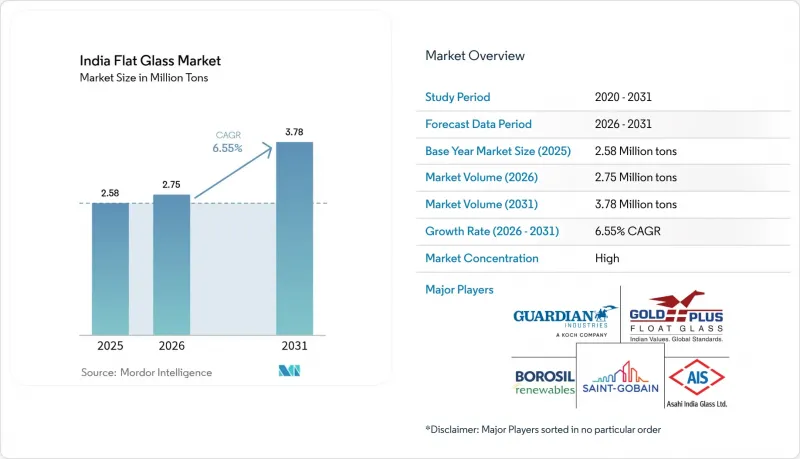
This report is Segmented by Product Type (Annealed Glass, Coater Glass, Processed Glass, Mirror Glass, Patterned Glass), End-User Industry (Building and Construction, Automotive, Solar Glass, Other End-User Industries). The Market Forecasts are Provided in Terms of Volume (Tons).
India Flat Glass Market Trends and Insights
Urban Infrastructure Boom & Smart Cities Push
India's Smart Cities Mission has approved 8,016 projects worth INR 1.64 trillion, which is translating into large procurement lots for low-emissivity, solar-control, and laminated facades that reduce HVAC load in public and private buildings. Policy mandates for green ratings have expanded specification depth, compelling architects to select glazing solutions with certified U-values and visible-light-transmittance benchmarks. Domestic contractors now tender facade packages earlier in project cycles, giving glass processors longer visibility of order pipelines and supporting capacity planning. As smaller municipalities replicate smart-city guidelines to draw investment, demand for certified glass spreads beyond major metros. International consortium partners from Europe and Japan transfer cutting-edge facade engineering know-how, nudging local processors toward triple-silver coatings and warm-edge spacer technologies that once were confined to premium offices. This diffusion of best practice heightens competitive pressure on legacy float-line operators to upgrade to magnetron sputtering or outsource coating to specialist toll coaters.
National Solar-PV Targets Spurring Solar Glass Capacity
India targets 500 GW of non-fossil power by 2030, of which solar constitutes the largest share, generating durable offtake for anti-reflective patterned glass used in photovoltaic modules. Anti-dumping duties on Chinese imports shield domestic players during scale-up, allowing them to pass through soda-ash cost spikes. Technological upgrades such as dual-textured rolling and online pyrolytic coating boost light transmission above 93%, enabling module efficiencies that rival imported glass. Manufacturers also integrate tin-bath waste-heat recovery to shave fuel costs and lower Scope 1 emissions. Export prospects brighten as Indian modules penetrate U.S. and European markets that require traceable, low-carbon glass inputs. Consequently, the India flat glass market gains a high-growth specialty branch that buffers against cyclicality in construction demand.
Volatile Prices of Soda Ash & Natural Gas
India imported more than 10 million tons of soda ash in FY 2024 to supplement domestic output of 2.5 million tons, exposing glassmakers to global price swings linked to energy costs and shipping disruptions. A 62% jump in domestic natural-gas prices in 2021 raised furnace-fuel costs, eroding EBITDA margins, especially for legacy float lines with specific-energy consumption above 5 GJ per ton. Manufacturers respond by forward-contracting soda-ash deliveries and blending petcoke or furnace oil when policy allows, though each alternative requires burner and emission-control retrofits. Spot gas volatility also complicates new-capacity project budgeting, prompting some investors to delay final investment decisions. The corresponding working-capital strain increases borrowing needs at a time when interest rates are elevated, pressuring free cash flows and slowing greenfield expansions that would otherwise help resolve domestic supply deficits.
Other drivers and restraints analyzed in the detailed report include:
- Data-Centre Construction Driving High-Performance Facade Glass
- PLI Schemes for Electronics Propelling Specialty Display Glass
- Stringent Emission Norms Elevating Compliance Costs
For complete list of drivers and restraints, kindly check the Table Of Contents.
Segment Analysis
Annealed Glass retained an 80.05% India flat glass market share in 2025, anchored by its ubiquitous use in residential windows and cost-sensitive commercial builds. The segment's scale benefits stem from established float-line infrastructure and minimal downstream processing. Yet Processed Glass is set to log a 7.05% CAGR through 2031, ensuring that its slice of the India flat glass market size widens meaningfully over the forecast horizon. Growth stems from the convergence of energy codes, architectural aesthetics, and vehicle-safety norms that require tempering, lamination, or functional coatings. The wider adoption of double-glazed units and solar-control coatings in premium offices drives coated-glass offtake, while mirrored and patterned variants cater to interior applications and decorative facades.
The shift carries strategic implications for margin profiles. Processed-glass realization often doubles the ex-factory price of annealed equivalents, enabling faster return on incremental capex for downstream lines. Several domestic producers now route as much as 45% of float output to their own tempering or lamination facilities, capturing integrated value. The India flat glass industry also observes increased licensing of sputter-coating technology from European firms, unlocking local production of low-E coatings once fully imported. Annealed-glass volumes are expected to persist in mass housing, yet their share gradually declines as code-compliant fenestration becomes mainstream in both new construction and retrofit markets.
Complete Report Scope:
- By Product Type
- Annealed Glass
- Coater Glass
- Processed Glass
- Mirror Glass
- Patterned Glass
- By End-user Industry
- Building and Construction
- Automotive
- Solar Glass
- Other End-user Industries
List of Companies Covered in this Report:
- Asahi India Glass Limited.
- Borosil Renewables
- Emerge Glass
- FUSO
- Gold Plus Group
- Guardian Industries Holdings
- Hindustan National Glass & Industries Limited
- Hi-Tech glass Industries
- Nippon Sheet Glass Co., Ltd
- Saint-Gobain
- SCHOTT
- Sisecam
Additional Benefits:
- The market estimate (ME) sheet in Excel format
- 3 months of analyst support
TABLE OF CONTENTS
1 Introduction
- 1.1 Study Assumptions and Market Definition
- 1.2 Scope of the Study
2 Research Methodology
3 Executive Summary
4 Market Landscape
- 4.1 Market Overview
- 4.2 Market Drivers
- 4.2.1 Urban infrastructure boom and Smart Cities push
- 4.2.2 Automotive glazing demand from rising vehicle production
- 4.2.3 National solar-PV targets spurring solar glass capacity
- 4.2.4 Data-centre construction driving high-performance facade glass
- 4.2.5 PLI schemes for electronics propelling speciality display glass
- 4.3 Market Restraints
- 4.3.1 Volatile prices of soda ash and natural gas
- 4.3.2 Stringent emission norms elevating compliance costs
- 4.3.3 High inbound freight for heavy float glass across regions
- 4.4 Value Chain Analysis
- 4.5 Porter's Five Forces Analysis
- 4.5.1 Bargaining Power of Suppliers
- 4.5.2 Bargaining Power of Buyers
- 4.5.3 Threat of New Entrants
- 4.5.4 Threat of Substitutes
- 4.5.5 Degree of Competition
5 Market Size and Growth Forecasts (Volume)
- 5.1 By Product Type
- 5.1.1 Annealed Glass
- 5.1.2 Coater Glass
- 5.1.3 Processed Glass
- 5.1.4 Mirror Glass
- 5.1.5 Patterned Glass
- 5.2 By End-user Industry
- 5.2.1 Building and Construction
- 5.2.2 Automotive
- 5.2.3 Solar Glass
- 5.2.4 Other End-user Industries
6 Competitive Landscape
- 6.1 Market Concentration
- 6.2 Strategic Moves
- 6.3 Market Share (%)**/Ranking Analysis
- 6.4 Company Profiles (includes Global Level Overview, Market Level Overview, Core Segments, Financials as available, Strategic Information, Market Rank/Share, Products and Services, Recent Developments)
- 6.4.1 Asahi India Glass Limited.
- 6.4.2 Borosil Renewables
- 6.4.3 Emerge Glass
- 6.4.4 FUSO
- 6.4.5 Gold Plus Group
- 6.4.6 Guardian Industries Holdings
- 6.4.7 Hindustan National Glass & Industries Limited
- 6.4.8 Hi-Tech glass Industries
- 6.4.9 Nippon Sheet Glass Co., Ltd
- 6.4.10 Saint-Gobain
- 6.4.11 SCHOTT
- 6.4.12 Sisecam
7 Market Opportunities and Future Outlook
- 7.1 White-space and Unmet-Need Assessment

