PUBLISHER: Mordor Intelligence | PRODUCT CODE: 2115209

PUBLISHER: Mordor Intelligence | PRODUCT CODE: 2115209
Europe Sourdough - Market Share Analysis, Industry Trends & Statistics, Growth Forecasts (2026 - 2031)
According to Mordor Intelligence, the European sourdough market size was valued at USD 0.90 billion in 2025 and estimated to grow from USD 0.95 billion in 2026 to reach USD 1.25 billion by 2031, at a CAGR of 5.59% during the forecast period (2026-2031).
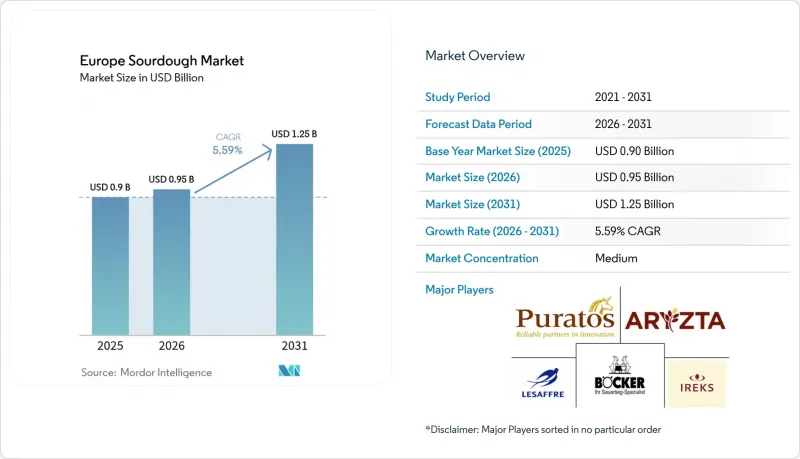
This report is Segmented by Form (Ready-To-Use Liquid, Dry Mix/Premix), Application (Bread and Buns, Pizza Crusts and Bases, Cakes and Pastries, Other Applications), Distribution Channel (Food Processing, Foodservice, Retail), and Geography (Germany, United Kingdom, Italy, France, Spain, Netherlands, Poland, Belgium, Sweden, Rest of Europe). Market Forecasts are Provided in Terms of Value (USD).
Europe Sourdough Market Trends and Insights
Rising Demand for Artisanal and Traditional Baking Methods
According to Puratos' tracking of Google trends data, searches for sourdough surged fivefold during the pandemic, underscoring a decisive shift in consumer preferences toward authentic fermentation processes. This heightened demand isn't limited to home bakers; commercial foodservice operators are now actively seeking out differentiated bread offerings that can command premium prices. In response to this trend, major industrial players are channeling investments into initiatives aimed at preserving culinary heritage. A prime example is Puratos, which maintains a library in Belgium housing 84 distinct sourdough cultures, alongside documentation of over 700 wild yeast strains and 1,500 lactic acid bacteria strains. By blending artisanal methods with industrial processes, suppliers gain a competitive edge, delivering consistent quality without compromising on traditional flavor profiles. In the UK, the Federation of Bakers has introduced a sourdough code of practice, offering regulatory clarity that not only sets quality standards for commercial production but also bolsters market expansion. This framework empowers smaller producers to compete on a level playing field, all while reinforcing consumer trust in the authenticity of the products.
Growing Demand for Clean-Label Breads with Longer Shelf Life
Driven by consumer scrutiny of ingredient lists and a demand for recognizable components, clean-label positioning has become essential for market access. Sourdough's natural fermentation process offers preservation benefits through organic acid production, which not only reduces the need for synthetic additives but also extends shelf life. In 2024, Kerry launched Biobake Fibre specifically for rye bread applications, showcasing how ingredient suppliers are meeting clean-label demands while fulfilling functional needs. The European Union mandates comprehensive disclosure of processing aids and additives, creating a competitive edge for naturally fermented products that need fewer ingredient declarations. Corbion introduced natural mold inhibition solutions in April 2025, highlighting industry innovation in tackling shelf-life challenges while maintaining clean-label integrity. This trend is especially advantageous for retail channels, as the extended shelf life of sourdough products not only reduces waste but also enhances distribution economics, allowing them to compete more effectively against conventional breads.
Price Elasticity Versus Conventional White Breads
Sourdough products often carry a 20-40% price premium over regular breads, creating affordability challenges that hinder their appeal to budget-conscious consumers. Between 2019 and 2023, German bakery prices surged by about 33%, with specialty breads facing a steeper inflation, leading to a dip in demand elasticity, as reported by FinanzNachrichten.de. In Eastern Europe, economic constraints limit the uptake of premium breads, as households prioritize essential foods over artisanal options. The widening price gap stems from rising ingredient costs for specialty flours and longer fermentation processes, outpacing inflation for standard bread inputs. In response, retail chains have introduced private-label sourdoughs, aiming to bridge the price gap without compromising on quality, yet these products yield slimmer margins compared to their conventional counterparts. While consumer education on the nutritional and digestibility benefits of sourdoughs helps rationalize the premium pricing, broader market growth hinges on further cost reductions via industrial scaling and enhanced supply chain efficiencies.
Other drivers and restraints analyzed in the detailed report include:
- Expansion of Convenient Formats and Home Baking Solutions
- Industrialized Liquid and Dried Starters Enabling Scale
- Limited Artisanal Baker Capacity in Secondary Cities
For complete list of drivers and restraints, kindly check the Table Of Contents.
Segment Analysis
In 2025, dry mix and premix formats dominate the market with a commanding 61.74% share, thanks to their convenience and scalability. Their extended shelf life not only minimizes inventory risks for distributors but also allows for wider geographic distribution without the need for cold chain logistics. Industrial bakeries prefer dry formats due to their consistent fermentation performance and simpler handling, unlike liquid starters that demand temperature control and precise timing. Meanwhile, ready-to-use liquids are on a growth trajectory, boasting a 6.48% CAGR through 2031. These liquid starters are particularly valued in artisanal settings, where their immediate fermentation and flavor depth are crucial. This is especially true for smaller bakeries aiming for authentic sourdough without the hassle of extensive starter upkeep.
Technological advancements in stabilization techniques have bolstered the segment's growth, ensuring microbial viability during dehydration and storage. This consistency in fermentation performance, regardless of environmental conditions, is a boon for manufacturers. Lesaffre's September 2024 launch of Tradizy Durum underscores this trend, introducing an innovative durum-based sourdough system that marries traditional fermentation with industrial reliability. Regulatory factors lean in favor of dry formats, which demand less stringent cold chain oversight and pose reduced microbiological transport risks. Furthermore, the European Food Safety Authority's safety framework, which eases regulatory hurdles for established microbial strains in dried starter production, further propels market expansion.
Complete Report Scope:
- By Form
- Ready-to-Use Liquid
- Dry Mix / Premix
- By Application
- Bread and Buns
- Pizza Crusts and Bases
- Cakes, and Pastries
- Other Applications
- By Distribution Channel
- Food Processing
- Foodservice
- Retail
- Supermarkets / Hypermarkets
- Specialty Stores
- Online Retail
- Other Off-Trade Channels
- By Geography
- Germany
- United Kingdom
- Italy
- France
- Spain
- Netherlands
- Poland
- Belgium
- Sweden
- Rest of Europe
List of Companies Covered in this Report:
- Puratos Group
- Aryzta AG
- Lesaffre
- IREKS GmbH
- Ernst Bocker GmbH & Co. KG
- Lallemand Inc.
- Backaldrin International
- Delifrance SA
- Lotus Bakeries
- AB Mauri
- DSM-Firmenich
- Novozymes
- MGP Ingredients (Europe)
- Puratos Sourdough Library
- GoodMills Group
- Hoorebeke Sourdough
- Cavendish Flour Mill
- Bake Plus
- Puratos Belgium
- DSF Sourdough Solutions
Additional Benefits:
- The market estimate (ME) sheet in Excel format
- 3 months of analyst support
TABLE OF CONTENTS
1 INTRODUCTION
- 1.1 Study Assumptions and Market Definition
- 1.2 Scope of the Study
2 RESEARCH METHODOLOGY
3 EXECUTIVE SUMMARY
4 MARKET DYNAMICS
- 4.1 Market Overview
- 4.2 Market Drivers
- 4.2.1 Rising demand for artisanal and traditional baking methods
- 4.2.2 Growing demand for clean-label breads with longer shelf life
- 4.2.3 Expansion of convenient formats and home baking solutions
- 4.2.4 Industrialised liquid and dried starters enabling scale
- 4.2.5 Regenerative and ancient-grain flour sourcing agreements
- 4.2.6 Increasing protein and nutrient fortification trends
- 4.3 Market Restraints
- 4.3.1 Price elasticity versus conventional white breads
- 4.3.2 Limited artisanal baker capacity in secondary cities
- 4.3.3 Regulatory and labeling constraints
- 4.3.4 Volatile rye and speciality-flour costs
- 4.4 Value Chain Analysis
- 4.5 Regulatory Landscape
- 4.6 Technological Outlook
- 4.7 Porter's Five Forces
- 4.7.1 Threat of New Entrants
- 4.7.2 Bargaining Power of Buyers
- 4.7.3 Bargaining Power of Suppliers
- 4.7.4 Threat of Substitute Products
- 4.7.5 Intensity of Competitive Rivalry
5 MARKET SIZE AND GROWTH FORECASTS (VALUE)
- 5.1 By Form
- 5.1.1 Ready-to-Use Liquid
- 5.1.2 Dry Mix / Premix
- 5.2 By Application
- 5.2.1 Bread and Buns
- 5.2.2 Pizza Crusts and Bases
- 5.2.3 Cakes, and Pastries
- 5.2.4 Other Applications
- 5.3 By Distribution Channel
- 5.3.1 Food Processing
- 5.3.2 Foodservice
- 5.3.3 Retail
- 5.3.3.1 Supermarkets / Hypermarkets
- 5.3.3.2 Specialty Stores
- 5.3.3.3 Online Retail
- 5.3.3.4 Other Off-Trade Channels
- 5.4 By Geography
- 5.4.1 Germany
- 5.4.2 United Kingdom
- 5.4.3 Italy
- 5.4.4 France
- 5.4.5 Spain
- 5.4.6 Netherlands
- 5.4.7 Poland
- 5.4.8 Belgium
- 5.4.9 Sweden
- 5.4.10 Rest of Europe
6 COMPETITIVE LANDSCAPE
- 6.1 Market Concentration
- 6.2 Strategic Moves
- 6.3 Market Ranking Analysis
- 6.4 Company Profiles (includes Global level Overview, Market level overview, Core Segments, Financials, Strategic Information, Market Rank/Share, Products and Services, Recent Developments)
- 6.4.1 Puratos Group
- 6.4.2 Aryzta AG
- 6.4.3 Lesaffre
- 6.4.4 IREKS GmbH
- 6.4.5 Ernst Bocker GmbH & Co. KG
- 6.4.6 Lallemand Inc.
- 6.4.7 Backaldrin International
- 6.4.8 Delifrance SA
- 6.4.9 Lotus Bakeries
- 6.4.10 AB Mauri
- 6.4.11 DSM-Firmenich
- 6.4.12 Novozymes
- 6.4.13 MGP Ingredients (Europe)
- 6.4.14 Puratos Sourdough Library
- 6.4.15 GoodMills Group
- 6.4.16 Hoorebeke Sourdough
- 6.4.17 Cavendish Flour Mill
- 6.4.18 Bake Plus
- 6.4.19 Puratos Belgium
- 6.4.20 DSF Sourdough Solutions
7 MARKET OPPORTUNITIES AND FUTURE TRENDS

