PUBLISHER: Mordor Intelligence | PRODUCT CODE: 2121428

PUBLISHER: Mordor Intelligence | PRODUCT CODE: 2121428
Sourdough - Market Share Analysis, Industry Trends & Statistics, Growth Forecasts (2026 - 2031)
According to Mordor Intelligence, the sourdough market size is expected to increase from USD 3.24 billion in 2025 to USD 3.45 billion in 2026 and reach USD 4.69 billion by 2031, growing at a CAGR of 6.33% over 2026-2031.
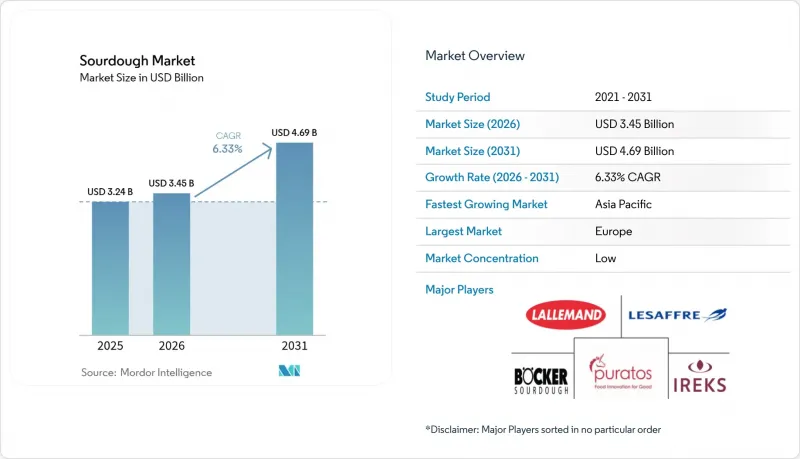
This report is Segmented by Form (Ready-To-Use Liquid and Dry Mix/Premix), Processing Type (Type I (Fresh), Type II (Dried), and More), Ingredient Source (Wheat, Rye, and More), Application (Breads and Buns, and More), Distribution Channel (Retail, and More), and Geography (North America, Europe, Asia-Pacific, South America, and Middle East and Africa). The Market Forecasts are Provided in Terms of Value (USD).
Global Sourdough Market Trends and Insights
Growing awareness of perceived health benefits associated with sourdough, such as easier digestibility and lower glycemic response
Awareness of the health benefits of sourdough is driving the market's growth. Sourdough bread has a glycemic index of approximately 55, which is close to the low glycemic threshold of 50 or less. This makes it a preferred choice for individuals looking to manage their blood sugar levels effectively, as highlighted by the Cleveland Clinic in July 2024. The natural fermentation process used in sourdough production not only makes it easier to digest but also enhances nutrient absorption, making it appealing to health-conscious consumers. With the increasing prevalence of lifestyle-related health issues such as diabetes and obesity, there is a growing demand for bakery products that are functional and have a low glycemic index. In response, bakeries and ingredient manufacturers are introducing a wider range of sourdough products that focus on promoting digestive health and balanced nutrition.
Rising participation in baking and home fermentation trends
The growing interest in baking and home fermentation is driving the sourdough market. Consumers are increasingly drawn to artisanal and homemade foods, boosting the popularity of sourdough products. A survey conducted by the Agriculture and Horticulture Development Board in February 2025 revealed that 11% of people in the United Kingdom baked at least once a week, while 20% baked at least once a month. This highlights consumers' consistent engagement in home baking. As a result, demand for sourdough starters, premixes, and fermentation ingredients has steadily risen, and these products are widely available at retail and specialty stores. Furthermore, more people are becoming aware of the benefits of natural fermentation, clean-label food options, and traditional baking techniques. This growing awareness has encouraged consumers to try sourdough baking at home, further expanding the market.
Sensitivity of sourdough cultures to temperature and humidity
The sensitivity of sourdough cultures to temperature and humidity is a significant challenge for the sourdough market, as stable fermentation conditions are crucial for maintaining consistent product quality. The main bacteria in sourdough, Lactobacillus sanfranciscensis, thrive within a specific temperature range of 28 °C to 32 °C. Any deviation from this range or exposure to low humidity can slow down microbial activity, weaken the starter, and negatively impact the final product. This issue is particularly problematic in regions with extreme weather conditions, such as high heat or excessive humidity, where maintaining optimal fermentation conditions becomes difficult. To address this, bakeries often rely on specialized fermentation chambers and controlled production environments. However, these solutions come with high costs, making it especially challenging for smaller or artisanal bakeries to adopt them.
Other drivers and restraints analyzed in the detailed report include:
- Growing consumer focus on gut health and digestive wellness is driving demand for naturally fermented sourdough products.
- Innovation in sourdough product formats, including packaged loaves, snacks, and ready-to-bake options
- Competition from faster-rising yeast-based and packaged bread alternatives
For complete list of drivers and restraints, kindly check the Table Of Contents.
Segment Analysis
Dry mix and premix products held the largest share of the sourdough market in 2025, accounting for 60.89% of the total market. These products are popular due to their longer shelf life, ease of storage, and convenience compared to traditional sourdough starters. They ensure consistent fermentation results, making them a preferred choice for commercial bakeries and large-scale food manufacturers. Premixes simplify the baking process by reducing preparation time and minimizing technical challenges. This convenience has driven their widespread use across both developed and emerging markets, furthering their dominance.
Ready-to-use liquid sourdough products are expected to grow at a CAGR of 7.21% between 2026 and 2031, driven by increasing demand for authentic flavors and artisanal-quality baked goods. These products save time by eliminating the need for fermentation preparation while delivering consistent taste and texture. They are particularly popular in premium bakery applications, such as specialty breads and clean-label products, which align with consumer preferences for natural and minimally processed ingredients. The growing availability of these products through commercial bakeries and foodservice channels is further boosting their adoption, contributing to their strong growth during the forecast period.
Type III powder starters accounted for 43.10% of sourdough market revenue in 2025, primarily due to their suitability for high-speed industrial production. These starters can be directly added to automated mixing systems, helping save time and boost efficiency in large-scale operations. Their consistent composition ensures uniform flavor, texture, and fermentation quality across different production sites. This makes them a preferred choice for commercial bakeries and packaged food manufacturers that prioritize reliability and scalability. The growing need for standardized and efficient production processes continues to drive the dominance of this segment.
Type II dried starters are projected to grow the fastest, with a CAGR of 7.55% through 2031. Recent advancements in spray drying and freeze-drying technologies have enhanced the ability to preserve flavors and maintain the viability of microorganisms. These improvements ensure better fermentation performance while retaining the authentic sourdough taste. Additionally, the extended shelf life and ease of transportation make dried starters ideal for global distribution. The rising demand for stable and high-quality sourdough solutions, both in industrial-scale baking and artisanal production, is expected to fuel the growth of this segment significantly.
Complete Report Scope:
- By Form
- Ready-To-Use Liquid
- Dry Mix/Premix
- By Processing Type
- Type I (Fresh)
- Type II (Dried)
- Type III (Powder)
- By Ingredient Source
- Wheat
- Rye
- Barley
- Others (Oats, etc.)
- By Application
- Breads and Buns
- Cakes and Pastries
- Pizza Crust
- Cookies and Crackers
- Others
- By Distribution Channel
- Food Processing Industry
- Foodservice
- Retail
- Supermarkets/Hypermarkets
- Online Stores
- Other Channels
- By Geography
- North America
- United States
- Canada
- Mexico
- Rest of North America
- South America
- Brazil
- Argentina
- Colombia
- Chile
- Peru
- Rest of South America
- Europe
- Germany
- United Kingdom
- Italy
- France
- Spain
- Poland
- Belgium
- Sweden
- Rest of Europe
- Asia-Pacific
- China
- Japan
- India
- Australia
- Indonesia
- South Korea
- Thailand
- Singapore
- Rest of Asia-Pacific
- Middle East and Africa
- South Africa
- Saudi Arabia
- United Arab Emirates
- Nigeria
- Egypt
- Morocco
- Turkey
- Rest of Middle East and Africa
- North America
Geography Analysis
Europe contributed 34.01% of the sourdough market revenue in 2025, driven by its strong baking traditions and recognition of natural fermentation processes by regulators. Countries like Germany, France, and the United Kingdom have a high demand for sourdough, as consumers prefer products made with heritage grains and artisanal techniques. Western Europe benefits from well-established bakery networks and premium product positioning, which maintain steady growth. Meanwhile, Eastern Europe is seeing new opportunities with the introduction of convenient options like ready-to-bake kits. These factors ensure Europe remains a key player in the global sourdough market while gradually expanding into emerging areas.
The Asia-Pacific region is the fastest-growing market, with a CAGR of 8.60% through 2031. Rapid urbanization and the expansion of the bakery industry are driving demand for sourdough, especially as consumers increasingly show interest in premium, fermented bakery products. Global and regional ingredient suppliers are investing in the region through acquisitions and training programs to strengthen their presence. Countries like China, India, and Australia are seeing a rise in organized bakeries, boosting sourdough adoption. Additionally, the growing popularity of artisanal bakery products in urban areas is further fueling market growth in this region.
North America continues to see steady growth in the sourdough market, supported by consumer interest in artisanal baking and fermented foods. Major commercial bakeries are driving innovation, while strong retail distribution networks ensure product availability. In Latin America, sourdough is gradually gaining traction, particularly in premium bakery segments and among urban consumers. The Middle East and Africa are also experiencing growth, supported by expatriate communities and the modernization of bakery operations. Investments in controlled production environments and the expansion of bakery infrastructure are helping producers meet the rising demand for artisanal products in these regions.
- Puratos Group
- Lesaffre International
- Lallemand Inc.
- IREKS GmbH
- Ernst Bocker GmbH
- AB Mauri
- GoodMills Group
- Alpha Baking Co. Inc.
- Truckee Sourdough Company
- Philibert Savours
- Semifreddi's Bakery
- Morabito Baking Company
- Bread SRSLY
- Backaldrin International
- Dr. Otto Suwelack GmbH & Co. KG
- Peak Rock Capital (Gold Coast Bakery)
- Riverside Sourdough
- The Health Factory
- Seven Stars Bakery
- Emu AG
Additional Benefits:
- The market estimate (ME) sheet in Excel format
- 3 months of analyst support
TABLE OF CONTENTS
1 INTRODUCTION
- 1.1 Study Assumptions and Market Definition
- 1.2 Scope of the Study
2 RESEARCH METHODOLOGY
3 EXECUTIVE SUMMARY
4 MARKET LANDSCAPE
- 4.1 Market Overview
- 4.2 Market Drivers
- 4.2.1 Growing awareness of perceived health benefits associated with sourdough, such as easier digestibility and lower glycemic response
- 4.2.2 Clean-label and minimal ingredient preference
- 4.2.3 Innovation in sourdough product formats, including packaged loaves, snacks, and ready-to-bake options
- 4.2.4 Rising participation in baking and home fermentation trends
- 4.2.5 Expansion of premium bakery offerings across retail and foodservice channels
- 4.2.6 Growing consumer focus on gut health and digestive wellness is driving demand for naturally fermented sourdough products.
- 4.3 Market Restraints
- 4.3.1 Sensitivity of sourdough cultures to temperature and humidity
- 4.3.2 Competition from faster-rising yeast-based and packaged bread alternatives
- 4.3.3 Longer fermentation cycles increase production complexity and constrain scalability
- 4.3.4 Higher retail prices compared to conventional bread
- 4.4 Consumer Behaviour Analysis
- 4.5 Regulatory Outlook
- 4.6 Porter's Five Forces
- 4.6.1 Threat of New Entrants
- 4.6.2 Bargaining Power of Buyers
- 4.6.3 Bargaining Power of Suppliers
- 4.6.4 Threat of Substitute Products
- 4.6.5 Intensity of Competitive Rivalry
5 MARKET SIZE AND GROWTH FORECASTS (VALUE)
- 5.1 By Form
- 5.1.1 Ready-To-Use Liquid
- 5.1.2 Dry Mix/Premix
- 5.2 By Processing Type
- 5.2.1 Type I (Fresh)
- 5.2.2 Type II (Dried)
- 5.2.3 Type III (Powder)
- 5.3 By Ingredient Source
- 5.3.1 Wheat
- 5.3.2 Rye
- 5.3.3 Barley
- 5.3.4 Others (Oats, etc.)
- 5.4 By Application
- 5.4.1 Breads and Buns
- 5.4.2 Cakes and Pastries
- 5.4.3 Pizza Crust
- 5.4.4 Cookies and Crackers
- 5.4.5 Others
- 5.5 By Distribution Channel
- 5.5.1 Food Processing Industry
- 5.5.2 Foodservice
- 5.5.3 Retail
- 5.5.3.1 Supermarkets/Hypermarkets
- 5.5.3.2 Online Stores
- 5.5.3.3 Other Channels
- 5.6 By Geography
- 5.6.1 North America
- 5.6.1.1 United States
- 5.6.1.2 Canada
- 5.6.1.3 Mexico
- 5.6.1.4 Rest of North America
- 5.6.2 South America
- 5.6.2.1 Brazil
- 5.6.2.2 Argentina
- 5.6.2.3 Colombia
- 5.6.2.4 Chile
- 5.6.2.5 Peru
- 5.6.2.6 Rest of South America
- 5.6.3 Europe
- 5.6.3.1 Germany
- 5.6.3.2 United Kingdom
- 5.6.3.3 Italy
- 5.6.3.4 France
- 5.6.3.5 Spain
- 5.6.3.6 Poland
- 5.6.3.7 Belgium
- 5.6.3.8 Sweden
- 5.6.3.9 Rest of Europe
- 5.6.4 Asia-Pacific
- 5.6.4.1 China
- 5.6.4.2 Japan
- 5.6.4.3 India
- 5.6.4.4 Australia
- 5.6.4.5 Indonesia
- 5.6.4.6 South Korea
- 5.6.4.7 Thailand
- 5.6.4.8 Singapore
- 5.6.4.9 Rest of Asia-Pacific
- 5.6.5 Middle East and Africa
- 5.6.5.1 South Africa
- 5.6.5.2 Saudi Arabia
- 5.6.5.3 United Arab Emirates
- 5.6.5.4 Nigeria
- 5.6.5.5 Egypt
- 5.6.5.6 Morocco
- 5.6.5.7 Turkey
- 5.6.5.8 Rest of Middle East and Africa
- 5.6.1 North America
6 COMPETITIVE LANDSCAPE
- 6.1 Market Concentration
- 6.2 Strategic Moves
- 6.3 Market Share Analysis
- 6.4 Company Profiles (includes Global-level Overview, Market-level Overview, Core Segments, Financials (if available), Strategic Information, Market Rank/Share, Products and Services, Recent Developments)
- 6.4.1 Puratos Group
- 6.4.2 Lesaffre International
- 6.4.3 Lallemand Inc.
- 6.4.4 IREKS GmbH
- 6.4.5 Ernst Bocker GmbH
- 6.4.6 AB Mauri
- 6.4.7 GoodMills Group
- 6.4.8 Alpha Baking Co. Inc.
- 6.4.9 Truckee Sourdough Company
- 6.4.10 Philibert Savours
- 6.4.11 Semifreddi's Bakery
- 6.4.12 Morabito Baking Company
- 6.4.13 Bread SRSLY
- 6.4.14 Backaldrin International
- 6.4.15 Dr. Otto Suwelack GmbH & Co. KG
- 6.4.16 Peak Rock Capital (Gold Coast Bakery)
- 6.4.17 Riverside Sourdough
- 6.4.18 The Health Factory
- 6.4.19 Seven Stars Bakery
- 6.4.20 Emu AG
7 MARKET OPPORTUNITIES AND FUTURE OUTLOOK

