PUBLISHER: Mordor Intelligence | PRODUCT CODE: 2115219

PUBLISHER: Mordor Intelligence | PRODUCT CODE: 2115219
Europe Men's Grooming Products - Market Share Analysis, Industry Trends & Statistics, Growth Forecasts (2026 - 2031)
According to Mordor Intelligence, the Europe men's grooming products market size was valued at USD 16.81 billion in 2025 and estimated to grow from USD 17.65 billion in 2026 to reach USD 22.54 billion by 2031, at a CAGR of 5.01% during the forecast period (2026-2031).
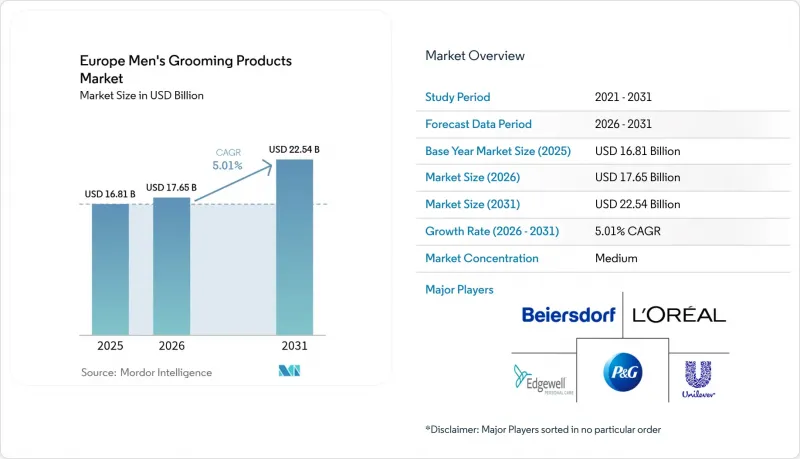
This report is Segmented by Product Type (Skin Care Products, Hair Care Products, Shaving Products, and More), Price Range (Mass and Premium), Category (Conventional and Natural/Organic), Distribution Channel (Supermarkets/Hypermarkets, Convenience Stores, Specialty Stores, Online Retail Stores, and More), and Geography. The Market Forecasts are Provided in Terms of Value (USD).
Europe Men's Grooming Products Market Trends and Insights
Changing cultural attitudes and evolving masculinity norms
Changing cultural attitudes and evolving masculinity norms are driving growth in the Europe men's grooming products market. Traditional perceptions of male self-care are shifting, with greater acceptance of grooming, skincare, and personal wellness. Modern European men increasingly view grooming not only as a hygienic practice but also as a means of expressing personal style, confidence, and individuality. This shift has reduced historical stigmas associated with the use of skincare, haircare, and cosmetic products. Social media, influencer culture, and targeted marketing campaigns have further accelerated this trend by normalizing discussions around skincare routines, facial hair styling, and premium grooming practices. These changing norms have also encouraged men to explore new product categories, including anti-aging treatments, natural and organic products, multifunctional skincare, and fragrances, which were previously considered niche or feminine. Consequently, the market is experiencing higher consumer engagement, increased adoption across various age groups, and a growing willingness to invest in premium and innovative grooming solutions, driving overall market expansion.
Workplace and social appearance expectations
Workplace and social appearance expectations are key factors driving the growth of the Europe men's grooming products market. Professional environments and social settings increasingly emphasize well-groomed appearances as essential for personal branding and career advancement. According to the Office for National Statistics, the United Kingdom's employment rate reached 75.0% in 2024, reflecting greater participation in competitive job markets . In such environments, polished appearances are often associated with professionalism, confidence, and social acceptance. This trend motivates men to adopt comprehensive grooming routines, including skincare, haircare, shaving, and styling products, to meet formal workplace standards and evolving social norms. The need to maintain a neat and fresh appearance throughout the workday and in social interactions further drives demand for multifunctional, long-lasting, and user-friendly grooming solutions. Moreover, increased workforce participation boosts the frequency of grooming product purchases and experimentation, as men seek products that enhance their personal image and align with contemporary expectations in both professional and casual settings.
Stringent Regulations
Stringent regulations pose a significant challenge to the Europe men's grooming products market, as manufacturers must comply with complex and frequently changing legal requirements related to product safety, ingredient usage, labeling, and environmental impact. European regulatory bodies enforce strict standards, such as the EU Cosmetics Regulation (EC) No 1223/2009, which mandates extensive testing, ingredient transparency, and adherence to restrictions on substances deemed harmful or controversial. These regulations can extend product development timelines, increase costs associated with formulation changes, safety evaluations, and documentation, and restrict the use of certain widely used ingredients, particularly in categories like fragrances, preservatives, and colorants. Smaller brands and new market entrants face heightened compliance challenges due to limited resources, which can hinder innovation and reduce market responsiveness.
Other drivers and restraints analyzed in the detailed report include:
- Product innovation and diversification
- Growing demand for beard care and styling
- Prevalence of fake grooming items
For complete list of drivers and restraints, kindly check the Table Of Contents.
Segment Analysis
Shaving products accounted for 26.05% of the Europe men's grooming products market revenue in 2025, maintaining a dominant position due to the high-frequency nature of shaving among European men. This segment's strength lies in its essential role as a routine necessity for a broad demographic, spanning various age groups, professions, and cultural backgrounds. Its stability and recurring demand are unmatched by many other grooming categories. The segment's leadership is further bolstered by continuous product innovation. Modern razors and blades feature advanced ergonomics, precision steel, lubrication strips, and flexible heads to enhance comfort and minimize irritation. Additionally, pre-shave creams, oils, and soaps have evolved to provide improved moisturization, skin protection, and smoother application.
Skincare is projected to grow at a robust CAGR of 5.74% from 2026 to 2031, significantly influencing the dynamics of the Europe men's grooming market. This growth is driven by a shift among male consumers from basic hygiene routines to more advanced, health-focused personal care habits. Increasing awareness of issues such as dryness, acne, sensitivity, pollution damage, and early signs of aging has led men to adopt products like cleansers, moisturizers, sunscreens, and targeted treatments, which were previously overlooked or used inconsistently. The segment's expansion is further supported by science-backed formulations and dermatology-inspired products tailored to men's thicker, oilier, and more irritation-prone skin, offering a more personalized and functional skincare experience.
Mass-market products accounted for a significant 68.10% of Europe men's grooming sales in 2025, maintaining their position as the cornerstone of the market. These products offer accessibility, familiarity, and broad appeal, aligning with the everyday grooming needs of most male consumers. Their dominance is attributed to their role as essential, repeat-purchase items, encompassing key categories such as shaving essentials, basic skincare, body care, deodorants, and haircare. These products are integral to routine hygiene rather than discretionary self-care. Mass-market brands have sustained their relevance by consistently upgrading formulations, incorporating skin-friendly ingredients, and modernizing packaging while keeping prices affordable. This ensures they remain the preferred choice for value-conscious and habitual shoppers. Their extensive product range, from simple moisturizers to multi-functional grooming solutions, caters to men seeking straightforward routines with reliable performance.
Premium offerings, projected to grow at a 6.09% CAGR through 2031, are transforming Europe men's grooming market by addressing a growing demand for high-quality, performance-oriented, and experience-driven grooming solutions. This segment's growth reflects an increasing willingness among men to invest in their appearance, skin health, and personal identity. Moving beyond basic hygiene, premium products emphasize indulgence, refinement, and self-care as aspirational lifestyle elements. These products stand out through advanced formulations, dermatologist-approved ingredients, superior textures, refined fragrances, and targeted benefits such as anti-aging, hydration, sensitive-skin care, beard conditioning, scalp treatments, and specialized styling. These features appeal to consumers who are becoming more educated, ingredient-conscious, and focused on product efficacy.
Complete Report Scope:
- By Product Type
- Skin Care products
- Face Wash
- Moisturizers
- Face Mask
- Other Skin Care Products
- Hair Care products
- Shampoo and Conditioners
- Styling Products
- Hair Colorants
- Other Hair Care Products
- Shaving Products
- Pre-Shave
- Shaving Cream
- Pre-Shave Oil
- Shaving Soap
- Other Pre-Shave Products
- Post-Shave
- After-Shave
- Balms
- Other Post-Shave Products
- Razors and Blades
- Pre-Shave
- Other Product Types
- Skin Care products
- By Price Range
- Mass
- Premium
- By Category
- Conventional
- Natural/Organic
- By Distribution Channel
- Supermarkets/Hypermarkets
- Convenience Stores
- Specialty Stores
- Online Retail Stores
- Other Retail Channels
- By Geography
- Germany
- United Kingdom
- Italy
- France
- Spain
- Netherlands
- Poland
- Belgium
- Sweden
- Rest of Europe
List of Companies Covered in this Report:
- Procter & Gamble Company
- Beiersdorf AG
- L'Oreal S.A.
- Unilever PLC
- Edgewell Personal Care Company
- Shiseido Co., Ltd.
- L'Occitane International SA
- Coty Inc.
- Henkel AG & Co. KGaA
- Reckitt Benckiser Group
- Bulldog Skincare Holdings
- Harry's Inc.
- Koninklijke Philips N.V.
- Braun GmbH
- Hans-Jurgen Muller GmbH & Co. KG
- Aesop SA
- Anthony Brands
- Malin + Goetz Inc.
- Omorovicza Cosmetics Ltd.
- Baxter of California
Additional Benefits:
- The market estimate (ME) sheet in Excel format
- 3 months of analyst support
TABLE OF CONTENTS
1 INTRODUCTION
- 1.1 Study Assumptions and Market Definition
- 1.2 Scope of the Study
2 RESEARCH METHODOLOGY
3 EXECUTIVE SUMMARY
4 MARKET LANDSCAPE
- 4.1 Market Overview
- 4.2 Market Drivers
- 4.2.1 Changing cultural attitudes and evolving masculinity norms
- 4.2.2 Workplace and social appearance expectations
- 4.2.3 Product innovation and diversification
- 4.2.4 Growing demand for beard care and styling
- 4.2.5 Increased focus on premium and sustainable formulations
- 4.2.6 Influence of social media, celebrities and influencers
- 4.3 Market Restraints
- 4.3.1 Stringent Regulations
- 4.3.2 Prevalence of fake grooming items
- 4.3.3 Intense competition and market saturation
- 4.3.4 Private Label Alternatives
- 4.4 Consumer Behaviour Analysis
- 4.5 Regulatory Landscape
- 4.6 Technological Outlook
- 4.7 Porter's Five Forces Analysis
- 4.7.1 Threat of New Entrants
- 4.7.2 Bargaining Power of Buyers
- 4.7.3 Bargaining Power of Suppliers
- 4.7.4 Threat of Substitutes
- 4.7.5 Intensity of Competitive Rivalry
5 MARKET SIZE AND GROWTH FORECASTS (VALUE)
- 5.1 By Product Type
- 5.1.1 Skin Care products
- 5.1.1.1 Face Wash
- 5.1.1.2 Moisturizers
- 5.1.1.3 Face Mask
- 5.1.1.4 Other Skin Care Products
- 5.1.2 Hair Care products
- 5.1.2.1 Shampoo and Conditioners
- 5.1.2.2 Styling Products
- 5.1.2.3 Hair Colorants
- 5.1.2.4 Other Hair Care Products
- 5.1.3 Shaving Products
- 5.1.3.1 Pre-Shave
- 5.1.3.1.1 Shaving Cream
- 5.1.3.1.2 Pre-Shave Oil
- 5.1.3.1.3 Shaving Soap
- 5.1.3.1.4 Other Pre-Shave Products
- 5.1.3.2 Post-Shave
- 5.1.3.2.1 After-Shave
- 5.1.3.2.2 Balms
- 5.1.3.2.3 Other Post-Shave Products
- 5.1.3.3 Razors and Blades
- 5.1.3.1 Pre-Shave
- 5.1.4 Other Product Types
- 5.1.1 Skin Care products
- 5.2 By Price Range
- 5.2.1 Mass
- 5.2.2 Premium
- 5.3 By Category
- 5.3.1 Conventional
- 5.3.2 Natural/Organic
- 5.4 By Distribution Channel
- 5.4.1 Supermarkets/Hypermarkets
- 5.4.2 Convenience Stores
- 5.4.3 Specialty Stores
- 5.4.4 Online Retail Stores
- 5.4.5 Other Retail Channels
- 5.5 By Geography
- 5.5.1 Germany
- 5.5.2 United Kingdom
- 5.5.3 Italy
- 5.5.4 France
- 5.5.5 Spain
- 5.5.6 Netherlands
- 5.5.7 Poland
- 5.5.8 Belgium
- 5.5.9 Sweden
- 5.5.10 Rest of Europe
6 COMPETITIVE LANDSCAPE
- 6.1 Market Concentration
- 6.2 Strategic Moves
- 6.3 Market Share Analysis
- 6.4 Company Profiles (includes Global level Overview, Market level overview, Core Segments, Financials as available, Strategic Information, Market Rank/Share for key companies, Products and Services, and Recent Developments)
- 6.4.1 Procter & Gamble Company
- 6.4.2 Beiersdorf AG
- 6.4.3 L'Oreal S.A.
- 6.4.4 Unilever PLC
- 6.4.5 Edgewell Personal Care Company
- 6.4.6 Shiseido Co., Ltd.
- 6.4.7 L'Occitane International SA
- 6.4.8 Coty Inc.
- 6.4.9 Henkel AG & Co. KGaA
- 6.4.10 Reckitt Benckiser Group
- 6.4.11 Bulldog Skincare Holdings
- 6.4.12 Harry's Inc.
- 6.4.13 Koninklijke Philips N.V.
- 6.4.14 Braun GmbH
- 6.4.15 Hans-Jurgen Muller GmbH & Co. KG
- 6.4.16 Aesop SA
- 6.4.17 Anthony Brands
- 6.4.18 Malin + Goetz Inc.
- 6.4.19 Omorovicza Cosmetics Ltd.
- 6.4.20 Baxter of California
7 MARKET OPPORTUNITIES AND FUTURE OUTLOOK

