PUBLISHER: Mordor Intelligence | PRODUCT CODE: 2187281

PUBLISHER: Mordor Intelligence | PRODUCT CODE: 2187281
Men's Grooming Products - Market Share Analysis, Industry Trends & Statistics, Growth Forecasts (2027 - 2032)
According to Mordor Intelligence, the men's grooming products market size is projected to expand from USD 66.44 billion in 2026 and USD 70.63 billion in 2027 to USD 95.06 billion by 2032, registering a CAGR of 6.12% between 2027 and 2032.
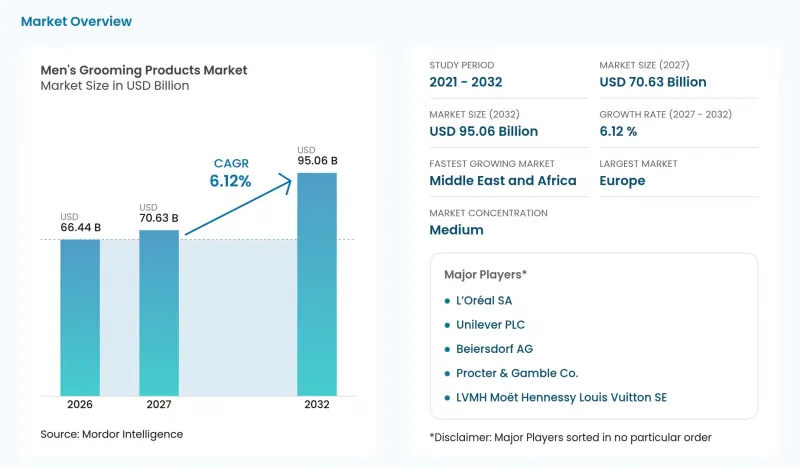
This report is segmented by Product Type (Skin Care products, Other Product Types, and more), Price Range (Mass and Premium), Category (Conventional and Natural and Organic), Distribution Channel (Supermarkets/Hypermarkets, Specialty Stores, and more), and Geography (Europe, North America, and more). The market forecasts are provided in terms of value (USD), based on availability.
Global Men's Grooming Products Market Trends and Insights
Expansion of men's skincare and specialized routines
A larger population practicing skincare expands the potential customer base without requiring more elaborate routines. Roy Morgan counted 2.19 million Australian men aged 14 and older reporting a skincare routine in the 12 months to June 2025, compared with 1.79 million in the 12 months to June 2021. Among men aged 14 to 24, the corresponding count rose from 366,000 to 469,000 over those periods. For suppliers, replenishment offers a way to convert broader participation into sales when a product serves an ongoing skincare need.
Growing market for beard care and styling
For a buyer keeping facial hair, conditioning offers a grooming need separate from shaving. In February 2025, The Shop announced expansion to CVS.com and 1,400 U.S. CVS stores with a 7-product men's grooming range that included Beard Cream leave-in conditioner. Its Beard Cream is a no-rinse product, giving conditioning a defined role within that broader assortment. That format can add a care step without requiring another rinse during the grooming routine. Broader retail placement would give the brand a route to offer that use alongside other personal-care products. Beard maintenance can consequently create a conditioning purchase alongside trimming, expanding the consumable opportunity within the same grooming decision.
Intense market competition
Retail access can limit a grooming brand's expansion even when its product addresses a clear consumer need. In its FY2025 filing, Edgewell described competition for increasingly limited retail shelf space across personal-care categories, including global wet shave. This creates a commercial hurdle between developing a shaving product and making it readily available to consumers. When suppliers contest limited space, an additional brand can displace another offering without expanding the category's retail reach. The resulting constraint is particularly relevant to a launch whose demand depends on physical-store exposure. Competitive intensity can therefore restrict incremental distribution and leave product development costs spread across a narrower selling opportunity.
Other drivers and restraints analyzed in the detailed report include:
- Technological innovations in grooming tools
- Rise of natural and organic products
- Environmental concerns associated with packaging
For complete list of drivers and restraints, kindly check the Table Of Contents.
Segment Analysis
Skin care products accounted for a 26.04% share of the men's grooming products market size in 2026 and are the fastest-growing segment, with a forecast CAGR of 7.92% between 2027 and 2032. Roy Morgan's survey for the 12 months to June 2025 counted 4.9 million Australian men aged 14 and older who had ever used skincare products. That broad user base gives brands an audience for offers centered on specific skin needs. For an occasional user, a clearly defined product role could provide a reason to consider a more regular place for skincare within personal care.
For a skincare supplier, adding a treatment creates a choice between a distinct use case and another variant of the same proposition. A specialized offer can broaden the routine when its role is distinguishable from products the buyer already uses. Hair care products serve a broad user population, with 79% of U.S. men aged 18 and older reporting shampoo or conditioner use in YouGov's August 2025 survey. That use base supports an offer built around an existing cleansing or conditioning need. A men's label alone would provide little explanation of that function, making the product's practical purpose central to how a brand distinguishes its offer.
Mass products represented a 72.54% men's grooming products market share in 2026, making them the largest segment. For a supplier targeting this price tier, the commercial task is to keep a useful grooming function accessible at a repeatable outlay. A reformulation that raises the selling price would need to justify that change through a benefit the buyer can readily understand. Range development can prioritize clearly differentiated uses instead of multiplying products that compete for the same spending. This approach would preserve a reason to repurchase without making success depend on consumers accepting a higher price tier.
Premium products are the fastest-growing segment, with a forecast CAGR of 7.33% between 2027 and 2032. LVMH reported that Dior's Sauvage held the world's best-selling men's fragrance position in 2025. Such a position gives a fragrance supplier a platform from which to compete on a recognizable product name. For a brand considering a higher price point, the investment choice is to build a distinctive benefit or experience that remains clear beside lower-priced options. The potential gain is value per purchase, provided the additional price connects to a meaningful difference in the offer.
Complete Report Scope:
- By Product Type
- Skin Care products
- Face Wash
- Moisturizers
- Face Mask
- Other Skin Care Products
- Hair Care products
- Shampoo and Conditioners
- Styling Products
- Hair Colorants
- Other Hair Care Products
- Shaving Products
- Pre-Shave
- Shaving Cream
- Pre-Shave Oil
- Shaving Soap
- Other Pre-Shave Products
- Post-Shave
- After-Shave
- Balms
- Other Post-Shave Products
- Razors and Blades
- Pre-Shave
- Other Product Types
- Skin Care products
- By Price Range
- Mass
- Premium
- By Category
- Conventional
- Natural and Organic
- By Distribution Channel
- Supermarkets/Hypermarkets
- Convenience Stores
- Specialty Stores
- Online Retail Stores
- Other Retail Channels
- By Geography
- North America
- United States
- Canada
- Mexico
- Rest of North America
- South America
- Brazil
- Argentina
- Colombia
- Chile
- Rest of South America
- Europe
- United Kingdom
- Germany
- France
- Italy
- Spain
- Russia
- Sweden
- Belgium
- Poland
- Netherlands
- Rest of Europe
- Asia-Pacific
- China
- Japan
- India
- Thailand
- Singapore
- Indonesia
- South Korea
- Australia
- New Zealand
- Rest of Asia-Pacific
- Middle East and Africa
- United Arab Emirates
- South Africa
- Saudi Arabia
- Nigeria
- Egypt
- Morocco
- Turkey
- Rest of Middle East and Africa
- North America
Geography Analysis
Europe accounted for a 27.12% share of the men's grooming products market size in 2026. Across the broader cosmetics and personal-care sector, European retail sales reached EUR 110 billion (USD 124 billion) in 2025. NIVEA UK reported NIVEA MEN's volume lead in the United Kingdom men's facial-skincare segment defined by Beiersdorf UK Ltd., using NielsenIQ data for the 52 weeks ending January 25, 2025. In the United Kingdom, a new men's face-care entrant would compete against NIVEA MEN's volume lead, making differentiation within an established facial-skincare category central to its proposition.
Middle East and Africa is the fastest-growing region, with a forecast CAGR of 8.17% between 2027 and 2032. In South Africa, Clicks Group rolled out BroScape in 2026, bringing beard care, shaving products, skincare and haircare together in a dedicated men's grooming section. Grouping these categories creates a route for a retailer to present a broader routine during a single shopping visit. For product suppliers, that format offers a commercial opening to be considered alongside related grooming needs rather than through an isolated category.
In North America, MANSCAPED announced an August 12, 2025 launch in 500 Canadian Tire stores and online in Canada, covering tools and formulations including aftershave lotion. In South America, Kantar found that Brazilian men's at-home sunscreen and eye-moisturizer use tripled by consumer count over the five years preceding 2025. In Asia-Pacific, the U.S. Department of Commerce described Singapore's online channels as expanding men's access to premium grooming products. In January 2025, Beauty Bar's merchandise group manager said men bought skincare and grooming products in the Philippines, including products not specifically marketed to men, while women also bought men's skincare for partners. Beauty Bar's observation shows why an offer aimed only at the man using it can miss the partner choosing it at this Philippine retailer.
- Procter & Gamble Co.
- Beiersdorf AG
- L'Oreal SA
- Edgewell Personal Care Co.
- Unilever PLC
- Natura Cosmeticos SA
- LVMH Moet Hennessy Louis Vuitton SE
- Chanel Ltd.
- Coty Inc.
- Combe Inc.
- Koninklijke Philips N.V.
- Panasonic Corp.
- Harry's Inc.
- Dollar Shave Club
- Beardbrand LLC
- Marico Ltd.
- Scotch Porter LLC
- Kenvue Inc.
- Kao Corp.
- Braun GmbH
Additional Benefits:
- The market estimate (ME) sheet in Excel format
- 3 months of analyst support
TABLE OF CONTENTS
1 INTRODUCTION
- 1.1 Study Assumptions and Market Definition
- 1.2 Scope of the Study
2 RESEARCH METHODOLOGY
3 EXECUTIVE SUMMARY
4 MARKET LANDSCAPE
- 4.1 Market Overview
- 4.2 Market Drivers
- 4.2.1 Expansion of men's skincare and specialized routines
- 4.2.2 Growing market for beard care and styling
- 4.2.3 Technological innovations in grooming tools
- 4.2.4 Rise of natural and organic products
- 4.2.5 Personalization and customization
- 4.2.6 Premiumization trend
- 4.3 Market Restraints
- 4.3.1 Intense market competition
- 4.3.2 Environmental concerns associated with packaging
- 4.3.3 Fluctuating raw material costs
- 4.3.4 Allergic reactions and skin sensitivities
- 4.4 Industry Value Chain Analysis
- 4.5 Regulatory Landscape
- 4.6 Technological Outlook
- 4.7 Porter's Five Forces Analysis
- 4.7.1 Threat of New Entrants
- 4.7.2 Bargaining Power of Suppliers
- 4.7.3 Bargaining Power of Buyers
- 4.7.4 Threat of Substitutes
- 4.7.5 Competitive Rivalry
5 MARKET SIZE AND GROWTH FORECASTS (VALUE)
- 5.1 By Product Type
- 5.1.1 Skin Care products
- 5.1.1.1 Face Wash
- 5.1.1.2 Moisturizers
- 5.1.1.3 Face Mask
- 5.1.1.4 Other Skin Care Products
- 5.1.2 Hair Care products
- 5.1.2.1 Shampoo and Conditioners
- 5.1.2.2 Styling Products
- 5.1.2.3 Hair Colorants
- 5.1.2.4 Other Hair Care Products
- 5.1.3 Shaving Products
- 5.1.3.1 Pre-Shave
- 5.1.3.1.1 Shaving Cream
- 5.1.3.1.2 Pre-Shave Oil
- 5.1.3.1.3 Shaving Soap
- 5.1.3.1.4 Other Pre-Shave Products
- 5.1.3.2 Post-Shave
- 5.1.3.2.1 After-Shave
- 5.1.3.2.2 Balms
- 5.1.3.2.3 Other Post-Shave Products
- 5.1.3.3 Razors and Blades
- 5.1.3.1 Pre-Shave
- 5.1.4 Other Product Types
- 5.1.1 Skin Care products
- 5.2 By Price Range
- 5.2.1 Mass
- 5.2.2 Premium
- 5.3 By Category
- 5.3.1 Conventional
- 5.3.2 Natural and Organic
- 5.4 By Distribution Channel
- 5.4.1 Supermarkets/Hypermarkets
- 5.4.2 Convenience Stores
- 5.4.3 Specialty Stores
- 5.4.4 Online Retail Stores
- 5.4.5 Other Retail Channels
- 5.5 By Geography
- 5.5.1 North America
- 5.5.1.1 United States
- 5.5.1.2 Canada
- 5.5.1.3 Mexico
- 5.5.1.4 Rest of North America
- 5.5.2 South America
- 5.5.2.1 Brazil
- 5.5.2.2 Argentina
- 5.5.2.3 Colombia
- 5.5.2.4 Chile
- 5.5.2.5 Rest of South America
- 5.5.3 Europe
- 5.5.3.1 United Kingdom
- 5.5.3.2 Germany
- 5.5.3.3 France
- 5.5.3.4 Italy
- 5.5.3.5 Spain
- 5.5.3.6 Russia
- 5.5.3.7 Sweden
- 5.5.3.8 Belgium
- 5.5.3.9 Poland
- 5.5.3.10 Netherlands
- 5.5.3.11 Rest of Europe
- 5.5.4 Asia-Pacific
- 5.5.4.1 China
- 5.5.4.2 Japan
- 5.5.4.3 India
- 5.5.4.4 Thailand
- 5.5.4.5 Singapore
- 5.5.4.6 Indonesia
- 5.5.4.7 South Korea
- 5.5.4.8 Australia
- 5.5.4.9 New Zealand
- 5.5.4.10 Rest of Asia-Pacific
- 5.5.5 Middle East and Africa
- 5.5.5.1 United Arab Emirates
- 5.5.5.2 South Africa
- 5.5.5.3 Saudi Arabia
- 5.5.5.4 Nigeria
- 5.5.5.5 Egypt
- 5.5.5.6 Morocco
- 5.5.5.7 Turkey
- 5.5.5.8 Rest of Middle East and Africa
- 5.5.1 North America
6 COMPETITIVE LANDSCAPE
- 6.1 Market Concentration
- 6.2 Strategic Moves
- 6.3 Market Share Analysis
- 6.4 Company Profiles (includes Global level Overview, Market level overview, Core Segments, Financials as available, Strategic Information, Market Rank/Share for key companies, Products and Services, and Recent Developments)
- 6.4.1 Procter & Gamble Co.
- 6.4.2 Beiersdorf AG
- 6.4.3 L'Oreal SA
- 6.4.4 Edgewell Personal Care Co.
- 6.4.5 Unilever PLC
- 6.4.6 Natura Cosmeticos SA
- 6.4.7 LVMH Moet Hennessy Louis Vuitton SE
- 6.4.8 Chanel Ltd.
- 6.4.9 Coty Inc.
- 6.4.10 Combe Inc.
- 6.4.11 Koninklijke Philips N.V.
- 6.4.12 Panasonic Corp.
- 6.4.13 Harry's Inc.
- 6.4.14 Dollar Shave Club
- 6.4.15 Beardbrand LLC
- 6.4.16 Marico Ltd.
- 6.4.17 Scotch Porter LLC
- 6.4.18 Kenvue Inc.
- 6.4.19 Kao Corp.
- 6.4.20 Braun GmbH
7 MARKET OPPORTUNITIES AND FUTURE OUTLOOK
- 7.1 White-Space and Unmet-Need Assessment

