PUBLISHER: Mordor Intelligence | PRODUCT CODE: 2115226

PUBLISHER: Mordor Intelligence | PRODUCT CODE: 2115226
Gas Insulated Substation - Market Share Analysis, Industry Trends & Statistics, Growth Forecasts (2026 - 2031)
According to Mordor Intelligence, the gas insulated substation market size was valued at USD 34.68 billion in 2025 and estimated to grow from USD 37.51 billion in 2026 to reach USD 55.55 billion by 2031, at a CAGR of 8.17% during the forecast period (2026-2031).
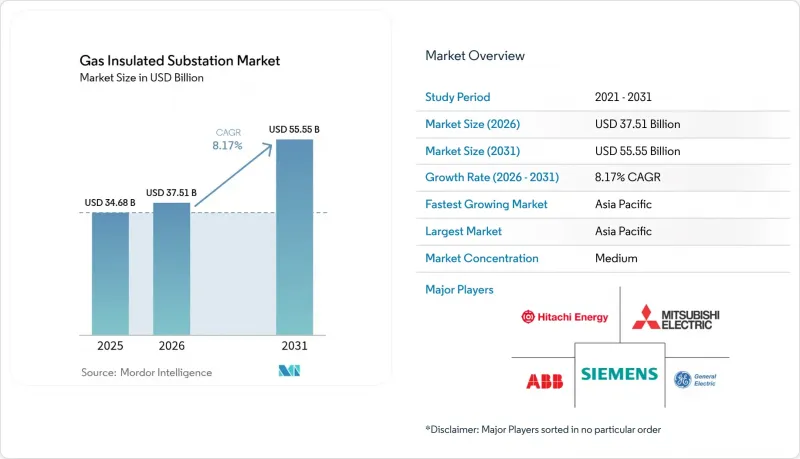
This report is Segmented by Voltage (Medium Voltage, High Voltage, and Extra High Voltage), Installation Type (Indoor GIS, Outdoor GIS, and Mobile/Skid-Mounted GIS), Technology (SF6-Based GIS, and SF6-Free GIS), End-User (Power Transmission Utilities, Power Distribution Utilities, Renewable Generators and IPPs, Industrial, and More), and Geography (North America, Europe, Asia-Pacific, and More).
Global Gas Insulated Substation Market Trends and Insights
Urban Land-Use Constraints Propel Compact GIS Adoption
Dense metropolitan growth leaves utilities scrambling for real estate, and gas-insulated substation market participants respond by delivering installations that occupy roughly 60% less space than air-insulated equivalents. Singapore's 230 kV underground "figure-eight" GIS, developed by SP Group, demonstrates how vertically stacked layouts preserve surface land without compromising grid capacity. Similar logic drove the construction of Cambridge, Massachusetts' fully underground substation, which supports a life-sciences campus where premium surface space was repurposed for community amenities. These projects demonstrate how the Gas Insulated Substation market aligns with emerging urban master plans that favor mixed-use zoning over large utility corridors. As real estate values climb, major Asian and European cities are increasingly stipulating compact GIS for new or replacement substations, turning space savings into a quantifiable economic benefit.
Renewable Integration Demands Reliable HV Infrastructure
Variable generation from offshore wind and utility-scale solar introduces power-flow swings that require fast-acting, high-voltage equipment for reactive compensation and fault isolation. Floating wind platforms off the Fukushima coast employ gas-insulated switchgear rated for dynamic motion and salt-spray exposure, proving GIS viability in maritime conditions. Massive ground-mounted solar clusters in Louisiana integrate collector substations equipped with GIS to maintain grid code compliance during irradiance fluctuations. In parallel, the World Bank identifies 400 GWp in floating-solar potential, a figure that points toward future demand for marine-grade substations. Collectively, these deployments reposition the Gas Insulated Substation market from a space-saving niche toward a reliability backbone for renewables-heavy grids.
High Upfront CAPEX Versus AIS Alternatives
The Gas-Insulated Substation market still competes with lower-cost air-insulated designs, and project quotations often show a 5-30% premium, depending on voltage, enclosure type, and seismic requirements. However, lifecycle models reveal that reduced maintenance offsets initial capital; budget-constrained utilities in Latin America and parts of Africa continue to select AIS for straightforward rural applications. The European Commission confirms that SF6-free GIS technologies add a further 5-30% to base prices, reinforcing cost sensitivity until volumes scale and manufacturing learning curves kick in. Procurement officers, therefore, conduct exhaustive total-cost-of-ownership analyses that incorporate carbon levies, leakage penalties, and land-purchasing costs before authorizing GIS expenditure.
Other drivers and restraints analyzed in the detailed report include:
- Modernization of Aging AIS Fleets in OECD Countries
- Grid-Upgrade Programs in APAC & North America
- SF6 Phase-Out Regulations Increase Compliance Costs
For complete list of drivers and restraints, kindly check the Table Of Contents.
Segment Analysis
Extra-high-voltage installations above 300 kV are growing at a 10.15% CAGR, a figure that surpasses the overall Gas Insulated Substation market CAGR as grid planners bring bulk renewable power from remote deserts and offshore zones to demand centers. The class enjoys regulatory backing because its low line-loss profile aligns with national efficiency mandates, and operators value GIS for its sealed architecture, which preserves dielectric integrity at altitude and in corrosive coastal air. High-Voltage systems, which held 51.90% of the Gas Insulated Substation market share in 2025, remain the workhorse for regional networks, sub-transmission rings, and heavy-industry feeders.
Hitachi Energy's delivery of the first SF6-free 550 kV GIS to State Grid marks the removal of the last technical barrier to eco-efficient systems at the top of the voltage pyramid, signalling a pivot point where investment decisions can align sustainability with megavolt-class performance. Utilities in Europe and Japan are already piloting similar units to stay ahead of 2030 legislative cut-offs, and North American operators are watching closely to evaluate lifespan economics. Medium-Voltage GIS below 72.5 kV continues to penetrate space-constrained distribution nodes where transformer substations must coexist with residential or commercial real estate.
Indoor halls account for 58.74% of the Gas Insulated Substation market, reflecting mature engineering standards and the prevalence of urban load centers that prioritize aesthetics and environmental control. However, mobile and skid-mounted packages, growing at 11.02% CAGR, illustrate how the Gas Insulated Substation market values agility during extreme-weather recovery, festival or event electrification, and planned equipment outages. Integrating breaker, disconnector, and control cubicles inside a single ISO container enables energization within one week, an advantage that outweighs the rental premium in outage cost calculations.
Midwest Energy's first factory-assembled skid reduced field construction from six months to 30 days, shrinking labor exposure and simplifying permitting because the design qualifies as temporary equipment. Oil-rich Gulf nations are increasingly adopting trailer-mounted GIS systems to maintain power during refinery turnarounds, thereby avoiding multimillion-dollar penalties associated with unplanned downtime. These examples demonstrate how mobility shifts substation planning from static infrastructure toward an operational toolkit that utilities can reposition as system conditions dictate.
Complete Report Scope:
- By Voltage
- Medium Voltage (Up to 72.5 kV)
- High Voltage (72.5 to 245 kV)
- Extra-High Voltage (Above 300 kV)
- By Installation Type
- Indoor GIS
- Outdoor GIS
- Mobile/Skid-Mounted GIS
- By Technology
- SF6-based GIS
- SF6-free (g3, Clean-Air, Vacuum) GIS
- By End-User
- Power Transmission Utilities
- Power Distribution Utilities
- Renewable Generators and IPPs
- Industrial (Oil and Gas, Mining, Metals, Chemicals)
- Commercial and Residential Buildings
- By Geography
- North America
- United States
- Canada
- Mexico
- Europe
- Germany
- United Kingdom
- France
- Italy
- NORDIC Countries
- Russia
- Rest of Europe
- Asia-Pacific
- China
- India
- Japan
- South Korea
- ASEAN Countries
- Rest of Asia-Pacific
- South America
- Brazil
- Argentina
- Rest of South America
- Middle East and Africa
- Saudi Arabia
- United Arab Emirates
- South Africa
- Egypt
- Rest of Middle East and Africa
- North America
Geography Analysis
The Asia-Pacific region, which accounted for 46.70% of 2025 revenue, is expected to sustain a 9.47% CAGR through 2031 as China and India develop ultra-high-voltage corridors from renewable-rich hinterlands to coastal load hubs. State Grid's USD 89 billion outlay underwrites +-1,100 kV DC and 1,000 kV AC schemes where sealed-gas enclosures maintain dielectric strength at altitude, mitigating corona losses that plague open-air busbars. Concurrently, Southern Power Grid's 2024-2027 budget of USD 195.3 billion emphasizes digital twin diagnostics for substation fleets, accelerating demand for smart-sensor-ready GIS bays. Japan's floating offshore substation serves as a regional lighthouse project, while ASEAN governments unlock concessional financing for solar and storage hybrids, each requiring compact collector hubs that integrate smoothly with urban load pockets.
North America leverages policy catalysts, such as the DOE's Grid Resilience grants, which funnel USD 2.2 billion into hardware upgrades that specify Gas Insulated Substation market equipment with embedded digital monitoring. National Grid's USD 35 billion plan encompasses 70 transmission enhancements, spanning from upstate New York to eastern Massachusetts, each engineered for weatherproof operation during prolonged heatwaves and ice storms. California's binding SF6 sunset prompts utilities like PG&E to standardize eco-efficient GIS, anchoring a procurement cycle likely to ripple across the West and into Canada as carbon-price convergence tightens. Supply-chain snarls for transformers remain a headwind; however, multi-year frameworks help OEMs justify capacity expansions in Texas and Mexico.
Europe channels a EUR 584 billion grid investment target into cross-border interconnectors and offshore wind hubs, enforcing tight environmental criteria that automatically elevate demand for SF6-free devices. Germany's TransnetBW swaps 26 bays at the Daxlanden site for Siemens Clean Air panels by 2029, while Norway's BKK Nett locks in a six-year framework for similar replacements. Scandinavia's wind cluster drives specialized marine GIS procurement for jacket-foundation substations, and the Iberian Peninsula's solar surge calls for desert-rated enclosures that handle dust-laden airflow. Although the regulatory environment incurs short-term costs, it also provides a predictable runway for OEM R&D investments aligned with net-zero goals.
- ABB Ltd
- Siemens AG
- Hitachi Energy Ltd.
- General Electric Company
- Mitsubishi Electric Corporation
- Schneider Electric SE
- Larsen & Toubro Ltd
- CG Power & Industrial Solutions Ltd
- Hyosung Heavy Industries Co., Ltd
- Bharat Heavy Electricals Ltd
- Toshiba Corp
- Elsewedy Electric S.A.E.
- Powell Industries, Inc.
- TBEA Co., Ltd.
- Eaton Corporation plc
- Fuji Electric Co., Ltd.
- Meidensha Corporation
- Hyundai Electric & Energy Systems Co.
- Jiangsu Xiangyu Power Co., Ltd
- ILJIN Electric Co., Ltd
Additional Benefits:
- The market estimate (ME) sheet in Excel format
- 3 months of analyst support
TABLE OF CONTENTS
1 Introduction
- 1.1 Study Assumptions & Market Definition
- 1.2 Scope of the Study
2 Research Methodology
3 Executive Summary
4 Market Landscape
- 4.1 Market Overview
- 4.2 Market Drivers
- 4.2.1 Urban land-use constraints propel compact GIS adoption
- 4.2.2 Renewable integration demands reliable HV infrastructure
- 4.2.3 Modernization of aging AIS fleets in OECD countries
- 4.2.4 Grid-upgrade programs in APAC & North America
- 4.2.5 Offshore wind & floating solar electrification needs
- 4.2.6 Climate-resilient substation designs for disaster zones
- 4.3 Market Restraints
- 4.3.1 High upfront CAPEX versus AIS alternatives
- 4.3.2 SF? phase-out regulations increase compliance costs
- 4.3.3 Long lead-times for critical GIS components
- 4.3.4 Talent gap for SF?-free technology commissioning
- 4.4 Supply-Chain Analysis
- 4.5 Regulatory Landscape
- 4.6 Technological Outlook
- 4.7 Porter's Five Forces
- 4.7.1 Bargaining Power of Suppliers
- 4.7.2 Bargaining Power of Consumers
- 4.7.3 Threat of New Entrants
- 4.7.4 Threat of Substitutes
- 4.7.5 Intensity of Competitive Rivalry
5 Market Size & Growth Forecasts
- 5.1 By Voltage
- 5.1.1 Medium Voltage (Up to 72.5 kV)
- 5.1.2 High Voltage (72.5 to 245 kV)
- 5.1.3 Extra-High Voltage (Above 300 kV)
- 5.2 By Installation Type
- 5.2.1 Indoor GIS
- 5.2.2 Outdoor GIS
- 5.2.3 Mobile/Skid-Mounted GIS
- 5.3 By Technology
- 5.3.1 SF6-based GIS
- 5.3.2 SF6-free (g3, Clean-Air, Vacuum) GIS
- 5.4 By End-User
- 5.4.1 Power Transmission Utilities
- 5.4.2 Power Distribution Utilities
- 5.4.3 Renewable Generators and IPPs
- 5.4.4 Industrial (Oil and Gas, Mining, Metals, Chemicals)
- 5.4.5 Commercial and Residential Buildings
- 5.5 By Geography
- 5.5.1 North America
- 5.5.1.1 United States
- 5.5.1.2 Canada
- 5.5.1.3 Mexico
- 5.5.2 Europe
- 5.5.2.1 Germany
- 5.5.2.2 United Kingdom
- 5.5.2.3 France
- 5.5.2.4 Italy
- 5.5.2.5 NORDIC Countries
- 5.5.2.6 Russia
- 5.5.2.7 Rest of Europe
- 5.5.3 Asia-Pacific
- 5.5.3.1 China
- 5.5.3.2 India
- 5.5.3.3 Japan
- 5.5.3.4 South Korea
- 5.5.3.5 ASEAN Countries
- 5.5.3.6 Rest of Asia-Pacific
- 5.5.4 South America
- 5.5.4.1 Brazil
- 5.5.4.2 Argentina
- 5.5.4.3 Rest of South America
- 5.5.5 Middle East and Africa
- 5.5.5.1 Saudi Arabia
- 5.5.5.2 United Arab Emirates
- 5.5.5.3 South Africa
- 5.5.5.4 Egypt
- 5.5.5.5 Rest of Middle East and Africa
- 5.5.1 North America
6 Competitive Landscape
- 6.1 Market Concentration
- 6.2 Strategic Moves (M&A, Partnerships, PPAs)
- 6.3 Market Share Analysis (Market Rank/Share for key companies)
- 6.4 Company Profiles (includes Global level Overview, Market level overview, Core Segments, Financials as available, Strategic Information, Products & Services, and Recent Developments)
- 6.4.1 ABB Ltd
- 6.4.2 Siemens AG
- 6.4.3 Hitachi Energy Ltd.
- 6.4.4 General Electric Company
- 6.4.5 Mitsubishi Electric Corporation
- 6.4.6 Schneider Electric SE
- 6.4.7 Larsen & Toubro Ltd
- 6.4.8 CG Power & Industrial Solutions Ltd
- 6.4.9 Hyosung Heavy Industries Co., Ltd
- 6.4.10 Bharat Heavy Electricals Ltd
- 6.4.11 Toshiba Corp
- 6.4.12 Elsewedy Electric S.A.E.
- 6.4.13 Powell Industries, Inc.
- 6.4.14 TBEA Co., Ltd.
- 6.4.15 Eaton Corporation plc
- 6.4.16 Fuji Electric Co., Ltd.
- 6.4.17 Meidensha Corporation
- 6.4.18 Hyundai Electric & Energy Systems Co.
- 6.4.19 Jiangsu Xiangyu Power Co., Ltd
- 6.4.20 ILJIN Electric Co., Ltd
7 Market Opportunities & Future Outlook
- 7.1 White-space & Unmet-Need Assessment

