PUBLISHER: Mordor Intelligence | PRODUCT CODE: 2115234

PUBLISHER: Mordor Intelligence | PRODUCT CODE: 2115234
Research Antibodies - Market Share Analysis, Industry Trends & Statistics, Growth Forecasts (2026 - 2031)
According to Mordor Intelligence, research antibodies market size in 2026 is estimated at USD 4.68 billion, growing from 2025 value of USD 4.48 billion with 2031 projections showing USD 5.81 billion, growing at 4.42% CAGR over 2026-2031.
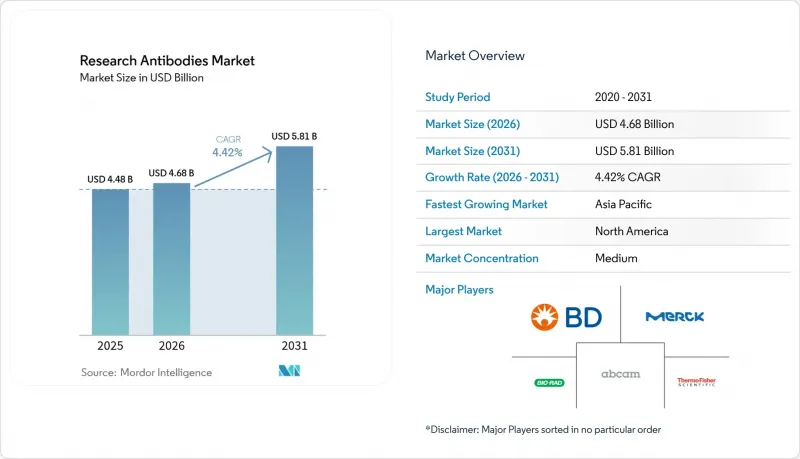
This report Segments the Industry by Antibody Type (Monoclonal Antibodies, and More), Source Species (Mouse, and More), Product (Primary Antibodies, and More), Application (Immunology, and More), End User (Pharmaceutical and Biotech Companies, and More), and Geography (North America, Europe, Asia-Pacific, Middle East and Africa, South America). The Market Forecasts are Provided in Terms of Value (USD).
Global Research Antibodies Market Trends and Insights
Continued Expansion of Life-Science R&D Budgets
AbbVie lifted R&D spending by 60% to USD 12.8 billion in 2024, and capital intensity across large pharmaceutical firms supports sustained antibody procurement. The rise in funding comes as biologics pipelines lengthen, and many assays require validated binders to confirm target engagement. Venture investment of USD 34 billion flowed into life-science startups by November 2024, creating fresh demand for high-quality reagents. Because antibody quality is a key variable in experimental reproducibility, global laboratories upgrade inventories to well-characterized formats. As a result, the research antibodies market benefits directly from every incremental dollar invested in therapeutic discovery.
Accelerated Growth of Proteomics & Genomics Projects
Thermo Fisher Scientific acquired Olink for USD 3.1 billion in July 2024, adding a 5,300-protein biomarker panel that depends on rigorously validated antibodies. Spatial transcriptomics platforms unite genetic and protein-level insights, which intensifies the requirement for binders that tolerate multiplexed imaging conditions. AI design engines reduce development cycles from months to days, letting suppliers launch application-specific antibodies in record time. Expansion into neurology and autoimmune research widens the addressable pool of protein targets, reinforcing the growth trajectory of the research antibodies market. The convergence of data-rich 'omics' disciplines ensures continuing demand for recombinant and sequence-defined reagents.
High Procurement & Validation Costs for Premium Antibodies
Monoclonal therapeutics can cost between USD 15,624 and USD 143,833 per treatment course, and high-grade research antibodies mirror that pricing pressure. Academic laboratories in lower-income regions often postpone projects or choose lower validation levels because budgets cannot stretch to premium reagents. Validation assays sometimes exceed the price of the antibody itself, since full characterization covers specificity, sensitivity, and lot stability. Although new expression systems cut production expenses, list prices remain elevated due to stringent quality controls. This cost burden restrains adoption and slows the overall research antibodies market in emerging economies.
Other drivers and restraints analyzed in the detailed report include:
- Outsourcing Boom to CROs & CDMOs for Antibody Production
- Rising Adoption of Precision-Medicine Diagnostics
- Batch-to-Batch Variability Causing Reproducibility Issues
For complete list of drivers and restraints, kindly check the Table Of Contents.
Segment Analysis
Monoclonal antibodies delivered 68.74% of 2025 revenue, reflecting their entrenched role in ELISA, Western blot, and flow cytometry protocols. Recombinant fragments such as scFv and Fab pieces register the quickest ascent at a 9.98% CAGR, because users value their defined sequences and lot-to-lot consistency. These fragments eliminate hybridoma drift and can be engineered for enhanced affinity, which supports multiplex imaging and high-throughput screening. The research antibodies market benefits as regulatory agencies endorse sequence-defined reagents for critical validation. Polyclonal antibodies, while less reproducible, retain relevance where multi-epitope binding boosts detection sensitivity.
The FDA removal of obligatory animal testing accelerates uptake of in-vitro recombinant expression systems that shorten production timelines. Humanized formats attract therapeutic developers seeking translatable binders, whereas murine clones continue servicing routine academic assays. Recombinant libraries also integrate seamlessly with AI affinity maturation, advancing bespoke solutions for niche targets. Together these factors keep the research antibodies market centered on innovation in antibody engineering.
Mouse-derived products owned 42.10% of demand in 2025 after decades of reliable hybridoma outputs. Camelid single-domain antibodies, however, grow at 8.36% CAGR due to their compact size and access to cryptic epitopes. Their heat resistance and solubility suit harsh assay environments, including intracellular imaging and microfluidic platforms. Rabbit monoclonals remain preferred for high-affinity Western blot detection because of strong antigen recognition.
Emerging transgenic chicken lines promise broad antibody diversity at industrial scale, and goat or donkey antibodies sustain niche roles as secondary reagents with multiple labeling sites. Camelid nanobodies enter therapeutic pipelines for tissue penetration advantages, fueling commercial investment by biotech firms. These species dynamics collectively diversify the research antibodies market and propel specialty reagent development.
Complete Report Scope:
- By Antibody Type
- Monoclonal Antibodies
- Murine
- Chimeric
- Humanized
- Human
- Polyclonal Antibodies
- Recombinant Fragments
- Monoclonal Antibodies
- By Source Species
- Mouse
- Rabbit
- Goat
- Donkey
- Camelid
- By Product
- Primary Antibodies
- Secondary Antibodies
- Controls & Isotype Standards
- By Application
- Immunology
- Oncology & Stem-Cell Biology
- Neuroscience
- Infectious Diseases
- Metabolic & Cardiovascular
- Others
- By End User
- Pharmaceutical & Biotech Companies
- CROs / CDMOs
- Academic & Research Institutes
- Diagnostic Laboratories
- Hospitals
- By Geography
- North America
- United States
- Canada
- Mexico
- Europe
- Germany
- United Kingdom
- France
- Italy
- Spain
- Rest of Europe
- Asia-Pacific
- China
- Japan
- India
- Australia
- South Korea
- Rest of Asia-Pacific
- Middle East & Africa
- GCC
- South Africa
- Rest of Middle East & Africa
- South America
- Brazil
- Argentina
- Rest of South America
- North America
Geography Analysis
North America held 43.05% of 2025 revenue and benefits from USD 288 billion in pharmaceutical R&D spending, venture capital depth, and regulatory policies that support non-animal validation. Canada's precision-medicine programs and Mexico's growing manufacturing base extend regional demand beyond the United States. Consequently, the research antibodies market receives consistent orders tied to oncology, immunology, and high-throughput screening initiatives.
Asia-Pacific registers an 8.61% CAGR to 2031, driven by China's leadership in antibody-drug conjugate trials and Japan's government funding that targets a tripling of biotech output by 2030. South Korea's strategic investment in cell therapy manufacturing and India's expanding generic biologics sector amplify reagent consumption. Regional CDMO capacity, projected to reach 45% of global supply by 2028, further anchors the research antibodies market within Asia.
Europe exhibits balanced growth supported by stringent validation standards and an overarching shift toward recombinant, animal-free reagents following World Health Organization draft guidelines. Germany and the United Kingdom remain innovation hubs, whereas France, Italy, and Spain benefit from rising biotech start-ups. Middle East, Africa, and South America deliver emerging pockets of demand as clinical research infrastructure matures, extending the research antibodies market footprint into new territories.
- Abcam
- Thermo Fisher Scientific
- Merck
- Bio-Rad Laboratories
- Cell Signaling Technology
- Agilent Technologies
- PerkinElmer
- Beckton Dickinson
- Roche
- Lonza Group
- GenScript Biotech Corp.
- Santa Cruz Biotechnology Inc.
- Proteintech Group Inc.
- Bio-Techne
- GeneTex Inc.
- Rockland Immunochemicals Inc.
- Jackson ImmunoResearch Labs
- Miltenyi Biotec
- Dianova GmbH
- Creative Diagnostics
Additional Benefits:
- The market estimate (ME) sheet in Excel format
- 3 months of analyst support
TABLE OF CONTENTS
1 Introduction
- 1.1 Study Assumptions & Market Definition
- 1.2 Scope of the Study
2 Research Methodology
3 Executive Summary
4 Market Landscape
- 4.1 Market Overview
- 4.2 Market Drivers
- 4.2.1 Continued Expansion of Life-Science R&D Budgets
- 4.2.2 Accelerated Growth of Proteomics & Genomics Projects
- 4.2.3 Outsourcing Boom to CROs & CDMOs for Antibody Production
- 4.2.4 Rising Adoption of Precision-Medicine Diagnostics
- 4.2.5 Spatial-Omics & Single-Cell Imaging Creating Novel Antibody Demand
- 4.2.6 CRISPR Screening Workflows Requiring Ultra-Specific Validation Antibodies
- 4.3 Market Restraints
- 4.3.1 High Procurement & Validation Costs for Premium Antibodies
- 4.3.2 Batch-To-Batch Variability Causing Reproducibility Issues
- 4.3.3 Rapid Emergence of Aptamers/Nanobodies as Substitute Affinity Reagents
- 4.3.4 Stricter Animal-Welfare Regulations Disrupting Animal-Sourced Antibody Supply
- 4.4 Porter's Five Forces Analysis
- 4.4.1 Threat of New Entrants
- 4.4.2 Bargaining Power of Buyers
- 4.4.3 Bargaining Power of Suppliers
- 4.4.4 Threat of Substitutes
- 4.4.5 Competitive Rivalry
5 Market Size & Growth Forecasts (Value in USD)
- 5.1 By Antibody Type
- 5.1.1 Monoclonal Antibodies
- 5.1.1.1 Murine
- 5.1.1.2 Chimeric
- 5.1.1.3 Humanized
- 5.1.1.4 Human
- 5.1.2 Polyclonal Antibodies
- 5.1.3 Recombinant Fragments
- 5.1.1 Monoclonal Antibodies
- 5.2 By Source Species
- 5.2.1 Mouse
- 5.2.2 Rabbit
- 5.2.3 Goat
- 5.2.4 Donkey
- 5.2.5 Camelid
- 5.3 By Product
- 5.3.1 Primary Antibodies
- 5.3.2 Secondary Antibodies
- 5.3.3 Controls & Isotype Standards
- 5.4 By Application
- 5.4.1 Immunology
- 5.4.2 Oncology & Stem-Cell Biology
- 5.4.3 Neuroscience
- 5.4.4 Infectious Diseases
- 5.4.5 Metabolic & Cardiovascular
- 5.4.6 Others
- 5.5 By End User
- 5.5.1 Pharmaceutical & Biotech Companies
- 5.5.2 CROs / CDMOs
- 5.5.3 Academic & Research Institutes
- 5.5.4 Diagnostic Laboratories
- 5.5.5 Hospitals
- 5.6 By Geography
- 5.6.1 North America
- 5.6.1.1 United States
- 5.6.1.2 Canada
- 5.6.1.3 Mexico
- 5.6.2 Europe
- 5.6.2.1 Germany
- 5.6.2.2 United Kingdom
- 5.6.2.3 France
- 5.6.2.4 Italy
- 5.6.2.5 Spain
- 5.6.2.6 Rest of Europe
- 5.6.3 Asia-Pacific
- 5.6.3.1 China
- 5.6.3.2 Japan
- 5.6.3.3 India
- 5.6.3.4 Australia
- 5.6.3.5 South Korea
- 5.6.3.6 Rest of Asia-Pacific
- 5.6.4 Middle East & Africa
- 5.6.4.1 GCC
- 5.6.4.2 South Africa
- 5.6.4.3 Rest of Middle East & Africa
- 5.6.5 South America
- 5.6.5.1 Brazil
- 5.6.5.2 Argentina
- 5.6.5.3 Rest of South America
- 5.6.1 North America
6 Competitive Landscape
- 6.1 Market Concentration
- 6.2 Market Share Analysis
- 6.3 Company Profiles (includes Global level Overview, Market level overview, Core Segments, Financials as available, Strategic Information, Market Rank/Share for key companies, Products & Services, and Recent Developments)
- 6.3.1 Abcam plc
- 6.3.2 Thermo Fisher Scientific Inc.
- 6.3.3 Merck KGaA
- 6.3.4 Bio-Rad Laboratories Inc.
- 6.3.5 Cell Signaling Technology Inc.
- 6.3.6 Agilent Technologies Inc.
- 6.3.7 PerkinElmer Inc.
- 6.3.8 Becton, Dickinson and Company
- 6.3.9 F. Hoffmann-La Roche Ltd
- 6.3.10 Lonza Group AG
- 6.3.11 GenScript Biotech Corp.
- 6.3.12 Santa Cruz Biotechnology Inc.
- 6.3.13 Proteintech Group Inc.
- 6.3.14 Bio-Techne Corporation
- 6.3.15 GeneTex Inc.
- 6.3.16 Rockland Immunochemicals Inc.
- 6.3.17 Jackson ImmunoResearch Labs
- 6.3.18 Miltenyi Biotec
- 6.3.19 Dianova GmbH
- 6.3.20 Creative Diagnostics
7 Market Opportunities & Future Outlook
- 7.1 White-space & Unmet-Need Assessment

