PUBLISHER: Mordor Intelligence | PRODUCT CODE: 2115245

PUBLISHER: Mordor Intelligence | PRODUCT CODE: 2115245
Asia-Pacific Pet Insurance - Market Share Analysis, Industry Trends & Statistics, Growth Forecasts (2026 - 2031)
According to Mordor Intelligence, the Asia-Pacific pet insurance market size was valued at USD 9.69 billion in 2025 and estimated to grow from USD 11.41 billion in 2026 to reach USD 25.94 billion by 2031, at a CAGR of 17.82% during the forecast period (2026-2031).
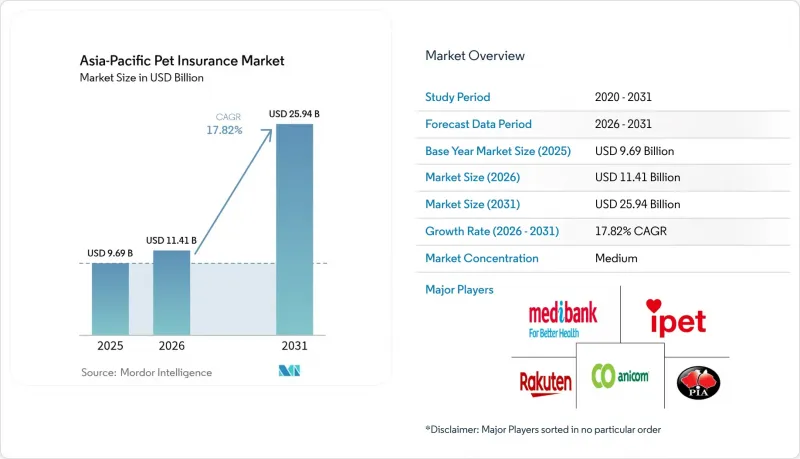
This report is Segmented by Coverage Type (Accident & Illness, and More), Animal (Dog, Cat, and Other Companion Animals), Provider (Private and Public/Mutual), Sales Channel (Direct-To-Consumer (Digital), and More), Policy Term (Lifetime and Annual/Non-lifetime), and Geography (China, Japan, Australia, India, South Korea, and More). The Market Forecasts are Provided in Terms of Value (USD).
Asia-Pacific Pet Insurance Market Trends and Insights
Surging "Pet Humanisation" Spending in Tier-1 Chinese Cities
Average annual veterinary spending in Beijing, Shanghai, and Guangzhou climbed 37.0% in 2024 as millennial and Gen-Z owners redirected 15-20% of discretionary income toward premium pet care. Insurance uptake in these hubs doubled from 8% to 14% year-over-year, and 76% of new policies were purchased via smartphone apps in Q1 2025. These urban consumers demand human-style benefits such as preventative check-ups and mental-health cover, prompting insurers to launch full-stack mobile journeys that close the sale in under three minutes. Enhanced data capture from app usage is now feeding AI underwriting engines, reducing rating errors and improving claims triage. The rising willingness to insure higher-value exotic breeds is also widening the premium pool despite the actuarial challenges linked to limited breed-specific claims history.
Expansion of Corporate Pet-care Benefit Programmes in Japan & Australia
Forty-two percent of Fortune 500 employers across Japan and Australia subsidised pet insurance in 2024, creating a stable, low-lapse distribution vein. Policies sold through human-resources packages showed 28% lower churn than direct-to-consumer contracts, and Anicom Holdings saw corporate-channel premiums jump 34%, representing 22% of its book. Australian market leader Medibank Private signed 17 enterprise deals that collectively insure 85,000 pets, bundling wellness allowances and tele-vet consults to raise utilisation and retention. Employers frame the benefit as a mental-health perk that lowers stress for staff worried about veterinary bills. Insurers, for their part, gain concentrated groups of low-average-age animals whose claim ratios trend below open-market averages, boosting portfolio profitability.
Cultural Reluctance toward Pet Insurance in Rural Provinces
Pet owners living in rural districts across India, China, and Indonesia frequently rely on home remedies or informal community veterinarians, leaving little perceived need for formal insurance. A 2024 survey by China's Ministry of Agriculture and Rural Affairs showed that only 1.5% of pet owners in county-level areas carried any form of cover, compared with 12.6% in adjacent prefecture-level cities. Similar patterns are visible in India, where the Department of Animal Husbandry found that 68% of rural households view veterinary costs as too low or too infrequent to justify premiums. Cultural traditions also favor natural remedies and barter-based care, reducing trust in written policies and digital claim processes. Limited smartphone penetration compounds the gap because most insurers distribute policies through mobile apps. As a result, rural uptake lags urban centers by more than a decade, forcing insurers to tailor grassroots awareness campaigns and micro-premium products that match seasonal income cycles.
Other drivers and restraints analyzed in the detailed report include:
- Post-COVID Companion-Animal Adoption across India & Southeast Asia
- Availability of Mobile-First On-boarding & Claim Apps
- High Fraudulent Claim Incidence in Certain Chinese Provinces
For complete list of drivers and restraints, kindly check the Table Of Contents.
Segment Analysis
Accident & Illness policies captured 71.62% of the APAC pet insurance market share in 2025 as they remain the default response to unpredictable, high-cost events. The segment enjoys deep adoption in Japan and Australia where a single cruciate-ligament surgery can cost more than USD 5,000. Insurers continue to refine sub-limits and deductible ladders to manage claim volatility while maintaining perceived value. Wellness & Routine-Care Add-ons are the growth engine, advancing at 18.10% CAGR and appealing to millennials who view preventative check-ups and dental cleanings as essential. Roughly 64% of new customers opted for at least one wellness rider in 2024. The APAC pet insurance market size for accident-only cover remains relevant in price-sensitive pockets such as India, Indonesia, and Thailand, where it functions as a low-premium entry gate. Innovative stepped-coverage designs now auto-upgrade accident-only policies to broader benefits after claim-free periods, boosting retention without requiring active customer decisions.
Second-generation products include behavioural therapy subsidies, lost-pet recovery services, and mental-health consultations for owners managing chronic pet conditions. These additions fight commoditisation and create upsell paths. Insurers report that bundles featuring at least one non-traditional perk show 1.6-times higher cross-sell rates into lifetime policies. As more data emerges that preventative spend lowers catastrophic outlay, underwriting margins are predicted to widen by mid-decade.
Dogs accounted for 64.02% of the APAC pet insurance market size in 2025, fuelled by higher average vet bills and regulatory scrutiny around canine ownership. Breed-specific plans in Japan cover hereditary issues in Shiba Inus and Dachshunds, allowing refined pricing that mitigates anti-selection. The cat segment's 28.77% share is expanding quickly at 13.95% CAGR as space-constrained apartment dwellers across Hong Kong, Singapore, and mainland China favour felines. Premiums for cats run 30-40% below canine equivalents, inviting first-time buyers. Exotic birds, rabbits, and reptiles make up 7.21% of policies but show niche promise: Pet Insurance Australia's February 2024 exotic-bird product sold out an initial 3,000-policy allocation in two months. The actuarial restraint noted earlier still inflates exotic-breed premiums, yet specialised carriers are investing in micro-cohorts to collect claims evidence and unlock under-served value.
Urban demographic changes underpin segment momentum. In Japan's ageing society, small-breed dogs and cats match limited living space and owner mobility. Mainland China's millennial cohort is now adopting cats at a faster absolute rate than dogs according to the 2024 Pet Industry White Paper. Higher feline adoption tilts portfolio risk profiles toward lower-severity claims, improving combined ratios and freeing capital for product experimentation.
Complete Report Scope:
- By Coverage Type
- Accident & Illness
- Accident-Only
- Wellness & Routine-Care Add-ons
- By Animal
- Dog
- Cat
- Other Companion Animals (Birds, Rabbits, etc.)
- By Provider
- Private
- Public / Mutual
- By Sales Channel
- Direct-to-Consumer (Digital)
- Agency & Broker
- Bancassurance & Affinity Partnerships
- Retail & Pet-store Embedded
- By Policy Term
- Lifetime
- Annual / Non-lifetime
- Geography
- China
- Japan
- Australia
- India
- South Korea
- Southeast Asia (Indonesia, Thailand, Malaysia, Vietnam, Philippines, Singapore)
- Rest of APAC (Hong Kong, Taiwan, New Zealand, Pakistan, Sri Lanka, etc.)
List of Companies Covered in this Report:
- Anicom Holdings, Inc.
- ipet Insurance Co., Ltd.
- Rakuten General Insurance Co., Ltd.
- Sompo Japan Insurance Inc.
- Mitsui Sumitomo Insurance (MS&AD)
- Tokio Marine & Nichido Fire Insurance Co.
- The New India Assurance Company
- Oriental Insurance
- Guide Dogs Pet Insurance (Australia)
- Medibank Private Ltd.
- Pet Insurance Australia Pty Ltd.
- The Hollard Insurance Company Ltd
- Bajaj Allianz General Insurance
- Future Generali India Insurance
Additional Benefits:
- The market estimate (ME) sheet in Excel format
- 3 months of analyst support
TABLE OF CONTENTS
1 Introduction
- 1.1 Study Assumptions & Market Definition
- 1.2 Scope of the Study
2 Research Methodology
3 Executive Summary
4 Market Landscape
- 4.1 Market Overview
- 4.2 Market Drivers
- 4.2.1 Surging Pet Humanization Spending in Tier-1 Chinese Cities
- 4.2.2 Expansion of Corporate Pet-care Benefit Programs in Japan & Australia
- 4.2.3 Post-COVID Uptick in Companion-Animal Adoption across India & South-East Asia
- 4.2.4 Availability of Mobile-First Insurance On-boarding & Claim Apps
- 4.2.5 ASEAN E-commerce Platforms Bundling Micro-Pet-Cover with Pet Food Subscriptions
- 4.2.6 Regulatory Mandates for Third-party Liability Cover for Dogs (South Korea, Singapore)
- 4.3 Market Restraints
- 4.3.1 Under-penetration of Veterinary Clinics Insurable under Private Networks
- 4.3.2 Limited Actuarial Data for Exotic/Pedigree Breeds Inflating Premiums
- 4.3.3 Cultural Reluctance toward Pet Insurance in Rural Provinces
- 4.3.4 High Fraudulent Claim Incidence in Certain Chinese Provinces
- 4.4 Regulatory Outlook
- 4.5 Porter's Five Forces Analysis
- 4.5.1 Threat of New Entrants
- 4.5.2 Bargaining Power of Buyers/Consumers
- 4.5.3 Bargaining Power of Suppliers
- 4.5.4 Threat of Substitute Products
- 4.5.5 Intensity of Competitive Rivalry
5 Market Size & Growth Forecasts (Value, USD)
- 5.1 By Coverage Type
- 5.1.1 Accident & Illness
- 5.1.2 Accident-Only
- 5.1.3 Wellness & Routine-Care Add-ons
- 5.2 By Animal
- 5.2.1 Dog
- 5.2.2 Cat
- 5.2.3 Other Companion Animals (Birds, Rabbits, etc.)
- 5.3 By Provider
- 5.3.1 Private
- 5.3.2 Public / Mutual
- 5.4 By Sales Channel
- 5.4.1 Direct-to-Consumer (Digital)
- 5.4.2 Agency & Broker
- 5.4.3 Bancassurance & Affinity Partnerships
- 5.4.4 Retail & Pet-store Embedded
- 5.5 By Policy Term
- 5.5.1 Lifetime
- 5.5.2 Annual / Non-lifetime
- 5.6 Geography
- 5.6.1 China
- 5.6.2 Japan
- 5.6.3 Australia
- 5.6.4 India
- 5.6.5 South Korea
- 5.6.6 Southeast Asia (Indonesia, Thailand, Malaysia, Vietnam, Philippines, Singapore)
- 5.6.7 Rest of APAC (Hong Kong, Taiwan, New Zealand, Pakistan, Sri Lanka, etc.)
6 Competitive Landscape
- 6.1 Market Concentration
- 6.2 Market Share Analysis
- 6.3 Company Profiles (includes Global-level Overview, Market-level Overview, Core Segments, Financials as available, Strategic Information, Market Rank/Share, Products & Services, Recent Developments)
- 6.3.1 Anicom Holdings, Inc.
- 6.3.2 ipet Insurance Co., Ltd.
- 6.3.3 Rakuten General Insurance Co., Ltd.
- 6.3.4 Sompo Japan Insurance Inc.
- 6.3.5 Mitsui Sumitomo Insurance (MS&AD)
- 6.3.6 Tokio Marine & Nichido Fire Insurance Co.
- 6.3.7 The New India Assurance Company Limited
- 6.3.8 Oriental Insurance
- 6.3.9 Guide Dogs Pet Insurance (Australia)
- 6.3.10 Medibank Private Ltd.
- 6.3.11 Pet Insurance Australia Pty Ltd.
- 6.3.12 The Hollard Insurance Company Ltd
- 6.3.13 Bajaj Allianz General Insurance
- 6.3.14 Future Generali India Insurance
7 Market Opportunities & Future Outlook

