PUBLISHER: Mordor Intelligence | PRODUCT CODE: 2115252

PUBLISHER: Mordor Intelligence | PRODUCT CODE: 2115252
FRP Grating - Market Share Analysis, Industry Trends & Statistics, Growth Forecasts (2026 - 2031)
According to Mordor Intelligence, the FRP grating market size is estimated at USD 547.78 million in 2026, and is expected to reach USD 703.13 million by 2031, at a CAGR of 5.12% during the forecast period (2026-2031).
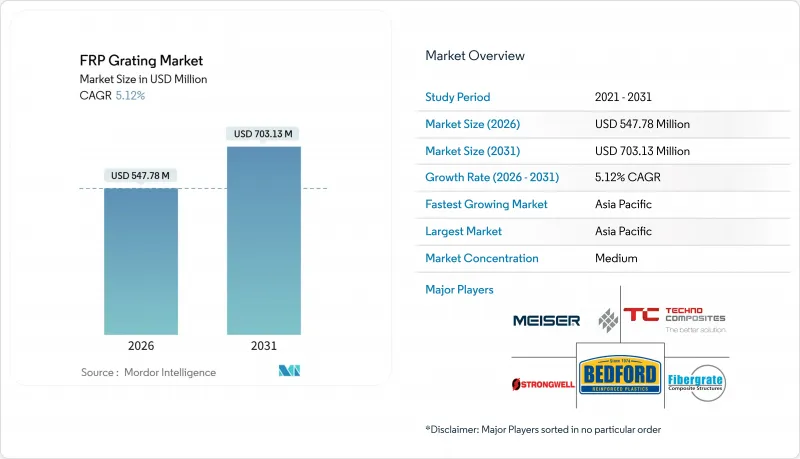
This report is Segmented by Type (Polyester, Vinyl Ester, and More), Manufacturing Process (Pultruded and Molded), Application (Stair Treads, Walkways, and More), End-User Industry (Oil and Gas, Plant and Chemical Processing, Waste and Water Treatment, and More), and Geography (Asia-Pacific, North America, Europe, South America, and Middle-East and Africa). Market Forecasts are Provided in Terms of Value (USD).
Global FRP Grating Market Trends and Insights
Shift from Steel to Corrosion-Resistant FRP Gratings
Lifecycle studies demonstrate that composites outperform mild steel in corrosive environments, despite a 30-50% upfront premium. Shell's Mars Platform retrofit in 2024 recorded a 60% fall in maintenance downtime and saved USD 1.2 million in coating labor across fifteen years. Publication of ISO 24681:2023 unified marine-grade design criteria, allowing offshore wind developers to quote identical load, fire, and UV benchmarks. China's 2024 Industrial Structure Adjustment Catalogue further incentivizes large-scale alkali-free glass-fiber production, ensuring consistent fiber quality.
Rising CAPEX in Wastewater Treatment Facilities
Hydrogen sulfide environments degrade galvanized steel within five to seven years, whereas molded FRP panels resist corrosion and satisfy OSHA 1910.22 slip rules without coatings. India's USD 12 billion Jal Jeevan Mission program specifies molded gratings for clarifier walkways to meet tight construction windows.
High Upfront Cost Versus Mild-Steel Grating
FRP gratings command a 30-50% price premium over galvanized steel equivalents, creating a procurement barrier in capital-constrained projects despite superior lifecycle economics. Budget-driven municipal wastewater projects in Brazil and Argentina often default to steel due to upfront cost constraints, even though FRP's 25-30 year service life versus steel's 10-15 year repaint-and-replace cycle would yield lower total cost of ownership. KPS Capital Partners' 2024-25 acquisitions of INEOS and Crane Composites aim to scale resin volumes that could trim fabricator costs by up to 12% by 2028.
Other drivers and restraints analyzed in the detailed report include:
- Expansion of Offshore Wind and Floating Solar Platforms
- Stricter Worker-Safety and Anti-Slip Regulations
- UV-Induced Resin Degradation
For complete list of drivers and restraints, kindly check the Table Of Contents.
Segment Analysis
Polyester retained a 42.36% 2025 FRP grating market share, reflecting a vast legacy in municipal walkways. Vinyl ester's 6.24% CAGR signals momentum in acid and solvent rich zones. Phenolic panels satisfy IMO SOLAS and ASTM E84 Class A requirements but command 50-70% higher prices. Epoxy remains confined to cleanrooms needing electrostatic discharge performance. Resin suppliers are introducing bio-attributed vinyl ester formulations to cut carbon intensity, pointing to wider acceptance as corporate sustainability targets tighten.
Vinyl ester uptake will accelerate because offshore and chemical buyers already budget for premium materials. Polyester will persist where cost drives decisions, while phenolic will capture fire-critical niches. Epoxy's limited load capacity restricts growth, though conductive additives inside vinyl ester threaten to cannibalize epoxy in electronics flooring.
Molded panels commanded 58.47% of 2025 volume, pultrusion dies, and bi-directional load distribution that suits platforms and trench covers subjected to multi-axis stresses. Pultruded panels, although capital intensive, are registering 6.18% CAGR by delivering higher tensile strength for truck loading bays and heavy-duty offshore walkways.
Molded products give bi-directional load paths that resist crack propagation, while pultruded variants yield tight tolerances ideal for modular retrofits. North American and European producers emphasize pultrusion to offset labor costs via automation, whereas Asian manufacturers exploit labor advantages in hand-layup molded production.
Complete Report Scope:
- By Type
- Polyester
- Vinyl Ester
- Phenolic
- Epoxy
- By Manufacturing Process
- Pultruded
- Molded
- By Application
- Stair Treads
- Walkways
- Platforms
- Floor Systems
- By End-User Industry
- Oil and Gas
- Plant and Chemical Processing
- Waste and Water Treatment
- Pulp and Paper
- Construction
- Others
- By Geography
- Asia-Pacific
- China
- India
- Japan
- South Korea
- ASEAN Countries
- Rest of Asia-Pacific
- North America
- United States
- Canada
- Mexico
- Europe
- Germany
- United Kingdom
- France
- Italy
- Spain
- Russia
- Rest of Europe
- South America
- Brazil
- Argentina
- Rest of South America
- Middle-East and Africa
- Saudi Arabia
- South Africa
- Rest of Middle-East and Africa
- Asia-Pacific
Geography Analysis
Asia-Pacific held 47.38% of 2025 revenue and is set for 5.94% CAGR through 2031. Chinese policy encourages premium glass-fiber output, ensuring feedstock quality. India's Jal Jeevan Mission injects USD 12 billion into sewage projects, establishing steady molded grating demand. ASEAN chemical hubs in Malaysia and Indonesia turn to vinyl ester panels for corrosion control. Japan sustains stable purchases for coastal civil structures that require seismic and corrosion resilience.
In North America, the US EPA's USD 515.4 billion water program will drive the largest slice of regional spending, complemented by East Coast offshore wind farm construction. Canada's oil sands operations specify pultruded panels for extreme temperature swings, and Mexican near-shoring is spurring molded panel demand in new automotive parks.
In Europe, Dogger Bank Wind Farm demonstrates FRP advantages in offshore substations. Germany's Rhine-Ruhr legislative environment is replacing steel walkways with vinyl ester to meet ISO 14122 mandates. Spain and Greece invest in desalination plants that adopt UV-stabilized polyester, though field feedback has already prompted resin reformulations.
In South America and the Middle East-Africa price sensitivity limits penetration, yet Brazil's pre-salt platforms and Saudi petrochemical complexes buy higher-grade vinyl ester and phenolic panels for corrosion and fire safety.
- AGC MATEX CO., Ltd.
- AIMS COMPOSITES
- American Grating
- SEASAFE, INC.
- Bedford Reinforced Plastics
- Daikure Co., Ltd.
- Exel Composites
- FASTEC International
- FERROTECH INTERNATIONAL FZE
- Fibergrate Composite Structures, Inc.
- Gebruder MEISER GmbH
- SEASAFE, INC.
- STRONGWELL CORPORATION
- Techno-Composites Domine GmbH
- Valmont Industries, Inc.
Additional Benefits:
- The market estimate (ME) sheet in Excel format
- 3 months of analyst support
TABLE OF CONTENTS
1 Introduction
- 1.1 Study Assumptions
- 1.2 Scope of the Study
2 Research Methodology
3 Executive Summary
4 Market Dynamics
- 4.1 Drivers
- 4.1.1 Shift from steel to corrosion-resistant FRP gratings
- 4.1.2 Rising CAPEX in wastewater treatment facilities
- 4.1.3 Expansion of offshore wind and floating solar platforms
- 4.1.4 Stricter worker-safety and anti-slip regulations
- 4.1.5 Adoption of smart-sensor embedded FRP walkways
- 4.2 Restraints
- 4.2.1 High upfront cost versus mild-steel grating
- 4.2.2 UV-induced resin degradation in high-insolation zones
- 4.2.3 Volatile styrene and glass-fiber prices
- 4.3 Industry Value Chain Analysis
- 4.4 Porter's Five Forces Analysis
- 4.4.1 Threat of New Entrants
- 4.4.2 Bargaining Power of Buyers
- 4.4.3 Bargaining Power of Suppliers
- 4.4.4 Threat of Substitute Products
- 4.4.5 Degree of Competition
5 Market Size & Growth Forecasts (Value)
- 5.1 By Type
- 5.1.1 Polyester
- 5.1.2 Vinyl Ester
- 5.1.3 Phenolic
- 5.1.4 Epoxy
- 5.2 By Manufacturing Process
- 5.2.1 Pultruded
- 5.2.2 Molded
- 5.3 By Application
- 5.3.1 Stair Treads
- 5.3.2 Walkways
- 5.3.3 Platforms
- 5.3.4 Floor Systems
- 5.4 By End-User Industry
- 5.4.1 Oil and Gas
- 5.4.2 Plant and Chemical Processing
- 5.4.3 Waste and Water Treatment
- 5.4.4 Pulp and Paper
- 5.4.5 Construction
- 5.4.6 Others
- 5.5 By Geography
- 5.5.1 Asia-Pacific
- 5.5.1.1 China
- 5.5.1.2 India
- 5.5.1.3 Japan
- 5.5.1.4 South Korea
- 5.5.1.5 ASEAN Countries
- 5.5.1.6 Rest of Asia-Pacific
- 5.5.2 North America
- 5.5.2.1 United States
- 5.5.2.2 Canada
- 5.5.2.3 Mexico
- 5.5.3 Europe
- 5.5.3.1 Germany
- 5.5.3.2 United Kingdom
- 5.5.3.3 France
- 5.5.3.4 Italy
- 5.5.3.5 Spain
- 5.5.3.6 Russia
- 5.5.3.7 Rest of Europe
- 5.5.4 South America
- 5.5.4.1 Brazil
- 5.5.4.2 Argentina
- 5.5.4.3 Rest of South America
- 5.5.5 Middle-East and Africa
- 5.5.5.1 Saudi Arabia
- 5.5.5.2 South Africa
- 5.5.5.3 Rest of Middle-East and Africa
- 5.5.1 Asia-Pacific
6 Competitive Landscape
- 6.1 Market Concentration
- 6.2 Strategic Moves
- 6.3 Market Share (%)**/Ranking Analysis
- 6.4 Company Profiles (includes Global level Overview, Market level overview, Core Segments, Financials as available, Production Capacity, Strategic Information, Market Rank/Share for key companies, Products and Services, and Recent Developments)
- 6.4.1 AGC MATEX CO., Ltd.
- 6.4.2 AIMS COMPOSITES
- 6.4.3 American Grating
- 6.4.4 SEASAFE, INC.
- 6.4.5 Bedford Reinforced Plastics
- 6.4.6 Daikure Co., Ltd.
- 6.4.7 Exel Composites
- 6.4.8 FASTEC International
- 6.4.9 FERROTECH INTERNATIONAL FZE
- 6.4.10 Fibergrate Composite Structures, Inc.
- 6.4.11 Gebruder MEISER GmbH
- 6.4.12 SEASAFE, INC.
- 6.4.13 STRONGWELL CORPORATION
- 6.4.14 Techno-Composites Domine GmbH
- 6.4.15 Valmont Industries, Inc.
7 Market Opportunities and Future Outlook
- 7.1 White-space and Unmet-Need Assessment

