PUBLISHER: Mordor Intelligence | PRODUCT CODE: 2115815

PUBLISHER: Mordor Intelligence | PRODUCT CODE: 2115815
Japan Pharmaceutical - Market Share Analysis, Industry Trends & Statistics, Growth Forecasts (2026 - 2031)
According to Mordor Intelligence, the Japan pharmaceutical market size is projected to be USD 88.14 billion in 2025, USD 89.54 billion in 2026, and reach USD 96.78 billion by 2031, growing at a CAGR of 1.57% from 2026 to 2031.
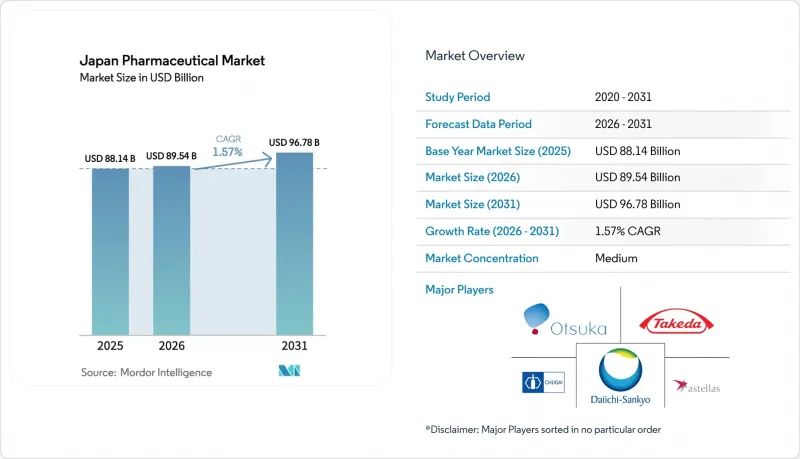
This report is Segmented by Drug Type (Prescription Drugs, Over-The-Counter Drugs), Therapeutic Area (Oncology, Cardiovascular, Anti-Diabetic, and More), Molecule Type (Small-Molecule, Biologics, Biosimilars), Formulation (Oral, Injectable, Topical, Other Formulations), and Distribution Channel (Hospital Pharmacies, Retail Pharmacies, and More). The Market Forecasts are Provided in Terms of Value (USD).
Japan Pharmaceutical Market Trends and Insights
Patent-Cliff Replenishment Through Specialty Drugs
Blockbuster experiences have prompted companies to shift toward higher-value, lower-volume assets that maintain pricing power. Humira biosimilars captured 22% of adalimumab prescriptions within 18 months of their 2024 launch, prompting originators to redirect their research and development efforts to antibody-drug conjugates and rare disease enzymes. Takeda's USD 2.1 billion biologics complex under construction in Fujisawa illustrates capital redeployment toward niche therapies that can earn a 10% premium under the expanded Premium on Marketability Promotion incentive. Smaller biotechs partner with domestic distributors to co-file rapid-launch products, thereby compressing the traditional lag in Japan launches. As margins on legacy drugs decline, specialty pipelines become the preferred hedge against pricing attrition.
Fast-Track Regulatory Pathways for Breakthrough Therapies
The SAKIGAKE designation reduced the median approval review time to nine months in 2024, compared to fourteen months under the conventional process. Conditional approvals granted to oncology biologics, such as Chugai's Polivy, allowed revenue capture while confirmatory trials continued, a competitive lever rarely available in Europe. Multinationals with global data packages, including AstraZeneca's Enhertu, have captured double-digit market shares within a year of launch. Real-world evidence obligations introduced in 2025 raise compliance costs, but firms with robust pharmacovigilance infrastructure view the requirement as manageable.
National Drug-Price Revisions & Biennial Cuts
The April 2024 revision reduced reimbursement for 53% of listed drugs, with an average decrease of 4.8% for brand-name drugs and 7.2% for generic drugs. Off-year cuts introduced in 2025 targeted high-selling therapies where transaction prices were undershot by at least 2% of the list prices. Sawai's operating profit fell 9.3% in fiscal 2024, as prices for atorvastatin and amlodipine declined. As value-based pricing expands, products lacking compelling real-world evidence are likely to face deeper erosion, accelerating consolidation.
Other drivers and restraints analyzed in the detailed report include:
- Growing Burden of Oncology & Rare Diseases
- Ageing Population Driving Chronic Therapies
- Generic Substitution Pressure
For complete list of drivers and restraints, kindly check the Table Of Contents.
Segment Analysis
Prescription medicines accounted for 71.78% of 2025 revenue, yet the over-the-counter segment is expected to advance at a 3.93% CAGR, more than double the CAGR of the Japan pharmaceutical market. The switch of loxoprofen to OTC status in 2024 exemplifies policy efforts to migrate routine pain management from clinics to retail shelves. Self-medication trends among seniors lifted analgesic and gastrointestinal remedy volumes throughout 2025, while e-commerce platforms captured incremental share.
Margin pressure persists for branded prescriptions because biennial revisions tamp profitability. Still, specialty injectables for rheumatoid arthritis and multiple sclerosis remain insulated, sustaining Japan's pharmaceutical market share leadership in prescription lines. Consumer-health divisions invest in influencer-led digital campaigns to grow OTC supplements, reflecting divergent strategies within the same corporate groups.
Oncology represented 18.73% of therapeutic-area revenue in 2025 and is expected to post a 4.19% CAGR through 2031, underscoring its status as the growth engine of the Japanese pharmaceutical market. Enhertu's JPY 87 billion in domestic sales for fiscal 2024 demonstrates the speed at which innovative products penetrate once reimbursement is secured.
Conversely, cardiovascular drugs advance at only 0.8% CAGR as generics dominate statins and ACE inhibitors. Diabetes therapies experience volume growth but face scrutiny regarding cost-effectiveness. Central nervous system pipelines suffer from high attrition in dementia trials, while respiratory biologics show moderate momentum due to rising urban asthma prevalence. Oncology, therefore, captures investment and launch priority across multinational and domestic portfolios.
Complete Report Scope:
- By Drug Type
- Prescription Drugs
- Over-the-Counter (OTC) Drugs
- By Therapeutic Area
- Oncology
- Cardiovascular
- Anti-diabetic
- Central Nervous System
- Infectious Disease
- Respiratory
- Others
- By Molecule Type
- Small-molecule
- Biologics
- Biosimilars
- By Formulation
- Oral
- Injectable
- Topical
- Other Formulations
- By Distribution Channel
- Hospital Pharmacies
- Retail Pharmacies
- Online & Mail-Order Pharmacies
List of Companies Covered in this Report:
- Astellas Pharma
- AstraZeneca K.K.
- Chugai Pharmaceutical Co. Ltd.
- Daiichi Sankyo Co. Ltd.
- Eisai
- Kyowa Kirin Co. Ltd.
- Mitsubishi Tanabe Pharma Corp.
- MSD K.K. (Merck)
- Nichi-Iko Pharmaceutical Co. Ltd.
- Novartis Pharma K.K.
- Ono Pharmaceutical Co. Ltd.
- Otsuka
- Pfizer Japan Inc.
- Roche Diagnostics K.K.
- Sawai Pharmaceutical Co. Ltd.
- Shionogi & Co. Ltd.
- Sumitomo Pharma Co. Ltd.
- Takeda Pharmaceuticals
- Teijin Pharma Ltd.
Additional Benefits:
- The market estimate (ME) sheet in Excel format
- 3 months of analyst support
TABLE OF CONTENTS
1 Introduction
- 1.1 Study Assumptions & Market Definition
- 1.2 Scope of the Study
2 Research Methodology
3 Executive Summary
4 Market Landscape
- 4.1 Market Overview
- 4.2 Market Drivers
- 4.2.1 Patent-Cliff Replenishment Through Specialty Drugs
- 4.2.2 Fast-Track Regulatory Pathways for Breakthrough Therapies
- 4.2.3 Growing Burden of Oncology & Rare Diseases
- 4.2.4 Ageing Population Driving Chronic Therapies
- 4.2.5 MHLW Incentives for Companion Diagnostics Integration
- 4.2.6 Digital-Health-Enabled Adherence Solutions Boosting Prescriptions
- 4.3 Market Restraints
- 4.3.1 National Drug-Price Revisions & Biennial Cuts
- 4.3.2 Generic Substitution Pressure
- 4.3.3 Long Approval Timelines for Regenerative Medicines Post-Review
- 4.3.4 Supply-Chain Vulnerabilities for Critical APIs
- 4.4 Pharmaceutical Imports & Exports Flow Analysis
- 4.5 Pipeline Analysis
- 4.6 Vlaue/Supply Chain Analysis
- 4.7 Regulatory Landscape
- 4.8 Technological Outlook
- 4.9 Porter's Five Forces Analysis
- 4.9.1 Threat of New Entrants
- 4.9.2 Bargaining Power of Buyers
- 4.9.3 Bargaining Power of Suppliers
- 4.9.4 Threat of Substitutes
- 4.9.5 Competitive Rivalry
5 Market Size & Growth Forecasts
- 5.1 By Drug Type
- 5.1.1 Prescription Drugs
- 5.1.2 Over-the-Counter (OTC) Drugs
- 5.2 By Therapeutic Area
- 5.2.1 Oncology
- 5.2.2 Cardiovascular
- 5.2.3 Anti-diabetic
- 5.2.4 Central Nervous System
- 5.2.5 Infectious Disease
- 5.2.6 Respiratory
- 5.2.7 Others
- 5.3 By Molecule Type
- 5.3.1 Small-molecule
- 5.3.2 Biologics
- 5.3.3 Biosimilars
- 5.4 By Formulation
- 5.4.1 Oral
- 5.4.2 Injectable
- 5.4.3 Topical
- 5.4.4 Other Formulations
- 5.5 By Distribution Channel
- 5.5.1 Hospital Pharmacies
- 5.5.2 Retail Pharmacies
- 5.5.3 Online & Mail-Order Pharmacies
6 Competitive Landscape
- 6.1 Market Concentration
- 6.2 Market Share Analysis
- 6.3 Company Profiles (includes Global level Overview, Market-level Overview, Core Segments, Financials, Strategic Information, Market Rank/Share, Products & Services, Recent Developments)
- 6.3.1 Astellas Pharma Inc.
- 6.3.2 AstraZeneca K.K.
- 6.3.3 Chugai Pharmaceutical Co. Ltd.
- 6.3.4 Daiichi Sankyo Co. Ltd.
- 6.3.5 Eisai Co. Ltd.
- 6.3.6 Kyowa Kirin Co. Ltd.
- 6.3.7 Mitsubishi Tanabe Pharma Corp.
- 6.3.8 MSD K.K. (Merck)
- 6.3.9 Nichi-Iko Pharmaceutical Co. Ltd.
- 6.3.10 Novartis Pharma K.K.
- 6.3.11 Ono Pharmaceutical Co. Ltd.
- 6.3.12 Otsuka Holdings Co. Ltd.
- 6.3.13 Pfizer Japan Inc.
- 6.3.14 Roche Diagnostics K.K.
- 6.3.15 Sawai Pharmaceutical Co. Ltd.
- 6.3.16 Shionogi & Co. Ltd.
- 6.3.17 Sumitomo Pharma Co. Ltd.
- 6.3.18 Takeda Pharmaceutical Co. Ltd.
- 6.3.19 Teijin Pharma Ltd.
7 Market Opportunities & Future Outlook
- 7.1 White-space & Unmet-need Assessment

