PUBLISHER: Mordor Intelligence | PRODUCT CODE: 2124386

PUBLISHER: Mordor Intelligence | PRODUCT CODE: 2124386
Italy Pharmaceutical - Market Share Analysis, Industry Trends & Statistics, Growth Forecasts (2026 - 2031)
According to Mordor Intelligence, the Italy pharmaceutical market size is projected to expand from USD 40.41 billion in 2026 to USD 48.10 billion by 2031, registering a 3.55% CAGR between 2026 and 2031.
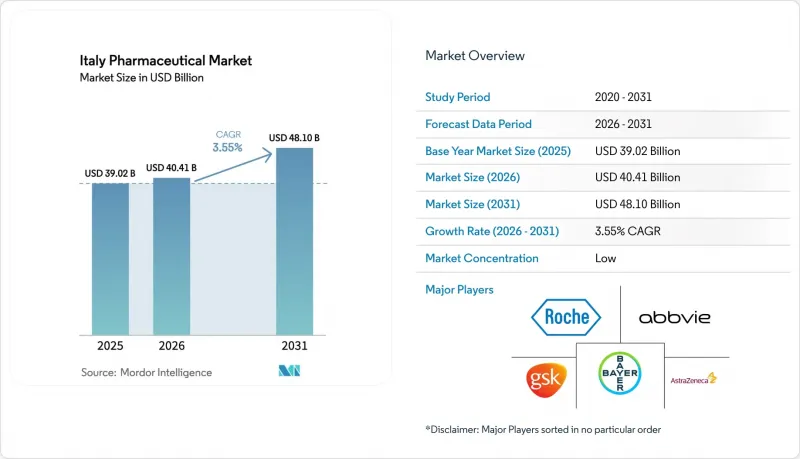
This report is Segmented by ATC/Therapeutic Class (Blood & Hematopoietic Organs, Cardiovascular, Dermatological, Gastrointestinal & Metabolism, and More), Drug Type (Branded, Generic, Biosimilars), Prescription Type (Rx, OTC), Route of Administration (Oral, Parenteral, Inhalation, Topical, Others), Distribution Channel (Hospital, Retail, Online, Wholesalers). Market Forecasts are Provided in Value (USD).
Italy Pharmaceutical Market Trends and Insights
Aging Population & Chronic Disease Burden
Italy's median age climbed to 48.4 years in 2025, the oldest in the EU, and citizens over 65 consume 4.2 times more medicines than working-age adults. Chronic illnesses affect 39.8% of adults, while polypharmacy among the over-75 cohort reached 28%, contributing to an 11% increase in adverse-event reports. Regions where seniors exceed 30% of residents, such as Liguria, post per-capita pharmaceutical outlays 22% above the national mean. The 2024 Chronic Care Plan now links reimbursement for cardiovascular and metabolic drugs to measurable hospital-avoidance outcomes, nudging suppliers to generate real-world evidence. Collectively, these demographics guarantee sustained demand across cardiometabolic and respiratory portfolios, bolstering the Italy pharmaceutical market even under tighter unit prices.
Government R&D Tax Incentives & Regional Grants
The PNRR earmarked EUR 1.67 billion for plant modernization and EUR 15.63 billion for broader health infrastructure, with preference for facilities located in Campania, Calabria and Sicily. A 5% tax credit on phase III trials in underserved provinces became effective in January 2025, already reversing a multi-year decline in oncology studies. Mid-cap companies capitalized on grants covering 35% of capital expenditure for sterile fill-finish lines, shortening payback periods to under five years. These fiscal carrots modestly lift forecast growth yet deliver oversized benefits to regions historically sidelined in drug development, gradually rebalancing the Italy pharmaceutical industry's research footprint.
Stringent AIFA Price & Reimbursement Negotiations
AIFA's payback clawed back EUR 1.24 billion from suppliers in 2024, 18% more than the prior year. Negotiations now average 18 months, delaying access to 14 EMA-cleared therapies, including new GLP-1 and PCSK9 agents. Managed-entry contracts cover 42% of innovative launches, yet just one-third possess robust data systems to confirm real-world outcomes, skewing financial exposure toward manufacturers. Additional 12% price cuts applied by Lombardy and Veneto hospital tenders multiply complexity. Because the 2025 Budget Law caps annual drug spending growth below projected market expansion, net realized prices could erode by 0.7 percentage points annually through 2031, dampening returns across the Italy pharmaceutical market.
Other drivers and restraints analyzed in the detailed report include:
- Biosimilar Uptake Post-Patent Cliffs
- Digital Health & E-Prescriptions Accelerating Access
- High Cost of Innovative Therapies
For complete list of drivers and restraints, kindly check the Table Of Contents.
Segment Analysis
Blood and hematopoietic agents are projected to generate the fastest 8.25% CAGR, positioning the subgroup as a central driver of the Italy pharmaceutical market size through 2031. CAR-T rollouts and biosimilar erythropoietins underpin this expansion, though limited infusion-center capacity currently constrains patient throughput. Cardiovascular drugs commanded 20.54% of 2025 revenue, but growth stagnates as statins and ACE inhibitors face 12% annual price erosion in regional tenders. Gastrointestinal agents anchored by GLP-1 agonists outperformed average prescription growth, reflecting rising obesity management.
Oncology biologics within the blood category increasingly dominate hospital budgets even as reimbursement hurdles persist. Biosimilar filgrastim and pegfilgrastim already captured near-total share, illustrating clinician comfort with hematology substitutes. Respiratory biologics for severe asthma gained traction after inhaler-based adherence tracking became compulsory, aiding formulary inclusion. Dermatology's IL-17 and IL-23 inhibitors continued robust adoption among biologic-naive psoriasis patients, reinforcing specialty-driven momentum for the Italy pharmaceutical market.
Generics controlled 55.54% of 2025 sales but posted just 1.2% volume growth due to entrenched prescriber preferences for branded SKUs. Biosimilars, by contrast, are set to expand at a 6.65% CAGR, unlocking EUR 2.1 billion in fresh revenue as adalimumab, ranibizumab and denosumab copies push substitution rates toward 70%. The Italy pharmaceutical market share tied to branded specialty drugs remains resilient, with Novartis's Entresto alone delivering EUR 340 million in national sales.
Teva and Viatris each launched seven additional biosimilars during 2024-2025, pricing 35-40% below originators and capturing quick hospital uptake. Regional decrees mandating biosimilar first-line use for naive patients accelerated the shift, especially in Lombardy and Veneto. Intensifying biologics competition is pushing generic manufacturers out of low-margin commodities, consolidating supply and subtly reshaping the Italy pharmaceutical industry's competitive contours.
Complete Report Scope:
- By ATC / Therapeutic Class
- Blood & Hematopoietic Organs
- Cardiovascular System
- Dermatological
- Gastrointestinal & Metabolism
- Nervous System
- Respiratory System
- Others
- By Drug Type
- Branded
- Generic
- Biosimilars
- By Prescription Type
- Prescription Drugs (Rx)
- OTC Drugs
- By Route of Administration
- Oral
- Parenteral
- Inhalation
- Topical
- Others
- By Distribution Channel
- Hospital Pharmacies
- Retail Pharmacies
- Online Pharmacies
- Wholesalers / Distributors
List of Companies Covered in this Report:
- Abbvie
- Alfasigma S.p.A.
- Angelini Pharma S.p.A.
- AstraZeneca
- Bayer
- Boehringer Ingelheim
- Bristol-Myers Squibb
- Chiesi Farmaceutici
- Eli Lilly and Company
- Roche
- GlaxoSmithKline
- Janssen Pharmaceutica NV (J&J)
- Menarini
- Merck
- Novartis
- Pfizer
- Recordati S.p.A.
- Sanofi
- Teva Pharmaceutical Industries
- Viatris
Additional Benefits:
- The market estimate (ME) sheet in Excel format
- 3 months of analyst support
TABLE OF CONTENTS
1 Introduction
- 1.1 Study Assumptions & Market Definition
- 1.2 Scope of the Study
2 Research Methodology
3 Executive Summary
4 Market Landscape
- 4.1 Market Overview
- 4.2 Market Drivers
- 4.2.1 Aging population & chronic disease burden
- 4.2.2 Government R&D tax incentives & regional grants
- 4.2.3 Biosimilar uptake post-patent cliffs
- 4.2.4 Digital health & e-prescriptions accelerating access
- 4.2.5 Surge in orphan-drug demand from improved diagnostics
- 4.2.6 PNRR funds catalysing life-sciences reshoring
- 4.3 Market Restraints
- 4.3.1 High cost of innovative therapies
- 4.3.2 Stringent AIFA price & reimbursement negotiations
- 4.3.3 Margin pressure from generic penetration
- 4.3.4 Carbon-footprint compliance costs in supply chain
- 4.4 Supply-Chain Analysis
- 4.5 Regulatory Landscape
- 4.6 Technological Outlook
- 4.7 Porter's Five Forces
- 4.7.1 Threat of New Entrants
- 4.7.2 Bargaining Power of Buyers/Consumers
- 4.7.3 Bargaining Power of Suppliers
- 4.7.4 Threat of Substitute Products
- 4.7.5 Intensity of Competitive Rivalry
5 Market Size & Growth Forecasts (Value, USD)
- 5.1 By ATC / Therapeutic Class
- 5.1.1 Blood & Hematopoietic Organs
- 5.1.2 Cardiovascular System
- 5.1.3 Dermatological
- 5.1.4 Gastrointestinal & Metabolism
- 5.1.5 Nervous System
- 5.1.6 Respiratory System
- 5.1.7 Others
- 5.2 By Drug Type
- 5.2.1 Branded
- 5.2.2 Generic
- 5.2.3 Biosimilars
- 5.3 By Prescription Type
- 5.3.1 Prescription Drugs (Rx)
- 5.3.2 OTC Drugs
- 5.4 By Route of Administration
- 5.4.1 Oral
- 5.4.2 Parenteral
- 5.4.3 Inhalation
- 5.4.4 Topical
- 5.4.5 Others
- 5.5 By Distribution Channel
- 5.5.1 Hospital Pharmacies
- 5.5.2 Retail Pharmacies
- 5.5.3 Online Pharmacies
- 5.5.4 Wholesalers / Distributors
6 Competitive Landscape
- 6.1 Market Concentration
- 6.2 Market Share Analysis
- 6.3 Company Profiles (includes Global level Overview, Market level overview, Core Segments, Financials as available, Strategic Information, Market Rank/Share for key companies, Products & Services, and Recent Developments)
- 6.3.1 AbbVie Inc.
- 6.3.2 Alfasigma S.p.A.
- 6.3.3 Angelini Pharma S.p.A.
- 6.3.4 AstraZeneca plc
- 6.3.5 Bayer AG
- 6.3.6 Boehringer Ingelheim GmbH
- 6.3.7 Bristol Myers Squibb Co.
- 6.3.8 Chiesi Farmaceutici S.p.A.
- 6.3.9 Eli Lilly and Co.
- 6.3.10 F. Hoffmann-La Roche AG
- 6.3.11 GlaxoSmithKline plc
- 6.3.12 Janssen Pharmaceutica NV (J&J)
- 6.3.13 Menarini Group
- 6.3.14 Merck & Co., Inc.
- 6.3.15 Novartis AG
- 6.3.16 Pfizer Inc.
- 6.3.17 Recordati S.p.A.
- 6.3.18 Sanofi S.A.
- 6.3.19 Teva Pharmaceutical Industries Ltd.
- 6.3.20 Viatris Inc.
7 Market Opportunities & Future Outlook
- 7.1 White-space & Unmet-Need Assessment

