PUBLISHER: Mordor Intelligence | PRODUCT CODE: 2115818

PUBLISHER: Mordor Intelligence | PRODUCT CODE: 2115818
Europe Automotive Telematics - Market Share Analysis, Industry Trends & Statistics, Growth Forecasts (2026 - 2031)
According to Mordor Intelligence, Europe automotive telematics market size in 2026 is estimated at USD 19.64 billion, growing from 2025 value of USD 17.12 billion with 2031 projections showing USD 39.09 billion, growing at 14.76% CAGR over 2026-2031.
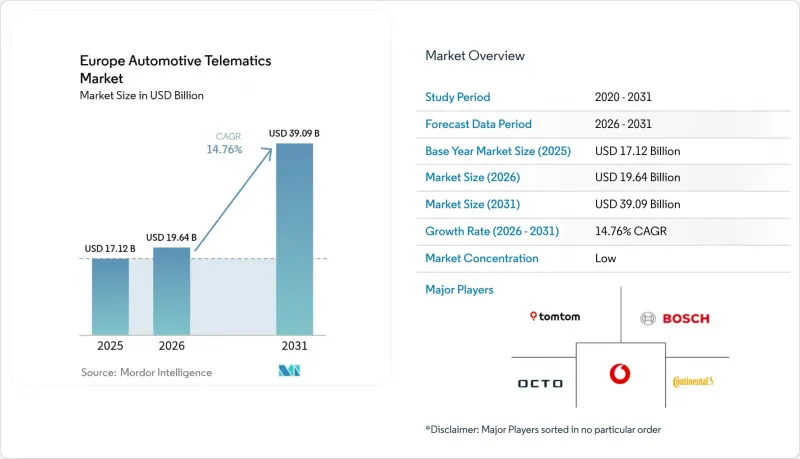
This report is Segmented by Service (Infotainment and Navigation, Fleet Management, Safety and Security, and More), Sales Channel Type (OEM-Fitted and Aftermarket), Connectivity Solution (Embedded, and More), Vehicle Type (Two-Wheelers, and More), End-User (Private Consumers, Fleet Operators, and More), and Country. Market Forecasts are Provided in Terms of Value (USD).
Europe Automotive Telematics Market Trends and Insights
Fleet-Management Digitization Wave
European fleets are increasingly adopting telematics for route optimization, driver scorecarding, and predictive maintenance. These efforts aim to combat fuel theft, minimize downtime, and enhance customer satisfaction. Deployments reveal that predictive maintenance can significantly reduce unplanned stoppages. Additionally, geofencing streamlines proof-of-delivery workflows, helping to accelerate invoicing cycles and improve operational efficiency. A recent survey from a prominent fleet-management platform highlighted that a substantial portion of European fleet managers intend to broaden their telematics usage in the near future. Their motivations include addressing stricter emission regulations and achieving better visibility into the return on investment for electric vehicles. The trend of platform consolidation is becoming more evident, as demonstrated by a technology vendor acquiring a mobility unit to integrate hardware, connectivity, and software into a single contract. This approach simplifies integration processes and significantly reduces the total cost of ownership for fleet buyers, making it a more attractive option for businesses.
5G and V2X Rollout Across Europe
The Connecting Europe Facility has allocated significant funding to equip thousands of kilometers of highways with roadside units. This effort is designed to enable cooperative adaptive cruise control and platooning, which can lead to notable reductions in truck fuel consumption. Key corridors, such as Germany's autobahn and France's A10, are at the forefront of C-V2X implementation. Original Equipment Manufacturers are proactively embedding advanced chipsets from Qualcomm and NXP into upcoming vehicle models to align with anticipated regulatory requirements. In addition to improving safety, the integration of 5G technology, with its low latency capabilities, supports innovative applications like remote-driven shuttle pilots and dynamic speed-limit broadcasts. These advancements further reinforce the rationale for sustained investments in infrastructure development.
GDPR Compliance Cost Inflation
Telematics providers are required to incorporate consent dashboards, implement encryption during data storage and transmission, and maintain extensive audit logs for an extended period, as mandated by the General Data Protection Regulation (GDPR). These legal and technical requirements significantly increase program costs, creating challenges for smaller aftermarket players that often lack the resources or dedicated teams to ensure compliance. Additionally, GDPR complicates and lengthens the commercialization process, as privacy-impact assessments must be conducted before launching any new analytic or monetization initiative. Companies that achieve recognized certifications, such as ISO 27001, and implement real-time consent management systems can appeal to enterprise fleets that prioritize risk mitigation. However, these firms face higher operational costs, which may drive cost-conscious customers to opt for alternatives with less stringent compliance measures.
Other drivers and restraints analyzed in the detailed report include:
- OEM Push for Software-Defined Revenue
- EU eCall and Safety-Mandate Tailwinds
- 2G/3G Sunset Retrofit Burden
For complete list of drivers and restraints, kindly check the Table Of Contents.
Segment Analysis
Fleet management accounted for 36.94% of 2025 service revenue and remains the backbone of the Europe automotive telematics market. The value proposition is concrete: real-time tracking reduces fuel theft, driver coaching prevents accidents, and route optimization shortens delivery windows, collectively enhancing fleet productivity and customer satisfaction. Diagnostics and prognostics are next in line, enabling fleets to transition from reactive to condition-based maintenance, thereby reducing downtime. Safety and security modules benefit from the eCall installed base, yet margins compress as the features become standard.
V2X and OTA services, although smaller today, are the fastest-growing categories, with a 16.95% CAGR. OTA updates enable automakers to introduce new features and security patches throughout a vehicle's life, thereby reducing recall costs and generating recurring revenue. V2X enables cooperative driving and intersection warnings, positioning vehicles as nodes within a larger transportation network. Insurance telematics growth is concentrated in high-penetration markets such as the UK and Italy, where usage-based policies reward safe driving with lower premiums. As services evolve, the Europe automotive telematics market size for OTA modules is expected to surpass that of legacy safety features, underscoring a shift in platform from tracking to continuous software delivery.
OEM-installed telematics represented 79.71% of total 2025 deployments, driven by regulatory mandates and automakers' need to control data footprints. Factory systems integrate deeply with the CAN bus, enabling remote diagnostics and secure OTA firmware updates. This tight integration also safeguards data ownership, a prerequisite for subscription-based service models.
The aftermarket is expanding at 16.48% CAGR, addressing fleets with pre-2018 vehicles and appealing to cost-sensitive consumers who seek insurance discounts without buying new cars. Plug-and-play OBD-II dongles and hard-wired trackers cost roughly one-third of OEM solutions and can be upgraded more quickly. With the phase-out of 2G/3G networks, many legacy aftermarket devices are becoming obsolete, leading to a growing preference for 4G/5G-compatible units. Over time, the market is expected to reach a balance, with original equipment manufacturers dominating a significant share while the aftermarket segment continues to cater to retrofit needs. This trend underscores the interplay between regulatory requirements and the demand for adaptable solutions within the European automotive telematics market.
Complete Report Scope:
- By Service
- Infotainment and Navigation
- Fleet Management
- Safety and Security
- Diagnostics and Prognostics
- Insurance Telematics
- V2X and OTA Updates
- By Sales Channel Type
- OEM-fitted
- Aftermarket
- By Connectivity Solution
- Embedded
- Integrated-smartphone
- Tethered / Portable
- By Vehicle Type
- Two-Wheelers
- Passenger Cars
- Hatchbacks
- Sedans
- Sports Utility Vehicles
- Multi Puropse Vehicles
- Light Commercial Vehicles
- Medium and Heavy Commercial Vehicles
- By End-User
- Private Consumers
- Fleet Operators
- Insurance and Leasing Firms
- Car-Sharing and Mobility Providers
- By Country
- Germany
- United Kingdom
- France
- Italy
- Spain
- Russia
- Rest of Europe
List of Companies Covered in this Report:
- Continental AG
- Robert Bosch GmbH
- TomTom International BV. (Webfleet Solutions)
- Octo Group S.p.A
- Targa Telematics
- Vodafone Automotive
- Harman International
- Verizon Connect
- MiX Telematics
- CalAmp Corp.
- Teltonika Telematics
- Ruptela UAB
- Visteon Corporation
- Aptiv
- ACTIA Group
Additional Benefits:
- The market estimate (ME) sheet in Excel format
- 3 months of analyst support
TABLE OF CONTENTS
1 Introduction
- 1.1 Study Assumptions and Market Definition
- 1.2 Scope of the Study
2 Research Methodology
3 Executive Summary
4 Market Landscape
- 4.1 Market Overview
- 4.2 Market Drivers
- 4.2.1 EU ecall and Safety-Mandate Tailwinds
- 4.2.2 Fleet-Management Digitization Wave
- 4.2.3 Infotainment and Navigation Demand Surge
- 4.2.4 5G and V2X Rollout Across Europe
- 4.2.5 ESG-Linked CO2 Reporting Requirements
- 4.2.6 OEM Push for Software-Defined Revenue
- 4.3 Market Restraints
- 4.3.1 GDPR Compliance Cost Inflation
- 4.3.2 High Embedded-Hardware BOM in Small Cars
- 4.3.3 Fragmented OEM Data Schemas
- 4.3.4 2G/3G Sunset Retrofit Burden
- 4.4 Value / Supply-Chain Analysis
- 4.5 Regulatory Landscape
- 4.6 Technological Outlook
- 4.7 Porter's Five Forces
- 4.7.1 Bargaining Power of Suppliers
- 4.7.2 Bargaining Power of Buyers
- 4.7.3 Threat of New Entrants
- 4.7.4 Threat of Substitutes
- 4.7.5 Industry Rivalry
5 Market Size and Growth Forecasts (Value, USD)
- 5.1 By Service
- 5.1.1 Infotainment and Navigation
- 5.1.2 Fleet Management
- 5.1.3 Safety and Security
- 5.1.4 Diagnostics and Prognostics
- 5.1.5 Insurance Telematics
- 5.1.6 V2X and OTA Updates
- 5.2 By Sales Channel Type
- 5.2.1 OEM-fitted
- 5.2.2 Aftermarket
- 5.3 By Connectivity Solution
- 5.3.1 Embedded
- 5.3.2 Integrated-smartphone
- 5.3.3 Tethered / Portable
- 5.4 By Vehicle Type
- 5.4.1 Two-Wheelers
- 5.4.2 Passenger Cars
- 5.4.2.1 Hatchbacks
- 5.4.2.2 Sedans
- 5.4.2.3 Sports Utility Vehicles
- 5.4.2.4 Multi Puropse Vehicles
- 5.4.3 Light Commercial Vehicles
- 5.4.4 Medium and Heavy Commercial Vehicles
- 5.5 By End-User
- 5.5.1 Private Consumers
- 5.5.2 Fleet Operators
- 5.5.3 Insurance and Leasing Firms
- 5.5.4 Car-Sharing and Mobility Providers
- 5.6 By Country
- 5.6.1 Germany
- 5.6.2 United Kingdom
- 5.6.3 France
- 5.6.4 Italy
- 5.6.5 Spain
- 5.6.6 Russia
- 5.6.7 Rest of Europe
6 Competitive Landscape
- 6.1 Market Concentration
- 6.2 Strategic Moves
- 6.3 Market Share Analysis
- 6.4 Company Profiles (Includes Global level Overview, Market level overview, Core Segments, Financials as available, Strategic Information, Market Rank/Share for key companies, Products & Services, and Recent Developments)
- 6.4.1 Continental AG
- 6.4.2 Robert Bosch GmbH
- 6.4.3 TomTom International BV. (Webfleet Solutions)
- 6.4.4 Octo Group S.p.A
- 6.4.5 Targa Telematics
- 6.4.6 Vodafone Automotive
- 6.4.7 Harman International
- 6.4.8 Verizon Connect
- 6.4.9 MiX Telematics
- 6.4.10 CalAmp Corp.
- 6.4.11 Teltonika Telematics
- 6.4.12 Ruptela UAB
- 6.4.13 Visteon Corporation
- 6.4.14 Aptiv
- 6.4.15 ACTIA Group
7 Market Opportunities & Future Outlook

