PUBLISHER: Mordor Intelligence | PRODUCT CODE: 2124237

PUBLISHER: Mordor Intelligence | PRODUCT CODE: 2124237
APAC Telematics - Market Share Analysis, Industry Trends & Statistics, Growth Forecasts (2026 - 2031)
According to Mordor Intelligence, the APAC telematics market size was valued at USD 18.70 billion in 2025 and estimated to grow from USD 20.54 billion in 2026 to reach USD 32.79 billion by 2031, at a CAGR of 9.82% during the forecast period (2026-2031).
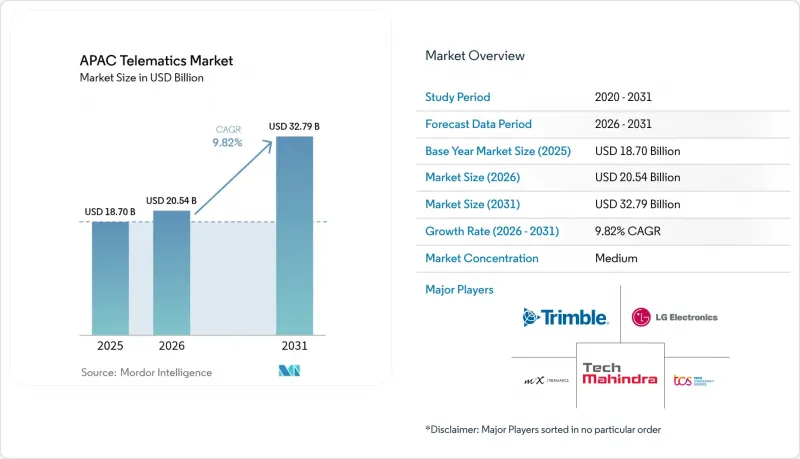
This report is Segmented by Vehicle Type (Light Commercial Vehicles, Medium and Heavy Commercial Vehicles), Channel (OEM-Embedded, Aftermarket Hard-Wired, Aftermarket OBD-II Dongle), Service Type (Fleet/Asset Tracking, Navigation and Infotainment, and More), Communication Technology (GNSS/GPS, Cellular, and More), and Country. The Market Forecasts are Provided in Terms of Value (USD).
APAC Telematics Market Trends and Insights
Proliferation of OEM-installed connectivity modules
Factory-fitted telematics units are increasingly standard across new commercial vehicles as attach rates rise toward 94% by 2028. Chinese manufacturers collaborate with domestic mobile-network operators to integrate embedded SIMs, while Japanese OEMs layer Android Automotive OS to deliver cloud-native services. The shift simplifies regulatory compliance, enables over-the-air software updates, and supports predictive maintenance that cuts unplanned downtime. Aftermarket vendors face pricing pressure as fleets favor deeper vehicle-bus integration that only embedded hardware can provide.
Regulatory mandates on AIS-140 and eCall
India's transport ministry requires GPS tracking and panic buttons under AIS-140 for all commercial vehicles, and from April 2026, will extend emergency braking and drowsiness warnings to larger passenger vehicles. Japan and South Korea have rolled out eCall, driving uniform emergency-response capabilities. This convergence allows platform vendors to scale compliance solutions region-wide, though varying technical formats still demand modular software architectures.
Cyber-security and data-privacy concerns
Fleet operators worry about remote hacking and unauthorized access to location or CAN bus data. Several APAC governments enforce strict rules on data localization and impose penalties for breaches, raising compliance budgets. Hardware vendors now integrate root-of-trust chips and collaborate with telecom carriers to deploy end-to-end encryption. Managed security operations center services are also emerging to monitor anomalies and coordinate rapid patching .
Other drivers and restraints analyzed in the detailed report include:
- Rising demand for usage-based insurance (UBI)
- Growth of e-commerce last-mile fleets
- Semiconductor supply-chain volatility post-2025
For complete list of drivers and restraints, kindly check the Table Of Contents.
Segment Analysis
Medium and Heavy Commercial Vehicles account for the fastest expansion at 10.41% CAGR to 2031, whereas Light Commercial Vehicles held 53.58% of the APAC telematics market share in 2025. The higher average revenue per installed unit on long-haul trucks comes from advanced fuel analytics, brake-wear prediction, and compliance modules that reduce costly roadside inspections. Conversely, LCV operators prioritize low-cost GPS tracking to safeguard parcels and streamline urban drops. Regulatory momentum, such as India's incoming ADAS rules for buses and trucks, further lifts M/HCV penetration. Platform consolidation, evident in Platform Science's 2025 acquisition of Trimble's fleet unit, signals that integrated offerings spanning ELD compliance and battery-health dashboards will dominate future growth.
M/HCV electrification projects necessitate concurrent telematics deployment to extend driving range and optimize charging windows. LCV fleet managers, pressed by e-commerce service-level agreements, adopt camera-based driver-behavior analytics to cut accident rates. Although the overall installed-base majority remains within LCVs, revenue share tilts toward M/HCVs because of feature-rich solutions bundled with subscription analytics platforms. The segment interplay, therefore, shapes differentiated go-to-market strategies for hardware OEMs and platform providers.
OEM-embedded units retained 41.89% revenue share in 2025, yet Aftermarket OBD-II dongles are on pace for 10.02% CAGR. Cost-conscious fleets value the ease of self-installation and the ability to switch vendors without forfeiting warranties. In contrast, embedded modules offer deeper vehicle-bus integration that supports over-the-air firmware downloads and factory-grade diagnostics. OEMs increasingly open APIs to third-party software platforms, narrowing the historical gap in flexibility and encouraging hybrid deployment models.
Certified aftermarket devices remain pivotal for retrofitting older assets and meeting AIS-140 in India. Hard-wired black boxes serve fleets demanding tamper-proof records or satellite fallback. Cloud-native telematics vendors bridge the channel divide by delivering a unified dashboard that ingests both embedded and aftermarket data streams. As 5G modems become standard from 2026 onward, vendors expect hardware refresh cycles to accelerate, allowing capex-light subscription bundles to spur adoption among small operators.
Complete Report Scope:
- By Vehicle Type
- Light Commercial Vehicles (LCV)
- Medium and Heavy Commercial Vehicles (M/HCV)
- By Channel
- OEM-embedded
- Aftermarket Hard-wired
- Aftermarket OBD-II Dongle
- By Service Type
- Fleet/Asset Tracking
- Navigation and Infotainment
- Remote Diagnostics
- Safety and Security (eCall, SVR)
- Insurance Telematics (UBI/PAYD)
- By Communication Technology
- GNSS/GPS
- Cellular (2G/3G/4G/5G)
- Satellite-based
- DSRC/C-V2X
- By Country
- China
- Japan
- South Korea
- India
- Australia and New Zealand
- South-East Asia (Indonesia, Thailand, Malaysia, Singapore, Vietnam, Philippines)
List of Companies Covered in this Report:
- LG Electronics Inc.
- Tata Consultancy Services Limited (TCS)
- MiX Telematics India Private Limited (Powerfleet)
- Trimble Inc.
- Tech Mahindra Limited
- Octo Telematics Ltd.
- Meitrack Group
- Concox (Shenzhen Jimi IoT Co., Ltd.)
- Arya Omnitalk Wireless Solutions Private Limited
- Asia Mobiliti Sdn. Bhd.
- Efkon India Private Limited
- Geotab Inc.
- CalAmp Corp.
- SinoTrack Group Limited
- Teltonika IoT Group
- Bosch Mobility Platform and Solutions India Private Limited
- Harman International Industries, Inc.
Additional Benefits:
- The market estimate (ME) sheet in Excel format
- 3 months of analyst support
TABLE OF CONTENTS
1 INTRODUCTION
- 1.1 Study Assumptions and Market Definition
- 1.2 Scope of the Study
2 RESEARCH METHODOLOGY
3 EXECUTIVE SUMMARY
4 MARKET LANDSCAPE
- 4.1 Market Overview
- 4.2 Market Drivers
- 4.2.1 Proliferation of OEM-installed connectivity modules
- 4.2.2 Regulatory mandates on AIS-140 and eCall
- 4.2.3 Rising demand for usage-based insurance (UBI)
- 4.2.4 Growth of e-commerce last-mile fleets
- 4.2.5 Smart-city ITS pilots driving data partnerships
- 4.2.6 OEM-fintech leasing models bundling telematics
- 4.3 Market Restraints
- 4.3.1 Cyber-security and data-privacy concerns
- 4.3.2 High upfront hardware/communication cost
- 4.3.3 Fragmented interoperability standards
- 4.3.4 Semiconductor supply-chain volatility post-2025
- 4.4 Value Chain Analysis
- 4.5 Regulatory Landscape
- 4.6 Technological Outlook
- 4.7 Impact of Macroeconomic Factors on the Industry
- 4.8 Porter's Five Forces Analysis
- 4.8.1 Bargaining Power of Suppliers
- 4.8.2 Bargaining Power of Consumers
- 4.8.3 Threat of New Entrants
- 4.8.4 Threat of Substitutes
- 4.8.5 Intensity of Competitive Rivalry
5 MARKET SIZE AND GROWTH FORECASTS (VALUE)
- 5.1 By Vehicle Type
- 5.1.1 Light Commercial Vehicles (LCV)
- 5.1.2 Medium and Heavy Commercial Vehicles (M/HCV)
- 5.2 By Channel
- 5.2.1 OEM-embedded
- 5.2.2 Aftermarket Hard-wired
- 5.2.3 Aftermarket OBD-II Dongle
- 5.3 By Service Type
- 5.3.1 Fleet/Asset Tracking
- 5.3.2 Navigation and Infotainment
- 5.3.3 Remote Diagnostics
- 5.3.4 Safety and Security (eCall, SVR)
- 5.3.5 Insurance Telematics (UBI/PAYD)
- 5.4 By Communication Technology
- 5.4.1 GNSS/GPS
- 5.4.2 Cellular (2G/3G/4G/5G)
- 5.4.3 Satellite-based
- 5.4.4 DSRC/C-V2X
- 5.5 By Country
- 5.5.1 China
- 5.5.2 Japan
- 5.5.3 South Korea
- 5.5.4 India
- 5.5.5 Australia and New Zealand
- 5.5.6 South-East Asia (Indonesia, Thailand, Malaysia, Singapore, Vietnam, Philippines)
6 COMPETITIVE LANDSCAPE
- 6.1 Market Concentration
- 6.2 Strategic Moves
- 6.3 Market Share Analysis
- 6.4 Company Profiles (includes Global level Overview, Market level overview, Core Segments, Financials as available, Strategic Information, Market Rank/Share for key companies, Products and Services, and Recent Developments)
- 6.4.1 LG Electronics Inc.
- 6.4.2 Tata Consultancy Services Limited (TCS)
- 6.4.3 MiX Telematics India Private Limited (Powerfleet)
- 6.4.4 Trimble Inc.
- 6.4.5 Tech Mahindra Limited
- 6.4.6 Octo Telematics Ltd.
- 6.4.7 Meitrack Group
- 6.4.8 Concox (Shenzhen Jimi IoT Co., Ltd.)
- 6.4.9 Arya Omnitalk Wireless Solutions Private Limited
- 6.4.10 Asia Mobiliti Sdn. Bhd.
- 6.4.11 Efkon India Private Limited
- 6.4.12 Geotab Inc.
- 6.4.13 CalAmp Corp.
- 6.4.14 SinoTrack Group Limited
- 6.4.15 Teltonika IoT Group
- 6.4.16 Bosch Mobility Platform and Solutions India Private Limited
- 6.4.17 Harman International Industries, Inc.
7 MARKET OPPORTUNITIES AND FUTURE OUTLOOK
- 7.1 White-space and Unmet-need Assessment

