PUBLISHER: Mordor Intelligence | PRODUCT CODE: 2115833

PUBLISHER: Mordor Intelligence | PRODUCT CODE: 2115833
Europe Automotive Glass - Market Share Analysis, Industry Trends & Statistics, Growth Forecasts (2026 - 2031)
According to Mordor Intelligence, the european automotive glass market size was valued at USD 7.02 billion in 2025 and estimated to grow from USD 7.38 billion in 2026 to reach USD 9.49 billion by 2031, at a CAGR of 5.16% during the forecast period (2026-2031).
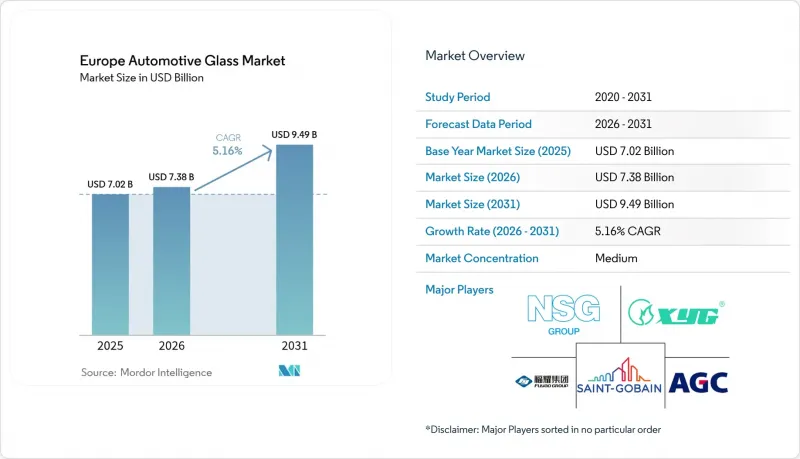
This report is Segmented by Glass Type (Regular Glass and Smart Glass), Application (Windshield, Backlite, and More), Vehicle Type (Passenger Cars, and More), Propulsion (Internal Combustion Engine (ICE) and More), Sales Channel (Original Equipment Manufacturer (OEM) and Aftermarket), and Geography (Germany, UK, France, and More). Market Forecasts are Provided in Terms of Value (USD).
Europe Automotive Glass Market Trends and Insights
Rapid Adoption of Panoramic Sunroofs and Larger Glazing Areas in European Sport Utility Vehicle and Crossover Launches
Sport utility vehicle (SUV) and crossover launches increasingly specify roof glass that enlarges perceived cabin space and commands premium option pricing. OEMs in Germany, France, and the United Kingdom saw compact and mid-size SUVs lead the new-registration mix. Larger apertures lift interior heat gain, pushing suppliers toward multi-layer laminates with infrared-absorbing PVB to manage solar load. The additional area also necessitates stiffer roof frames, creating design collaboration between glassmakers and body engineers. Switchable polymer-dispersed-liquid-crystal (PDLC) panels are migrating from luxury nameplates into upper-mid trims as material prices fall. Over the medium term, panoramic glass roofs are expected to feature solar cells that trickle-charge accessory batteries, further increasing surface value per vehicle.
EU Vehicle Safety Regulations Mandating Advanced Laminated and HUD-Ready Windshields
UN Regulation No. 43 requires laminated windshields across all categories to reduce occupant ejection risk, while Euro NCAP's 2025 roadmap offers additional safety points for embedded HUD capability. These rules compress development cycles and favor suppliers that can co-engineer interlayers supporting camera mounts and reflective coatings. OEM engineering teams are incorporating windshield curvature tolerances tighter than 0.2 mm to maintain optical clarity for forward-looking sensors. The mandates also increase replacement complexity in the aftermarket, reinforcing design-in advantages for tier-one producers equipped with in-house validation labs. As sensor suites proliferate, HUD-ready glass is poised to become the baseline on most C-segment vehicles by 2030.
High Production and Integration Cost of Smart/Advanced Glazing Limiting Penetration in Mass-Market Segments
Electrochromic and SPD systems add approximately EUR 300-800 (USD 353 to 941.5) per vehicle, a delta that mass-market OEMs struggle to offset when competing on price. Organic electrochromic films promise simpler stacks yet face hermetic-sealing challenges that depress yield. Volume brands in Poland, Spain, and Italy prioritize cost-down programs, limiting deployment to flagship trims. The restraint moderates diffusion speed even as consumer awareness grows, keeping penetration below outside premium segments through 2027. Long-term, scale and material breakthroughs must cut costs to unlock high-volume platforms.
Other drivers and restraints analyzed in the detailed report include:
- Accelerating OEM Integration of Smart/Electrochromic Glass for Energy Efficiency and Occupant Comfort
- Lightweight Acoustic Glazing Demand Driven by EV Range Optimization Targets
- Skills Shortage for ADAS Windshield Calibration in Aftermarket Service Networks
For complete list of drivers and restraints, kindly check the Table Of Contents.
Segment Analysis
Regular laminated and tempered variants commanded 60.85% revenue in 2025, driven by their use in windshields, backlites, and sidelites where proven durability and cost efficiency prevail. UN Regulation No. 43 mandates laminated windshields, keeping baseline demand high and supporting the Europe automotive glass market size predictability. Tempered glass continues as standard for sidelites and backlites; its rapid disintegration upon impact aids passenger egress and simplifies recycling streams. Smart glass, however, is accelerating at a 6.03% CAGR as electrochromic, SPD, and PDLC technologies migrate from luxury concepts into series production.
Electrochromic solutions lead the smart subset by volume and are widely favored for precise tint control and low power draw. These stacks employ tungsten-oxide or lithium-ion layers that darken under applied voltage, offering step-less modulation within one percent increments. SPD films align suspended particles to enable transparency when energized, delivering faster switching but requiring continuous power. PDLC is gaining traction for privacy windows in luxury MPVs and ride-sharing shuttles. The European automotive glass market continues to reward suppliers who can integrate smart layers without sacrificing optical clarity or acoustic damping.
Windshields held 46.55% revenue in 2025 because of their size and the embedded technology stack that now includes cameras, infrared heating meshes, and HUD projection foils. Euro NCAP's 2025 protocol awards points for HUD functions, reinforcing OEM preference for laminated surfaces able to maintain optical transmittance at defined refractive indices. Aftermarket replacement can cost significantly for ADAS-equipped panes, expanding revenue potential beyond first fit. Sunroofs are projected to grow at a 5.62% CAGR as automakers differentiate trims with expansive glass that improves perceived cabin space. Modules integrating switchable PDLC and solar cells can harvest up to 150 W under peak irradiance, contributing to accessory loads and boosting the European automotive glass market share for roof applications.
Backlites and sidelites, accounting for roughly one-third of volume, are transitioning from tempered to laminated construction to meet rising acoustic and security expectations. Electrified drivetrains reveal new noise sources, making acoustic sidelites a potent refinement tool. Mirrors, although small in area, now incorporate electrochromic dimming and camera feeds, capitalizing on UN Regulation No. 46's allowance for virtual mirrors UNECE. Quarter and vent panels remain commodity items yet benefit from adoption of laminated quiet-zone glass in premium SUVs. Across all applications, the Europe automotive glass market rewards multi-function designs that couple coatings, sensors, and electronics into a single pane.
Complete Report Scope:
- By Glass Type
- Regular Glass
- Laminated Glass
- Tempered Glass
- Smart Glass
- Electrochromic
- Suspended Particle Device (SPD)
- Polymer Dispersed Liquid Crystal (PDLC)
- Thermochromic
- Regular Glass
- By Application
- Windshield
- Backlite (Rear Window)
- Sidelite (Side Windows)
- Sunroof
- Rear-view and Side-view Mirrors
- Other Glazing (Quarter and Vent)
- By Vehicle Type
- Passenger Cars
- Hatchback
- Sedan
- Sport Utility Vehicle and Crossover
- Luxury and Sports
- Light Commercial Vehicles
- Medium and Heavy Commercial Vehicles
- Passenger Cars
- By Propulsion
- Internal Combustion Engine (ICE)
- Battery Electric Vehicle (BEV)
- Hybrid Electric Vehicle (HEV/PHEV)
- Fuel Cell Electric Vehicle (FCEV)
- By Sales Channel
- Original Equipment Manufacturer (OEM)
- Aftermarket
- By Country
- Germany
- United Kingdom
- France
- Italy
- Spain
- Rest of Europe
List of Companies Covered in this Report:
- Saint-Gobain Sekurit
- AGC Inc. (Asahi Glass)
- NSG Group (Pilkington)
- Fuyao Glass Industry Group Co., Ltd.
- Guardian Industries (PPG/Koch)
- Webasto SE
- Inalfa Roof Systems Group B.V.
- CIE Automotive
- Magna International Inc.
- Gentex Corporation
- Inteva Products
- Xinyi Glass Holdings Ltd.
- Vitro Automotive
- Sisecam Group
- Corning Incorporated
- Covestro AG
- Teijin Limited
- Smartglass International
- Gauzy Ltd.
Additional Benefits:
- The market estimate (ME) sheet in Excel format
- 3 months of analyst support
TABLE OF CONTENTS
1 Introduction
- 1.1 Study Assumptions and Market Definition
- 1.2 Scope of the Study
2 Research Methodology
3 Executive Summary
4 Market Landscape
- 4.1 Market Overview
- 4.2 Market Drivers
- 4.2.1 Rapid Adoption of Panoramic Sunroofs and Larger Glazing Areas in European SUV and Crossover Launches
- 4.2.2 EU Vehicle Safety Regulations Mandating Advanced Laminated and HUD-Ready Windshields
- 4.2.3 Accelerating OEM Integration of Smart/Electrochromic Glass for Energy Efficiency and Occupant Comfort
- 4.2.4 Lightweight Acoustic Glazing Demand Driven by EV Range Optimization Targets
- 4.2.5 Supply-Chain Localization Incentives in Eastern Europe Reducing Lead-Time and Cost for OEM Glass Sourcing
- 4.2.6 Automotive Circular-Economy Mandates Pushing Recycled, Low-Carbon Glass Innovation
- 4.3 Market Restraints
- 4.3.1 High Production and Integration Cost of Smart/Advanced Glazing Limiting Penetration in Mass-Market Segments
- 4.3.2 Skills Shortage for ADAS Windshield Calibration in Aftermarket Service Networks
- 4.3.3 Volatility in Soda Ash and Energy Prices Impacting European Float-Glass Profitability
- 4.3.4 Stringent Europe End-of-Life Recycling Targets Raising Compliance Costs for Laminated Glass Recovery
- 4.4 Value / Supply-Chain Analysis
- 4.5 Regulatory Landscape
- 4.6 Technological Outlook
- 4.7 Porter's Five Forces
- 4.7.1 Threat of New Entrants
- 4.7.2 Bargaining Power of Suppliers
- 4.7.3 Bargaining Power of Buyers
- 4.7.4 Threat of Substitutes
- 4.7.5 Competitive Rivalry
5 Market Size and Growth Forecasts
- 5.1 By Glass Type
- 5.1.1 Regular Glass
- 5.1.1.1 Laminated Glass
- 5.1.1.2 Tempered Glass
- 5.1.2 Smart Glass
- 5.1.2.1 Electrochromic
- 5.1.2.2 Suspended Particle Device (SPD)
- 5.1.2.3 Polymer Dispersed Liquid Crystal (PDLC)
- 5.1.2.4 Thermochromic
- 5.1.1 Regular Glass
- 5.2 By Application
- 5.2.1 Windshield
- 5.2.2 Backlite (Rear Window)
- 5.2.3 Sidelite (Side Windows)
- 5.2.4 Sunroof
- 5.2.5 Rear-view and Side-view Mirrors
- 5.2.6 Other Glazing (Quarter and Vent)
- 5.3 By Vehicle Type
- 5.3.1 Passenger Cars
- 5.3.1.1 Hatchback
- 5.3.1.2 Sedan
- 5.3.1.3 Sport Utility Vehicle and Crossover
- 5.3.1.4 Luxury and Sports
- 5.3.2 Light Commercial Vehicles
- 5.3.3 Medium and Heavy Commercial Vehicles
- 5.3.1 Passenger Cars
- 5.4 By Propulsion
- 5.4.1 Internal Combustion Engine (ICE)
- 5.4.2 Battery Electric Vehicle (BEV)
- 5.4.3 Hybrid Electric Vehicle (HEV/PHEV)
- 5.4.4 Fuel Cell Electric Vehicle (FCEV)
- 5.5 By Sales Channel
- 5.5.1 Original Equipment Manufacturer (OEM)
- 5.5.2 Aftermarket
- 5.6 By Country
- 5.6.1 Germany
- 5.6.2 United Kingdom
- 5.6.3 France
- 5.6.4 Italy
- 5.6.5 Spain
- 5.6.6 Rest of Europe
6 Competitive Landscape
- 6.1 Market Concentration
- 6.2 Strategic Moves
- 6.3 Market Share Analysis
- 6.4 Company Profiles (Includes Global level Overview, Market level overview, Core Segments, Financials as available, Strategic Information, Market Rank/Share for key companies, Products and Services, and Recent Developments)
- 6.4.1 Saint-Gobain Sekurit
- 6.4.2 AGC Inc. (Asahi Glass)
- 6.4.3 NSG Group (Pilkington)
- 6.4.4 Fuyao Glass Industry Group Co., Ltd.
- 6.4.5 Guardian Industries (PPG/Koch)
- 6.4.6 Webasto SE
- 6.4.7 Inalfa Roof Systems Group B.V.
- 6.4.8 CIE Automotive
- 6.4.9 Magna International Inc.
- 6.4.10 Gentex Corporation
- 6.4.11 Inteva Products
- 6.4.12 Xinyi Glass Holdings Ltd.
- 6.4.13 Vitro Automotive
- 6.4.14 Sisecam Group
- 6.4.15 Corning Incorporated
- 6.4.16 Covestro AG
- 6.4.17 Teijin Limited
- 6.4.18 Smartglass International
- 6.4.19 Gauzy Ltd.
7 Market Opportunities and Future Outlook
- 7.1 White-space and Unmet-need Assessment

