PUBLISHER: Mordor Intelligence | PRODUCT CODE: 2115834

PUBLISHER: Mordor Intelligence | PRODUCT CODE: 2115834
North America Automotive Glass - Market Share Analysis, Industry Trends & Statistics, Growth Forecasts (2026 - 2031)
According to Mordor Intelligence, the North America automotive glass market size is expected to grow from USD 6.26 billion in 2025 to USD 6.69 billion in 2026 and is forecast to reach USD 9.32 billion by 2031 at 6.85% CAGR over 2026-2031.
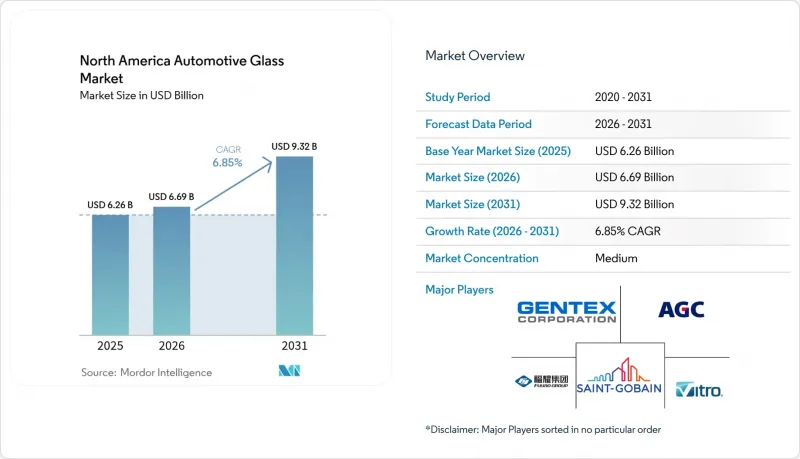
This report is Segmented by Type (Laminated Glass, Tempered Glass, and More), Application (Windshield, Sidelite, and More), Sales Channel (OEM and Aftermarket (Replacement and Calibration)), Vehicle Type (Passenger Cars, Light Commercial Vehicles, and More), and Country (United States, Canada, and More). The Market Forecasts are Provided in Terms of Value (USD).
North America Automotive Glass Market Trends and Insights
Rapid adoption of smart/switchable glass in premium trims
Electrochromic sunroofs, dimmable sidelites, and in-glass displays are crossing from luxury badges into upper-mid trims as OEMs seek cabin differentiation. Gentex ships more than 50 million dimmable devices annually, demonstrating manufacturing maturity that lowers cost barriers. Film-based electrochromic stacks trim weight compared with traditional glass-glass cell construction, aligning smart glazing with EV range targets. Added digital layers accommodate heads-up images and driver-monitoring sensors, letting manufacturers bundle safety and infotainment. As regulatory bodies encourage driver-monitoring technology, smart glass adoption rises in parallel, strengthening the North America automotive glass market.
Bundled ADAS recalibration services boosting replacement demand
Camera-based systems mounted on windshields must be recalibrated after glass replacement, turning a once-simple job into an electronics service visit. Insurers now require certified procedures, raising the skill floor for technicians and allowing chains that own calibration equipment to charge premiums. Windshield units grow in billable complexity, and complementary sensor modules on sidelites are also entering the aftermarket mix. The heightened technical barrier lifts revenue per job and helps sustain the North America automotive glass market beyond natural vehicle parc growth.
Volatility in soda ash, PVB, and EVA interlayer prices
Sekisui Chemical raised PVB prices by 6-15% in late 2024, citing energy and logistics inflation. Sisecam's acquisition of Ciner Group's U.S. soda-ash assets concentrates supply at a time when demand is rising toward 83 million tons by 2030. Limited natural soda-ash mines and a small group of global PVB producers give upstream vendors pricing power, squeezing float margins and forcing processors to hedge or vertically integrate. Sudden cost spikes erode profitability across the North America automotive glass market when price pass-throughs lag.
Other drivers and restraints analyzed in the detailed report include:
- Rising light-vehicle production across North America
- Electrification push favoring lightweight laminated glazing
- High incremental cost of smart and coated glass solutions
For complete list of drivers and restraints, kindly check the Table Of Contents.
Segment Analysis
Laminated glazing generated 56.78% of 2025 revenue in the North America automotive glass market, anchored by its indispensable role in windshields and the growing use of laminated sidelites for security and acoustic comfort. Smart or switchable glass leads to growth with an 8.28% CAGR as electrochromic sunroofs migrate into broader vehicle lines. Tempered panes, once dominant for cost reasons, are slowly being displaced in non-critical areas as manufacturers chase mass savings and higher thermal performance. Coated glass segments expand in parallel, propelled by EV programs that demand low solar heat gain to protect battery range.
Continuous innovation underpins segment momentum. Gentex's film-based approach trims thickness while enabling large geometric freedom for roof modules. Integrated display technology merges glare control with infotainment, opening new revenue pools for glass makers. Laminated constructions now embed multiple interlayers-acoustic, solar, and structural-demonstrating how a single part can satisfy safety, comfort, and energy efficiency. As technology complexity climbs, suppliers with chemistry, coating, and electronics capabilities deepen their hold on the North America automotive glass market.
Windshields retained a 48.10% share of the North America automotive glass market in 2025, supported by mandatory fitment and strict impact regulations. Sunroof and rooflite modules, however, clock the fastest 7.62% CAGR through 2031 as panoramic roofs become a mainstream styling element. Laminated roof panels integrate electrochromic dimming, UV filtration, and heating grids, enhancing the cabin experience without adding opaque shades.
Sidelites transition from tempered to laminated formats in higher trims, providing burglary resistance and quieter cabins-attributes prized in near-silent EVs. Backlites remain stable in volume, yet see incremental smart features like integrated antennas and defog lines evolve. Exterior mirror glass migrates toward camera-based e-mirrors, reshaping the hardware stack but still relying on precision-polished substrates. Larger apertures and multi-functional coatings raise the engineering bar and reinforce OEM dependency on experienced glazing partners within the North America automotive glass market.
Complete Report Scope:
- By Type
- Laminated Glass
- Tempered Glass
- Coated and Solar-Control Glass
- Smart/Switchable Glass
- By Application
- Windshield
- Sidelite
- Backlite
- Sunroof/Rooflite
- Rear-view and Exterior Mirrors
- By Sales Channel
- OEM
- Aftermarket (Replacement and Calibration)
- By Vehicle Type
- Passenger Cars
- Hatchback
- Sedan
- Sport Utility Vehicle
- Multi-purpose Vehicle
- Light Commercial Vehicles
- Medium and Heavy Commercial Vehicles
- Passenger Cars
- By Country
- United States
- Canada
- Rest of North America
List of Companies Covered in this Report:
- AGC Inc.
- Saint-Gobain Sekurit
- Fuyao Glass Industry Group Co., Ltd.
- NSG Group/Pilkington
- Gentex Corporation
- Vitro S.A.B. de C.V.
- Samvardhana Motherson (SMR)
- Xinyi Glass Holdings Ltd.
- Webasto SE
- Magna International Inc.
- Guardian Industries
- PPG Industries Inc.
- Corning Incorporated
Additional Benefits:
- The market estimate (ME) sheet in Excel format
- 3 months of analyst support
TABLE OF CONTENTS
1 Introduction
- 1.1 Study Assumptions & Market Definition
- 1.2 Scope of the Study
2 Research Methodology
3 Executive Summary
4 Market Landscape
- 4.1 Market Overview
- 4.2 Market Drivers
- 4.2.1 Rapid adoption of smart/switchable glass in premium trims
- 4.2.2 Bundled ADAS recalibration services boosting replacement demand
- 4.2.3 Rising light-vehicle production across North America
- 4.2.4 Electrification push favouring lightweight laminated glazing
- 4.2.5 OEM near-shoring of glass supply to cut Asia risk
- 4.2.6 Stringent FMVSS and Transport Canada glazing safety regulations
- 4.3 Market Restraints
- 4.3.1 Volatility in soda ash, PVB, and EVA interlayer prices
- 4.3.2 High incremental cost of smart and coated glass solutions
- 4.3.3 Capacity constraints in low-iron float lines (under-radar)
- 4.3.4 Insurance-driven preference for low-cost aftermarket glass
- 4.4 Value / Supply-Chain Analysis
- 4.5 Regulatory Landscape
- 4.6 Technological Outlook
- 4.7 Porter's Five Forces Analysis
- 4.7.1 Threat of New Entrants
- 4.7.2 Bargaining Power of Buyers/Consumers
- 4.7.3 Bargaining Power of Suppliers
- 4.7.4 Threat of Substitute Products
- 4.7.5 Intensity of Competitive Rivalry
5 Market Size & Growth Forecasts (Value in USD)
- 5.1 By Type
- 5.1.1 Laminated Glass
- 5.1.2 Tempered Glass
- 5.1.3 Coated and Solar-Control Glass
- 5.1.4 Smart/Switchable Glass
- 5.2 By Application
- 5.2.1 Windshield
- 5.2.2 Sidelite
- 5.2.3 Backlite
- 5.2.4 Sunroof/Rooflite
- 5.2.5 Rear-view and Exterior Mirrors
- 5.3 By Sales Channel
- 5.3.1 OEM
- 5.3.2 Aftermarket (Replacement and Calibration)
- 5.4 By Vehicle Type
- 5.4.1 Passenger Cars
- 5.4.1.1 Hatchback
- 5.4.1.2 Sedan
- 5.4.1.3 Sport Utility Vehicle
- 5.4.1.4 Multi-purpose Vehicle
- 5.4.2 Light Commercial Vehicles
- 5.4.3 Medium and Heavy Commercial Vehicles
- 5.4.1 Passenger Cars
- 5.5 By Country
- 5.5.1 United States
- 5.5.2 Canada
- 5.5.3 Rest of North America
6 Competitive Landscape
- 6.1 Market Concentration
- 6.2 Strategic Moves
- 6.3 Market Share Analysis
- 6.4 Company Profiles (Includes Global Level Overview, Market Level Overview, Core Segments, Financials as Available, Strategic Information, Market Rank/Share for Key Companies, Products and Services, SWOT Analysis, and Recent Developments)
- 6.4.1 AGC Inc.
- 6.4.2 Saint-Gobain Sekurit
- 6.4.3 Fuyao Glass Industry Group Co., Ltd.
- 6.4.4 NSG Group/Pilkington
- 6.4.5 Gentex Corporation
- 6.4.6 Vitro S.A.B. de C.V.
- 6.4.7 Samvardhana Motherson (SMR)
- 6.4.8 Xinyi Glass Holdings Ltd.
- 6.4.9 Webasto SE
- 6.4.10 Magna International Inc.
- 6.4.11 Guardian Industries
- 6.4.12 PPG Industries Inc.
- 6.4.13 Corning Incorporated
7 Market Opportunities & Future Outlook
- 7.1 White-space & Unmet-need Assessment

