PUBLISHER: Mordor Intelligence | PRODUCT CODE: 2115839

PUBLISHER: Mordor Intelligence | PRODUCT CODE: 2115839
Europe Mild Hybrid Vehicles - Market Share Analysis, Industry Trends & Statistics, Growth Forecasts (2026 - 2031)
According to Mordor Intelligence, the european mild hybrid vehicles market size stood at USD 102.36 billion in 2026 and is projected to reach USD 134.47 billion by 2031, expanding at a 5.63% CAGR.
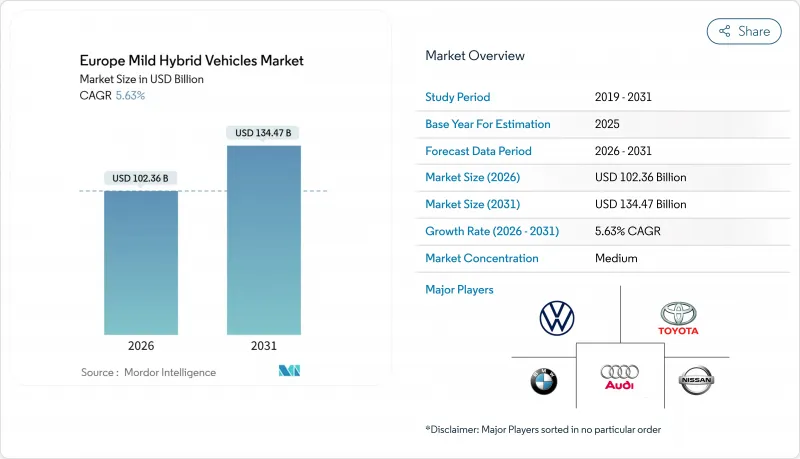
This report is Segmented by Battery Type (Less Than 48 Volt, 48 Volt, and Above 48 Volt), Vehicle Type (Passenger Cars and Commercial Vehicles), Powertrain Type (Gasoline Mild Hybrid and Diesel Mild Hybrid), Propulsion Technology (Belt-Driven Starter Generator, and More), and Country (Germany, United Kingdom, and More). The Market Forecasts are Provided in Terms of Value (USD) and Volume in Units.
Europe Mild Hybrid Vehicles Market Trends and Insights
EU CO2-Target Tightening 2025-2030
The European Union's fleet-average CO2 ceiling of 93.6 g/km for passenger cars, effective January 2025, imposes a EUR 95 (approximately USD 110) penalty per excess gram multiplied by total annual registrations, creating a huge compliance cost for volume manufacturers missing the target by 5 g/km. The regulation's zero- and low-emission vehicle crediting mechanism, which awards super-credits for battery electric vehicles (BEVs) and plug-in hybrids, paradoxically incentivizes mild-hybrid deployment as a hedge; manufacturers can meet the 2025 target by blending 15% BEVs with 40% mild hybrids rather than committing to 25% battery electric vehicles (BEVs) alone, preserving capital for the steeper 49.5 g/km threshold arriving in 2030.
Diesel Decline Accelerating 48V Adoption
In Q1 2025, diesel vehicles captured a 9.5% market share, following a 27.1% decline in the diesel car market, as urban low-emission zones in Paris, Madrid, and Milan tighten access for Euro 6d-TEMP vehicles. This contraction forces automakers with legacy diesel-engine capacity to repurpose production lines; Stellantis's decision to equip its 1.5-liter MultiJet diesel with a 48-volt belt-driven starter generator across the Peugeot 3008 and Opel Grandland platforms exemplifies this strategy, extracting residual value from sunk tooling investments while meeting CO2 targets. Mild-hybrid vehicles, whether diesel or gasoline, enhance fuel economy modestly in urban settings, due to features like regenerative braking and start-stop functionality. Although diesel engines have been known for their efficiency on highways, the fuel savings in urban stop-and-go scenarios are not as pronounced as once thought, diminishing the perceived advantage of diesel efficiency. Fleet operators are now leaning towards 48-volt mild-hybrid gasoline systems. These systems not only simplify maintenance and sidestep the complexities of diesel particulate filter regeneration but also offer urban fuel savings without significant added costs.
Rapid BEV Price Parity Eroding MHEV Value
Battery-electric vehicles (BEVs) continued to gain traction in Europe in 2025, supported by expanding model availability and more competitive pricing strategies. Several entry-level electric models, particularly in the small-car segment, are now priced around or below EUR 25,000 (approximately USD 27,148) in select European markets, improving affordability relative to internal-combustion alternatives. Tesla has also adopted aggressive pricing in Europe, introducing lower-priced Model 3 variants to stimulate demand and enhance competitiveness against premium internal-combustion and hybrid sedans. These developments reflect intensifying price competition in the European battery electric vehicle market as manufacturers seek to accelerate adoption and defend market share amid tightening emissions regulations.
Other drivers and restraints analyzed in the detailed report include:
- Falling 48V System Costs
- Consumer Shift from BEV to Hybrids Amid Cost and Charging Anxiety
- Non-Harmonized Tax Rules for Mild Hybrids
For complete list of drivers and restraints, kindly check the Table Of Contents.
Segment Analysis
The 48-volt segment captured an 87.13% Europe mild hybrid vehicles market share in 2025 as OEMs exploited its ability to trim 8-12 g/km CO2 at a fraction of full-hybrid cost. DC-DC converters let them retain legacy 12-volt loads, avoiding wholesale redesign. Above-48-volt packs, required for regenerative braking in 3.5-ton vans, are projected to grow at a 21.37% CAGR through 2031.
Automakers are turning to 48-volt mild-hybrid systems as a budget-friendly solution to boost fuel efficiency and curb emissions, especially in light of tightening standards like Euro 7. These 48V systems enable advanced features such as regenerative braking, torque assist, and improved start-stop functionality, leading to greater reductions in fuel consumption and CO2 emissions compared to traditional 12V systems.
Passenger cars accounted for 81.26% of the 2025 volume as fleet buyers optimized benefit-in-kind taxation. Commercial vehicles, however, are set to clock a 14.18% CAGR to 2031 as last-mile operators target sub-EUR 40,000 (approximately USD 47,000) vans that sidestep payload penalties.
In Germany, the taxation of company cars employs a standard 1% "Benefit-in-Kind" (BIK) rule for internal combustion vehicles. In contrast, fully electric vehicles enjoy a reduced tax base of 0.25% of their gross list price, albeit up to certain thresholds. Plug-in hybrids, contingent on meeting specific range and CO2 criteria, are taxed at intermediate rates. This approach underscores a fiscal differentiation rooted in the vehicle's powertrain type. Notably, hybrids failing to meet these stringent criteria forfeit their preferential status, reverting to the standard 1% rate, a shift that significantly impacts corporate fleet choices.
Complete Report Scope:
- By Battery Type
- Less Than 48 Volt
- 48 Volt
- Above 48 Volt
- By Vehicle Type
- Passenger Cars
- Commercial Vehicles
- By Powertrain Type
- Gasoline Mild Hybrid
- Diesel Mild Hybrid
- By Propulsion Technology
- Belt-Driven Starter Generator (BSG)
- Integrated Starter Generator (ISG)
- Crankshaft-Mounted Starter Generator
- By Country
- Germany
- United Kingdom
- France
- Italy
- Spain
- Rest of Europe
List of Companies Covered in this Report:
- Volkswagen AG
- Stellantis NV
- Mercedes-Benz Group AG
- BMW Group
- Nissan Motor Co. Ltd.
- Ford Motor Company
- Renault Group
- Hyundai Motor Company
- Kia Corporation
- Toyota Motor Corporation
- Suzuki Motor Corporation
- Volvo Car Corporation
- Audi AG
- Skoda
Additional Benefits:
- The market estimate (ME) sheet in Excel format
- 3 months of analyst support
TABLE OF CONTENTS
1 Introduction
- 1.1 Study Assumptions and Market Definition
2 Research Methodology
3 Executive Summary
4 Market Landscape
- 4.1 Market Overview
- 4.2 Market Drivers
- 4.2.1 Europe (EU) CO2-Target Tightening 2025-2030
- 4.2.2 Diesel Decline Accelerating 48 V Adoption
- 4.2.3 Falling 48 V System Costs
- 4.2.4 Consumer Shift from Battery Electric Vehicle (BEV) to Hybrids Amid Cost and Charging Anxiety
- 4.2.5 48 V Needed to Power ADAS L2+ Without HV Bus
- 4.2.6 Battery Electric Vehicle (BEV) Plant-Conversion Gaps Back-Filled by MHEV Production
- 4.3 Market Restraints
- 4.3.1 Rapid Battery Electric Vehicle (BEV) Price Parity Eroding Mild Hybrid Electric Vehicle (MHEV) Value
- 4.3.2 Non-Harmonized Tax Rules for Mild Hybrids
- 4.3.3 Belt-Drive Durability and Warranty Risk in BSG Designs
- 4.3.4 80-100 V MOSFET Supply Constraints
- 4.4 Value/Supply-Chain Analysis
- 4.5 Regulatory Landscape
- 4.6 Technological Outlook
- 4.7 Porter's Five Forces
- 4.7.1 Bargaining Power of Suppliers
- 4.7.2 Bargaining Power of Buyers
- 4.7.3 Threat of New Entrants
- 4.7.4 Threat of Substitutes
- 4.7.5 Competitive Rivalry
5 Market Size and Growth Forecasts (Value (USD) and Volume (Units))
- 5.1 By Battery Type
- 5.1.1 Less Than 48 Volt
- 5.1.2 48 Volt
- 5.1.3 Above 48 Volt
- 5.2 By Vehicle Type
- 5.2.1 Passenger Cars
- 5.2.2 Commercial Vehicles
- 5.3 By Powertrain Type
- 5.3.1 Gasoline Mild Hybrid
- 5.3.2 Diesel Mild Hybrid
- 5.4 By Propulsion Technology
- 5.4.1 Belt-Driven Starter Generator (BSG)
- 5.4.2 Integrated Starter Generator (ISG)
- 5.4.3 Crankshaft-Mounted Starter Generator
- 5.5 By Country
- 5.5.1 Germany
- 5.5.2 United Kingdom
- 5.5.3 France
- 5.5.4 Italy
- 5.5.5 Spain
- 5.5.6 Rest of Europe
6 Competitive Landscape
- 6.1 Market Concentration
- 6.2 Strategic Moves
- 6.3 Market Share Analysis
- 6.4 Company Profiles (Includes Global level Overview, Market level overview, Core Segments, Financials as available, Strategic Information, Market Rank/Share for key companies, Products and Services, and Recent Developments)
- 6.4.1 Volkswagen AG
- 6.4.2 Stellantis NV
- 6.4.3 Mercedes-Benz Group AG
- 6.4.4 BMW Group
- 6.4.5 Nissan Motor Co. Ltd.
- 6.4.6 Ford Motor Company
- 6.4.7 Renault Group
- 6.4.8 Hyundai Motor Company
- 6.4.9 Kia Corporation
- 6.4.10 Toyota Motor Corporation
- 6.4.11 Suzuki Motor Corporation
- 6.4.12 Volvo Car Corporation
- 6.4.13 Audi AG
- 6.4.14 Skoda
7 Market Opportunities and Future Outlook
- 7.1 White-space and Unmet-Need Assessment

