PUBLISHER: Mordor Intelligence | PRODUCT CODE: 2115842

PUBLISHER: Mordor Intelligence | PRODUCT CODE: 2115842
Dimethylaminopropylamine (DMAPA) - Market Share Analysis, Industry Trends & Statistics, Growth Forecasts (2026 - 2031)
According to Mordor Intelligence, the dimethylaminopropylamine market size is estimated at 290.37 kilotons in 2026, and is expected to reach 362.03 kilotons by 2031, at a CAGR of 4.51% during the forecast period (2026-2031).
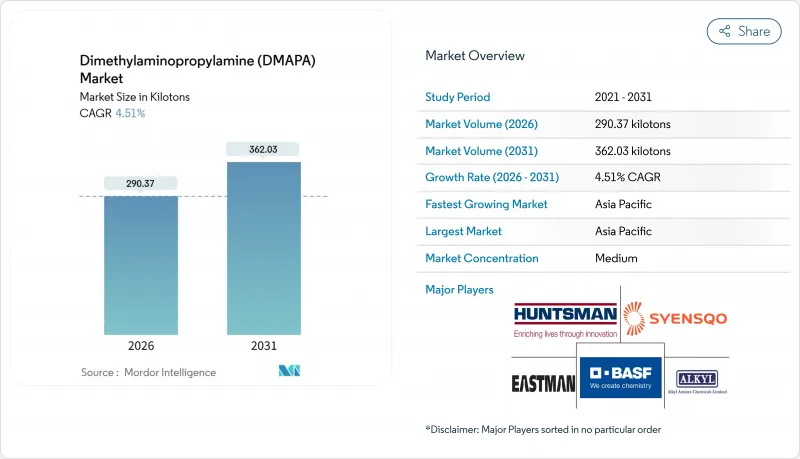
This report is Segmented by Grade (Industrial Grade, and More), Application (Beauty and Personal Care Surfactants, Water and Waste-Water Treatment Chemicals, and More), End-Use Industry (Personal Care and Cosmetics, and More), and Geography (Asia-Pacific, North America, Europe, South America, and Middle East and Africa). The Market Forecasts are Provided in Terms of Volume (Kilotons).
Global Dimethylaminopropylamine (DMAPA) Market Trends and Insights
Rapid Shift to Mild, CAPB-Based Surfactants in Hair- and Skin-Care Formulations
Shampoo and body-wash brands are replacing sodium lauryl sulfate with cocamidopropyl betaine to meet irritation-free claims and regulatory guidance on chronic skin exposure. Each tonne of CAPB uses about 0.35 tonnes of DMAPA, so every reformulation cycle lifts demand for high-purity amine feedstock. Syensqo earned ISCC PLUS certification at Zhangjiagang in 2023, enabling bio-circular Dimethylaminopropylamine that lowers Scope 3 footprints by up to 30%. Personal-care suppliers in the United States and Germany now lock in multi-year purchase agreements for low-amine grades, while Chinese contract manufacturers ramp batch tolling to supply regional indie brands. Urban consumers in Seoul, Shanghai, and Los Angeles drive double-digit growth in premium mild cleansers, anchoring the Dimethylaminopropylamine market in value-added segments.
Regulatory Push for Formaldehyde-Free, Low-VOC Chemistries in Coatings and PU Foams
The U.S. 40 CFR Part 59 rule and EU Directive 2004/42/EC cap VOC content in decorative paints, prompting formulators to swap solvent-borne hardeners for DMAPA-derived waterborne systems. Huntsman's JEFFCAT LE-340 meets VDA-278 emission thresholds for automotive seating, and orders surged after German OEMs mandated low-emission catalysts in new electric-vehicle interiors. Evonik embeds DMAPA into its Ancamine line to cut drying time in high-solids primers, giving coatings producers a way to comply without sacrificing throughput. The regulatory clampdown converts compliance cost into volume upside for continuous-process producers that can guarantee residual amine below 0.2%.
Volatility in Acrylonitrile and Dimethylamine Feedstock Pricing
Spot acrylonitrile and dimethylamine swung by more than 20% inside 2025, eroding margins for producers without captive upstream units. Huntsman's Performance Products EBITDA slid 24% on cost pass-through lags, highlighting exposure in merchant-purchase regions. BASF's Verbund model at Ludwigshafen and Nanjing shelters earnings by integrating propylene oxide and ammonia on-site. Mid-tier Indian and Southeast Asian firms that buy methanol or propylene at market rates face working-capital strain when feedstocks spike, forcing some to idle reactors to avoid losses.
Other drivers and restraints analyzed in the detailed report include:
- Asia-Pacific Capacity Expansions for Batch and Continuous Plants
- Emergence of Bio-Circular DMAPA via ISCC PLUS Certified Feedstocks
- Stricter EU Cosmetic Limits on Residual DMAPA
For complete list of drivers and restraints, kindly check the Table Of Contents.
Segment Analysis
Industrial grade dominated with 60.58% volume in 2025, but price discounts widened as new Chinese lines targeted water-treatment and agrochemical blenders. Pharmaceutical and Cosmetic grades, grouped as "Other Grades" in earlier audits, are expanding at a 4.91% CAGR as EU Annex III and Good Manufacturing Practice rules tighten. BASF's Nanjing upgrade dedicated extra trays to high-purity cuts, while Evonik's 2024 project embeds continuous hydrogenation and inline GC analytics to keep residual secondary amine below 0.2% (evonik.com). The Dimethylaminopropylamine market size for premium grades reached about 115 kilotons in 2026 and is on track to cross 150 kilotons by 2031.
Syensqo's bio-circular cosmetic grade sells at a 25-35% premium, attracting luxury shampoo makers eager for Europe's Green Deal labeling advantage. Huntsman leverages GMP-certified lines in Singapore to supply EDC coupling agents in peptide drug synthesis, where lot traceability outweighs price sensitivity. This three-tier structure, industrial, pharmaceutical, and bio-circular, locks in higher average selling prices even as commodity margins compress.
Complete Report Scope:
- By Grade
- Industrial Grade
- Pharmaceutical Grade
- Other Grades (Cosmetics, Low Amine)
- By Application
- Beauty and Personal Care Surfactants
- Water and Waste-water Treatment Chemicals
- Polyurethane Foam Catalysts
- Epoxy Resin Hardeners and Coatings
- Crop-Protection Intermediates
- Industrial and Institutional Cleaning Agents
- Others (Oilfield, Corrosion Inhibitors, and Ion-Exchange Resins)
- By End-Use Industry
- Personal Care and Cosmetics
- Water Treatment
- Building and Construction
- Agriculture
- Pharmaceuticals
- Others (Electronics, Textile, and more)
- By Geography
- Asia-Pacific
- China
- India
- Japan
- South Korea
- ASEAN Countries
- Rest of Asia-Pacific
- North America
- United States
- Canada
- Mexico
- Europe
- Germany
- United Kingdom
- France
- Italy
- Rest of Europe
- South America
- Brazil
- Argentina
- Rest of South America
- Middle East and Africa
- Saudi Arabia
- South Africa
- Rest of Middle-East and Africa
- Asia-Pacific
Geography Analysis
Asia-Pacific anchored 42.55% of 2025 demand, with a 5.02% CAGR outlook as Chinese and Indian producers integrate propylene oxide, dimethylamine, and renewable power onsite. BASF's July 2025 doubling of Nanjing capacity secured local supply for Jiangsu's personal-care contract manufacturers, while Evonik's adjacent build targets pharmaceutical and low-amine variants. India, buoyed by Alkyl Amines and Balaji Amines expansions, shifts from a net importer to a balanced trade, yet still relies on Chinese propylene intermediates.
In North America, Huntsman opened its Conroe E-GRADE unit in May 2025, aiming at semiconductor wet-process chemicals, an emerging high-purity pocket. US buyers absorb higher delivered costs than Asian peers but value local supply and regulatory certainty. Mexico's near-shoring boom in autos and personal-care filling plants nudges regional uptake, though the country remains import-dependent.
In Europe, producers grapple with energy surcharges yet win on premium price points because Annex III compliance filters supply. BASF took full control of the Chalampe amine-precursor site in July 2025, increasing feedstock security for specialty amines in the bloc. Demand tilts to cosmetic and epoxy hardener grades, sustaining the Dimethylaminopropylamine market despite flat macro consumption.
In South America and Middle East and Africa, Brazil's personal-care clusters in Sao Paulo and Minas Gerais drive imports, while Saudi Arabia's Jubail site supplies oilfield service chains that value DMAPA corrosion-inhibitor precursors. Longer lead times and currency swings temper growth, but do not change the underlying upward trajectory tied to population expansion and infrastructure spend.
- BASF
- Alkyl Amines Chemicals Ltd.
- Arkema
- Eastman Chemical Company
- Evonik Industries AG
- Hefei TNJ Chemical Industry Co.
- Hubei Jusheng Technology Co., Ltd.
- Huntsman International LLC
- Jinan HNA Chemical Co. Ltd
- Merck KGaA
- Prasol Chemicals Pvt Ltd
- Shandong Zhishang Chemical Co. Ltd
- Syensqo
- Tokyo Chemical Industry Co., Ltd. (TCI)
Additional Benefits:
- The market estimate (ME) sheet in Excel format
- 3 months of analyst support
TABLE OF CONTENTS
1 Introduction
- 1.1 Study Assumptions & Market Definition
- 1.2 Scope of the Study
2 Research Methodology
3 Executive Summary
4 Market Landscape
- 4.1 Market Overview
- 4.2 Market Drivers
- 4.2.1 Rapid shift to mild, CAPB-based surfactants in hair- and skin-care formulations
- 4.2.2 Regulatory push for formaldehyde-free, low-VOC chemistries in coatings and PU foams
- 4.2.3 Asia-Pacific capacity expansions for batch and continuous DMAPA plants
- 4.2.4 Emergence of bio-circular DMAPA via ISCC-PLUS certified feedstocks
- 4.2.5 Growing OEM additive packages for electric-vehicle coolants and lubricants
- 4.3 Market Restraints
- 4.3.1 Volatility in acrylonitrile and dimethylamine feedstock pricing
- 4.3.2 Stricter EU cosmetic limits on residual DMAPA
- 4.3.3 High capex for explosion-proof continuous hydrogenation systems
- 4.4 Value Chain Analysis
- 4.5 Porter's Five Forces
- 4.5.1 Threat of New Entrants
- 4.5.2 Bargaining Power of Buyers
- 4.5.3 Bargaining Power of Suppliers
- 4.5.4 Threat of Substitutes
- 4.5.5 Degree of Competition
5 Market Size & Growth Forecasts (Volume)
- 5.1 By Grade
- 5.1.1 Industrial Grade
- 5.1.2 Pharmaceutical Grade
- 5.1.3 Other Grades (Cosmetics, Low Amine)
- 5.2 By Application
- 5.2.1 Beauty and Personal Care Surfactants
- 5.2.2 Water and Waste-water Treatment Chemicals
- 5.2.3 Polyurethane Foam Catalysts
- 5.2.4 Epoxy Resin Hardeners and Coatings
- 5.2.5 Crop-Protection Intermediates
- 5.2.6 Industrial and Institutional Cleaning Agents
- 5.2.7 Others (Oilfield, Corrosion Inhibitors, and Ion-Exchange Resins)
- 5.3 By End-Use Industry
- 5.3.1 Personal Care and Cosmetics
- 5.3.2 Water Treatment
- 5.3.3 Building and Construction
- 5.3.4 Agriculture
- 5.3.5 Pharmaceuticals
- 5.3.6 Others (Electronics, Textile, and more)
- 5.4 By Geography
- 5.4.1 Asia-Pacific
- 5.4.1.1 China
- 5.4.1.2 India
- 5.4.1.3 Japan
- 5.4.1.4 South Korea
- 5.4.1.5 ASEAN Countries
- 5.4.1.6 Rest of Asia-Pacific
- 5.4.2 North America
- 5.4.2.1 United States
- 5.4.2.2 Canada
- 5.4.2.3 Mexico
- 5.4.3 Europe
- 5.4.3.1 Germany
- 5.4.3.2 United Kingdom
- 5.4.3.3 France
- 5.4.3.4 Italy
- 5.4.3.5 Rest of Europe
- 5.4.4 South America
- 5.4.4.1 Brazil
- 5.4.4.2 Argentina
- 5.4.4.3 Rest of South America
- 5.4.5 Middle East and Africa
- 5.4.5.1 Saudi Arabia
- 5.4.5.2 South Africa
- 5.4.5.3 Rest of Middle-East and Africa
- 5.4.1 Asia-Pacific
6 Competitive Landscape
- 6.1 Market Concentration
- 6.2 Strategic Moves
- 6.3 Market Share (%)/Ranking Analysis
- 6.4 Company Profiles {(includes Global level Overview, Market level overview, Core Segments, Financials as available, Strategic Information, Products & Services, and Recent Developments)}
- 6.4.1 BASF
- 6.4.2 Alkyl Amines Chemicals Ltd.
- 6.4.3 Arkema
- 6.4.4 Eastman Chemical Company
- 6.4.5 Evonik Industries AG
- 6.4.6 Hefei TNJ Chemical Industry Co.
- 6.4.7 Hubei Jusheng Technology Co., Ltd.
- 6.4.8 Huntsman International LLC
- 6.4.9 Jinan HNA Chemical Co. Ltd
- 6.4.10 Merck KGaA
- 6.4.11 Prasol Chemicals Pvt Ltd
- 6.4.12 Shandong Zhishang Chemical Co. Ltd
- 6.4.13 Syensqo
- 6.4.14 Tokyo Chemical Industry Co., Ltd. (TCI)
7 Market Opportunities & Future Outlook
- 7.1 White-space & Unmet-Need Assessment
- 7.2 Bio-Based and Circular Feedstock Initiatives

