PUBLISHER: Mordor Intelligence | PRODUCT CODE: 2115843

PUBLISHER: Mordor Intelligence | PRODUCT CODE: 2115843
Europe Automotive Bearing - Market Share Analysis, Industry Trends & Statistics, Growth Forecasts (2026 - 2031)
According to Mordor Intelligence, the european automotive bearing market size is expected to grow from USD 7.74 billion in 2025 to USD 8.03 billion in 2026 and is forecast to reach USD 9.62 billion by 2031 at 3.69% CAGR over 2026-2031.
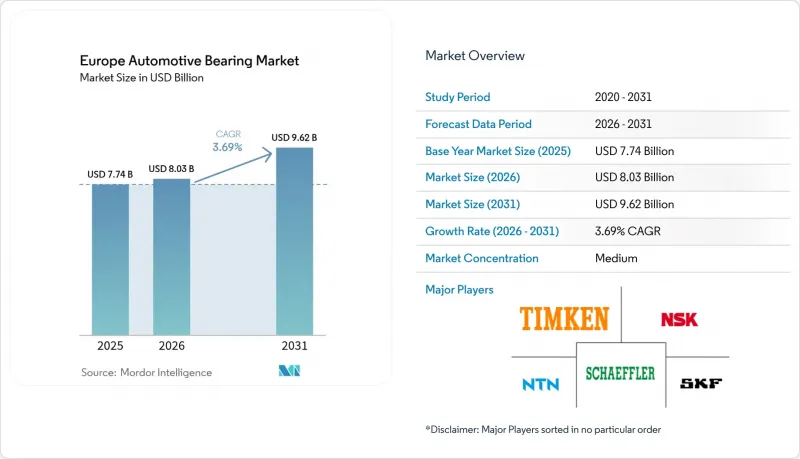
This report is Segmented by Bearing Type (Plain Bearings, and Rolling-Element Bearings), Material (Steel, and More), Vehicle Type (Passenger Cars, Light Commercial Vehicles, and More), Application (Wheel End, Engine and Turbocharger, Transmission and Driveline, and More), Sales Channel (OEM and Aftermarket), and Country. Market Forecasts are Provided in Terms of Value (USD).
Europe Automotive Bearing Market Trends and Insights
Rising EV Adoption Demanding High-Speed Insulated Bearings
Europe's automotive bearing market suppliers must now engineer products for traction motors that regularly spin at 3,000-16,000 rpm, with top-tier designs exceeding 20,000 rpm. At such speeds, stray currents can pit steel raceways within 50,000 miles if no insulation is provided. OEMs mitigate the risk with multi-layer protection that blends ceramic elements, grounding clamps, and common-mode chokes. NSK's deep-groove ball bearings, featuring proprietary insulation coatings, and Schaeffler's hybrid ceramic solutions exemplify how vendors are adding electrical robustness without sacrificing load capacity. The shift increases the per-unit value, especially on high-voltage 800 V platforms, which intensifies concerns about current leakage. Germany and France account for the bulk of early EV volumes, but the Nordics serve as a growing testbed for cold-temperature validation.
Stringent EU CO2 and Noise Limits Pushing Low-Friction Designs
Euro 7 rules, effective 2025, curb tailpipe CO2 to 93 g/km for passenger cars and tighten brake-particulate and noise thresholds. Bearing makers, therefore, prioritize surface engineering and lubricant compatibility with ultra-low-viscosity fluids as thin as 3.5 cSt at 100 °C. Diamond-like carbon coatings, advanced texturing, and mechanochemical finishing reduce low-speed wear by up to five times while damping NVH in near-silent EV cabins.
Raw-Material Price Volatility (Steel, Rare Alloys)
Hot-rolled coil prices yo-yoed in 2024, squeezing margins for bearing-grade steels that require precision metallurgy and vacuum degassing . Specialty alloys containing rare-earth elements introduce additional volatility due to their concentrated global supply. The Carbon Border Adjustment Mechanism, while protecting EU steelmakers from carbon leakage, imposes additional compliance costs on imported raw materials. Smaller bearing manufacturers without scale to negotiate favorable supply agreements or maintain strategic inventory buffers face the most tremendous pressure. The restraint clips 0.8 percentage points from the growth of the European automotive bearing market in the short term.
Other drivers and restraints analyzed in the detailed report include:
- Sensor-Integrated "Smart" Bearings for Predictive Maintenance
- On-Demand Additive Manufacturing of Polymer Cages
- Competition From Low-Cost Asian Imports
For complete list of drivers and restraints, kindly check the Table Of Contents.
Segment Analysis
Rolling-element bearings command 84.05% of the European automotive bearing market share in 2025 while simultaneously leading growth at 4.15% CAGR through 2031. Ball bearings within this category demonstrate particular strength in electric vehicle applications, where high-speed capabilities and electrical insulation properties address the unique requirements of traction motors operating at 10,000-20,000 rpm. Timken's research comparing tapered roller bearings to deep groove ball bearings in EV intermediate shafts reveals that application-weighted power losses are effectively equivalent under real-world conditions, despite conventional wisdom favoring ball bearings for efficiency.
Roller bearings, encompassing both cylindrical and tapered variants, are experiencing robust growth in commercial vehicle applications where higher load capacities and extended service intervals justify premium pricing. Cylindrical roller bearings benefit from their ability to handle pure radial loads with minimal friction, making them ideal for wheel-end applications in electric commercial vehicles. Tapered roller bearings are gaining traction in EV gearboxes due to their combined radial and thrust load capabilities, enabling more compact transmission designs that are critical for battery electric vehicle packaging constraints. Plain bearings, although representing a smaller market share, remain important in specialized applications such as turbocharger assemblies and engine auxiliaries, where their simple construction and high-temperature capabilities provide advantages over rolling-element alternatives.
Steel bearings maintain the largest market share at 53.74% of the European automotive bearing market in 2025, leveraging established manufacturing processes and cost-effectiveness across mainstream automotive applications. However, polymer and other advanced materials are emerging as the fastest-growing segment, with a 4.32% CAGR through 2031, driven by weight reduction initiatives and specialized application requirements in electric vehicles. Silicon nitride ceramic bearings are gaining prominence in high-performance applications, offering superior hardness, lower weight, and electrical insulation properties that address bearing current issues in electric traction motors. Hyundai-Transys' research on silicon nitride ball bearings reveals critical manufacturing considerations, with hot isostatic pressing (HIP) treatments achieving 18.7% higher fracture toughness compared to standard sintering processes.
Ceramic and hybrid bearings, which combine ceramic rolling elements with steel raceways, offer optimal solutions for electric vehicle applications. This design prevents bearing current damage while maintaining mechanical performance, thanks to electrical insulation. These hybrid configurations block the flow of electrical current, which can cause pitting and premature failure in high-voltage electric drivetrains. Advanced polymer materials, including PEEK and reinforced nylon, enable additive manufacturing of customized bearing cages that optimize lubricant flow and reduce noise in quiet electric vehicles. The material selection increasingly considers lifecycle environmental impact, with EU circular economy regulations favoring materials that support remanufacturing and recycling. Graphene-infused lubricants and coatings represent emerging technologies that enhance bearing performance while supporting sustainability objectives. The transition toward lower-viscosity lubricants in EV applications places greater emphasis on bearing material properties and surface treatments to maintain adequate lubrication films under boundary lubrication conditions.
Complete Report Scope:
- By Bearing Type
- Plain Bearings
- Rolling-Element Bearings
- Ball Bearings
- Roller Bearings
- Cylindrical Roller
- Tapered Roller
- By Material
- Steel
- Ceramic and Hybrid
- Polymer and Others
- By Vehicle Type
- Passenger Cars
- Light Commercial Vehicles (LCV)
- Heavy Commercial Vehicles (HCV)
- Two-Wheelers
- Off-Highway (Agri/Construction/Mining)
- By Application / Position
- Wheel End
- Engine and Turbocharger
- Transmission and Driveline
- Steering and Suspension
- HVAC, Alternator and Accessories
- By Sales Channel
- Original Equipment Manufacturer (OEM)
- Aftermarket
- By Country
- Germany
- United Kingdom
- France
- Italy
- Spain
- Rest of Europe
List of Companies Covered in this Report:
- AB SKF
- Schaeffler AG
- NSK Ltd
- NTN Corporation
- JTEKT Corporation
- The Timken Company
- ILJIN co., ltd.
- MinebeaMitsumi Group
- C&U Europe Holding GmbH
- FERSA BEARINGS, S.A.
- GMB Corporation
- Regal Rexnord Corporation
- Rheinmetall AG
- IBC Walzlager GmbH
- ROLLAX GmbH & Co. KG
Additional Benefits:
- The market estimate (ME) sheet in Excel format
- 3 months of analyst support
TABLE OF CONTENTS
1 Introduction
- 1.1 Study Assumptions and Market Definition
- 1.2 Scope of the Study
2 Research Methodology
3 Executive Summary
4 Market Landscape
- 4.1 Market Overview
- 4.2 Market Drivers
- 4.2.1 Rising EV Adoption Demanding High-Speed Insulated Bearings
- 4.2.2 Stringent EU CO? and Noise Limits Pushing Low-Friction Designs
- 4.2.3 Recovery In European Vehicle Production and Exports
- 4.2.4 EU Circular-Economy Rules Boosting Remanufactured Bearings
- 4.2.5 Sensor-Integrated "Smart" Bearings for Predictive Maintenance
- 4.2.6 On-Demand Additive Manufacturing of Polymer Cages
- 4.3 Market Restraints
- 4.3.1 Raw-Material Price Volatility (Steel, Rare Alloys)
- 4.3.2 Competition From Low-Cost Asian Imports
- 4.3.3 Cyber-Security Shutdowns in Smart-Factory Bearing Plants
- 4.3.4 EV Drivetrain Simplification Cutting Bearing Counts Per Car
- 4.4 Value / Supply-Chain Analysis
- 4.5 Regulatory Landscape
- 4.6 Technological Outlook
- 4.7 Porter's Five Forces
- 4.7.1 Threat of New Entrants
- 4.7.2 Bargaining Power of Suppliers
- 4.7.3 Bargaining Power of Buyers
- 4.7.4 Threat of Substitutes
- 4.7.5 Competitive Rivalry
5 Market Size and Growth Forecasts (Value (USD))
- 5.1 By Bearing Type
- 5.1.1 Plain Bearings
- 5.1.2 Rolling-Element Bearings
- 5.1.2.1 Ball Bearings
- 5.1.2.2 Roller Bearings
- 5.1.2.2.1 Cylindrical Roller
- 5.1.2.2.2 Tapered Roller
- 5.2 By Material
- 5.2.1 Steel
- 5.2.2 Ceramic and Hybrid
- 5.2.3 Polymer and Others
- 5.3 By Vehicle Type
- 5.3.1 Passenger Cars
- 5.3.2 Light Commercial Vehicles (LCV)
- 5.3.3 Heavy Commercial Vehicles (HCV)
- 5.3.4 Two-Wheelers
- 5.3.5 Off-Highway (Agri/Construction/Mining)
- 5.4 By Application / Position
- 5.4.1 Wheel End
- 5.4.2 Engine and Turbocharger
- 5.4.3 Transmission and Driveline
- 5.4.4 Steering and Suspension
- 5.4.5 HVAC, Alternator and Accessories
- 5.5 By Sales Channel
- 5.5.1 Original Equipment Manufacturer (OEM)
- 5.5.2 Aftermarket
- 5.6 By Country
- 5.6.1 Germany
- 5.6.2 United Kingdom
- 5.6.3 France
- 5.6.4 Italy
- 5.6.5 Spain
- 5.6.6 Rest of Europe
6 Competitive Landscape
- 6.1 Market Concentration
- 6.2 Strategic Moves
- 6.3 Market Share Analysis
- 6.4 Company Profiles (Includes Global-level Overview, Market-level Overview, Core Segments, Financials, Strategic Information, Market Rank/Share, Products and Services, Recent Developments)
- 6.4.1 AB SKF
- 6.4.2 Schaeffler AG
- 6.4.3 NSK Ltd
- 6.4.4 NTN Corporation
- 6.4.5 JTEKT Corporation
- 6.4.6 The Timken Company
- 6.4.7 ILJIN co., ltd.
- 6.4.8 MinebeaMitsumi Group
- 6.4.9 C&U Europe Holding GmbH
- 6.4.10 FERSA BEARINGS, S.A.
- 6.4.11 GMB Corporation
- 6.4.12 Regal Rexnord Corporation
- 6.4.13 Rheinmetall AG
- 6.4.14 IBC Walzlager GmbH
- 6.4.15 ROLLAX GmbH & Co. KG
7 Market Opportunities and Future Outlook

