PUBLISHER: Mordor Intelligence | PRODUCT CODE: 2115859

PUBLISHER: Mordor Intelligence | PRODUCT CODE: 2115859
Butyraldehyde - Market Share Analysis, Industry Trends & Statistics, Growth Forecasts (2026 - 2031)
According to Mordor Intelligence, butyraldehyde market size in 2026 is estimated at USD 254.96 million, growing from 2025 value of USD 242.54 million with 2031 projections showing USD 327.32 million, growing at 5.12% CAGR over 2026-2031.
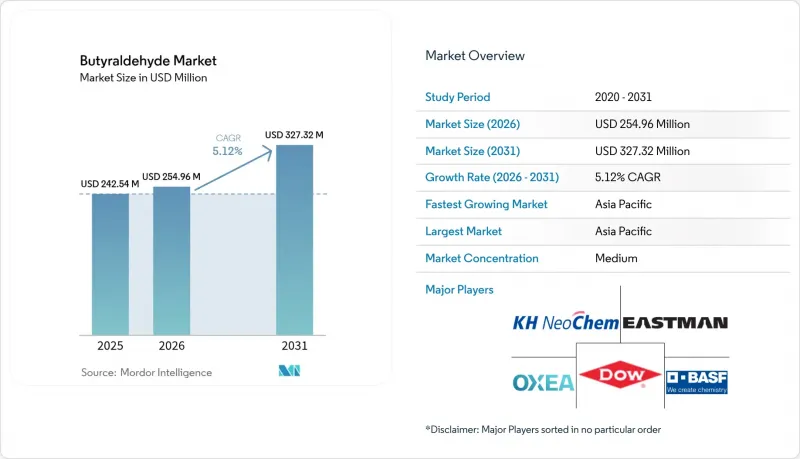
This report Segments the Industry by Product Type (N-Butanol, 2-Ethylhexanol, and More), Application (Paints and Coatings, Agrochemical, and More), End-User Industry (Building and Construction, Automotive, Healthcare, and More), Process Technology (Hydroformylation, Catalytic Dehydrogenation, and More), and Geography (Asia-Pacific, North America, Europe, South America, and Middle East and Africa).
Global Butyraldehyde Market Trends and Insights
EU shift to low-VOC water-borne architectural coatings
Implementation of the European Green Deal and national statutes that cut allowable VOCs in architectural paints is accelerating the need for n-butanol-rich coalescents and resin modifiers. Producers are reformulating premium exterior and interior coatings to achieve mandated emission reductions of 55% versus 1990 by 2030, and butyraldehyde-derived additives help maintain gloss, hardness, and weatherability in these lower-solvent systems. Paint makers in Germany, France, Italy, and Spain have published roadmaps calling for 50-65% VOC cuts by 2029, driving early pull-through for butyraldehyde derivatives across resin plants and formulating hubs.
Technological advancements in production catalysis
Novel rhodium-zeolite catalysts deliver over 99% linear aldehyde selectivity and higher turnover frequency than traditional rhodium-phosphine systems, cutting purification steps and improving overall carbon efficiency. Asian producers who retrofit reactors with the new catalyst suite achieve better propylene utilization and can flex feedstocks when olefin pricing becomes volatile. Reduced by-product severity also means smaller wastewater loads, a key advantage in provinces tightening discharge standards.
Health and environmental hazards of butyraldehyde
Classified as a hazardous air pollutant, butyraldehyde emissions face strict limits that compel producers to invest in scrubbers, closed-loop handling, and real-time monitoring. Cities combating smog see heightened scrutiny because aldehyde photochemistry fosters ground-level ozone formation, prompting some downstream users to investigate less-toxic solvents for consumer-facing products. While industrial customers understand mitigation measures, negative public perception shapes retailer procurement policies.
Other drivers and restraints analyzed in the detailed report include:
- Expanding agricultural industry
- Growth in the pharmaceutical sector
- Raw-material volatility (propylene)
For complete list of drivers and restraints, kindly check the Table Of Contents.
Segment Analysis
N-butanol retained a 44.35% revenue share in 2025, making it the anchor product within the butyraldehyde market thanks to its solvent performance in coatings, adhesives, and inks. Regulatory focus on lower-VOC systems has ironically sustained n-butanol because formulators rely on its balanced evaporation rate to tune film formation without sacrificing compliance. The segment's cost advantage over higher-value derivatives also ensures base-load demand during economic slowdowns.
Momentum now shifts toward 2-ethylhexanol, the fastest-growing derivative at a 5.95% CAGR between 2026 and 2031 as flexible PVC demand rises in construction membranes, wire insulation, and synthetic leather. China's decision to restrict four conventional phthalates from 2026 spurs the adoption of next-generation plasticizers built on 2-ethylhexanol that meet performance and health criteria. Polyvinyl butyral remains niche but gains from safety-glass uptake in electric vehicles and high-performance architecture as Eastman upgrades its Ghent lines to capture specification-driven orders.
Paints and coatings absorbed 34.60% of global volume in 2025, anchored in architectural, industrial, and protective finishes that integrate n-butanol as a co-solvent and use oxo-derived resins to balance flow, leveling, and chemical resistance. Tightening emission ceilings reinforce butyraldehyde derivatives' importance because few alternate solvents match their reactivity in resin esterification while remaining cost-competitive. Construction recovery in Southeast Asia and ongoing US retrofits bolster short-cycle consumption.
Pharmaceutical applications reach just 11.90% of the current volume but post a 5.85% CAGR to 2031, the highest among applications. The butyraldehyde market size tied to pharmaceutical synthesis is expected to increase, assisted by contract manufacturing investment across China, Singapore, and Ireland. Butyraldoximes and other tailored intermediates help medicinal chemists insert functional groups selectively, reducing protecting-group steps and batch cycle times. Agrochemicals, flavors, and personal-care uses together keep the molecule's demand pattern broad, insulating suppliers from shocks in any single vertical.
Complete Report Scope:
- By Product Type
- N-Butanol
- 2-Ethylhexanol (2EH)
- Polyvinyl Butyral (PVB)
- Other Derivatives
- By Application
- Paints and Coatings
- Agrochemicals
- Pharmaceuticals
- Other Applications
- By End-User Industry
- Building and Construction
- Automotive
- Healthcare
- Agriculture
- Others (Consumer Goods and Electronics)
- By Process Technology
- Hydroformylation (Oxo Process)
- Catalytic Dehydrogenation
- Bio-based Fermentation and Others
- By Geography
- Asia-Pacific
- China
- India
- Japan
- South Korea
- Rest of Asia-Pacific
- North America
- United States
- Canada
- Mexico
- Europe
- Germany
- United Kingdom
- France
- Italy
- Rest of Europe
- South America
- Brazil
- Argentina
- Rest of South America
- Middle East and Africa
- Saudi Arabia
- United Arab Emirates
- South Africa
- Nigeria
- Rest of Middle East and Africa
- Asia-Pacific
Geography Analysis
Asia held 54.40% of global revenue in 2025 and is expected to widen its lead through a 6.35% CAGR to 2031, fueled by multi-billion-dollar oxo complexes in Jiangsu, Shandong, and Gujarat. Evergreen New Material's USD 1.4 billion fine-chemical park in Taizhou exemplifies capacity build-outs that underpin integrated chains from propylene through oxo derivatives to high-margin plasticizers. Southeast Asian producers gain from duty-free export access into the Regional Comprehensive Economic Partnership bloc, further enhancing regional attractiveness for downstream investors.
Germany and the Netherlands anchor a balanced producer-consumer landscape, highlighting Europe's significant presence in the market. Stringent environmental law accelerates the adoption of compliant derivatives and encourages capital spending on low-emission reactors and solvent-recovery loops. Concurrently, cross-border collaboration between resin houses and coating formulators drives premium specifications that depend on high-purity n-butanol and tailored oxo intermediates.
North America benefits from advantaged shale-based propylene and hosts several world-scale hydroformylation units along the US Gulf Coast. That feedstock edge supports competitive export pricing into Latin America and Europe, even after freight. South America, led by Brazil, sees volume growth alongside soy and sugar-cane-driven agrochemical demand and supportive tax regimes for specialty chemical investment. Middle East & Africa remain smaller but pursue value-chain integration strategies via petrochemical diversification in Saudi Arabia and United Arab Emirates free zones.
- BASF SE
- Dow
- Eastman Chemical Company
- INEOS
- KH Neochem Co., Ltd.
- LG Chem
- Mitsubishi Chemical Group Corporation
- OXEA GmbH
- Perstorp
- PetroChina Company Limited
- Sasol Limited
Additional Benefits:
- The market estimate (ME) sheet in Excel format
- 3 months of analyst support
TABLE OF CONTENTS
1 Introduction
- 1.1 Study Assumptions and Market Definition
- 1.2 Scope of the Study
2 Research Methodology
3 Executive Summary
4 Market Landscape
- 4.1 Market Overview
- 4.2 Market Drivers
- 4.2.1 EU Shift to Low-VOC Water-borne Architectural Coatings
- 4.2.2 Technological Advancements in Production
- 4.2.3 Expanding Agricultural Industry
- 4.2.4 Growth in the Pharmaceutical Sector
- 4.3 Market Restraints
- 4.3.1 Health and Environmental Hazard of Butyraldehyde
- 4.3.2 Raw Material Volatility
- 4.3.3 Availability of Substitutes
- 4.4 Value Chain Analysis
- 4.5 Technological Outlook
- 4.6 Porter's Five Forces Analysis
- 4.6.1 Threat of New Entrants
- 4.6.2 Bargaining Power of Buyers
- 4.6.3 Bargaining Power of Suppliers
- 4.6.4 Threat of Substitutes
- 4.6.5 Degree of Competition
5 Market Size and Growth Forecasts (Value)
- 5.1 By Product Type
- 5.1.1 N-Butanol
- 5.1.2 2-Ethylhexanol (2EH)
- 5.1.3 Polyvinyl Butyral (PVB)
- 5.1.4 Other Derivatives
- 5.2 By Application
- 5.2.1 Paints and Coatings
- 5.2.2 Agrochemicals
- 5.2.3 Pharmaceuticals
- 5.2.4 Other Applications
- 5.3 By End-User Industry
- 5.3.1 Building and Construction
- 5.3.2 Automotive
- 5.3.3 Healthcare
- 5.3.4 Agriculture
- 5.3.5 Others (Consumer Goods and Electronics)
- 5.4 By Process Technology
- 5.4.1 Hydroformylation (Oxo Process)
- 5.4.2 Catalytic Dehydrogenation
- 5.4.3 Bio-based Fermentation and Others
- 5.5 By Geography
- 5.5.1 Asia-Pacific
- 5.5.1.1 China
- 5.5.1.2 India
- 5.5.1.3 Japan
- 5.5.1.4 South Korea
- 5.5.1.5 Rest of Asia-Pacific
- 5.5.2 North America
- 5.5.2.1 United States
- 5.5.2.2 Canada
- 5.5.2.3 Mexico
- 5.5.3 Europe
- 5.5.3.1 Germany
- 5.5.3.2 United Kingdom
- 5.5.3.3 France
- 5.5.3.4 Italy
- 5.5.3.5 Rest of Europe
- 5.5.4 South America
- 5.5.4.1 Brazil
- 5.5.4.2 Argentina
- 5.5.4.3 Rest of South America
- 5.5.5 Middle East and Africa
- 5.5.5.1 Saudi Arabia
- 5.5.5.2 United Arab Emirates
- 5.5.5.3 South Africa
- 5.5.5.4 Nigeria
- 5.5.5.5 Rest of Middle East and Africa
- 5.5.1 Asia-Pacific
6 Competitive Landscape
- 6.1 Market Concentration
- 6.2 Strategic Moves
- 6.3 Market Share(%)/ Ranking Analysis
- 6.4 Company Profiles (includes Global level Overview, Market level overview, Core Segments, Financials as available, Strategic Information, Market Rank/Share for key companies, Products and Services, and Recent Developments)
- 6.4.1 BASF SE
- 6.4.2 Dow
- 6.4.3 Eastman Chemical Company
- 6.4.4 INEOS
- 6.4.5 KH Neochem Co., Ltd.
- 6.4.6 LG Chem
- 6.4.7 Mitsubishi Chemical Group Corporation
- 6.4.8 OXEA GmbH
- 6.4.9 Perstorp
- 6.4.10 PetroChina Company Limited
- 6.4.11 Sasol Limited
7 Market Opportunities and Future Outlook
- 7.1 Regulatory Support for Green Chemistry
- 7.2 White-space and Unmet-need Assessment

