PUBLISHER: Mordor Intelligence | PRODUCT CODE: 2115871

PUBLISHER: Mordor Intelligence | PRODUCT CODE: 2115871
Biofuel Enzymes - Market Share Analysis, Industry Trends & Statistics, Growth Forecasts (2026 - 2031)
According to Mordor Intelligence, the biofuel enzymes market size is projected to expand from USD 0.69 billion in 2025 and USD 0.74 billion in 2026 to USD 1.02 billion by 2031, registering a CAGR of 6.63% between 2026 to 2031.
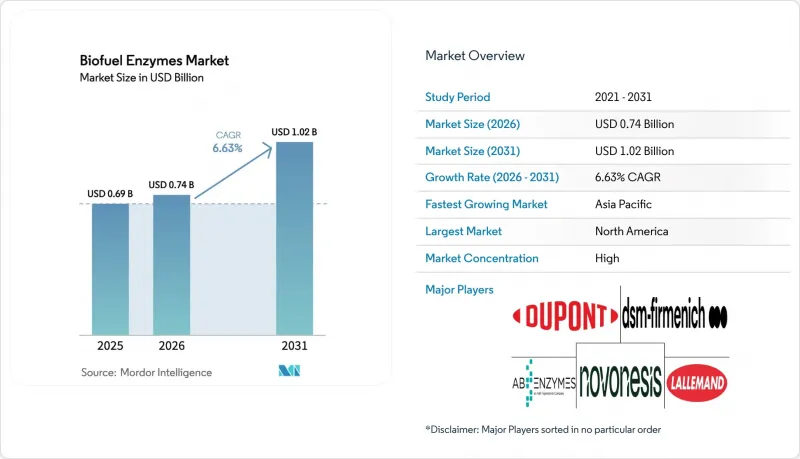
This report is Segmented by Product Type (Amylases, Cellulases, and More), Feedstock (Starch Crops, Algae, and More), Technology (Free Enzyme Catalysis, Immobilized Enzyme Systems, and More), Application (Corn/Starch-based Ethanol, Biodiesel, and More), End-User Industry (Fuel Producers, Biorefineries, and More), and Geography (Asia-Pacific, North America, Europe, South America and Middle-East and Africa).
Global Biofuel Enzymes Market Trends and Insights
Growing Biodiesel Blending Mandates
Regulatory mandates are recalibrating enzyme demand as biodiesel blending ratios rise faster than ethanol obligations in several jurisdictions. The European Union's Renewable Energy Directive III requires advanced biofuels to supply 5.5% of transport energy by 2030, a threshold that pushes enzymatic transesterification of waste oils and tallow into the mainstream. Indonesia's B35 program consumes roughly 14 million metric tons of crude palm oil annually, incentivizing lipase enzymes that convert high-free-fat-acid feedstocks without costly pre-esterification. Brazil lifted its biodiesel blend to B15 in 2025, widening substrate diversity and opening opportunities for enzyme formulations that handle soybean oil, tallow and used cooking oil interchangeably. The U.S. Environmental Protection Agency set 2026 biomass-based diesel at 3.35 billion gallons, rewarding enzyme suppliers capable of lowering catalyst cost below USD 0.08 per gallon. California's Low Carbon Fuel Standard multiplies credit values for fuels derived from waste fats, propelling demand for lipases tolerant of moisture and impurities.
Expanding Demand for Second-Generation (Cellulosic) Ethanol
Commercial deployment of cellulosic ethanol plants is multiplying enzyme consumption per gallon of fuel. The U.S. Department of Energy awarded USD 118 million in 2025 to projects targeting cellulase cost reductions below USD 0.30 per gallon by 2030. POET-DSM's Project LIBERTY produced 22 million gallons of cellulosic ethanol in 2025 and consumed about 110 metric tons of cellulase and xylanase, proving full-scale economics once plants run near nameplate capacity. India contracted 500 million liters of second-generation ethanol from rice straw and bagasse, demanding cocktails optimized for high-ash feedstocks. China approved 600,000 metric tons per year of cellulosic capacity with on-site enzyme plants to avoid cold-chain costs in northern provinces. The European Commission's Innovation Fund invested EUR 150 million in sunliquid technology that co-locates enzyme production with pretreatment and fermentation, cutting supply-chain overhead by 40%.
High Enzyme Production and Immobilization Costs
Fermentation, purification and formulation represent up to half of delivered enzyme cost, challenging adoption in price-sensitive regions. NREL pegged cellulase production at USD 4.50-6.00 per kg in 2025, equal to USD 0.45-0.60 per gallon of cellulosic ethanol, eroding margins whenever oil trades below USD 70 per barrel. Immobilized systems allow catalyst reuse but require USD 2-5 million for carriers and retrofits, a barrier for mid-sized mills. Advanced Enzyme Technologies noted recovery and recycling add 15-20% to enzyme outlay and only 30% of plants have installed the hardware. Indian distilleries operating on USD 0.08-0.12 per liter margins often choose lower-grade enzymes that slow throughput. Tropical supply chains face refrigerated transport surcharges of USD 0.50-0.80 per kg, pricing out small biodiesel producers.
Other drivers and restraints analyzed in the detailed report include:
- Rapid Advances in Enzyme Engineering and Directed Evolution
- On-Site Enzyme Production Lowering Operating Costs
- Feedstock Price Volatility Dampening Enzyme Demand Visibility
For complete list of drivers and restraints, kindly check the Table Of Contents.
Segment Analysis
Cellulases are projected to grow at 8.67% between 2026-2031, outpacing all other enzyme categories as policy targets drive lignocellulosic ethanol build-out. Amylases retained 41.27% revenue share in 2025, a legacy of corn and wheat starch dominance in North America and Asia-Pacific. Xylanases and accessory enzymes are being bundled with cellulases to maximize hemicellulose conversion, while lipase development focuses on biodiesel from waste oils and animal fats.
Demand dynamics are diverging by region. U.S. corn-ethanol plants remain the cornerstone for amylase volumes, yet suppliers are diverting R&D budgets toward thermostable cellulases that maintain activity above 65 °C to cut cooling energy. Patent filings for cellulases rose 27% in 2025 versus 8% for amylases, underscoring the pivot. Lipases, although smaller in value, underpin emerging palm-oil biodiesel markets in Southeast Asia and waste-oil transesterification in Europe. Suppliers are marketing enzyme packages that integrate laccases or pectinases to loosen lignin and pectin matrices in tough biomass such as softwood or algal cell walls.
Starch crops generated 40.35% revenue in 2025, yet their share is gradually eroding in favor of residues, energy crops and algae. The biofuel enzymes market share linked to algae carries the highest 9.68% CAGR forecast through 2031 as aviation mandates favor low-carbon lipids. Agricultural residues hold vast potential but are constrained by enzyme cost per gallon; next-generation cocktails demonstrated by NREL that lower dosage to 12 mg g-1 promise to unlock this segment.
Suppliers are tailoring formulations to high-ash rice straw in India and moisture-rich corn stover in the U.S., while Scandinavian firms develop cold-adapted cellulases for forestry residues processed at 15-20 °C. Waste cooking oil conversion is another bright spot, with lipases handling 15% free-fatty-acid streams without caustic pretreatment, saving USD 0.10 per gallon in European biodiesel plants. Algal biofuel pilots are demanding cellulases that break tough cell walls and lipases that free intracellular lipids without energy-intensive drying, a niche where early-stage suppliers are positioning for first-mover advantage.
Complete Report Scope:
- By Product Type
- Amylases
- Cellulases
- Xylanases
- Other Product Types (Lipases, Accessory Enzymes, etc.)
- By Feedstock
- Starch Crops
- Sugar Crops
- Waste Cooking Oil and Grease
- Agricultural Residues
- Energy Crops (Switchgrass, Miscanthus)
- Forestry Residues
- Algae
- By Technology
- Free Enzyme Catalysis
- Immobilized Enzyme Systems
- Consolidated Bioprocessing (CBP)
- On-site Enzyme Production
- Continuous-flow Micro-reactor Systems
- By Application
- Corn/Starch-based Ethanol
- Biodiesel
- Lignocellulosic Ethanol
- Leather and Textile
- Other Applications (Biogas/Renewable Natural Gas, Biochemicals (e.g., biobutanol), etc.)
- By End-user Industry
- Fuel Producers (Biodiesel Plants, Ethanol Distilleries)
- Biorefineries
- Oil and Gas Blenders
- Chemical Manufacturers
- Other End-user Industries (Academic, Pilot Plants)
- By Geography
- Asia-Pacific
- China
- India
- Japan
- South Korea
- ASEAN Countries
- Rest of Asia-Pacific
- North America
- United States
- Canada
- Mexico
- Europe
- Germany
- United Kingdom
- France
- Italy
- NORDIC Countries
- Rest of Europe
- South America
- Brazil
- Argentina
- Rest of South America
- Middle-East and Africa
- Saudi Arabia
- South Africa
- Rest of Middle-East and Africa
- Asia-Pacific
Geography Analysis
North America captured 35.55% revenue in 2025, underpinned by 15.4 billion gallons of U.S. corn ethanol and the continent's deepest R&D ecosystem. The 2026 EPA mandate sets 590 million gallons of cellulosic biofuel, sustaining cellulase demand despite political debate over Renewable Fuel Standard targets. Canada's Clean Fuel Regulations support wheat-straw ethanol, while Mexico's E10 blend in metro areas fosters sugarcane-derived demand. Research institutions such as NREL and the Great Lakes Bioenergy Research Center published 134 enzyme papers in 2025, feeding a pipeline of licensed variants.
Asia-Pacific is the fastest-growing region at 7.98% CAGR through 2031 as China and India crank up ethanol blends and Southeast Asia boosts palm-oil biodiesel. China's E10 rollout across 15 provinces adds 4 billion liters of ethanol demand and needs roughly 20,000 metric tons of amylase annually. India's E20 target will double ethanol consumption to 10 billion liters by 2030, driving enzymes across 400 distilleries. Japan, South Korea and ASEAN economies layer additional fuel standards that diversify enzyme portfolios toward rice straw and waste cooking oil.
Europe benefits from mature biodiesel capacity and Renewable Energy Directive III's 5.5% advanced-fuel sub-target, but growth is moderating as blending plateaus. Germany produced 3.2 million tons of biodiesel in 2025, leveraging lipases for rapeseed and used oil. France reached 95% E10 penetration, while the U.K. incentivizes double-counting of waste-based fuels. NORDIC countries push forestry-residue ethanol, requiring cold-active cellulases. Italy's 600,000 ton advanced-biofuel capacity at Eni sites underscores ongoing, albeit slower, demand creation.
South America is anchored by Brazil's 32 billion liters of sugarcane ethanol and RenovaBio credit scheme that values second-generation capacity at 2.5X first-generation. Raizen's Bonfim plant alone consumes 410 metric tons of cellulase yearly and demonstrates economic viability for bagasse-to-ethanol conversion. Argentina's soybean-oil biodiesel hits 2.1 million tons and explores lipase routes to cut energy costs. Colombia and Paraguay expand sugarcane distillation but remain smaller enzyme consumers.
Middle East and Africa remain emergent. Saudi Arabia targets 2 billion liters of waste-oil biofuel by 2030 under Public Investment Fund backing, while South Africa's E10 and B5 mandates stimulate modest enzyme imports. The UAE pilots high-salinity algae fuels, requiring novel lipase and cellulase blends.
- AB Enzymes
- Advanced Enzyme Technologies
- Agrivida Inc.
- Amano Enzyme Inc.
- Aumenzymes
- Biocatalysts
- Creative Enzymes
- dsm-firmenich
- DuPont
- Enzyme Supplies Limited
- International Flavors & Fragrances Inc.
- Iogen Corporation
- Lallemand Inc.
- MetGen Oy
- Novozymes A/S (Novonesis Group)
- TransBiodiesel Ltd
Additional Benefits:
- The market estimate (ME) sheet in Excel format
- 3 months of analyst support
TABLE OF CONTENTS
1 Introduction
- 1.1 Study Assumptions and Market Definition
- 1.2 Scope of the Study
2 Research Methodology
3 Executive Summary
4 Market Landscape
- 4.1 Market Overview
- 4.2 Market Drivers
- 4.2.1 Growing Biodiesel Blending Mandates
- 4.2.2 Expanding Demand for Second-Generation (Cellulosic) Ethanol
- 4.2.3 Rapid Advances in Enzyme Engineering and Directed Evolution
- 4.2.4 On-Site Enzyme Production Lowering Operating Costs
- 4.2.5 Biorefinery Integration with Advanced Pretreatment Platforms
- 4.3 Market Restraints
- 4.3.1 High Enzyme Production and Immobilization Costs
- 4.3.2 Feedstock Price Volatility Dampening Enzyme Demand Visibility
- 4.3.3 Competitive Pressure from Thermo-Chemical Conversion Routes
- 4.4 Value Chain Analysis
- 4.5 Porter's Five Forces
- 4.5.1 Threat of New Entrants
- 4.5.2 Bargaining Power of Buyers
- 4.5.3 Bargaining Power of Suppliers
- 4.5.4 Threat of Substitutes
- 4.5.5 Degree of Competition
5 Market Size and Growth Forecasts (Value)
- 5.1 By Product Type
- 5.1.1 Amylases
- 5.1.2 Cellulases
- 5.1.3 Xylanases
- 5.1.4 Other Product Types (Lipases, Accessory Enzymes, etc.)
- 5.2 By Feedstock
- 5.2.1 Starch Crops
- 5.2.2 Sugar Crops
- 5.2.3 Waste Cooking Oil and Grease
- 5.2.4 Agricultural Residues
- 5.2.5 Energy Crops (Switchgrass, Miscanthus)
- 5.2.6 Forestry Residues
- 5.2.7 Algae
- 5.3 By Technology
- 5.3.1 Free Enzyme Catalysis
- 5.3.2 Immobilized Enzyme Systems
- 5.3.3 Consolidated Bioprocessing (CBP)
- 5.3.4 On-site Enzyme Production
- 5.3.5 Continuous-flow Micro-reactor Systems
- 5.4 By Application
- 5.4.1 Corn/Starch-based Ethanol
- 5.4.2 Biodiesel
- 5.4.3 Lignocellulosic Ethanol
- 5.4.4 Leather and Textile
- 5.4.5 Other Applications (Biogas/Renewable Natural Gas, Biochemicals (e.g., biobutanol), etc.)
- 5.5 By End-user Industry
- 5.5.1 Fuel Producers (Biodiesel Plants, Ethanol Distilleries)
- 5.5.2 Biorefineries
- 5.5.3 Oil and Gas Blenders
- 5.5.4 Chemical Manufacturers
- 5.5.5 Other End-user Industries (Academic, Pilot Plants)
- 5.6 By Geography
- 5.6.1 Asia-Pacific
- 5.6.1.1 China
- 5.6.1.2 India
- 5.6.1.3 Japan
- 5.6.1.4 South Korea
- 5.6.1.5 ASEAN Countries
- 5.6.1.6 Rest of Asia-Pacific
- 5.6.2 North America
- 5.6.2.1 United States
- 5.6.2.2 Canada
- 5.6.2.3 Mexico
- 5.6.3 Europe
- 5.6.3.1 Germany
- 5.6.3.2 United Kingdom
- 5.6.3.3 France
- 5.6.3.4 Italy
- 5.6.3.5 NORDIC Countries
- 5.6.3.6 Rest of Europe
- 5.6.4 South America
- 5.6.4.1 Brazil
- 5.6.4.2 Argentina
- 5.6.4.3 Rest of South America
- 5.6.5 Middle-East and Africa
- 5.6.5.1 Saudi Arabia
- 5.6.5.2 South Africa
- 5.6.5.3 Rest of Middle-East and Africa
- 5.6.1 Asia-Pacific
6 Competitive Landscape
- 6.1 Market Concentration
- 6.2 Strategic Moves
- 6.3 Market Share(%)/Ranking Analysis
- 6.4 Company Profiles (includes Global-level Overview, Market-level Overview, Core Segments, Financials as available, Strategic Information, Products and Services, Recent Developments)
- 6.4.1 AB Enzymes
- 6.4.2 Advanced Enzyme Technologies
- 6.4.3 Agrivida Inc.
- 6.4.4 Amano Enzyme Inc.
- 6.4.5 Aumenzymes
- 6.4.6 Biocatalysts
- 6.4.7 Creative Enzymes
- 6.4.8 dsm-firmenich
- 6.4.9 DuPont
- 6.4.10 Enzyme Supplies Limited
- 6.4.11 International Flavors & Fragrances Inc.
- 6.4.12 Iogen Corporation
- 6.4.13 Lallemand Inc.
- 6.4.14 MetGen Oy
- 6.4.15 Novozymes A/S (Novonesis Group)
- 6.4.16 TransBiodiesel Ltd
7 Market Opportunities and Future Outlook
- 7.1 White-space and Unmet-need Assessment

