PUBLISHER: Mordor Intelligence | PRODUCT CODE: 2115882

PUBLISHER: Mordor Intelligence | PRODUCT CODE: 2115882
GCC Algae Biofuel Prospects - Market Share Analysis, Industry Trends & Statistics, Growth Forecasts (2026 - 2031)
According to Mordor Intelligence, GCC algae biofuel prospects market size in 2026 is estimated at USD 152.65 million, growing from 2025 value of USD 140.56 million with 2031 projections showing USD 230.59 million, growing at 8.6% CAGR over 2026-2031.
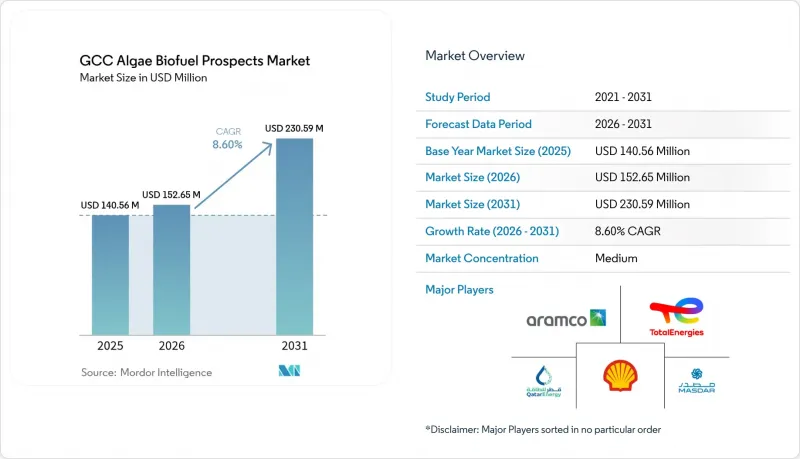
This report is Segmented by Biofuel Type (Biodiesel, Bio-jet/SAF, and More), Feedstock Species (Microalgae and Macroalgae), Cultivation System (Open Raceway Pond, Closed Photobioreactor, Hybrid, and Heterotrophic Fermentation), End-Use Application (Road Transportation, Aviation, Marine, Power Generation and CHP, and Industrial and Others), Geography (Saudi Arabia, United Arab Emirates, and More).
GCC Algae Biofuel Prospects Market Trends and Insights
Carbon-pricing pressure on oil-exporting GCC economies
Tightening carbon-pricing frameworks across the Gulf accelerates government diversification into algae-based biofuels, which safeguard export revenues in line with Vision 2030 objectives. Saudi Arabia's Public Investment Fund allocated USD 20 billion to renewable energy in 2024, with a focus on algae platforms that retrofit existing petrochemical sites. Using refinery CO2 as feedstock converts compliance costs into biomass value, granting algae producers long-term offtake contracts from emitting industries. The policy mix, therefore, anchors predictable demand, mitigates stranded asset risk, and reinforces the GCC algae biofuel market as a hedge against shrinking fossil fuel margins.
Mandated SAF blending targets for national airlines
Emirates, Qatar Airways, and Saudia must meet 5-10% SAF mandates by 2030, guaranteeing a captive aviation customer base. Emirates already holds a decade-long SAF supply agreement that earmarks 30% local algae content by 2028. Blending rules stabilise revenue for algae refiners, unlock project finance, and encourage rapid scale-up near hub airports. Because the GCC controls critical aviation transit corridors, regional producers can supply foreign carriers that refuel en route, widening the GCC algae biofuel market beyond domestic consumption.
High salinity-tolerant strain IP owned by foreign firms
Key patents covering halophilic microalgae are controlled by US and European biotech companies such as Algenol Biotech, resulting in expensive licence fees and limited technology transfer.UAE pilot plants have already faced commissioning delays while negotiating access rights, exposing the market to supply-chain risks and slowing indigenous R&D. Local universities are ramping up gene-editing programs, yet commercial strains may take 5-10 years to reach scale, restraining the growth of the GCC algae biofuel market.
Other drivers and restraints analyzed in the detailed report include:
- Seawater-based cultivation cost savings versus freshwater systems
- CO2-utilisation partnerships with steel & desalination plants
- Limited local downstream transesterification capacity
For complete list of drivers and restraints, kindly check the Table Of Contents.
Segment Analysis
The segment commanded a GCC algae biofuel market size of USD 94.67 million in 2025, with biodiesel holding a 67.35% share thanks to established fleets in road transport. Bio-jet fuel, however, is projected to record a 16.5% CAGR through 2031, spurred by mandatory 5-10% SAF mandates at Gulf hubs. Airlines accept 2-3 times the price of kerosene to meet compliance timelines, shielding producers from commodity price fluctuations and thereby elevating their margins.
Growing SAF demand widens feedstock procurement opportunities while encouraging investments in certification. Bioethanol retains a 15.20% share chiefly through ground-transport blending, and biogas stands at 8.10% because plentiful pipeline gas crowds out methane-rich digestate. Algae-derived hydrogen captures only 4.05% share but attracts R&D dollars as national energy agendas eye export-ready green molecules, indicating an emerging, though longer-dated, diversification path for the GCC algae biofuel market.
Microalgae generated 88.60% of 2025 volume and expanded at a 9.96% CAGR, cementing leadership through superior lipid yields and year-round output. Strains such as Nannochloropsis and Chlorella reach lipid concentrations of 20-30% when cultivated in high-salinity ponds along the Arabian Gulf. The GCC algae biofuel market size for microalgae is forecast to maintain its expansion on the back of ongoing genetic optimisation initiatives.
Macroalgae hold an 11.40% share due to episodic harvest windows and lower oil content; however, brown seaweed trials show promise for integrated biorefinery chemicals. Spirulina farms straddle nutrition markets, offering cross-subsidies that improve early-stage cash flow. Indigenous strain programs aim to cut royalty costs, underpinning long-term autonomy for the GCC algae biofuel industry.
Complete Report Scope:
- By Biofuel Type
- Biodiesel
- Bioethanol
- Bio-jet / SAF
- Biogas
- Bio-hydrogen & Others
- By Feedstock Species
- Microalgae (Nannochloropsis, Chlorella, Spirulina, Dunaliella, Others)
- Macroalgae (Red, Brown, Green)
- By Cultivation System
- Open Raceway Pond
- Closed Photobioreactor
- Hybrid (ORP + PBR)
- Heterotrophic Fermentation
- By End-Use Application
- Road Transportation
- Aviation (SAF)
- Marine
- Power Generation and CHP
- Industrial and Others
- By Country
- Saudi Arabia
- United Arab Emirates
- Qatar
- Kuwait
- Oman
- Bahrain
List of Companies Covered in this Report:
- Saudi Aramco
- Masdar (Biofuels JV)
- QatarEnergy
- TotalEnergies
- Shell plc
- Exxon Mobil Corp.
- Chevron Corp.
- BP plc
- Neste Oyj
- Algenol Biotech LLC
- Algae Systems LLC
- Sapphire Energy Inc.
- Qeshm Microalgae Biorefinery Co.
- Seambiotic Ltd.
- Photanol BV
- Global Bioenergies SA
- Solazyme TerraVia Legacy
- BIND BioEnergy KSA
- Desert Algae Tech UAE
- GreenFuel Tech USA
- Boeing SAF Partnerships
Additional Benefits:
- The market estimate (ME) sheet in Excel format
- 3 months of analyst support
TABLE OF CONTENTS
1 Introduction
- 1.1 Study Assumptions & Market Definition
- 1.2 Scope of the Study
2 Research Methodology
3 Executive Summary
4 Market Landscape
- 4.1 Market Overview
- 4.2 Market Drivers
- 4.2.1 Carbon-pricing pressure on oil-exporting GCC economies
- 4.2.2 Mandated SAF blending targets for national airlines
- 4.2.3 Seawater-based cultivation cost savings versus freshwater systems
- 4.2.4 CO?-utilisation partnerships with steel & desalination plants
- 4.2.5 Military demand for logistics-friendly drop-in fuels
- 4.2.6 Waste-heat integration from gas-fired power plants
- 4.3 Market Restraints
- 4.3.1 High salinity-tolerant strain IP owned by foreign firms
- 4.3.2 Limited local downstream transesterification capacity
- 4.3.3 Scarce venture funding for pre-revenue bio-refineries
- 4.3.4 Competition from ultra-low-cost solar-H2 in GCC
- 4.4 Supply-Chain Analysis
- 4.5 Regulatory Landscape
- 4.6 Technological Outlook
- 4.7 Porter's Five Forces
- 4.7.1 Bargaining Power of Suppliers
- 4.7.2 Bargaining Power of Buyers
- 4.7.3 Threat of New Entrants
- 4.7.4 Threat of Substitutes
- 4.7.5 Intensity of Rivalry
5 Market Size & Growth Forecasts
- 5.1 By Biofuel Type
- 5.1.1 Biodiesel
- 5.1.2 Bioethanol
- 5.1.3 Bio-jet / SAF
- 5.1.4 Biogas
- 5.1.5 Bio-hydrogen & Others
- 5.2 By Feedstock Species
- 5.2.1 Microalgae (Nannochloropsis, Chlorella, Spirulina, Dunaliella, Others)
- 5.2.2 Macroalgae (Red, Brown, Green)
- 5.3 By Cultivation System
- 5.3.1 Open Raceway Pond
- 5.3.2 Closed Photobioreactor
- 5.3.3 Hybrid (ORP + PBR)
- 5.3.4 Heterotrophic Fermentation
- 5.4 By End-Use Application
- 5.4.1 Road Transportation
- 5.4.2 Aviation (SAF)
- 5.4.3 Marine
- 5.4.4 Power Generation and CHP
- 5.4.5 Industrial and Others
- 5.5 By Country
- 5.5.1 Saudi Arabia
- 5.5.2 United Arab Emirates
- 5.5.3 Qatar
- 5.5.4 Kuwait
- 5.5.5 Oman
- 5.5.6 Bahrain
6 Competitive Landscape
- 6.1 Market Concentration
- 6.2 Strategic Moves (M&A, Partnerships, PPAs)
- 6.3 Market Share Analysis (Market Rank/Share for key companies)
- 6.4 Company Profiles (includes Global level Overview, Market level overview, Core Segments, Financials as available, Strategic Information, Products & Services, and Recent Developments)
- 6.4.1 Saudi Aramco
- 6.4.2 Masdar (Biofuels JV)
- 6.4.3 QatarEnergy
- 6.4.4 TotalEnergies
- 6.4.5 Shell plc
- 6.4.6 Exxon Mobil Corp.
- 6.4.7 Chevron Corp.
- 6.4.8 BP plc
- 6.4.9 Neste Oyj
- 6.4.10 Algenol Biotech LLC
- 6.4.11 Algae Systems LLC
- 6.4.12 Sapphire Energy Inc.
- 6.4.13 Qeshm Microalgae Biorefinery Co.
- 6.4.14 Seambiotic Ltd.
- 6.4.15 Photanol BV
- 6.4.16 Global Bioenergies SA
- 6.4.17 Solazyme TerraVia Legacy
- 6.4.18 BIND BioEnergy KSA
- 6.4.19 Desert Algae Tech UAE
- 6.4.20 GreenFuel Tech USA
- 6.4.21 Boeing SAF Partnerships
7 Market Opportunities & Future Outlook
- 7.1 White-space & Unmet-Need Assessment

