PUBLISHER: Mordor Intelligence | PRODUCT CODE: 2115902

PUBLISHER: Mordor Intelligence | PRODUCT CODE: 2115902
North America REIT Industry - Market Share Analysis, Industry Trends & Statistics, Growth Forecasts (2026 - 2031)
According to Mordor Intelligence, the North America REIT industry market size in 2026 is estimated at USD 292.59 billion, growing from 2025 value of USD 284.43 billion with 2031 projections showing USD 336.86 billion, growing at 2.87% CAGR over 2026-2031.
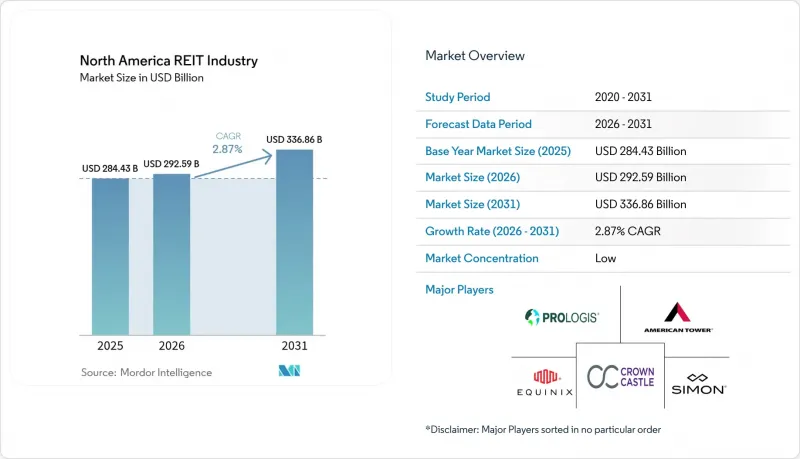
This report Segments the Industry by Sector of Exposure (Retail, Industrial, Office, and More), by REIT Structure (Equity REITs, Mortgage REITs, and Hybrid REITs), by Market-Capitalization Size (Large-Cap (>= US $10 Bn), Mid-Cap (US $3-10 Bn), and Small-Cap (<= US $3 Bn)), and by Country (United States, Canada, and Mexico). The Market Forecasts are Provided in Terms of Value (USD).
North America REIT Industry Trends and Insights
Fed Rate-Cut Expectations Reinvigorating Fundraising Pipelines
Monetary policy easing forecasts lower borrowing costs, improving net operating income margins for leveraged platforms. Equity issuance volumes rose markedly in late 2024, unlocking capital for development and acquisitions. The USD 150.9 billion CMBS maturity wall scheduled for 2025 poses risk for highly leveraged peers but offers well-capitalized REITs discounted buying opportunities . Issuers with strong balance sheets can refinance or opportunistically acquire assets before wider market repricing sets in. The policy backdrop, therefore, acts as both a catalyst and a filter, rewarding disciplined capital allocators.
Demand Surge for Last-Mile Logistics Assets
In 2024, e-commerce was responsible for over half of the growth in US retail sales, driving significant changes in fulfillment strategies. Companies are prioritizing facilities located near densely populated consumer areas, with urban infill warehouses achieving rental rates 15% higher than traditional distribution centers. Despite residual excess capacity from pandemic-era expansions, inventory restocking initiatives and supply-chain resilience programs are fueling additional demand. Prologis research projects a requirement for an extra 250-350 million sq ft of logistics space by 2030 to meet these evolving needs . Real estate investment trusts (REITs) with zoning entitlements in land-constrained metropolitan markets are leveraging their strategic positioning to maintain pricing power. These portfolios are also benefiting from consistently high occupancy rates, reflecting the growing demand for well-located logistics facilities.
Elevated Refinancing Wall Amid Tapering CMBS Appetites
Commercial mortgage-backed securities (CMBS) investors are pushing for wider credit spreads, which is reducing loan proceeds and increasing refinancing costs for maturing loans. Approximately USD 4.70 trillion in commercial real estate debt is expected to require refinancing by 2028, heightening the risk of financial distress for highly leveraged office and retail properties. Real estate investment trusts (REITs) with investment-grade credit ratings and staggered debt maturities are better positioned to manage these challenges. However, REITs that rely heavily on floating-rate debt are likely to face significant financial pressure. These entities may need to resort to issuing dilutive equity or selling assets to meet their obligations. The refinancing wave underscores the growing divide between financially stable REITs and those with weaker balance sheets.
Other drivers and restraints analyzed in the detailed report include:
- AI-Led Hyperscale Data-Center Absorption
- Institutional Capital Rotation from Office to Alternative Sectors
- Work-From-Home Pressure on CBD Office Occupancy
For complete list of drivers and restraints, kindly check the Table Of Contents.
Segment Analysis
Industrial facilities captured 25.20% of the North America REIT market share in 2025. The segment benefits from resilient supply-chain re-engineering, e-commerce fulfilment, and reshoring that lift warehouse absorption in port-proximate and inland hubs. Vacancy rates in tier-one logistics corridors have remained below 4% since 2023, underpinning rent growth outperformance. Capital recycling focuses on acquiring infill last-mile assets even at compressed yields, reflecting confidence in long-term demand durability. Data-center, healthcare, and self-storage niches continue to draw incremental capital, yet industrial remains the anchor allocation for diversified portfolios.
Residential REITs post the fastest expansion at a 5.05% CAGR through 2031, propelled by affordability constraints, rising household formation in the Sunbelt, and demographic aging bolstering senior housing. The North America REIT market size for residential platforms is projected to advance faster than any other property type as build-to-rent pipelines grow. Occupancy above 95% and steady same-property rent gains support dividend visibility. Legislative oversight poses a medium-term risk, though diversified rent affordability programs help sustain community engagement. Retail and office allocations remain under strategic review, with necessity-based retail holding steady while discretionary apparel centers lag footfall recovery.
Complete Report Scope:
- By Sector of Exposure
- Retail
- Industrial
- Office
- Residential
- Diversified
- Other Sectors
- By REIT Structure
- Equity REITs
- Mortgage REITs
- Hybrid REITs
- By Market-Capitalization Size
- Large-Cap (>= US $10 bn)
- Mid-Cap (US $3-10 bn)
- Small-Cap (<= US $3 bn)
- By Country
- United States
- Canada
- Mexico
List of Companies Covered in this Report:
- Prologis Inc.
- American Tower Corporation
- Equinix Inc.
- Crown Castle Inc.
- Simon Property Group Inc.
- Public Storage
- Welltower Inc.
- Digital Realty Trust
- Realty Income Corporation
- AvalonBay Communities
- VICI Properties
- Invitation Homes
- Camden Property Trust
- Extra Space Storage
- Sun Communities
- Alexandria Real Estate Equities
- Healthpeak Properties
- Ventas Inc.
- Iron Mountain Inc.
- CubeSmart
- Boston Properties
Additional Benefits:
- The market estimate (ME) sheet in Excel format
- 3 months of analyst support
TABLE OF CONTENTS
1 Introduction
- 1.1 Study Assumptions & Market Definition
- 1.2 Scope of the Study
2 Research Methodology
3 Executive Summary
4 Market Landscape
- 4.1 Market Overview
- 4.2 Market Drivers
- 4.2.1 Fed rate-cut expectations reinvigorating fundraising pipelines
- 4.2.2 Demand surge for last-mile logistics assets
- 4.2.3 AI-led hyperscale data-center absorption
- 4.2.4 Resilient rent growth in single-family rental portfolios
- 4.2.5 Institutional capital rotation from office to alternative sectors
- 4.2.6 Tokenization of fractional REIT units on blockchain exchanges
- 4.3 Market Restraints
- 4.3.1 Elevated refinancing wall amid tapering CMBS appetites
- 4.3.2 Work-from-home pressure on CBD office occupancy
- 4.3.3 Legislative scrutiny of housing REIT rent escalations
- 4.3.4 Grid-capacity bottlenecks delaying data-center developments
- 4.4 Value / Supply-Chain Analysis
- 4.5 Regulatory Landscape
- 4.6 Technological Outlook
- 4.7 Porter's Five Forces
- 4.7.1 Threat of New Entrants
- 4.7.2 Bargaining Power of Buyers
- 4.7.3 Bargaining Power of Suppliers
- 4.7.4 Threat of Substitutes
- 4.7.5 Competitive Rivalry
5 Market Size & Growth Forecasts (Value, USD billion)
- 5.1 By Sector of Exposure
- 5.1.1 Retail
- 5.1.2 Industrial
- 5.1.3 Office
- 5.1.4 Residential
- 5.1.5 Diversified
- 5.1.6 Other Sectors
- 5.2 By REIT Structure
- 5.2.1 Equity REITs
- 5.2.2 Mortgage REITs
- 5.2.3 Hybrid REITs
- 5.3 By Market-Capitalization Size
- 5.3.1 Large-Cap (>= US $10 bn)
- 5.3.2 Mid-Cap (US $3-10 bn)
- 5.3.3 Small-Cap (<= US $3 bn)
- 5.4 By Country
- 5.4.1 United States
- 5.4.2 Canada
- 5.4.3 Mexico
6 Competitive Landscape
- 6.1 Market Concentration
- 6.2 Strategic Moves
- 6.3 Market Share Analysis
- 6.4 Company Profiles (includes Global level Overview, Market level overview, Core Segments, Financials as available, Strategic Information, Market Rank/Share for key companies, Products & Services, and Recent Developments)
- 6.4.1 Prologis Inc.
- 6.4.2 American Tower Corporation
- 6.4.3 Equinix Inc.
- 6.4.4 Crown Castle Inc.
- 6.4.5 Simon Property Group Inc.
- 6.4.6 Public Storage
- 6.4.7 Welltower Inc.
- 6.4.8 Digital Realty Trust
- 6.4.9 Realty Income Corporation
- 6.4.10 AvalonBay Communities
- 6.4.11 VICI Properties
- 6.4.12 Invitation Homes
- 6.4.13 Camden Property Trust
- 6.4.14 Extra Space Storage
- 6.4.15 Sun Communities
- 6.4.16 Alexandria Real Estate Equities
- 6.4.17 Healthpeak Properties
- 6.4.18 Ventas Inc.
- 6.4.19 Iron Mountain Inc.
- 6.4.20 CubeSmart
- 6.4.21 Boston Properties
7 Market Opportunities & Future Outlook
- 7.1 White-space & Unmet-Need Assessment

