PUBLISHER: Mordor Intelligence | PRODUCT CODE: 2115904

PUBLISHER: Mordor Intelligence | PRODUCT CODE: 2115904
Temporary Power - Market Share Analysis, Industry Trends & Statistics, Growth Forecasts (2026 - 2031)
According to Mordor Intelligence, temporary power market size in 2026 is estimated at USD 7.02 billion, growing from 2025 value of USD 6.43 billion with 2031 projections showing USD 10.86 billion, growing at 9.14% CAGR over 2026-2031.
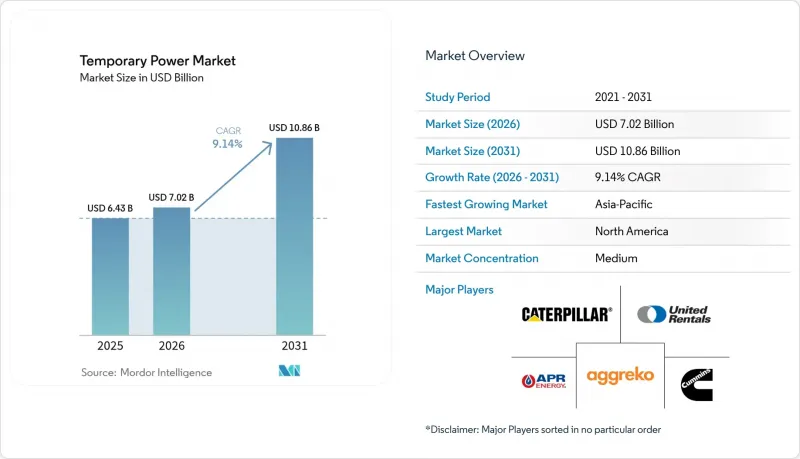
This report is Segmented by Fuel Type (Diesel, Gas, and Hybrid and Others), Power Rating (Up To 50 KW, 501 To 2, 000 KW, Above 2, 000 KW, and More), Application (Base-load/Continuous, Grid Support and Transmission Outage, and More), End-User Industry (Utilities and Power, Oil and Gas, Data Centres and ICT, and More), and Geography (North America, Europe, Asia-Pacific, South America, and Middle East and Africa)
Global Temporary Power Market Trends and Insights
Rising Frequency of Extreme-Weather Outages
Hurricanes, heat waves, wildfires, and monsoon floods are triggering longer and more frequent grid failures, causing emergency generator rentals to spike immediately after each event. Utilities and municipal authorities now pre-stage rental fleets ahead of storm seasons, allowing suppliers to reposition assets and optimize pricing. Insurance underwriters increasingly insist on on-site backup for hospitals, telecom nodes, and cold-chain warehouses. These contractual safeguards convert what was once sporadic, disaster-driven revenue into predictable seasonal demand. As climate variability intensifies, emergency power services have become an embedded line item in North America and Europe's resilience budgets.
Industrialisation & Construction Booms in Emerging Markets
Megaproject pipelines in India, Indonesia, and the Gulf Cooperation Council nations require high-capacity generators to run cranes, concrete plants, and dewatering pumps when grid feeds are absent or unstable. Local rental providers typically supply <= 500 kW units, but multinational contractors now prefer bundled packages of 1 MW and above to lower per-kilowatt logistics costs. The resulting scale shift allows global fleets to deliver containerized plants on accelerated timelines. Government stimulus for roads, ports, and industrial corridors further widens the user base, supporting steady multi-year contracts rather than one-off rentals.
Stricter Global & Local Emission Standards on Gensets
EU Stage V rules oblige particulate filters on 19-560 kW engines; India's forthcoming CPCB IV+ will extend coverage to 800 kW sets, while California is drafting Tier 5 proposals likely to surpass European stringency. Each tightening cycle raises capital costs and compresses residual values of legacy fleets, lowering return on invested capital for rental operators. Urban authorities also deploy low-emission zones that limit runtime hours, constraining traditional diesel utilization in core city projects. Although cleaner technologies can offset lost volumes, the transition demands funding and technical retraining.
Other drivers and restraints analyzed in the detailed report include:
- Ageing Grid Infrastructure & Planned Maintenance Shutdowns
- Multi-Gigawatt Data-Center "Utility-Gap" Demand
- Diesel-Price Volatility & Fuel-Logistics Disruptions
For complete list of drivers and restraints, kindly check the Table Of Contents.
Segment Analysis
Diesel sets generated 69.85% of 2025 revenue, reflecting ubiquitous service infrastructure, high energy density, and rapid response capabilities that remain indispensable on disaster sites and off-grid projects. Nevertheless, the temporary power market is pivoting toward hybrid formats that combine solar arrays, battery packs, or propane engines, a category forecast to compound at 15.05% annually through 2031. Aggreko's Martin County microgrid, built around five 1.3 MW gas generators, illustrates the scaling potential for cleaner fuels in oilfield operations. Construction firms adopting electric excavators also request low-noise solar-battery generators, signaling how equipment electrification ripples through the broader temporary power industry. As cost curves fall, hybrid packages shift from pilot deployments to core rental offerings, redesigning procurement specifications across Europe and North America.
Sets in the 501-2,000 kW band held 32.35% of 2025 revenue, serving industrial processes and sizeable construction jobs that value transportability alongside capacity. Above-2,000 kW machines deliver the highest forecast growth at 11.02% CAGR, underpinned by hyperscale data-center commissioning schedules that now demand 100 MW-plus bridging solutions. Aggreko's rollout of eight 1.5 MVA gensets for a Malaysian data-center complex exemplifies how modular design lets operators match rising load profiles without extended downtime. Meanwhile, the up-to-50 kW niche retains relevance for residential and small commercial backup, but its share erodes as telecom towers and clinics migrate to solar-battery kits.
Complete Report Scope:
- By Fuel Type
- Diesel
- Gas
- Hybrid and Others
- By Power Rating
- Up to 50 kW
- 51 to 280 kW
- 281 to 500 kW
- 501 to 2,000 kW
- Above 2,000 kW
- By Application
- Base-load/Continuous
- Grid Support and Transmission Outage
- Disaster Relief and Emergency
- Remote-area Electrification
- By End-User Industry
- Utilities and Power
- Oil and Gas
- Construction and Mining
- Manufacturing and Industrial
- Events and Entertainment
- Data Centres and ICT
- By Geography
- North America
- United States
- Canada
- Mexico
- Europe
- Germany
- United Kingdom
- France
- Italy
- NORDIC Countries
- Russia
- Rest of Europe
- Asia-Pacific
- China
- India
- Japan
- South Korea
- ASEAN Countries
- Rest of Asia-Pacific
- South America
- Brazil
- Argentina
- Rest of South America
- Middle East and Africa
- Saudi Arabia
- United Arab Emirates
- South Africa
- Egypt
- Rest of Middle East and Africa
- North America
Geography Analysis
North America's leadership in the temporary power market rests on a sophisticated rental ecosystem, deep OEM-dealer partnerships, and disciplined asset-management practices. United Rentals alone operates 1,591 locations and manages a USD 21.4 billion equipment fleet, enabling rapid mobilization when storms threaten Gulf Coast refineries or when Midwest utilities announce transformer change-outs. The United States accounts for most regional demand, while Canada supplements with LNG plant builds and hydro dam refurbishments. Mexico adds volume through nearshoring-driven factory expansions.
Asia-Pacific supplies the highest growth trajectory as governments channel multi-year funding into roads, airports, and urban transit. China drives headline volumes but faces policy-induced caps on diesel runtime in tier-1 cities, accelerating migration toward gas and hybrid sets. India adopts similar standards under CPCB IV+ yet remains a diesel stronghold for rural electrification and construction. ASEAN economies, Vietnam, Indonesia, and the Philippines, present diverse grid resiliency challenges, favoring mid-scale containerized solutions. Japanese and Korean contractors specify Stage V-equivalent engines, anchoring premium demand in the region.
Europe's market centres on emission compliance and renewable-grid integration. Germany, France, and the United Kingdom purchase large fleets of Stage V gensets paired with battery pods for low-noise urban applications. The region also pioneers hydrogen-ready mobile turbines to balance offshore wind intermittency in the North Sea. Southern and Eastern European countries grow more modestly but exhibit episodic spikes tied to hydro-dam refurbishments and gas-pipeline expansions. Across the continent, city authorities incentivize hybrid rental packages by granting low-emission-zone access, thereby shaping fleet renewal cycles.
- Aggreko PLC
- Caterpillar Inc.
- Cummins Inc.
- APR Energy Ltd
- Atlas Copco AB
- Kohler Co.
- United Rentals Inc.
- Ashtead Group plc (Sunbelt Rentals)
- Speedy Hire plc
- Generac Holdings Inc.
- Wartsila Corp.
- HIMOINSA S.L. (Yanmar)
- Rolls-Royce plc (mtu Solutions)
- Multiquip Inc.
- Doosan Portable Power
- JCB Power Products
- Energyst Rental Solutions
- Altaaqa Global Energy Services
Additional Benefits:
- The market estimate (ME) sheet in Excel format
- 3 months of analyst support
TABLE OF CONTENTS
1 Introduction
- 1.1 Study Assumptions & Market Definition
- 1.2 Scope of the Study
2 Research Methodology
3 Executive Summary
4 Market Landscape
- 4.1 Market Overview
- 4.2 Market Drivers
- 4.2.1 Rising frequency of extreme-weather outages
- 4.2.2 Industrialisation & construction booms in emerging markets
- 4.2.3 Ageing grid infrastructure & planned maintenance shutdowns
- 4.2.4 Multi-gigawatt data-centre "utility-gap" demand
- 4.2.5 Renewable integration requiring flexible peaking capacity
- 4.2.6 ESG-driven shift toward low-emission & hybrid rental fleets
- 4.3 Market Restraints
- 4.3.1 Diesel-price volatility & fuel-logistics disruptions
- 4.3.2 Stricter global & local emission standards on gensets
- 4.3.3 Battery storage & micro-grids eroding genset demand
- 4.3.4 Generator-component supply-chain bottlenecks
- 4.4 Supply-Chain Analysis
- 4.5 Regulatory Landscape
- 4.6 Technological Outlook
- 4.7 Porter's Five Forces
- 4.7.1 Bargaining Power of Suppliers
- 4.7.2 Bargaining Power of Consumers
- 4.7.3 Threat of New Entrants
- 4.7.4 Threat of Substitute Products & Services
- 4.7.5 Intensity of Competitive Rivalry
5 Market Size & Growth Forecasts
- 5.1 By Fuel Type
- 5.1.1 Diesel
- 5.1.2 Gas
- 5.1.3 Hybrid and Others
- 5.2 By Power Rating
- 5.2.1 Up to 50 kW
- 5.2.2 51 to 280 kW
- 5.2.3 281 to 500 kW
- 5.2.4 501 to 2,000 kW
- 5.2.5 Above 2,000 kW
- 5.3 By Application
- 5.3.1 Base-load/Continuous
- 5.3.2 Grid Support and Transmission Outage
- 5.3.3 Disaster Relief and Emergency
- 5.3.4 Remote-area Electrification
- 5.4 By End-User Industry
- 5.4.1 Utilities and Power
- 5.4.2 Oil and Gas
- 5.4.3 Construction and Mining
- 5.4.4 Manufacturing and Industrial
- 5.4.5 Events and Entertainment
- 5.4.6 Data Centres and ICT
- 5.5 By Geography
- 5.5.1 North America
- 5.5.1.1 United States
- 5.5.1.2 Canada
- 5.5.1.3 Mexico
- 5.5.2 Europe
- 5.5.2.1 Germany
- 5.5.2.2 United Kingdom
- 5.5.2.3 France
- 5.5.2.4 Italy
- 5.5.2.5 NORDIC Countries
- 5.5.2.6 Russia
- 5.5.2.7 Rest of Europe
- 5.5.3 Asia-Pacific
- 5.5.3.1 China
- 5.5.3.2 India
- 5.5.3.3 Japan
- 5.5.3.4 South Korea
- 5.5.3.5 ASEAN Countries
- 5.5.3.6 Rest of Asia-Pacific
- 5.5.4 South America
- 5.5.4.1 Brazil
- 5.5.4.2 Argentina
- 5.5.4.3 Rest of South America
- 5.5.5 Middle East and Africa
- 5.5.5.1 Saudi Arabia
- 5.5.5.2 United Arab Emirates
- 5.5.5.3 South Africa
- 5.5.5.4 Egypt
- 5.5.5.5 Rest of Middle East and Africa
- 5.5.1 North America
6 Competitive Landscape
- 6.1 Market Concentration
- 6.2 Strategic Moves (M&A, Partnerships, PPAs)
- 6.3 Market Share Analysis (Market Rank/Share for key companies)
- 6.4 Company Profiles (includes Global level Overview, Market level overview, Core Segments, Financials as available, Strategic Information, Products & Services, and Recent Developments)
- 6.4.1 Aggreko PLC
- 6.4.2 Caterpillar Inc.
- 6.4.3 Cummins Inc.
- 6.4.4 APR Energy Ltd
- 6.4.5 Atlas Copco AB
- 6.4.6 Kohler Co.
- 6.4.7 United Rentals Inc.
- 6.4.8 Ashtead Group plc (Sunbelt Rentals)
- 6.4.9 Speedy Hire plc
- 6.4.10 Generac Holdings Inc.
- 6.4.11 Wartsila Corp.
- 6.4.12 HIMOINSA S.L. (Yanmar)
- 6.4.13 Rolls-Royce plc (mtu Solutions)
- 6.4.14 Multiquip Inc.
- 6.4.15 Doosan Portable Power
- 6.4.16 JCB Power Products
- 6.4.17 Energyst Rental Solutions
- 6.4.18 Altaaqa Global Energy Services
7 Market Opportunities & Future Outlook
- 7.1 White-space & Unmet-Need Assessment

