PUBLISHER: Mordor Intelligence | PRODUCT CODE: 2115909

PUBLISHER: Mordor Intelligence | PRODUCT CODE: 2115909
Pneumatic Conveying Systems - Market Share Analysis, Industry Trends & Statistics, Growth Forecasts (2026 - 2031)
According to Mordor Intelligence, the pneumatic conveying systems market size is expected to grow from USD 35.23 billion in 2025 to USD 37.03 billion in 2026 and is forecast to reach USD 47.53 billion by 2031 at 5.11% CAGR over 2026-2031.
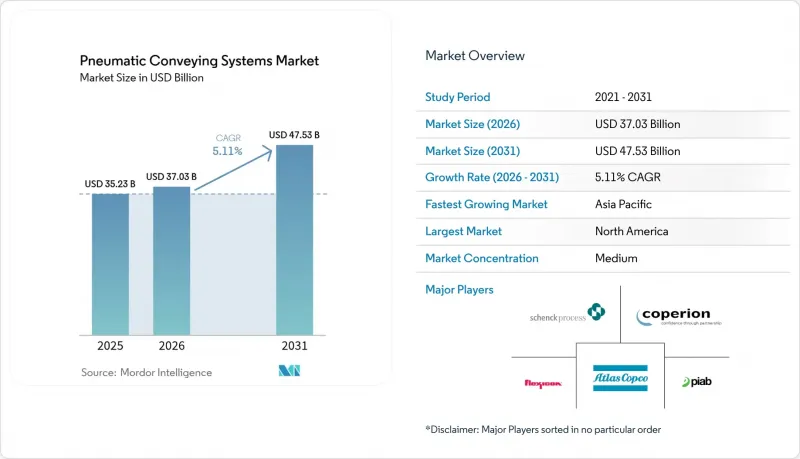
This report is Segmented by Conveying Phase (Dilute Phase, Semi-Dense Phase, and Dense Phase), Operating Principle (Positive-Pressure Conveying, Vacuum Conveying, and Combination), End-User (Food and Beverages, Chemicals and Petrochemicals, Battery Manufacturing, Plastics and Rubber, and More), and Geography (North America, Europe, Asia-Pacific, South America, and Middle East and Africa).
Global Pneumatic Conveying Systems Market Trends and Insights
Rising Demand for Energy-Efficient Bulk-Handling Automation
Compressed air systems account for nearly 10% of total industrial electricity use in developed economies, prompting manufacturers to scrutinise energy performance. Dense phase technology operates at lower velocities and uses less air, resulting in up to 50% energy savings compared to dilute phase conveying. Variable-frequency drives, smart sensors, and energy audit programs further optimize consumption, delivering typical payback periods of 18-24 months. Across 206 audited plants, analysts identified potential annual savings of USD 228 million from compressed-air optimisation. These benefits drive sustained upgrades and position dense-phase systems as a strategic lever for achieving decarbonization targets.
Stringent Food & Pharma Hygiene Regulations Favouring Closed Conveying
FDA 21 CFR 110.40 and USDA 7 CFR 58.228 require corrosion-resistant, sanitary transport surfaces, making enclosed pneumatic conveying essential for contamination-free movement of powders and tablets. Vacuum configurations provide negative pressure, preventing product escape and airborne dust, which supports cGMP documentation and HACCP compliance. ISO 8573 oil-free compressed-air standards and air-quality monitoring provisions further cement demand for sealed systems with easy-clean designs. The regulatory compliance imperative secures long-term adoption across food and pharmaceutical facilities.
High Up-Front CAPEX Versus Mechanical Conveyors
Pneumatic solutions often cost 40-60% more than belt or drag conveyors because they require compressors, filtration units, and pressure vessels. Added engineering expertise raises design fees, making justification difficult for small manufacturers that prioritise immediate cost reduction. Capital intensity slows adoption in price-sensitive regions, even when lifecycle savings in labour and hygiene compliance favour pneumatic choices.
Other drivers and restraints analyzed in the detailed report include:
- Rapid Capacity Build-Out of Battery-Materials Gigafactories
- AI-Enabled Airflow Optimization Software Cuts OPEX
- Component Erosion & Pipeline Wear Raise Maintenance Cost
For complete list of drivers and restraints, kindly check the Table Of Contents.
Segment Analysis
In 2025, the dilute phase accounted for 56.62% of the pneumatic conveying systems market, but the dense phase is projected to post the highest CAGR of 6.74% from 2026 to 2031. Dense phase operations occur at lower air velocities, reducing energy use by 30-50% while preserving fragile particles, which appeals to pharmaceutical and specialty chemical processors. Semi-dense phase serves intermediate needs and remains a niche option for moderate distances.
Growing regulatory pressure for energy efficiency and reduced dust emissions is accelerating the adoption of dense phase. Vendors enhance their offerings with advanced pressure-control valves and wear-resistant pipeline materials. As manufacturers pursue sustainability certifications, dense-phase solutions are increasingly replacing legacy dilute lines, supporting the trajectory of the pneumatic conveying systems market.
Complete Report Scope:
- By Conveying Phase
- Dilute Phase
- Semi-Dense Phase
- Dense Phase
- By Operating Principle
- Positive-Pressure Conveying
- Vacuum Conveying
- Combination (Vacuum + Pressure)
- By End-User Industry
- Food and Beverage
- Chemicals and Petrochemicals
- Pharmaceuticals
- Plastics and Rubber
- Minerals and Metals
- Battery Manufacturing
- Others
- By Geography
- North America
- United States
- Canada
- Mexico
- Europe
- Germany
- United Kingdom
- France
- Italy
- NORDIC Countries
- Russia
- Rest of Europe
- Asia-Pacific
- China
- India
- Japan
- South Korea
- ASEAN Countries
- Rest of Asia-Pacific
- South America
- Brazil
- Argentina
- Rest of South America
- Middle East and Africa
- Saudi Arabia
- United Arab Emirates
- South Africa
- Egypt
- Rest of Middle East and Africa
- North America
Geography Analysis
North America led with a 33.08% share in 2025, supported by mature food processing, expansive pharmaceutical capacity, and early uptake of AI-enabled upgrades. Stringent FDA and USDA standards create recurring retrofit cycles, while infrastructure investment incentives encourage energy-efficient revamps. United States installations dominate, followed by Canadian grain and Mexican automotive suppliers that favour sealed systems for paint and resin powders.
The Asia-Pacific is the fastest-growing region, with a 7.46% CAGR from 2026 to 2031, owing to India's National Manufacturing Policy and China's acceleration of Industry 4.0. New lithium-ion plants, plastics complexes, and packaged-food facilities specify enclosed conveying from inception, leapfrogging older open-belt alternatives. Local players, such as Tianjin FeiYun, now under the Piab Group, extend the reach of vacuum technology and shorten delivery cycles.
Europe maintains a steady uptake, anchored in ATEX explosion-protection directives and carbon-reduction targets that favour dense-phase solutions. Germany's chemicals corridor, France's food sector, and the United Kingdom's pharmaceutical industry spearhead investments, while Eastern Europe rises due to regulatory synchronisation with EU norms. Nordic manufacturers prioritise ultra-low energy consumption and source advanced, dense-phase packages to meet sustainability charters.
- Atlas Copco AB
- Schenck Process Holding GmbH
- Coperion GmbH
- Flexicon Corporation
- Cyclonaire Corporation
- Palamatic Process
- Dynamic Air Inc.
- Gericke AG
- Nilfisk Group
- Dongyang P&F
- Piab AB
- AERZEN Machinery
- Parker Hannifin Corp.
- Kice Industries
- Volkmann GmbH
- Trimech Industries
- STT Systems & Solutions
- Premier Tech Chronos
- Schrage Conveying Systems
- Telschig GmbH
Additional Benefits:
- The market estimate (ME) sheet in Excel format
- 3 months of analyst support
TABLE OF CONTENTS
1 Introduction
- 1.1 Study Assumptions & Market Definition
- 1.2 Scope of the Study
2 Research Methodology
3 Executive Summary
4 Market Landscape
- 4.1 Market Overview
- 4.2 Market Drivers
- 4.2.1 Rising demand for energy-efficient bulk-handling automation
- 4.2.2 Stringent food & pharma hygiene regulations favouring closed conveying
- 4.2.3 Rapid capacity build-out of battery-materials gigafactories
- 4.2.4 AI-enabled airflow optimisation software cuts OPEX
- 4.2.5 Growth of bio-based plastics requiring gentle transport
- 4.2.6 Increasing retrofits to comply with dust-explosion ATEX codes
- 4.3 Market Restraints
- 4.3.1 High up-front CAPEX versus mechanical conveyors
- 4.3.2 Component erosion & pipeline wear raise maintenance cost
- 4.3.3 Carbon-pricing on compressed-air electricity use
- 4.3.4 Scarcity of dense-phase design & tuning expertise
- 4.4 Supply-Chain Analysis
- 4.5 Regulatory Landscape
- 4.6 Technological Outlook
- 4.7 Porter's Five Forces
- 4.7.1 Bargaining Power of Suppliers
- 4.7.2 Bargaining Power of Consumers
- 4.7.3 Threat of New Entrants
- 4.7.4 Threat of Substitutes
- 4.7.5 Intensity of Competitive Rivalry
5 Market Size & Growth Forecasts
- 5.1 By Conveying Phase
- 5.1.1 Dilute Phase
- 5.1.2 Semi-Dense Phase
- 5.1.3 Dense Phase
- 5.2 By Operating Principle
- 5.2.1 Positive-Pressure Conveying
- 5.2.2 Vacuum Conveying
- 5.2.3 Combination (Vacuum + Pressure)
- 5.3 By End-User Industry
- 5.3.1 Food and Beverage
- 5.3.2 Chemicals and Petrochemicals
- 5.3.3 Pharmaceuticals
- 5.3.4 Plastics and Rubber
- 5.3.5 Minerals and Metals
- 5.3.6 Battery Manufacturing
- 5.3.7 Others
- 5.4 By Geography
- 5.4.1 North America
- 5.4.1.1 United States
- 5.4.1.2 Canada
- 5.4.1.3 Mexico
- 5.4.2 Europe
- 5.4.2.1 Germany
- 5.4.2.2 United Kingdom
- 5.4.2.3 France
- 5.4.2.4 Italy
- 5.4.2.5 NORDIC Countries
- 5.4.2.6 Russia
- 5.4.2.7 Rest of Europe
- 5.4.3 Asia-Pacific
- 5.4.3.1 China
- 5.4.3.2 India
- 5.4.3.3 Japan
- 5.4.3.4 South Korea
- 5.4.3.5 ASEAN Countries
- 5.4.3.6 Rest of Asia-Pacific
- 5.4.4 South America
- 5.4.4.1 Brazil
- 5.4.4.2 Argentina
- 5.4.4.3 Rest of South America
- 5.4.5 Middle East and Africa
- 5.4.5.1 Saudi Arabia
- 5.4.5.2 United Arab Emirates
- 5.4.5.3 South Africa
- 5.4.5.4 Egypt
- 5.4.5.5 Rest of Middle East and Africa
- 5.4.1 North America
6 Competitive Landscape
- 6.1 Market Concentration
- 6.2 Strategic Moves (M&A, Partnerships, PPAs)
- 6.3 Market Share Analysis (Market Rank/Share for key companies)
- 6.4 Company Profiles (includes Global level Overview, Market level overview, Core Segments, Financials as available, Strategic Information, Products & Services, and Recent Developments)
- 6.4.1 Atlas Copco AB
- 6.4.2 Schenck Process Holding GmbH
- 6.4.3 Coperion GmbH
- 6.4.4 Flexicon Corporation
- 6.4.5 Cyclonaire Corporation
- 6.4.6 Palamatic Process
- 6.4.7 Dynamic Air Inc.
- 6.4.8 Gericke AG
- 6.4.9 Nilfisk Group
- 6.4.10 Dongyang P&F
- 6.4.11 Piab AB
- 6.4.12 AERZEN Machinery
- 6.4.13 Parker Hannifin Corp.
- 6.4.14 Kice Industries
- 6.4.15 Volkmann GmbH
- 6.4.16 Trimech Industries
- 6.4.17 STT Systems & Solutions
- 6.4.18 Premier Tech Chronos
- 6.4.19 Schrage Conveying Systems
- 6.4.20 Telschig GmbH
7 Market Opportunities & Future Outlook
- 7.1 White-space & Unmet-Need Assessment

