PUBLISHER: Mordor Intelligence | PRODUCT CODE: 2115922

PUBLISHER: Mordor Intelligence | PRODUCT CODE: 2115922
Oil Storage - Market Share Analysis, Industry Trends & Statistics, Growth Forecasts (2026 - 2031)
According to Mordor Intelligence, the oil storage market size is projected to expand from USD 23.13 billion in 2025 and USD 24.49 billion in 2026 to USD 31.80 billion by 2031, registering a CAGR of 5.36% between 2026 to 2031.
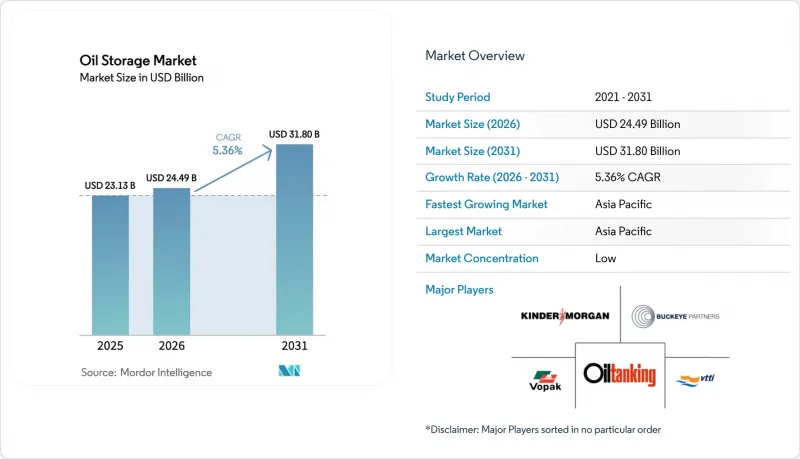
This report is Segmented by Storage Facility (Above Ground Storage Tanks and Underground Storage Tanks), Construction Material (Carbon Steel, Fiberglass-Reinforced Plastic, and More), Product Stored (Crude Oil, Aviation Fuel, and More), Capacity Range (Up To 100k M3, Above 500k M3, and More), Application (Oil and Gas Producers, Strategic Petroleum Reserve Agencies, and More) and Geography (Asia-Pacific, and More)
Global Oil Storage Market Trends and Insights
Rising Global Energy Demand and Petroleum-Product Consumption
The International Energy Agency (IEA) expects petroleum-product demand to expand by 1.8 million b/d between 2026 and 2028, led by aviation-fuel growth in Asia-Pacific and diesel in sub-Saharan Africa. Accelerating industrialization in India drove a 4.2% increase in refinery throughput during 2025, highlighted by Indian Oil Corporation's 300,000 b/d capacity addition at its Gujarat complex. Tank-farm utilization in China's Shandong province surpassed 92% in early 2025, underscoring infrastructure lag relative to crude-import quotas. Operators co-located with refinery clusters leverage resilient tariff premiums as just-in-time inventory strategies become fragile under logistics stress.
Strategic Petroleum Reserve Build-Outs by Governments
Washington allocated USD 1.5 billion in fiscal 2025 to replenish the U.S. SPR after emergency releases depleted inventories to 395 million barrels, its lowest level since 1983. Beijing's state reserve capacity reached roughly 1.0 billion barrels by end-2025, equal to 90 days of net imports, as part of a sovereignty-focused energy agenda. India's third phase added 6.5 million barrels across Chandikhol and Padur, lifting national reserves to 39 million barrels. These sovereign procurements pivot demand from spot leasing toward long-term tariffs, trimming merchant margins yet lifting baseline utilization for operators that accept lower returns. A European Commission proposal to mandate 90-day cover across member states could stimulate another 50 million barrels of capacity before 2028.
AI-Driven Predictive Tank-Farm Optimization Adoption
Vopak deployed Honeywell Forge analytics across Singapore and Rotterdam in 2025, trimming unplanned downtime by 18% and boosting annual tariff revenue by USD 12 million. Kinder Morgan piloted a digital-twin platform at the Houston Ship Channel, lowering truck-loading queues by 22 minutes per transaction. Only Tier-1 operators with access to USD 5-10 million technology budgets are scaling such systems, widening the performance gap with smaller independents.
Other drivers and restraints analyzed in the detailed report include:
- Volatile Crude-Oil Prices Increasing Commercial Stock-Holding
- Growing Refinery Throughput in Emerging Economies
- Modular Floating Storage Units for Offshore Production Zones
For complete list of drivers and restraints, kindly check the Table Of Contents.
Segment Analysis
Underground caverns controlled 61.8% of the oil storage market share in 2025, largely because salt-dome geology yields operating costs near USD 3.50 per barrel versus USD 12 for above-ground systems. China's Huangdao and Zhoushan SPR sites illustrate how coastal aquifers provide secure, surveillance-resistant capacity for sovereign reserves. Above-ground tanks, however, are projected to log a 6.4% CAGR through 2031, driven by rapid-deployment schedules, lower permitting barriers, and growing use in offshore production zones where modular designs shorten construction to 18 months.
Commercial operators favor above-ground tanks because higher product turnover and blending flexibility offset their larger evaporation losses. Fiberglass-reinforced plastic vessels are winning conversions from carbon steel in sour-crude and high-sulfur fuel-oil service thanks to reduced corrosion maintenance. The Bryan Mound and Big Hill SPR caverns in Texas remain emblematic of cavern economics, yet Vopak's 2025 installation of FRP vessels at Fujairah signals a shifting value calculus for commercial terminals.
Carbon steel accounted for 40.4% of construction-material demand within the oil storage market size in 2025 because of mature fabrication supply chains and comprehensive API 650 certification. It stays cost-advantaged for large-diameter tanks above 50 meters. Still, fiberglass-reinforced plastic is slated to grow at 6.9% CAGR as owners weigh full lifecycle economics rather than headline capex.
Lifecycle modeling shows corrosion management consumes roughly 35% of a steel tank's total ownership cost over 30 years, whereas FRP eliminates internal coating and cathodic-protection budgets. Duplex stainless steel is gaining traction in sulfur-rich crude service; Saudi Aramco opted for that material in its Yanbu expansion to anticipate Manifa blend properties. Regulatory pressure on volatile organic compound emissions further tilts European gasoline and naphtha storage toward FRP and stainless steel solutions.
Complete Report Scope:
- By Storage Facility
- Above Ground Storage Tanks (ASTs)
- Underground Storage Tanks (USTs)
- By Construction Material
- Carbon Steel
- Stainless Steel
- Fiberglass-Reinforced Plastic
- Composites and Others
- By Product Stored
- Crude Oil
- Gasoline & Naphtha
- Diesel & Middle Distillates
- Aviation Fuel
- Others (Fuel Oil, LPG, etc.)
- By Capacity Range
- Up to 100k m3
- 100 to 250k m3
- 250 to 500k m3
- Above 500k m3
- By Application
- Oil and Gas Producers
- Refineries
- Traders and Distributors
- Petrochemical and Industrial Users
- Strategic Petroleum Reserve Agencies (SPRs)
- By Geography
- North America
- United States
- Canada
- Mexico
- Europe
- Germany
- United Kingdom
- France
- Italy
- Spain
- NORDIC Countries
- Russia
- Rest of Europe
- Asia-Pacific
- China
- India
- Japan
- South Korea
- ASEAN Countries
- Australia and New Zealand
- Rest of Asia-Pacific
- South America
- Brazil
- Argentina
- Colombia
- Rest of South America
- Middle East and Africa
- Saudi Arabia
- United Arab Emirates
- South Africa
- Egypt
- Rest of Middle East and Africa
- North America
Geography Analysis
Asia-Pacific controlled 42.3% of 2025 revenue and will sustain a 5.8% CAGR through 2031, led by refinery throughput additions totaling 2.6 million b/d between 2024 and 2028. Independent refiners in Shandong province lifted storage capacity by 8 million barrels during 2024-2025, yet utilization stayed above 90% amid higher crude-import quotas. India's third SPR phase delivered 6.5 million barrels of new caverns, bringing total sovereign reserves to 39 million barrels and raising national cover to 9.5 days of 2025 net imports. ASEAN import terminals expanded to meet rising diesel and jet-fuel needs, with Singapore's Jurong Island retaining its role as a regional hub.
North America captured roughly 24% oil storage market share in 2025 and is expected to grow at a 4.9% CAGR as refinery rationalization balances Gulf Coast export-terminal expansion. Cushing, Oklahoma's working capacity sits near 76 million barrels, yet utilization averaged only 62% in mid-2025 after pipeline reversals routed Permian flows directly to coastal refineries. Kinder Morgan and Enterprise Products added 12 million barrels of new export storage around Corpus Christi and Houston to support 4 million b/d of outbound crude. The U.S. SPR refill program targets 180 million barrels by 2027, partially offsetting slower demand growth.
Europe, the Middle East, and Africa together generated 34% of the 2025 turnover with varying momentum. Europe advances at 4.2% CAGR as refinery closures moderate demand but energy-security initiatives lift strategic stocks. Vopak added 2 million barrels at Rotterdam in 2025 to serve renewable diesel and LNG-to-liquids trades. The Middle East exhibits stronger growth at 6.1% CAGR thanks to downstream integration by Saudi Aramco and ADNOC, alongside Fujairah's expansion as an inter-regional bunkering center. Africa's capacity builds cluster around Nigeria, Angola, and Egypt, balancing offshore production storage with product import terminals where domestic refining lags consumption.
- Koninklijke Vopak NV
- Oiltanking GmbH
- Vitol Tank Terminals International (VTTI)
- Kinder Morgan Inc.
- Buckeye Partners L.P.
- Magellan Midstream Partners L.P.
- NuStar Energy L.P.
- Rubis Terminal
- Horizon Terminals Ltd.
- Gulf Petrochem FZC (GP Terminal)
- McDermott International Inc.
- Fluor Corporation
- China National Petroleum Corporation
- Saudi Aramco (including Aramco Trading & Terminals)
- PetroChina Company Ltd.
- ERGIL Group
- T.F. Warren Group
- Shawcor Ltd.
- Chemie Tech Group
- INCO Group
- Heavy Engineering Industries & Shipbuilding (HEISCO)
- Stolthaven Terminals
Additional Benefits:
- The market estimate (ME) sheet in Excel format
- 3 months of analyst support
TABLE OF CONTENTS
1 Introduction
- 1.1 Study Assumptions & Market Definition
- 1.2 Scope of the Study
2 Research Methodology
3 Executive Summary
4 Market Landscape
- 4.1 Market Overview
- 4.2 Market Drivers
- 4.2.1 Rising global energy demand & petroleum-product consumption
- 4.2.2 Strategic petroleum reserve build-outs by governments
- 4.2.3 Volatile crude-oil prices increasing commercial stock-holding
- 4.2.4 Growing refinery throughput in emerging economies
- 4.2.5 AI-driven predictive tank-farm optimisation adoption
- 4.2.6 Modular floating storage units for offshore production zones
- 4.3 Market Restraints
- 4.3.1 Energy-transition-led decline in fossil-fuel share
- 4.3.2 High capex & lengthy permitting for new terminals
- 4.3.3 Cyber-insurance mandates inflating OPEX
- 4.3.4 Coastal-zoning land scarcity near deep-water ports
- 4.4 Supply-Chain Analysis
- 4.5 Regulatory Landscape
- 4.6 Technological Outlook
- 4.7 Porter's Five Forces
- 4.7.1 Bargaining Power of Suppliers
- 4.7.2 Bargaining Power of Consumers
- 4.7.3 Threat of New Entrants
- 4.7.4 Threat of Substitute Products & Services
- 4.7.5 Intensity of Competitive Rivalry
5 Market Size & Growth Forecasts
- 5.1 By Storage Facility
- 5.1.1 Above Ground Storage Tanks (ASTs)
- 5.1.2 Underground Storage Tanks (USTs)
- 5.2 By Construction Material
- 5.2.1 Carbon Steel
- 5.2.2 Stainless Steel
- 5.2.3 Fiberglass-Reinforced Plastic
- 5.2.4 Composites and Others
- 5.3 By Product Stored
- 5.3.1 Crude Oil
- 5.3.2 Gasoline & Naphtha
- 5.3.3 Diesel & Middle Distillates
- 5.3.4 Aviation Fuel
- 5.3.5 Others (Fuel Oil, LPG, etc.)
- 5.4 By Capacity Range
- 5.4.1 Up to 100k m3
- 5.4.2 100 to 250k m3
- 5.4.3 250 to 500k m3
- 5.4.4 Above 500k m3
- 5.5 By Application
- 5.5.1 Oil and Gas Producers
- 5.5.2 Refineries
- 5.5.3 Traders and Distributors
- 5.5.4 Petrochemical and Industrial Users
- 5.5.5 Strategic Petroleum Reserve Agencies (SPRs)
- 5.6 By Geography
- 5.6.1 North America
- 5.6.1.1 United States
- 5.6.1.2 Canada
- 5.6.1.3 Mexico
- 5.6.2 Europe
- 5.6.2.1 Germany
- 5.6.2.2 United Kingdom
- 5.6.2.3 France
- 5.6.2.4 Italy
- 5.6.2.5 Spain
- 5.6.2.6 NORDIC Countries
- 5.6.2.7 Russia
- 5.6.2.8 Rest of Europe
- 5.6.3 Asia-Pacific
- 5.6.3.1 China
- 5.6.3.2 India
- 5.6.3.3 Japan
- 5.6.3.4 South Korea
- 5.6.3.5 ASEAN Countries
- 5.6.3.6 Australia and New Zealand
- 5.6.3.7 Rest of Asia-Pacific
- 5.6.4 South America
- 5.6.4.1 Brazil
- 5.6.4.2 Argentina
- 5.6.4.3 Colombia
- 5.6.4.4 Rest of South America
- 5.6.5 Middle East and Africa
- 5.6.5.1 Saudi Arabia
- 5.6.5.2 United Arab Emirates
- 5.6.5.3 South Africa
- 5.6.5.4 Egypt
- 5.6.5.5 Rest of Middle East and Africa
- 5.6.1 North America
6 Competitive Landscape
- 6.1 Market Concentration
- 6.2 Strategic Moves (M&A, Partnerships, PPAs)
- 6.3 Market Share Analysis (Market Rank/Share for key companies)
- 6.4 Company Profiles (includes Global level Overview, Market level overview, Core Segments, Financials as available, Strategic Information, Products & Services, and Recent Developments)
- 6.4.1 Koninklijke Vopak NV
- 6.4.2 Oiltanking GmbH
- 6.4.3 Vitol Tank Terminals International (VTTI)
- 6.4.4 Kinder Morgan Inc.
- 6.4.5 Buckeye Partners L.P.
- 6.4.6 Magellan Midstream Partners L.P.
- 6.4.7 NuStar Energy L.P.
- 6.4.8 Rubis Terminal
- 6.4.9 Horizon Terminals Ltd.
- 6.4.10 Gulf Petrochem FZC (GP Terminal)
- 6.4.11 McDermott International Inc.
- 6.4.12 Fluor Corporation
- 6.4.13 China National Petroleum Corporation
- 6.4.14 Saudi Aramco (including Aramco Trading & Terminals)
- 6.4.15 PetroChina Company Ltd.
- 6.4.16 ERGIL Group
- 6.4.17 T.F. Warren Group
- 6.4.18 Shawcor Ltd.
- 6.4.19 Chemie Tech Group
- 6.4.20 INCO Group
- 6.4.21 Heavy Engineering Industries & Shipbuilding (HEISCO)
- 6.4.22 Stolthaven Terminals
7 Market Opportunities & Future Outlook
- 7.1 White-space & Unmet-Need Assessment

