PUBLISHER: Mordor Intelligence | PRODUCT CODE: 2115926

PUBLISHER: Mordor Intelligence | PRODUCT CODE: 2115926
Field-Erected Cooling Tower - Market Share Analysis, Industry Trends & Statistics, Growth Forecasts (2026 - 2031)
According to Mordor Intelligence, the field-Erected cooling tower market size was valued at USD 2.93 billion in 2025 and estimated to grow from USD 3.09 billion in 2026 to reach USD 4.06 billion by 2031, at a CAGR of 5.58% during the forecast period (2026-2031).
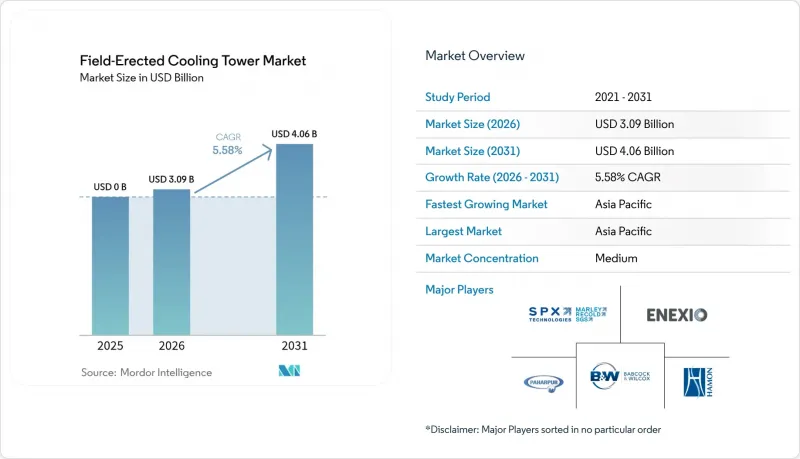
This report is Segmented by Type (Wet, Dry, and Hybrid), Design (Natural Draft, Induced Draft, and Forced Draft), End User (Power Generation, Petrochemicals, Oil and Gas, Iron and Steel and Metallurgy, Paper Mills, and Other End Users), and Geography (North America, Europe, Asia-Pacific, South America, and Middle East and Africa).
Global Field-Erected Cooling Tower Market Trends and Insights
Expansion of Thermal-Power Capacity in Emerging Economies
Surging electricity demand in India, China, and Southeast Asia is driving large-scale steam-cycle investments that rely on high-capacity, field-erected cooling towers for optimal condenser performance. NTPC's Lara Super Thermal Power Project extension in India and Nantong Tongzhou Bay ultra-supercritical units in China illustrate how mega-projects are setting new standards for tower dimensions, material durability, and water-saving capabilities. Utility engineers are increasingly mandating performance guarantees for drift loss, plume visibility, and lifecycle corrosion resistance, elevating suppliers with proven computational fluid dynamics design and in-house FRP fabrication capabilities. Local joint-venture manufacturing hubs in Gujarat, Guangxi, and Ho Chi Minh City also help reduce transport costs and expedite erection schedules, thereby strengthening regional ties between equipment vendors and engineering, procurement, and construction (EPC) contractors. With most national energy plans extending to 2030 and beyond, the driver supports a continuous, multi-year procurement pipeline in the Asia-Pacific region.
Mandatory Refurbishment of Aging Plant Cooling Assets
In North America and the European Union, the majority of fossil and nuclear generating units entered service before 1995; condenser vacuum losses, fan inefficiencies, and structural corrosion now threaten output and compliance with permit requirements. Utilities are allocating rising capital budgets to replace fill media, upgrade gearboxes, and install high-efficiency fans that restore approach temperatures without extended outages. Holtec's heat-exchanger replacement at the Palisades facility exemplifies how modular skid assemblies reduce tie-in windows and minimize costly civil works. Retrofit demand also benefits aftermarket divisions of global suppliers such as Baltimore Aircoil Company, which offer turnkey rebuild programs involving thermal audits, vibration monitoring, and drift-elimination upgrades. Because refurbishment programs often lock in service contracts for 10 years or more, this revenue stream helps temper the cyclical swings associated with new-build projects.
High Water-Use Penalties in Arid Regions
Utility commissions in Arizona, Nevada, and parts of the Middle East have introduced volumetric surcharges that punish evaporative losses above specified thresholds. For coal, gas-fired, and concentrating solar power stations located far from abundant freshwater sources, these fees erode generation margins and complicate dispatch economics. Although dry cooling offers a compliance pathway, lower heat-transfer coefficients translate into higher turbine back-pressure and reduced net output. Project sponsors, therefore, face a trade-off between water savings and fuel efficiency, which can undermine the economics of thermal projects in already challenging merchant power markets. The policy environment encourages hybridization but simultaneously raises financing hurdles for pure wet tower projects in water-stressed geographies, capping near-term field-erected cooling tower market growth potential.
Other drivers and restraints analyzed in the detailed report include:
- Tightening Plume-Abatement Norms Favouring Hybrid Towers
- Geothermal & Waste-to-Energy Projects Seeking Low-Water Dry Towers
- Raw-Material Price Volatility (Steel, FRP Resins)
For complete list of drivers and restraints, kindly check the Table Of Contents.
Segment Analysis
Wet systems contributed 66.42% of global revenue in 2025, underscoring their unrivalled thermodynamic efficiency wherever water is readily available. These units are the default choice for coal-, gas-, and biomass-fired plants aiming to maximize cycle efficiency because evaporative cooling lowers condenser temperatures well below dry-bulb levels. As a result, the field-erected cooling tower market continues to see sizeable procurement volumes for wet designs across Asia-Pacific and parts of Latin America. Yet, the hybrid subsegment is expanding at a 6.55% CAGR, benefiting from rule changes that cap visible plume height in metropolitan jurisdictions, as well as corporate water-stewardship targets linked to ESG reporting.
The premium for hybrid systems narrows every year thanks to modular add-on sections that retrofit onto existing basins and eliminate the need for separate dry coolers. Innovation in fill-material geometry and drift-eliminator blade profiles also enhances wet-mode efficiency, allowing plants in moderate climates to operate hybrids with minimal water penalty. Conversely, dry towers represent an essential solution for arid or drought-prone areas, although their high capital intensity limits their adoption outside government-mandated contexts. Suppliers are countering the cost hurdle through taller finned-tube bundles and enhanced tube-surface coatings that elevate heat-transfer coefficients, thereby reducing footprint. Collectively, these advances illustrate how product evolution, rather than outright technology substitution, sustains momentum in the field-erected cooling tower market.
Complete Report Scope:
- By Type
- Wet
- Dry
- Hybrid
- By Design
- Natural Draft
- Induced Draft
- Forced Draft
- By End User
- Power Generation
- Petrochemicals
- Oil and Gas
- Iron and Steel and Metallurgy
- Paper Mills
- Other End Users
- By Geography
- North America
- United States
- Canada
- Mexico
- Europe
- Germany
- United Kingdom
- France
- Italy
- NORDIC Countries
- Russia
- Rest of Europe
- Asia-Pacific
- China
- India
- Japan
- South Korea
- ASEAN Countries
- Rest of Asia-Pacific
- South America
- Brazil
- Argentina
- Rest of South America
- Middle East and Africa
- Saudi Arabia
- United Arab Emirates
- South Africa
- Egypt
- Rest of Middle East and Africa
- North America
Geography Analysis
The Asia-Pacific region retained 42.10% of global revenue in 2025 and is projected to grow at a 6.92% CAGR to 2031, driven by aggressive thermal power additions, industrial expansion, and supportive state investment in transmission infrastructure. China's deployment of ultra-supercritical coal units and India's pipeline of >80 GW of new capacity demonstrate the scale of ongoing demand. The rapid build-out of petrochemical clusters in Indonesia and Vietnam further amplifies the regional pull for advanced cooling technologies. Local tower fabrication yards in China's Jiangsu province and India's Maharashtra state reduce logistics costs and nurture domestic skill bases, reinforcing competitive cost advantages that keep Asia-Pacific at the heart of the field-erected cooling tower market.
North America ranks second by value, anchored by an entrenched fleet of coal and nuclear stations facing tightening environmental performance standards. The region's market grows largely through retrofits, hybrid conversions, and life-extension projects rather than fresh capacity. Environmental Protection Agency (EPA) rules on water intake and hazardous air pollutants increase compliance complexity, prompting utilities to adopt high-efficiency drift eliminators, plume control modules,, advanced water chemistry systems. Parallel demand emerges from data centre clusters in Virginia's Loudoun County and Oregon's Columbia River corridor, where utility rebates for heat reuse strengthen the business case for field-erected installations capable of district energy integration.
Europe maintains a technology-driven profile centered on decarbonization, noise abatement, and water stewardship. Most EU member states enforce stringent pollution visibility thresholds, which accelerate the adoption of hybrid towers. Hydrogen-ready gas turbines and waste-to-energy plants also require bespoke cooling solutions, a trend exemplified by Denmark's first WtE plant with integrated carbon capture in Aalborg. Composite fill packs engineered for low-chloride, high-alkalinity water accommodate recirculated condensate streams, underscoring the interplay between process chemistry and tower design.
Latin America and the Middle East & Africa together add a smaller yet important growth pocket. Brazil and Saudi Arabia are advancing combined-cycle plants tied to gas discoveries, while South Africa examines dry-cooling retrofits to mitigate freshwater shortages. Local engineering expertise remains uneven; therefore, global suppliers often partner with regional EPC firms for civil works and commissioning. Financial closure challenges arise when sovereign credit risk increases lending costs, yet multilateral climate funds are increasingly supporting hybrid or dry installations that conserve water, thereby gradually enhancing market viability in these regions.
- SPX Cooling Technologies, Inc.
- Hamon & Cie International SA
- Paharpur Cooling Towers Ltd
- Enexio Management GmbH
- Babcock & Wilcox Enterprises Inc.
- Evapco Inc.
- Towertech Cooling Systems Pvt Ltd
- Watco Group Ltd (Wacon)
- Cyrco Inc.
- Marley Flow Control Pty Ltd
- Baltimore Aircoil Company
- Johnson Controls (York Process Systems)
- Delta Cooling Towers Inc.
- Composite Cooling Solutions LP
- Nooter Eriksen (NEXT Cooling)
- Chart Industries / Howden
- Cooling Tower Depot Inc.
- Mesan Group
- Liang Chi Industry Co. Ltd
- Star Cooling Towers Pvt Ltd
Additional Benefits:
- The market estimate (ME) sheet in Excel format
- 3 months of analyst support
TABLE OF CONTENTS
1 Introduction
- 1.1 Study Assumptions & Market Definition
- 1.2 Scope of the Study
2 Research Methodology
3 Executive Summary
4 Market Landscape
- 4.1 Market Overview
- 4.2 Market Drivers
- 4.2.1 Expansion of thermal-power capacity in emerging economies
- 4.2.2 Mandatory refurbishment of aging plant cooling assets
- 4.2.3 Tightening plume-abatement norms favouring hybrid towers
- 4.2.4 Geothermal & WtE projects seeking low-water dry towers
- 4.2.5 District-scale data-centre heat-reuse cooling demand
- 4.2.6 Modular FRP components reducing on-site labour costs
- 4.3 Market Restraints
- 4.3.1 High water-use penalties in arid regions
- 4.3.2 Raw-material price volatility (steel, FRP resins)
- 4.3.3 FRP-shaft CU-deposit cracking in coastal plants
- 4.3.4 Stricter acoustic rules driving costly fan retrofits
- 4.4 Supply-Chain Analysis
- 4.5 Regulatory Landscape
- 4.6 Technological Outlook
- 4.7 Porter's Five Forces
- 4.7.1 Bargaining Power of Suppliers
- 4.7.2 Bargaining Power of Consumers
- 4.7.3 Threat of New Entrants
- 4.7.4 Threat of Substitute Products & Services
- 4.7.5 Intensity of Competitive Rivalry
5 Market Size & Growth Forecasts
- 5.1 By Type
- 5.1.1 Wet
- 5.1.2 Dry
- 5.1.3 Hybrid
- 5.2 By Design
- 5.2.1 Natural Draft
- 5.2.2 Induced Draft
- 5.2.3 Forced Draft
- 5.3 By End User
- 5.3.1 Power Generation
- 5.3.2 Petrochemicals
- 5.3.3 Oil and Gas
- 5.3.4 Iron and Steel and Metallurgy
- 5.3.5 Paper Mills
- 5.3.6 Other End Users
- 5.4 By Geography
- 5.4.1 North America
- 5.4.1.1 United States
- 5.4.1.2 Canada
- 5.4.1.3 Mexico
- 5.4.2 Europe
- 5.4.2.1 Germany
- 5.4.2.2 United Kingdom
- 5.4.2.3 France
- 5.4.2.4 Italy
- 5.4.2.5 NORDIC Countries
- 5.4.2.6 Russia
- 5.4.2.7 Rest of Europe
- 5.4.3 Asia-Pacific
- 5.4.3.1 China
- 5.4.3.2 India
- 5.4.3.3 Japan
- 5.4.3.4 South Korea
- 5.4.3.5 ASEAN Countries
- 5.4.3.6 Rest of Asia-Pacific
- 5.4.4 South America
- 5.4.4.1 Brazil
- 5.4.4.2 Argentina
- 5.4.4.3 Rest of South America
- 5.4.5 Middle East and Africa
- 5.4.5.1 Saudi Arabia
- 5.4.5.2 United Arab Emirates
- 5.4.5.3 South Africa
- 5.4.5.4 Egypt
- 5.4.5.5 Rest of Middle East and Africa
- 5.4.1 North America
6 Competitive Landscape
- 6.1 Market Concentration
- 6.2 Strategic Moves (M&A, Partnerships, PPAs)
- 6.3 Market Share Analysis (Market Rank/Share for key companies)
- 6.4 Company Profiles (includes Global level Overview, Market level overview, Core Segments, Financials as available, Strategic Information, Products & Services, and Recent Developments)
- 6.4.1 SPX Cooling Technologies, Inc.
- 6.4.2 Hamon & Cie International SA
- 6.4.3 Paharpur Cooling Towers Ltd
- 6.4.4 Enexio Management GmbH
- 6.4.5 Babcock & Wilcox Enterprises Inc.
- 6.4.6 Evapco Inc.
- 6.4.7 Towertech Cooling Systems Pvt Ltd
- 6.4.8 Watco Group Ltd (Wacon)
- 6.4.9 Cyrco Inc.
- 6.4.10 Marley Flow Control Pty Ltd
- 6.4.11 Baltimore Aircoil Company
- 6.4.12 Johnson Controls (York Process Systems)
- 6.4.13 Delta Cooling Towers Inc.
- 6.4.14 Composite Cooling Solutions LP
- 6.4.15 Nooter Eriksen (NEXT Cooling)
- 6.4.16 Chart Industries / Howden
- 6.4.17 Cooling Tower Depot Inc.
- 6.4.18 Mesan Group
- 6.4.19 Liang Chi Industry Co. Ltd
- 6.4.20 Star Cooling Towers Pvt Ltd
7 Market Opportunities & Future Outlook
- 7.1 White-Space & Unmet-Need Assessment

