PUBLISHER: Mordor Intelligence | PRODUCT CODE: 2115932

PUBLISHER: Mordor Intelligence | PRODUCT CODE: 2115932
Intelligent Network - Market Share Analysis, Industry Trends & Statistics, Growth Forecasts (2026 - 2031)
According to Mordor Intelligence, the intelligent network market size was valued at USD 3.81 billion in 2025 and estimated to grow from USD 4.56 billion in 2026 to reach USD 11.13 billion by 2031, at a CAGR of 19.57% during the forecast period (2026-2031).
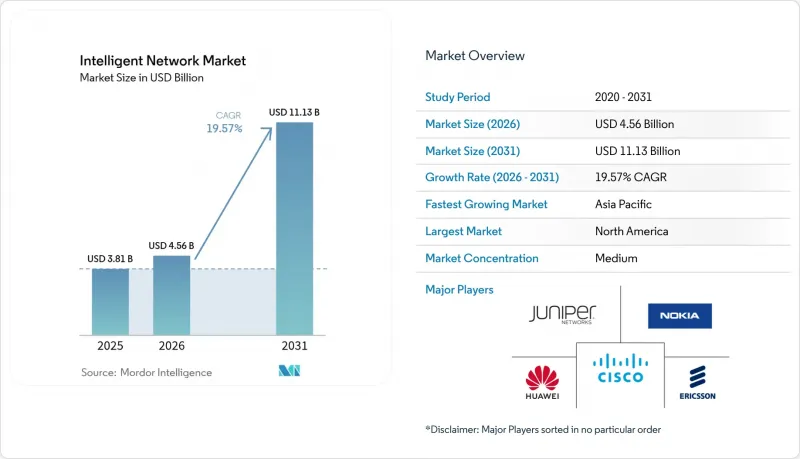
This report is Segmented by Component (Hardware, Software and Services), Deployment Mode (On-Premises, Cloud / SaaS), Enterprise Size (Small and Medium-Sized Enterprises, Large Enterprises), Application (Network Analytics, Network Automation and Orchestration and More), End-User and Geography. The Market Forecasts are Provided in Terms of Value (USD).
Global Intelligent Network Market Trends and Insights
5G and IoT Traffic Surge Drives Infrastructure Modernization
Mobile data traffic is exploding on newly built 5G networks, with average use in the Gulf expected to hit 30 GB per smartphone in 2025. Operators therefore deploy intelligent networking that reallocates capacity in real time. Ericsson's intent-based automation project with ATandT illustrates the shift, as the 5G Standalone core now prioritizes slices without manual intervention. Enterprises are also adopting 5G to power smart factories and autonomous vehicles, creating new revenue paths for carriers that embrace AI orchestration.
Exponential Data-Center Bandwidth Demand Reshapes Network Architecture
Hyperscalers such as Lumen Technologies have secured USD 5 billion in AI connectivity contracts, doubling inter-city fiber over the next five years. Arista's Etherlink AI spine supports 460 Tbps, enabling XPU clusters beyond 100,000 nodes. To meet training loads, operators migrate from 400 G to 800 G and even 1.6 T optics while adopting rollable-ribbon fiber that boosts duct capacity.
Scarcity of AI-Networking Skill Sets Limits Rollouts
High demand for engineers fluent in AI frameworks and routing protocols is pushing wages up and elongating project timelines. Managed services and no-code automation mitigate the gap but only partially.
Other drivers and restraints analyzed in the detailed report include:
- CSP Pivot to Cloud-Native Cores Accelerates Automation
- Telco "AI Factories" Emerge for Sovereign AI Workloads
- Legacy Integration Complexity Slows Transformation
For complete list of drivers and restraints, kindly check the Table Of Contents.
Segment Analysis
Software automation captured 41.35% of revenue in 2025 and remains the anchor of the intelligent network market. Vendors deliver closed-loop orchestration, anomaly detection and capacity prediction as modular services that shorten mean-time-to-repair. Hardware retains relevance for high-performance routing, though price pressures intensify as white-box alternatives rise. Professional services grow fastest at 23.3% CAGR, covering design, multi-vendor integration and continuous optimization. Their contribution to the intelligent network market size is projected to climb steadily through 2031, reflecting buyers' need for specialized expertise.
In the second half of the decade, platform-centric models will shift revenue mix further toward subscriptions. Cisco reported 100% security-software growth after recent acquisitions, signalling how incumbents can pivot. Start-ups such as NextHop AI focus on hyperscale scenarios that traditional appliances cannot address, giving operators diversified sourcing options.
Cloud/SaaS models accounted for 54.25% of the intelligent network market in 2025 and will expand at 27.1% CAGR, as organizations consume orchestration, analytics and policy as turnkey services. Elastic consumption suits unpredictable AI traffic bursts and sidesteps capital budgeting hurdles. Hybrid models are gaining traction among firms with sovereignty mandates, keeping critical control planes on-premises. This pragmatic mix lets buyers leverage cloud scalability while maintaining compliance. On-premises deployments, although slower, still matter for ultra-low-latency industrial sites.
Advanced SaaS offerings also update autonomously, easing skills shortages while bringing new capabilities online faster. Vendors embed AIOps into service layers, generating predictive insights that reduce ticket volume by up to 50%. Consequently, the intelligent network market share for legacy perpetual-license appliances will likely shrink each year of the forecast period.
Complete Report Scope:
- By Component
- Hardware
- Software
- Services
- By Deployment Mode
- On-Premises
- Cloud / SaaS
- By Enterprise Size
- Small and Medium-sized Enterprises
- Large Enterprises
- By Application
- Network Analytics
- Network Automation and Orchestration
- Intent-based Networking
- Traffic Management and Policy
- Self-optimising Networks (SON)
- By End-user
- Telecom Service Providers
- Cloud / Hyperscale Providers
- Managed Network Service Providers
- Enterprises and Verticals
- By Geography
- North America
- United States
- Canada
- Mexico
- South America
- Brazil
- Argentina
- Rest of South America
- Europe
- Italy
- United Kingdom
- Germany
- France
- Rest of Europe
- Asia-Pacific
- India
- China
- Japan
- Rest of Asia-Pacific
- Middle East and Africa
- Middle East
- Israel
- Saudi Arabia
- United Arab Emirates
- Rest of Middle East
- Africa
- South Africa
- Nigeria
- Kenya
- Rest of Africa
- Middle East
- North America
Geography Analysis
North America commands 36.65% of 2025 revenue, fuelled by hyperscaler CAPEX and early adoption of AI orchestration. Lumen's USD 5 billion AI network contract pipeline highlights sustained investment. Yet the region's forecast 17.1% CAGR trails global averages as market penetration rises, and competitive intensity grows.
APAC is the engine of future expansion, posting 23.5% CAGR. China's national AI strategy and large-scale 5G rollouts underpin demand. Singapore and the UAE are creating sovereign AI hubs that require ultra-secure, low-latency connectivity. Regional mobile penetration will reach 50% by 2030, adding 751 million new subscribers and necessitating AI-driven capacity scaling. Major projects such as China Mobile's terabit optical backbone show commitment to next-generation infrastructure.
Europe maintains moderate growth while leading sustainability mandates. EE's cell-sleep initiative cut energy use materially, showcasing how green regulation encourages intelligent architectures. Telefonica's program to achieve level 4 autonomy across EU networks sets the template for operational excellence. However, strict data-sovereignty laws complicate cross-border service delivery, slowing certain pan-regional offerings.
- Cisco Systems, Inc.
- Huawei Technologies Co., Ltd.
- Telefonaktiebolaget LM Ericsson
- Nokia Corporation
- Juniper Networks, Inc.
- Hewlett Packard Enterprise Company
- Dell Technologies Inc.
- Ciena Corporation
- IBM Corporation
- Lumen Technologies, Inc.
- Tech Mahindra Limited
- Arista Networks, Inc.
- Ribbon Communications Inc.
- Sandvine Incorporated ULC
- Aria Networks Ltd.
- Colt Technology Services Group Ltd.
Additional Benefits:
- The market estimate (ME) sheet in Excel format
- 3 months of analyst support
TABLE OF CONTENTS
1 INTRODUCTION
- 1.1 Study Assumptions and Market Definition
- 1.2 Scope of the Study
2 RESEARCH METHODOLOGY
3 EXECUTIVE SUMMARY
4 MARKET LANDSCAPE
- 4.1 Market Overview
- 4.2 Market Drivers
- 4.2.1 5G and IoT traffic surge
- 4.2.2 Exponential data-center bandwidth demand
- 4.2.3 CSP pivot to cloud-native cores
- 4.2.4 Telco AI factoriesfor sovereign AI workloads
- 4.2.5 Energy-efficiency mandates (Scope-3) on networks
- 4.2.6 Open-API monetisation (Network-as-Code)
- 4.3 Market Restraints
- 4.3.1 Scarcity of AI-networking skill sets
- 4.3.2 Legacy integration complexity
- 4.3.3 Power-draw of AI accelerators inflating OPEX
- 4.3.4 Data-sovereignty and cross-border traffic rules
- 4.4 Value / Supply-Chain Analysis
- 4.5 Regulatory Landscape
- 4.6 Technological Outlook
- 4.7 Porter's Five Forces Analysis
- 4.7.1 Threat of New Entrants
- 4.7.2 Bargaining Power of Buyers
- 4.7.3 Bargaining Power of Suppliers
- 4.7.4 Threat of Substitutes
- 4.7.5 Competitive Rivalry
5 TECHNOLOGY SNAPSHOT
6 MARKET SIZE AND GROWTH FORECASTS (VALUE)
- 6.1 By Component
- 6.1.1 Hardware
- 6.1.2 Software
- 6.1.3 Services
- 6.2 By Deployment Mode
- 6.2.1 On-Premises
- 6.2.2 Cloud / SaaS
- 6.3 By Enterprise Size
- 6.3.1 Small and Medium-sized Enterprises
- 6.3.2 Large Enterprises
- 6.4 By Application
- 6.4.1 Network Analytics
- 6.4.2 Network Automation and Orchestration
- 6.4.3 Intent-based Networking
- 6.4.4 Traffic Management and Policy
- 6.4.5 Self-optimising Networks (SON)
- 6.5 By End-user
- 6.5.1 Telecom Service Providers
- 6.5.2 Cloud / Hyperscale Providers
- 6.5.3 Managed Network Service Providers
- 6.5.4 Enterprises and Verticals
- 6.6 By Geography
- 6.6.1 North America
- 6.6.1.1 United States
- 6.6.1.2 Canada
- 6.6.1.3 Mexico
- 6.6.2 South America
- 6.6.2.1 Brazil
- 6.6.2.2 Argentina
- 6.6.2.3 Rest of South America
- 6.6.3 Europe
- 6.6.3.1 Italy
- 6.6.3.2 United Kingdom
- 6.6.3.3 Germany
- 6.6.3.4 France
- 6.6.3.5 Rest of Europe
- 6.6.4 Asia-Pacific
- 6.6.4.1 India
- 6.6.4.2 China
- 6.6.4.3 Japan
- 6.6.4.4 Rest of Asia-Pacific
- 6.6.5 Middle East and Africa
- 6.6.5.1 Middle East
- 6.6.5.1.1 Israel
- 6.6.5.1.2 Saudi Arabia
- 6.6.5.1.3 United Arab Emirates
- 6.6.5.1.4 Rest of Middle East
- 6.6.5.2 Africa
- 6.6.5.2.1 South Africa
- 6.6.5.2.2 Nigeria
- 6.6.5.2.3 Kenya
- 6.6.5.2.4 Rest of Africa
- 6.6.5.1 Middle East
- 6.6.1 North America
7 COMPETITIVE LANDSCAPE
- 7.1 Market Concentration
- 7.2 Strategic Moves
- 7.3 Market Share Analysis
- 7.4 Company Profiles (includes Global level Overview, Market level overview, Core Segments, Financials as available, Strategic Information, Market Rank/Share for key companies, Products and Services, and Recent Developments)
- 7.4.1 Cisco Systems, Inc.
- 7.4.2 Huawei Technologies Co., Ltd.
- 7.4.3 Telefonaktiebolaget LM Ericsson
- 7.4.4 Nokia Corporation
- 7.4.5 Juniper Networks, Inc.
- 7.4.6 Hewlett Packard Enterprise Company
- 7.4.7 Dell Technologies Inc.
- 7.4.8 Ciena Corporation
- 7.4.9 IBM Corporation
- 7.4.10 Lumen Technologies, Inc.
- 7.4.11 Tech Mahindra Limited
- 7.4.12 Arista Networks, Inc.
- 7.4.13 Ribbon Communications Inc.
- 7.4.14 Sandvine Incorporated ULC
- 7.4.15 Aria Networks Ltd.
- 7.4.16 Colt Technology Services Group Ltd.
8 MARKET OPPORTUNITIES AND FUTURE OUTLOOK
- 8.1 White-space and Unmet-need Assessment

