PUBLISHER: Mordor Intelligence | PRODUCT CODE: 2116002

PUBLISHER: Mordor Intelligence | PRODUCT CODE: 2116002
Ring Main Unit (RMU) - Market Share Analysis, Industry Trends & Statistics, Growth Forecasts (2026 - 2031)
According to Mordor Intelligence, the ring main unit market size reaches USD 3.08 billion in 2026 and is forecast to grow to USD 4.26 billion by 2031 at a 6.72% CAGR, underscoring how medium-voltage distribution architecture is pivoting toward SF6-free insulation, digital automation, and distributed-generation readiness.
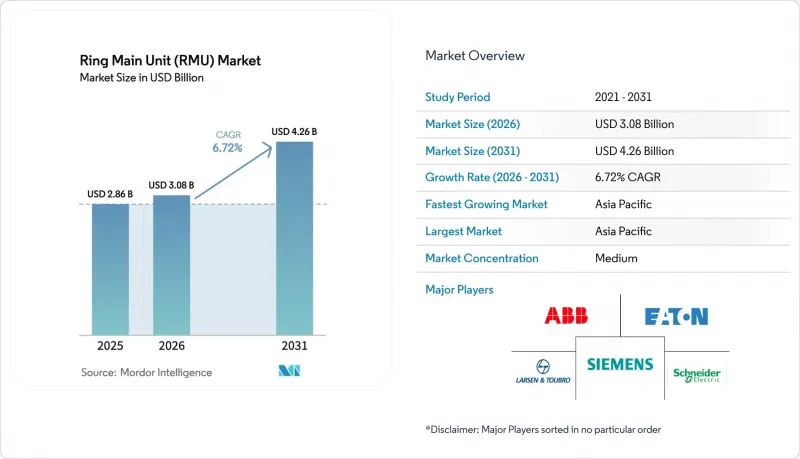
This report is Segmented by Insulation Type (Gas-Insulated, Air-Insulated, and More), Installation (Outdoor and Indoor), Voltage Rating (Up To 15 KV, 16 To 25 KV, and Above 25 KV), Automation Level (Conventional and Smart/Motorized/Digital), End-User (Distribution Utilities, Industrial Facilities, and More), and Geography (North America, Europe, Asia-Pacific, South America, and Middle East and Africa).
Global Ring Main Unit (RMU) Market Trends and Insights
SF6-Free RMU Adoption Accelerated by EU F-Gas Phase-Out
Regulation (EU) 2024/573 bans SF6-insulated switchgear up to 24 kV from January 2026 and up to 52 kV by January 2030, forcing utilities to migrate toward vacuum interrupters and solid dielectrics. Suppliers such as ABB and Eaton have already commercialized SF6-free RMUs that replicate 25 kA short-circuit ratings while removing fluorinated gases. Certification costs for technicians handling residual SF6 equipment also climb under Regulation 2025/627, accelerating fleet turnover. Across the Atlantic, Pacific Gas & Electric now specifies vacuum technology for any secondary substation commissioned after 2024 in anticipation of future EPA restrictions. Newly revised IEC 62271 series tests assure interoperability across the emerging dielectric mix, further derisking adoption.
Urban Underground Distribution Upgrades in Asia Mega-Cities
State Grid Corporation of China directs CNY 520 billion (USD 73 billion) per year to bury 10 kV feeders in Beijing, Shanghai, Shenzhen, and Guangzhou, curbing visual clutter and storm damage. India's Revamped Distribution Sector Scheme allocates INR 3 lakh crore (USD 36 billion) through 2027 for similar ring-main topologies in Delhi, Mumbai, and Bangalore. ASEAN utilities echo the trend as Singapore enforces 100% underground distribution. Compact indoor RMUs occupy 40-60% less footprint than outdoor enclosures, fitting basements beneath high-rise developments. High downtown land prices of USD 10,000 per m2 in Hong Kong and Tokyo make below-grade installations financially rational despite higher switchgear unit prices.
High Cap-Ex & Limited Local Assembly in Sub-Saharan Africa
Electrification lags at 48% and utilities prioritize generation over distribution, leaving RMU adoption restrained by unit prices of USD 15,000-50,000 versus USD 5,000-10,000 for pole-mounted gear. Ninety percent of switchgear is imported, exposing projects to currency swings such as Nigeria's 40% naira devaluation in 2024. Local assembly remains nascent, with only a few Schneider Electric and ABB facilities serving South Africa and Kenya. Skills shortages prolong commissioning by 6-12 months, eroding investor confidence.
Other drivers and restraints analyzed in the detailed report include:
- Grid-Automation Investments by North-American Utilities
- Medium-Voltage Collector Circuits in Renewable Parks
- SF6 Phase-Out Transition-Cost Uncertainty for Utilities
For complete list of drivers and restraints, kindly check the Table Of Contents.
Segment Analysis
Gas-insulated units held 58.2% of 2025 revenue. Solid and SF6-free designs, however, will advance at a 9.5% CAGR, pushing gas-insulated share below 50% by 2028. Eaton's Xiria achieves 630 A continuous current and 25 kA short-circuit within a footprint 20% smaller than gas units, appealing where vault space is fixed. Utilities face retraining costs of USD 10,000-20,000 per maintenance crew for vacuum diagnostics. The ring main unit market share for solid dielectrics is forecast to reach 35% in 2031, up from 18% in 2025.
Gas-insulated incumbency remains strong in high-fault networks up to 40 kA, but voluntary SF6 bans in California and Japan signal a global pivot. Air-insulated RMUs thrive in dust-free rural networks under 20 kA, while oil-insulated variants edge toward obsolescence. Lifecycle carbon disclosures, now required by many European tenders, are hastening the shift.
Outdoor RMUs generated 57.5% of 2025 sales, yet indoor installations will compound at 8.4% through 2031, buoyed by real-estate premiums in dense cities. When land acquisition, fencing, and aesthetic mitigation are included, indoor options often undercut the outdoor total installed cost. Singapore already records an indoor penetration above 90%. In contrast, the ring main unit market size for outdoor gear remains higher in the GCC because ventilation and land availability outweigh space constraints.
Schneider's SM6 series (0.8 m2 per feeder bay) exemplifies how compact indoor gear enables retrofit without civil expansion. IEEE C37.20.7 environmental tests add USD 5,000-10,000 certification overhead for outdoor variants exposed to solar radiation, sand, and seismic risk. As urban ordinances ban visible equipment, utilities in Europe, Japan, and South Korea pivot to indoor.
Complete Report Scope:
- By Insulation Type
- Gas-Insulated
- Air-Insulated
- Oil-Insulated
- Solid/SF6-Free Dielectric
- By Installation
- Outdoor
- Indoor
- By Voltage Rating
- Up to 15 kV
- 16 to 25 kV
- Above 25 kV (incl. 36/40.5 kV)
- By Automation Level
- Conventional
- Smart/Motorized/Digital RMU
- By End-User
- Distribution Utilities
- Industrial Facilities
- Commercial and Residential Infrastructure
- Renewable Energy and Micro-grids
- By Geography
- North America
- United States
- Canada
- Mexico
- Europe
- United Kingdom
- Germany
- France
- Spain
- Nordic Countries
- Russia
- Rest of Europe
- Asia-Pacific
- China
- India
- Japan
- South Korea
- ASEAN Countries
- Rest of Asia-Pacific
- South America
- Brazil
- Argentina
- Colombia
- Rest of South America
- Middle East and Africa
- United Arab Emirates
- Saudi Arabia
- South Africa
- Egypt
- Rest of Middle East and Africa
- North America
Geography Analysis
Asia-Pacific generated 43.2% of 2025 revenue and will persist at an 8.4% CAGR, driven by China's annual CNY 520 billion (USD 73 billion) grid budget and India's INR 3 lakh crore (USD 36 billion) modernization scheme. Solid and SF6-free adoption in the region is forecast to reach 25% of sales by 2028. Japan and South Korea retrofit substations with smart RMUs to align with METI guidelines on fluorinated-gas alternatives. Europe, the second-largest market, accelerates due to the 2026 and 2030 SF6 bans. Germany, France, Spain, and the Nordics already see SF6-free products capturing 40% of 2025 new installations. Ofgem's RIIO-ED2 in the U.K. links expenditure to outage penalties, spurring digital RMU uptake.
North America benefits from USD 3.5 billion in annual DOE funding but remains fragmented by state regulation. Mexico's CFE will spend MXN 80 billion (USD 4.7 billion) in 2024 on ring-main upgrades in urban centers. South America wrestles with 12-18-month certification lags that keep gas-insulated dominance intact. Brazil's ring main unit market will, however, recover as ANEEL channels R$20 billion (USD 4 billion) into distribution 2024-2025. The Middle East invests heavily, with DEWA allocating AED 86 billion (USD 23.4 billion) and SEC spending SAR 50 billion (USD 13.3 billion) yearly on 33-36 kV loops suited to giga-projects. Sub-Saharan Africa remains constrained by high cap-ex and currency volatility. Yet localized assembly efforts by CHINT and TGOOD, plus IFC-backed electrification funding, could unlock latent demand if cost curves fall.
- ABB Ltd.
- Schneider Electric SE
- Siemens AG
- Eaton Corporation plc
- Lucy Electric Ltd.
- Ormazabal (VELATIA)
- Larsen & Toubro Ltd.
- GE Grid Solutions
- ENTEC Electric & Electronic Co. Ltd.
- LS Electric Co. Ltd.
- Fuji Electric Co. Ltd.
- Hyundai Electric & Energy Systems Co. Ltd.
- CHINT Group Co. Ltd.
- Tavrida Electric
- TGOOD Global Ltd.
- Meidensha Corp.
- Shanghai Electric Group Co. Ltd.
- Alfanar Group
- Havells India Ltd.
- Hager Group
Additional Benefits:
- The market estimate (ME) sheet in Excel format
- 3 months of analyst support
TABLE OF CONTENTS
1 Introduction
- 1.1 Study Assumptions & Market Definition
- 1.2 Scope of the Study
2 Research Methodology
3 Executive Summary
4 Market Landscape
- 4.1 Market Overview
- 4.2 Market Drivers
- 4.2.1 SF6-free RMU Adoption Accelerated by EU F-Gas Phase-Out
- 4.2.2 Urban Underground Distribution Upgrades in Asia Mega-Cities
- 4.2.3 Grid-Automation Investments by North-American Utilities
- 4.2.4 Medium-Voltage Collector Circuits in Renewable Parks
- 4.2.5 Sub-Transmission Retrofit Programs across GCC States
- 4.2.6 High-Reliability Demand from Hyperscale Data-Centres
- 4.3 Market Restraints
- 4.3.1 High Cap-Ex & Limited Local Assembly in Sub-Saharan Africa
- 4.3.2 SF6 Phase-Out Transition-Cost Uncertainty for Utilities
- 4.3.3 Lengthy Utility Type-Approval Cycles in South America
- 4.3.4 Vacuum Interrupter & Semiconductor Supply Volatility
- 4.4 Supply-Chain Analysis
- 4.5 Regulatory Outlook
- 4.6 Technological Outlook
- 4.7 Porter's Five Forces
- 4.7.1 Bargaining Power of Suppliers
- 4.7.2 Bargaining Power of Buyers
- 4.7.3 Threat of New Entrants
- 4.7.4 Threat of Substitutes
- 4.7.5 Competitive Rivalry
5 Market Size & Growth Forecasts
- 5.1 By Insulation Type
- 5.1.1 Gas-Insulated
- 5.1.2 Air-Insulated
- 5.1.3 Oil-Insulated
- 5.1.4 Solid/SF6-Free Dielectric
- 5.2 By Installation
- 5.2.1 Outdoor
- 5.2.2 Indoor
- 5.3 By Voltage Rating
- 5.3.1 Up to 15 kV
- 5.3.2 16 to 25 kV
- 5.3.3 Above 25 kV (incl. 36/40.5 kV)
- 5.4 By Automation Level
- 5.4.1 Conventional
- 5.4.2 Smart/Motorized/Digital RMU
- 5.5 By End-User
- 5.5.1 Distribution Utilities
- 5.5.2 Industrial Facilities
- 5.5.3 Commercial and Residential Infrastructure
- 5.5.4 Renewable Energy and Micro-grids
- 5.6 By Geography
- 5.6.1 North America
- 5.6.1.1 United States
- 5.6.1.2 Canada
- 5.6.1.3 Mexico
- 5.6.2 Europe
- 5.6.2.1 United Kingdom
- 5.6.2.2 Germany
- 5.6.2.3 France
- 5.6.2.4 Spain
- 5.6.2.5 Nordic Countries
- 5.6.2.6 Russia
- 5.6.2.7 Rest of Europe
- 5.6.3 Asia-Pacific
- 5.6.3.1 China
- 5.6.3.2 India
- 5.6.3.3 Japan
- 5.6.3.4 South Korea
- 5.6.3.5 ASEAN Countries
- 5.6.3.6 Rest of Asia-Pacific
- 5.6.4 South America
- 5.6.4.1 Brazil
- 5.6.4.2 Argentina
- 5.6.4.3 Colombia
- 5.6.4.4 Rest of South America
- 5.6.5 Middle East and Africa
- 5.6.5.1 United Arab Emirates
- 5.6.5.2 Saudi Arabia
- 5.6.5.3 South Africa
- 5.6.5.4 Egypt
- 5.6.5.5 Rest of Middle East and Africa
- 5.6.1 North America
6 Competitive Landscape
- 6.1 Market Concentration
- 6.2 Strategic Moves (M&A, Partnerships, PPAs)
- 6.3 Market Share Analysis (Market Rank/Share for key companies)
- 6.4 Company Profiles (includes Global-level Overview, Market-level Overview, Core Segments, Financials as available, Strategic Information, Market Rank/Share, Products & Services, Recent Developments)
- 6.4.1 ABB Ltd.
- 6.4.2 Schneider Electric SE
- 6.4.3 Siemens AG
- 6.4.4 Eaton Corporation plc
- 6.4.5 Lucy Electric Ltd.
- 6.4.6 Ormazabal (VELATIA)
- 6.4.7 Larsen & Toubro Ltd.
- 6.4.8 GE Grid Solutions
- 6.4.9 ENTEC Electric & Electronic Co. Ltd.
- 6.4.10 LS Electric Co. Ltd.
- 6.4.11 Fuji Electric Co. Ltd.
- 6.4.12 Hyundai Electric & Energy Systems Co. Ltd.
- 6.4.13 CHINT Group Co. Ltd.
- 6.4.14 Tavrida Electric
- 6.4.15 TGOOD Global Ltd.
- 6.4.16 Meidensha Corp.
- 6.4.17 Shanghai Electric Group Co. Ltd.
- 6.4.18 Alfanar Group
- 6.4.19 Havells India Ltd.
- 6.4.20 Hager Group
7 Market Opportunities & Future Outlook
- 7.1 White-Space & Unmet-Need Assessment

