PUBLISHER: Mordor Intelligence | PRODUCT CODE: 2116011

PUBLISHER: Mordor Intelligence | PRODUCT CODE: 2116011
Wireless Infrastructure Monitoring - Market Share Analysis, Industry Trends & Statistics, Growth Forecasts (2026 - 2031)
According to Mordor Intelligence, the wireless infrastructure monitoring market size is expected to grow from USD 4.72 billion in 2025 to USD 5.32 billion in 2026 and is forecast to reach USD 9.69 billion by 2031 at 12.74% CAGR over 2026-2031.
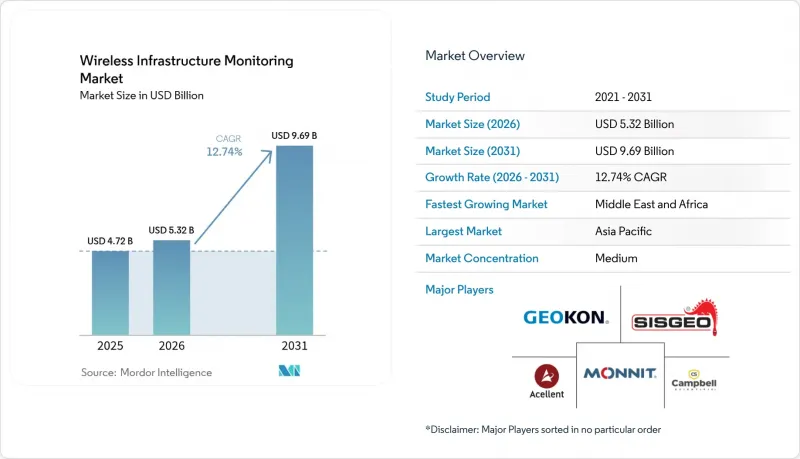
This report is Segmented by Component (Hardware, Software and More), Connectivity Technology (Wi-Fi, and More), Application (Structural Monitoring, and More), Infrastructure Type (Bridges and Tunnels, and More), Sensor Type (Strain and Stress Sensors, and More), End-User (Civil Infrastructure Owners and Operators, and More), and Geography. The Market Forecasts are Provided in Terms of Value (USD).
Global Wireless Infrastructure Monitoring Market Trends and Insights
5G roll-outs demanding tower integrity verification
The densification of 5G networks places heavier wind and vibrational loads on existing towers. Operators now embed continuous structural health monitoring to detect early fatigue, optimize maintenance scheduling, and ensure regulatory compliance. Real-time analytics have trimmed tower energy consumption by 20% through dynamic power adjustment.
Digital-twin mandates for aging bridges in the US & EU
Regulators increasingly require digital replicas supported by live sensor data, extending bridge lifespans by up to 20% while reallocating maintenance budgets toward assets exhibiting real structural stress. Sixty-six Horizon 2020 projects now target wireless inspection technologies.
Signal attenuation inside reinforced concrete
Steel rebar forms a Faraday cage, forcing integrators to add gateways or higher-power transmitters, raising capex and maintenance. New sub-GHz protocols such as VaiNet improve penetration, reducing repeater count.
Other drivers and restraints analyzed in the detailed report include:
- LPWAN sensor cost decline enabling dense monitoring grids
- Insurance-linked monitoring for tailings dams in LatAm
- Data-sovereignty barriers for cloud analytics in the Middle East
For complete list of drivers and restraints, kindly check the Table Of Contents.
Segment Analysis
Hardware captured 60.85% of the wireless infrastructure monitoring market in 2025, owing to large-scale sensor roll-outs across bridges, dams, and energy assets. Yet, services are scaling at a 13.92% CAGR as owners prioritize insight extraction over device procurement. Managed analytics contracts now bundle hardware, gateways, and predictive dashboards, generating higher margins than product sales. Gateways that translate multiple protocols into unified data streams are the fastest-growing hardware sub-segment, enabling fleet-wide visibility. Packet Power notes that predictive maintenance can halve downtime and cut maintenance costs by 30%.
The software layer, though smaller, anchors long-term value. Vendors embed AI algorithms that transform raw time-series data into actionable alerts and automated work orders. As systems mature, differentiation shifts from sensor specs to outcome-based service level agreements, with vendors staking revenue on uptime guarantees. This service-centric model locks in recurring cash flows and raises switching costs, underpinning consolidation moves across the wireless infrastructure monitoring market.
LPWAN delivered 37.22% revenue in 2025, balancing multi-year battery life with kilometer-scale range. It underpins the majority of long-cycle civil-infrastructure deployments where data packets are small but frequent. Conversely, 5G/cellular revenues advance at 13.54% CAGR, powering real-time video feeds and edge-AI analytics for mission-critical assets. A hybrid deployment model leveraging LPWAN for baseline telemetry and 5G overlays for peak-data events is emerging as the reference architecture for nationwide wireless infrastructure monitoring systems. This integrated approach optimizes operating costs while maximizing bandwidth availability for advanced analytics and event-driven applications.
Bluetooth and Wi-Fi retain relevance for short-range building and industrial plants leveraging existing LAN coverage, while satellite links unlock remote, off-grid deployments. IEEE studies confirm the LPWAN-5G integration path as central to scaling billions of IoT nodes.
Complete Report Scope:
- By Component
- Hardware
- Sensors
- Data Acquisition Systems
- Gateways and Comms Devices
- Software
- Services
- Hardware
- By Connectivity Technology
- Wi-Fi
- Bluetooth
- Zigbee
- Cellular (3G/4G/5G)
- LPWAN (LoRa, Sigfox, NB-IoT)
- Satellite and Other Connectivity Technologies
- By Application
- Structural Monitoring
- Geotechnical Monitoring
- Environmental Monitoring
- Seismic and Vibration Monitoring
- Corrosion Monitoring
- Other Specialized Applications
- By Infrastructure Type
- Bridges and Tunnels
- Buildings and Commercial Structures
- Dams and Water Infrastructure
- Oil and Gas Pipelines and Refineries
- Power Plants and Energy Facilities
- Transportation Infrastructure (Rail, Roads, Airports)
- Mining Sites
- Renewable Energy Assets (Wind, Solar)
- By Sensor Type
- Strain and Stress Sensors
- Displacement and Deflection Sensors
- Accelerometers and Vibration Sensors
- Temperature and Humidity Sensors
- Inclination and Tilt Sensors
- Other Sensor Types
- By End-user
- Civil Infrastructure Owners and Operators
- Oil and Gas Companies
- Utilities and Energy Companies
- Transportation Authorities
- Mining Companies
- Government and Defense
- Other End-users
- By Geography
- North America
- United States
- Canada
- Mexico
- South America
- Brazil
- Argentina
- Rest of South America
- Europe
- United Kingdom
- Germany
- France
- Italy
- Spain
- Nordics
- Rest of Europe
- Asia-Pacific
- China
- India
- Japan
- South Korea
- ASEAN
- Australia
- New Zealand
- Rest of Asia-Pacific
- Middle East and Africa
- GCC
- Turkey
- Israel
- South Africa
- Nigeria
- Rest of Middle East and Africa
- North America
Geography Analysis
Asia Pacific retained 28.34% of global revenue in 2025, led by China, Japan, and South Korea, where IoT adoption supports national smart-city agendas. India's smart-city mission and ASEAN infrastructure upgrades further widen the regional base. The Middle East is forecast to clock the fastest 14.06% CAGR through 2031, propelled by GCC megaprojects and mandatory monitoring standards for arid-climate resilience. Regional data-sovereignty rules, however, steer deployments toward localized clouds, shaping vendor go-to-market models across the wireless infrastructure monitoring market.
North America remains a mature but significant arena, channeling federal funds into bridge and roadway integrity programs. Insurance mandates expedite adoption for high-risk assets such as tailings dams. Europe leverages stringent safety directives and Horizon 2020 funding to extend the lifespans of mid-20th-century infrastructure, with digital twin pilots multiplying. South America focuses on mining and hydroelectric monitoring amid challenging topographies, whereas Africa, though nascent, offers greenfield opportunities aligning with new infrastructure investment waves.
- Acellent Technologies, Inc.
- Monnit Corporation
- Sisgeo S.r.l.
- Campbell Scientific, Inc.
- Geokon, Inc.
- RST Instruments Ltd.
- Nova Metrix LLC
- Worldsensing SL
- Ackcio Pte Ltd.
- Xylem Inc.
- Honeywell International Inc.
- Cisco Systems, Inc.
- Schneider Electric SE
- Trimble Inc.
- HBM (HBK)
- National Instruments Corp.
- Fugro N.V.
- James Fisher & Sons plc
- Smart Structures Inc.
- Sixense Group
- Move Solutions Srl
- Sonicu
- Sensemetrics Inc.
- Vaisala
Additional Benefits:
- The market estimate (ME) sheet in Excel format
- 3 months of analyst support
TABLE OF CONTENTS
1 INTRODUCTION
- 1.1 Study Assumptions and Market Definition
- 1.2 Scope of the Study
2 RESEARCH METHODOLOGY
3 EXECUTIVE SUMMARY
4 MARKET LANDSCAPE
- 4.1 Market Overview
- 4.2 Market Drivers
- 4.2.1 5G Roll-outs Demanding Tower Integrity Verification
- 4.2.2 Digital-Twin Mandates for Aging Bridges in US and EU
- 4.2.3 LPWAN Sensor Cost Decline Enabling Dense Monitoring Grids
- 4.2.4 Insurance-Linked Monitoring for Tailings Dams in Latam
- 4.2.5 Offshore-Wind Corrosion Monitoring in Harsh Marine Zones
- 4.3 Market Restraints
- 4.3.1 Signal Attenuation inside Reinforced Concrete
- 4.3.2 Data-Sovereignty Barriers for Cloud Analytics in ME
- 4.3.3 Funding Gaps for Small Municipal Infrastructure Owners
- 4.4 Industry Value Chain Analysis
- 4.5 Regulatory Outlook
- 4.6 Porter's Five Forces Analysis
- 4.6.1 Threat of New Entrants
- 4.6.2 Bargaining Power of Buyers
- 4.6.3 Bargaining Power of Suppliers
- 4.6.4 Threat of Substitutes
- 4.6.5 Competitive Rivalry
5 MARKET SIZE AND GROWTH FORECASTS (VALUE)
- 5.1 By Component
- 5.1.1 Hardware
- 5.1.1.1 Sensors
- 5.1.1.2 Data Acquisition Systems
- 5.1.1.3 Gateways and Comms Devices
- 5.1.2 Software
- 5.1.3 Services
- 5.1.1 Hardware
- 5.2 By Connectivity Technology
- 5.2.1 Wi-Fi
- 5.2.2 Bluetooth
- 5.2.3 Zigbee
- 5.2.4 Cellular (3G/4G/5G)
- 5.2.5 LPWAN (LoRa, Sigfox, NB-IoT)
- 5.2.6 Satellite and Other Connectivity Technologies
- 5.3 By Application
- 5.3.1 Structural Monitoring
- 5.3.2 Geotechnical Monitoring
- 5.3.3 Environmental Monitoring
- 5.3.4 Seismic and Vibration Monitoring
- 5.3.5 Corrosion Monitoring
- 5.3.6 Other Specialized Applications
- 5.4 By Infrastructure Type
- 5.4.1 Bridges and Tunnels
- 5.4.2 Buildings and Commercial Structures
- 5.4.3 Dams and Water Infrastructure
- 5.4.4 Oil and Gas Pipelines and Refineries
- 5.4.5 Power Plants and Energy Facilities
- 5.4.6 Transportation Infrastructure (Rail, Roads, Airports)
- 5.4.7 Mining Sites
- 5.4.8 Renewable Energy Assets (Wind, Solar)
- 5.5 By Sensor Type
- 5.5.1 Strain and Stress Sensors
- 5.5.2 Displacement and Deflection Sensors
- 5.5.3 Accelerometers and Vibration Sensors
- 5.5.4 Temperature and Humidity Sensors
- 5.5.5 Inclination and Tilt Sensors
- 5.5.6 Other Sensor Types
- 5.6 By End-user
- 5.6.1 Civil Infrastructure Owners and Operators
- 5.6.2 Oil and Gas Companies
- 5.6.3 Utilities and Energy Companies
- 5.6.4 Transportation Authorities
- 5.6.5 Mining Companies
- 5.6.6 Government and Defense
- 5.6.7 Other End-users
- 5.7 By Geography
- 5.7.1 North America
- 5.7.1.1 United States
- 5.7.1.2 Canada
- 5.7.1.3 Mexico
- 5.7.2 South America
- 5.7.2.1 Brazil
- 5.7.2.2 Argentina
- 5.7.2.3 Rest of South America
- 5.7.3 Europe
- 5.7.3.1 United Kingdom
- 5.7.3.2 Germany
- 5.7.3.3 France
- 5.7.3.4 Italy
- 5.7.3.5 Spain
- 5.7.3.6 Nordics
- 5.7.3.7 Rest of Europe
- 5.7.4 Asia-Pacific
- 5.7.4.1 China
- 5.7.4.2 India
- 5.7.4.3 Japan
- 5.7.4.4 South Korea
- 5.7.4.5 ASEAN
- 5.7.4.6 Australia
- 5.7.4.7 New Zealand
- 5.7.4.8 Rest of Asia-Pacific
- 5.7.5 Middle East and Africa
- 5.7.5.1 GCC
- 5.7.5.2 Turkey
- 5.7.5.3 Israel
- 5.7.5.4 South Africa
- 5.7.5.5 Nigeria
- 5.7.5.6 Rest of Middle East and Africa
- 5.7.1 North America
6 COMPETITIVE LANDSCAPE
- 6.1 Market Concentration
- 6.2 Strategic Moves
- 6.3 Market Share Analysis
- 6.4 Company Profiles (includes Global Level Overview, Market Level Overview, Core Segments, Financials as available, Strategic Information, Market Rank/Share, Products and Services, Recent Developments)
- 6.4.1 Acellent Technologies, Inc.
- 6.4.2 Monnit Corporation
- 6.4.3 Sisgeo S.r.l.
- 6.4.4 Campbell Scientific, Inc.
- 6.4.5 Geokon, Inc.
- 6.4.6 RST Instruments Ltd.
- 6.4.7 Nova Metrix LLC
- 6.4.8 Worldsensing SL
- 6.4.9 Ackcio Pte Ltd.
- 6.4.10 Xylem Inc.
- 6.4.11 Honeywell International Inc.
- 6.4.12 Cisco Systems, Inc.
- 6.4.13 Schneider Electric SE
- 6.4.14 Trimble Inc.
- 6.4.15 HBM (HBK)
- 6.4.16 National Instruments Corp.
- 6.4.17 Fugro N.V.
- 6.4.18 James Fisher & Sons plc
- 6.4.19 Smart Structures Inc.
- 6.4.20 Sixense Group
- 6.4.21 Move Solutions Srl
- 6.4.22 Sonicu
- 6.4.23 Sensemetrics Inc.
- 6.4.24 Vaisala
7 MARKET OPPORTUNITIES AND FUTURE OUTLOOK
- 7.1 White-space and Unmet-Need Assessment

