PUBLISHER: Mordor Intelligence | PRODUCT CODE: 2124096

PUBLISHER: Mordor Intelligence | PRODUCT CODE: 2124096
Infrastructure Monitoring - Market Share Analysis, Industry Trends & Statistics, Growth Forecasts (2026 - 2031)
According to Mordor Intelligence, infrastructure monitoring market size in 2026 is estimated at USD 8.74 billion, growing from 2025 value of USD 7.95 billion with 2031 projections showing USD 14.05 billion, growing at 9.96% CAGR over 2026-2031.
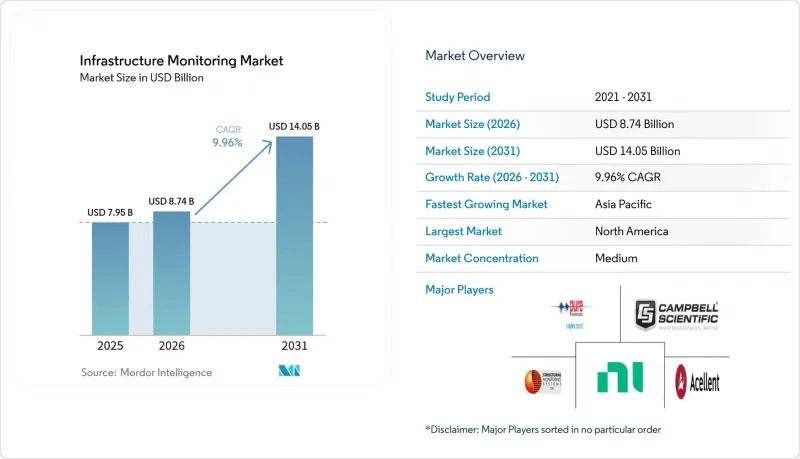
This report is Segmented by Technology (Wired, Wireless), Offering (Hardware, Software, and Services), Deployment Model (On-Premise, Cloud), Application (corrosion Monitoring, Crack/Strain Detection, and More), End-User Industry (Civil Infrastructure, Energy, Aerospace and Defense, and More), and by Geography. The Market Forecasts are Provided in Terms of Value (USD).
Global Infrastructure Monitoring Market Trends and Insights
Accelerating Deployment of Wireless Sensor Networks in Aging Bridges (NA & EU)
Aging bridges-45% are more than 50 years old-are prompting asset owners to install wireless nodes that stream strain and vibration data continuously. Linear wireless sensor network designs have cut power consumption and eased installation on long-span structures, evidenced by the 64-node Golden Gate Bridge deployment collecting 1 kHz data without traffic disruption. Project timelines are shortening because cloud-based dashboards allow engineers to validate sensor performance remotely, minimizing field revisits and scaffolding costs.
Smart-City Megaprojects Fuel Real-Time SHM Demand
UN-Habitat forecasts APAC's urban population to reach 3.5 billion by 2050, pushing municipal authorities to embed SHM into transit corridors, tunnels, and public buildings. ASEAN's 108 active smart-city programs are standardizing data exchanges for structural sensors, while 5G federated edge platforms in Macau and Hong Kong stream gigabyte-scale dynamic-load data in under 50 milliseconds. Procurement frameworks now require open APIs, encouraging start-ups to license micro-services for crack detection, corrosion mapping, and anomaly triage.
High Capex for Remote-Area Wireless Links
Sparse backhaul in remote regions raises deployment costs by up to 45%, deterring adoption despite proven ROI in urban settings. While low-earth-orbit satellite constellations promise relief, terminals remain price-prohibitive for many municipalities, postponing sensor roll-outs on rural bridges and pipelines.
Other drivers and restraints analyzed in the detailed report include:
- EU & Japan Predictive-Maintenance Mandates for Dams/Tunnels
- US IIJA-Funded Digital-Twin Roll-outs
- Data-Governance & Cyber-Security Barriers in EU Public Assets
For complete list of drivers and restraints, kindly check the Table Of Contents.
Segment Analysis
Wireless platforms underpin USD 4.88 billion of 2025 revenue, equivalent to 61.35% of the infrastructure monitoring market. Supported by improvements in mesh routing, sub-GHz radios, and energy harvesting, wireless networks now achieve five-year battery life, matching wired uptime benchmarks while avoiding conduit and trenching expenses. The infrastructure monitoring market size for wireless systems is forecast to expand at 11.45% CAGR, driven by public bridge retrofits in North America and Europe. In contrast, the wired cohort retains relevance for nuclear plants and long-span tunnels where deterministic latency is non-negotiable.
As cloud vendors introduce digital-signal-processing services, asset managers can deploy vibration and acoustic algorithms without maintaining on-premise servers. Edge-optimized AI chips embedded in wireless gateways now execute modal analysis locally, transmitting compressed features rather than raw waveforms-cutting bandwidth costs by 70%. This shift unlocks green-field opportunities in emerging economies where 3G/4G coverage is patchy yet growing.
Hardware still represents 54.30% of 2025 revenue, but services are set to outpace all other categories with a 12.44% CAGR. The infrastructure monitoring market size for services will rise as owners outsource data engineering, AI model training, and dashboard customization to firms that blend civil-engineering know-how with cloud-native skills. Demand is especially acute in Latin America and Southeast Asia, where engineer shortages hamper in-house program development.
Software platforms account for the remaining 18.35% of spending, yet face persistent integration challenges. Open-source middleware initiatives seek to standardize message brokers and semantic models, but vendor lock-in remains common. Cyber-security hardening features-zero-trust access, secure boot, over-the-air patching-are now baseline requirements for enterprise procurement.
Complete Report Scope:
- By Technology
- Wired
- Wireless
- By Offering
- Hardware
- Software
- Services
- By Deployment Model
- On-premise
- Cloud / Edge
- By Application
- Corrosion Monitoring
- Crack / Strain Detection
- Vibration and Dynamic Load Monitoring
- Remote Structural-Health Monitoring (SHM)
- Environmental and Seismic Monitoring
- By End-user Industry
- Civil Infrastructure (Bridges, Roads, Tunnels, Dams)
- Energy and Utilities
- Aerospace and Defense
- Mining and Metals
- Oil and Gas / Petro-chemicals
- Transportation (Harbors, Rail, Airports)
- By Geography
- North America
- United States
- Canada
- Mexico
- South America
- Brazil
- Argentina
- Rest of South America
- APAC
- China
- Japan
- India
- South Korea
- ASEAN
- Rest of APAC
- Europe
- Germany
- United Kingdom
- France
- Italy
- Nordics
- Rest of Europe
- Middle East and Africa
- GCC
- Turkey
- Rest of Middle East and Africa
- North America
Geography Analysis
North America anchors 29.40% of 2025 revenue, supported by IIJA-funded digital-twin pilots and a policy push to rehabilitate bridges older than 50 years. Smart-sensor retrofits demonstrate 20% maintenance cost savings, prompting state agencies to incorporate sensing budgets into resurfacing contracts. Canadian provinces leverage federal green-infrastructure grants to trial edge-AI crack detection on remote timber bridges, while Mexico accelerates toll-road concessions that stipulate condition-based monitoring from day one.
Asia-Pacific delivers the steepest trajectory with a 11.86% CAGR through 2031. China's 14th Five-Year Plan prioritizes SHM on high-speed rail viaducts, and Japan's Society 5.0 target embeds robotics in tunnel maintenance. India's Smart Cities Mission funds integrated command centers that ingest flood gauges and traffic sensors, offering a blueprint for mid-tier cities across ASEAN. Australia's asset-management councils adopt fiber-optic strain lines on coastal seawalls to anticipate storm-surge damage, a practice now spreading to New Zealand and Pacific Island states.
Europe's regulatory rigor fosters early adoption of predictive-maintenance mandates. Nordic countries pioneer infrastructure-as-a-service concessions where contractors guarantee uptime using continuous monitoring. The Netherlands applies real-time deflection sensing on dykes to counter sea-level rise, while Germany pilots quantum gravimetry to detect subsidence beneath Autobahn foundations. Southern Europe channels pandemic-recovery funds into seismic retrofits, bundling accelerometers with energy-efficiency upgrades.
- Schneider Electric SE
- Pure Technologies Ltd. Company (Xylem Inc.)
- Structural Monitoring Systems plc
- Acellent Technologies Inc.
- National Instruments Corp.
- Campbell Scientific, Inc.
- Siemens AG
- Trimble Inc.
- HBM (Hottinger Bruel & Kjaer)
- Geocomp Corporation
- Geokon Inc.
- SISGEO SRL
- RST Instruments Ltd.
- Bridge Diagnostics Inc.
- Sixense Group
- Digitexx Data Systems Inc.
- AVT Reliability (AES Engineering)
- Honeywell International Inc.
- Civionics
- Topcon Positioning Systems
- Nova Metrix LLC
- Worldsensing
Additional Benefits:
- The market estimate (ME) sheet in Excel format
- 3 months of analyst support
TABLE OF CONTENTS
1 INTRODUCTION
- 1.1 Study Assumptions and Market Definition
- 1.2 Scope of the Study
2 RESEARCH METHODOLOGY
3 EXECUTIVE SUMMARY
4 MARKET LANDSCAPE
- 4.1 Market Overview
- 4.2 Market Drivers
- 4.2.1 Accelerating Deployment of Wireless Sensor Networks in Aging Bridges
- 4.2.2 Smart-City Megaprojects Fuel Real-Time SHM Demand
- 4.2.3 EU and Japan Predictive-Maintenance Mandates for Dams / Tunnels
- 4.2.4 US IIJA-Funded Digital-Twin Roll-outs
- 4.2.5 Cloud-First Monitoring Adoption by GCC EPC Majors
- 4.2.6 Falling MEMS Sensor Cost Enabling Secondary-Road Instrumentation
- 4.3 Market Restraints
- 4.3.1 High Capex for Remote-area Wireless Links
- 4.3.2 Data-Governance and Cyber-Security Barriers in EU Public Assets
- 4.3.3 Shortage of Structural-Data Scientists in Emerging Markets
- 4.3.4 Interoperability Gaps between Legacy Wired and IoT Sensors
- 4.4 Value / Supply-Chain Analysis
- 4.5 Regulatory Outlook
- 4.6 Porter's Five Forces
- 4.6.1 Threat of New Entrants
- 4.6.2 Bargaining Power of Buyers
- 4.6.3 Bargaining Power of Suppliers
- 4.6.4 Threat of Substitutes
- 4.6.5 Intensity of Competitive Rivalry
- 4.7 Impact of Covid-19 on the Market
5 MARKET SIZE AND GROWTH FORECASTS (VALUE)
- 5.1 By Technology
- 5.1.1 Wired
- 5.1.2 Wireless
- 5.2 By Offering
- 5.2.1 Hardware
- 5.2.2 Software
- 5.2.3 Services
- 5.3 By Deployment Model
- 5.3.1 On-premise
- 5.3.2 Cloud / Edge
- 5.4 By Application
- 5.4.1 Corrosion Monitoring
- 5.4.2 Crack / Strain Detection
- 5.4.3 Vibration and Dynamic Load Monitoring
- 5.4.4 Remote Structural-Health Monitoring (SHM)
- 5.4.5 Environmental and Seismic Monitoring
- 5.5 By End-user Industry
- 5.5.1 Civil Infrastructure (Bridges, Roads, Tunnels, Dams)
- 5.5.2 Energy and Utilities
- 5.5.3 Aerospace and Defense
- 5.5.4 Mining and Metals
- 5.5.5 Oil and Gas / Petro-chemicals
- 5.5.6 Transportation (Harbors, Rail, Airports)
- 5.6 By Geography
- 5.6.1 North America
- 5.6.1.1 United States
- 5.6.1.2 Canada
- 5.6.1.3 Mexico
- 5.6.2 South America
- 5.6.2.1 Brazil
- 5.6.2.2 Argentina
- 5.6.2.3 Rest of South America
- 5.6.3 APAC
- 5.6.3.1 China
- 5.6.3.2 Japan
- 5.6.3.3 India
- 5.6.3.4 South Korea
- 5.6.3.5 ASEAN
- 5.6.3.6 Rest of APAC
- 5.6.4 Europe
- 5.6.4.1 Germany
- 5.6.4.2 United Kingdom
- 5.6.4.3 France
- 5.6.4.4 Italy
- 5.6.4.5 Nordics
- 5.6.4.6 Rest of Europe
- 5.6.5 Middle East and Africa
- 5.6.5.1 GCC
- 5.6.5.2 Turkey
- 5.6.5.3 Rest of Middle East and Africa
- 5.6.1 North America
6 COMPETITIVE LANDSCAPE
- 6.1 Market Concentration
- 6.2 Strategic Moves
- 6.3 Market Share Analysis
- 6.4 Company Profiles (includes Global Level Overview, Market Level Overview, Core Segments, Financials as available, Strategic Information, Market Rank/Share, Products and Services, Recent Developments)
- 6.4.1 Schneider Electric SE
- 6.4.2 Pure Technologies Ltd. Company (Xylem Inc.)
- 6.4.3 Structural Monitoring Systems plc
- 6.4.4 Acellent Technologies Inc.
- 6.4.5 National Instruments Corp.
- 6.4.6 Campbell Scientific, Inc.
- 6.4.7 Siemens AG
- 6.4.8 Trimble Inc.
- 6.4.9 HBM (Hottinger Bruel & Kjaer)
- 6.4.10 Geocomp Corporation
- 6.4.11 Geokon Inc.
- 6.4.12 SISGEO SRL
- 6.4.13 RST Instruments Ltd.
- 6.4.14 Bridge Diagnostics Inc.
- 6.4.15 Sixense Group
- 6.4.16 Digitexx Data Systems Inc.
- 6.4.17 AVT Reliability (AES Engineering)
- 6.4.18 Honeywell International Inc.
- 6.4.19 Civionics
- 6.4.20 Topcon Positioning Systems
- 6.4.21 Nova Metrix LLC
- 6.4.22 Worldsensing
7 MARKET OPPORTUNITIES AND FUTURE OUTLOOK
- 7.1 White-space and Unmet-Need Assessment

