PUBLISHER: Mordor Intelligence | PRODUCT CODE: 2116054

PUBLISHER: Mordor Intelligence | PRODUCT CODE: 2116054
Latin America Professional Liquid Soap - Market Share Analysis, Industry Trends & Statistics, Growth Forecasts (2026 - 2031)
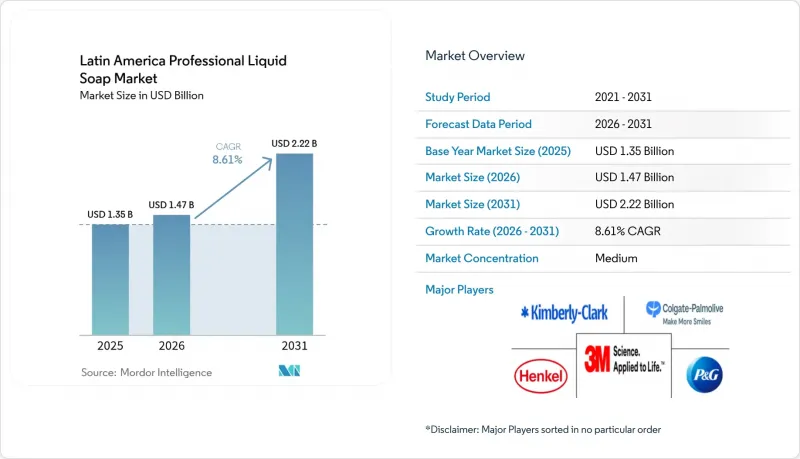
According to Mordor Intelligence, the Latin America professional liquid soap market size was valued at USD 1.35 billion in 2025 and estimated to grow from USD 1.47 billion in 2026 to reach USD 2.22 billion by 2031, at a CAGR of 8.61% during the forecast period (2026-2031).
This report is Segmented by Packaging Type (Pump Dispensers and Others), Product Type (Foaming Soaps and More), Category (Regular/Conventional and Natural/Organic), Price (Mass and Premium), End-User (Hospitals and Clinics, and More), Distribution Channel (Online Channel and Offline Channel), and Geography (Brazil and More). The Market Forecasts are Provided in Terms of Value (USD).
Latin America Professional Liquid Soap Market Trends and Insights
Expansion of hotels and hospitality sector
Hilton reported nearly 280 hotels operating in Central and Latin America by the end of 2024, adding over 60 new properties during the year and signing agreements for approximately 6,000 rooms from 2024 deals alone; Mexico surpassed 100 hotels with roughly 40 more planned, while Brazil expanded to 25 hotels with 20 additional properties in the pipeline. This surge in branded hospitality infrastructure is elevating demand for premium liquid soap amenities, vegan, pH-balanced, PETA-certified formulations in eco-friendly sachets, that differentiate guest experiences and align with corporate sustainability pledges. Luxury and lifestyle segments are growing fastest, with properties in Sao Paulo, Buenos Aires, Cartagena, and Santiago specifying Cradle to Cradle Gold-certified or USDA BioPreferred formulations to appeal to environmentally conscious travelers. The shift is not merely cosmetic; hotels are bundling touchless dispensers with refillable cartridges to reduce single-use plastic waste, a move that lowers long-run procurement costs while meeting investor ESG expectations.
Increasing adoption of touchless/automatic dispensers
GOJO's January 2024 launch of the PURELL ES10 touch-free dispenser, featuring 30% less plastic and 38% lower greenhouse gas emissions versus the prior ES8 model, plus an integrated double-AA battery per refill and a complimentary Dispenser Advisor app for remote usage monitoring, exemplifies the technology race in professional hygiene. Healthcare facilities in Brazil and Mexico are prioritizing touchless systems to reduce cross-contamination; a Brazilian ICU study documented that RFID-enabled electronic hand-hygiene monitoring cut infection rates, while a Mexican pediatric hospital achieved USD 308,000 to USD 546,000 in savings over six months by deploying automated monitoring. Regulatory frameworks reinforce adoption: Brazil's NR-32 mandates hand-hygiene protocols for healthcare workers, Mexico's NOM-017-STPS-2008 requires personal protective equipment in industrial settings, and Argentina's Law 24,557 governs occupational risk prevention . The confluence of labor shortages, exacerbated by post-pandemic attrition, and stringent hygiene audits is pushing facility managers to invest in IoT-enabled dispensers that alert staff when refills are needed, minimizing stockouts and ensuring compliance during surprise inspections.
Packaging waste concerns from single-use containers
Brazil's Green Seal Program, launched in June 2024 with standards expected in H1 2025, will formalize sustainability criteria for hygiene products, pressuring suppliers to demonstrate lifecycle assessments and circular-design credentials. Refill pouches, growing at 8.84% CAGR, offer a lower-plastic-mass alternative to rigid pump dispensers, with Dr. Bronner's paperboard gable-top refill carton (69% FSC-certified paper, 5% aluminum, 26% polyethylene) achieving 90% plastic reduction versus a 32-oz rPET bottle and avoiding over 27,000 pounds of plastic since launch. Evonik's REWOFERM biosurfactant platform, featuring glycolipid-based sophorolipids and rhamnolipids, enables laundry and hygiene pouches with superior biodegradability and mildness, positioning natural ingredients as performance-competitive with synthetic surfactants. The challenge lies in consumer and facility-manager education: pouches are unsuitable for wet environments and require durable reusable bottles, necessitating on-pack QR codes linking to lifecycle assessments and recycling instructions to avoid greenwashing accusations.
Other drivers and restraints analyzed in the detailed report include:
- Growing demand for antibacterial and antimicrobial soaps
- Demand for eco-friendly and biodegradable liquid soaps
- High initial cost of touchless dispensing systems
For complete list of drivers and restraints, kindly check the Table Of Contents.
Segment Analysis
Pump dispensers commanded 39.86% market share in 2025, entrenched by decades of institutional procurement inertia and compatibility with existing dispenser infrastructure in hospitals, hotels, and offices. Yet refill pouches are expanding at 8.79% CAGR through 2031, driven by Brazil's Decree 12,688 mandating escalating recycled-content and recovery targets, and corporate sustainability pledges from Unilever, Kimberly-Clark, and regional players. Bottles and containers for refill applications hold a steady share in facilities that prefer bulk purchasing and on-site refilling to minimize packaging waste, particularly in industrial and manufacturing settings where high-volume usage justifies dedicated storage.
Pouches, including sachets and mini travel packs, are proliferating in hospitality amenities, with 10 ml and 30 ml formats offering single-use convenience for guests while reducing plastic mass per dose compared to rigid bottles. Others (bulk tanks, cartridge systems) serve niche applications in food processing and pharmaceutical manufacturing, where closed-loop dispensing prevents contamination. The shift toward pouches is not uniform: Argentina's import liberalization has flooded the market with low-cost rigid bottles from Asia, temporarily slowing pouch adoption, while Chile's mining sector favors rugged pump dispensers that withstand harsh environments. Suppliers are responding with hybrid models, refillable pump dispensers accepting pouch inserts, to bridge the transition, though compatibility issues and consumer confusion around recycling instructions remain barriers.
Gel-based soaps held a 51.05% share in 2025, reflecting their versatility across end-users and compatibility with legacy dispensers, but foaming soaps are surging at a 9.24% CAGR, propelled by water-efficiency mandates and superior user perception. CWS PureLine Foam's 30% water-consumption reduction and 50% soap-consumption reduction per wash resonate with facilities facing rising utility costs and sustainability audits. Foaming formulations deliver perceived luxury, richer lather, softer feel, at lower cost per dose, a combination that appeals to premium hospitality and corporate segments.
Cream-based soaps, though smaller in share, serve specialized applications in healthcare and industrial settings where emollient properties reduce dermatitis risk among workers performing frequent handwashing; Brazil's NR-32 and Mexico's NOM-017-STPS-2008 occupational-safety standards increasingly specify skin-friendly formulations to mitigate chemical-sensitivity claims. Gel-based variants retain dominance in foodservice and restaurant back-of-house applications, where viscosity aids adherence to hands during scrubbing protocols, but the gap is narrowing as foam dispensers become more affordable and reliable.
Complete Report Scope:
- Packaging Type
- Pump Dispensers
- Bottles/Containers (Refill)
- Pouches (Refill)
- Others
- Product Type
- Foaming Soaps
- Gel-Based Soaps
- Cream-Based Soaps
- Category
- Regular/Conventional
- Natural/Organic
- Price
- Mass
- Premium
- End User
- Hospitals and Clinics
- Hotels and Resorts
- Restaurants and Food Services
- Commercial Offices and Corporate Buildings
- Schools and Universities
- Industrial and Manufacturing Facilities
- Others
- Distribution Channel
- Online Channel
- Offline Channel
- Geography
- Brazil
- Argentina
- Colombia
- Chile
- Peru
- Rest of South America
List of Companies Covered in this Report:
- Kimberly-Clark
- GOJO Industries, Inc.
- Henkel AG & Co. KGaA
- Colgate-Palmolive Company
- Prolimp del Centro SA de CV
- Procter & Gamble
- Unilever PLC
- Reckitt Benckiser Group plc
- 3M
- S.C. Johnson & Son, Inc.
- Mex-Ar Productos SA de CV
- Daryza SAC
- Ecolab Inc.
- Diversey Holdings Ltd.
- Spartan Chemical Company, Inc.
- Christeyns NV/SA
- Betco Corporation
- Karcher Group
- Walter Surface Technologies
- Nilfisk A/S
Additional Benefits:
- The market estimate (ME) sheet in Excel format
- 3 months of analyst support
TABLE OF CONTENTS
1 INTRODUCTION
- 1.1 Study Assumptions and Market Definition
- 1.2 Scope of the Study
2 RESEARCH METHODOLOGY
3 EXECUTIVE SUMMARY
4 MARKET LANDSCAPE
- 4.1 Market Overview
- 4.2 Market Drivers
- 4.2.1 Expansion of hotels and hospitality sector
- 4.2.2 Increasing adoption of touchless/automatic dispensers
- 4.2.3 Growing demand for antibacterial and antimicrobial soaps
- 4.2.4 Demand for eco-friendly and biodegradable liquid soaps
- 4.2.5 Social media and public campaigns promoting hand hygiene
- 4.2.6 Enhanced skin-friendly and moisturizing product offerings
- 4.3 Market Restraints
- 4.3.1 Competition from bar soaps or alternative sanitizers
- 4.3.2 Packaging waste concerns from single-use containers
- 4.3.3 High initial cost of touchless dispensing systems
- 4.3.4 Sensitivity of some users to chemicals and fragrances
- 4.4 Consumer Demand Analysis
- 4.5 Regulatory Landscape
- 4.6 Porter's Five Forces
- 4.6.1 Threat of New Entrants
- 4.6.2 Bargaining Power of Buyers
- 4.6.3 Bargaining Power of Suppliers
- 4.6.4 Threat of Substitutes
- 4.6.5 Competitive Rivalry
5 MARKET SIZE AND GROWTH FORECASTS (VALUE)
- 5.1 Packaging Type
- 5.1.1 Pump Dispensers
- 5.1.2 Bottles/Containers (Refill)
- 5.1.3 Pouches (Refill)
- 5.1.4 Others
- 5.2 Product Type
- 5.2.1 Foaming Soaps
- 5.2.2 Gel-Based Soaps
- 5.2.3 Cream-Based Soaps
- 5.3 Category
- 5.3.1 Regular/Conventional
- 5.3.2 Natural/Organic
- 5.4 Price
- 5.4.1 Mass
- 5.4.2 Premium
- 5.5 End User
- 5.5.1 Hospitals and Clinics
- 5.5.2 Hotels and Resorts
- 5.5.3 Restaurants and Food Services
- 5.5.4 Commercial Offices and Corporate Buildings
- 5.5.5 Schools and Universities
- 5.5.6 Industrial and Manufacturing Facilities
- 5.5.7 Others
- 5.6 Distribution Channel
- 5.6.1 Online Channel
- 5.6.2 Offline Channel
- 5.7 Geography
- 5.7.1 Brazil
- 5.7.2 Argentina
- 5.7.3 Colombia
- 5.7.4 Chile
- 5.7.5 Peru
- 5.7.6 Rest of South America
6 COMPETITIVE LANDSCAPE
- 6.1 Market Concentration
- 6.2 Strategic Moves
- 6.3 Market Share Analysis
- 6.4 Company Profiles (includes Global level Overview, Market level overview, Core Segments, Financials as available, Strategic Information, Market Rank/Share for key companies, Products and Services, and Recent Developments)
- 6.4.1 Kimberly-Clark
- 6.4.2 GOJO Industries, Inc.
- 6.4.3 Henkel AG & Co. KGaA
- 6.4.4 Colgate-Palmolive Company
- 6.4.5 Prolimp del Centro SA de CV
- 6.4.6 Procter & Gamble
- 6.4.7 Unilever PLC
- 6.4.8 Reckitt Benckiser Group plc
- 6.4.9 3M
- 6.4.10 S.C. Johnson & Son, Inc.
- 6.4.11 Mex-Ar Productos SA de CV
- 6.4.12 Daryza SAC
- 6.4.13 Ecolab Inc.
- 6.4.14 Diversey Holdings Ltd.
- 6.4.15 Spartan Chemical Company, Inc.
- 6.4.16 Christeyns NV/SA
- 6.4.17 Betco Corporation
- 6.4.18 Karcher Group
- 6.4.19 Walter Surface Technologies
- 6.4.20 Nilfisk A/S
7 MARKET OPPORTUNITIES AND FUTURE OUTLOOK

