PUBLISHER: Mordor Intelligence | PRODUCT CODE: 2154440

PUBLISHER: Mordor Intelligence | PRODUCT CODE: 2154440
South America Professional Liquid Soap - Market Share Analysis, Industry Trends & Statistics, Growth Forecasts (2026 - 2031)
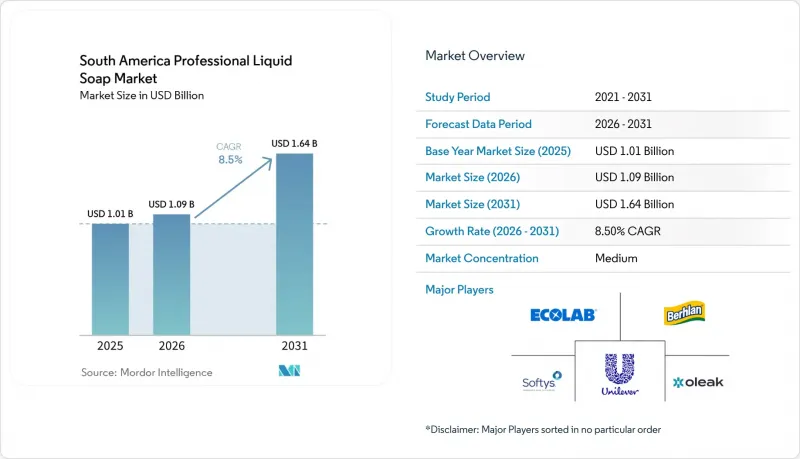
According to Mordor Intelligence, the South America professional liquid hand soap market size was valued at USD 1.01 billion in 2025 and is estimated to grow from USD 1.09 billion in 2026 to reach USD 1.64 billion by 2031, at a CAGR of 8.50% during the forecast period (2026-2031).
South America Professional Liquid Soap Market Trends and Insights
Increasing Institutional Focus on Hand Hygiene and Infection Prevention
Healthcare-associated infections remain a major concern in hospitals, keeping infection prevention and hand hygiene central to healthcare procurement. Brazil's hand-hygiene protocols follow the WHO's five key moments, reinforcing the need for accessible hand-hygiene products at points of care. Brazil Ministry of Health - Hand Hygiene Protocol PAHO also promotes infection-prevention programs across the Americas, including the availability of appropriate hand-hygiene supplies in healthcare facilities. PAHO - Infection Prevention and Control Programs Standardized protocols therefore support consistent demand for liquid soap and other professional hand-hygiene products. Hospitals increasingly favor formulations that combine effective cleansing with skin-care properties, particularly for frequent-use settings. Dispenser compatibility and refill efficiency also influence procurement decisions because they help facilities maintain hygiene standards while controlling operating costs.
Expansion of Healthcare and Hospitality Infrastructure
Brazil allocated BRL 31 billion (USD 5.7 billion) through 2026 for the construction and renovation of 2,762 public healthcare facilities under the Novo PAC Saude program, creating recurring opportunities for institutional washroom and hygiene-supply procurement. Colombia's expanding hotel sector is similarly increasing the number of commercial facilities requiring professionally supplied hygiene products, supported by continued investment from international hotel chains. Together, healthcare infrastructure development in Brazil and hospitality expansion in Colombia are creating new-account opportunities for professional liquid hand soap suppliers across South America. New facilities also require standardized dispensers, refill systems, and routine hygiene replenishment, creating opportunities beyond the initial product sale. Procurement frameworks favor suppliers capable of maintaining consistent supply, regulatory compliance, and service coverage across multiple locations.
Availability of Lower-Cost Bar Soaps and Alternative Hand-Hygiene Products
Bar soap remains widely used in price-sensitive schools, municipal offices, and smaller food-service businesses, where buyers typically prioritize the lowest compliant unit cost. This pressure is particularly evident in Peru and informal Brazilian channels, encouraging substitution toward more affordable registered cleaning products. Alcohol-based hand rubs also compete for dispenser space in healthcare facilities, creating additional pressure on liquid soap demand. Limited procurement budgets and high usage frequency further reinforce demand for economical hand-hygiene solutions. Suppliers offering bulk packs and cost-efficient formulations can therefore gain an advantage in high-volume institutional accounts. As a result, the mass tier maintains a strong value position, while differentiated and premium formats continue to gain traction.
Other drivers and restraints analyzed in the detailed report include:
- Growing Demand for Specialized and Antimicrobial Formulations
- Expansion of Institutional and Workplace Hygiene Standards
- Regulatory and Certification Complexity Across Countries
For complete list of drivers and restraints, kindly check the Table Of Contents.
Segment Analysis
Pump dispensers held 39.86% of the South America professional liquid hand soap market share in 2025. Their leading position reflects use in regulated settings that need controlled single-dose dispensing. Hospitals, large hotels, and corporate complexes have an established base of dispenser equipment. This installed base supports recurring purchases of compatible liquid soap. Suppliers often bundle the dispenser and consumable product in service agreements lasting several years. These arrangements reduce reliance on spot purchasing and can stabilize account relationships. Refill bottles remain relevant for mid-size food-service operators and educational facilities. Other product types serve narrower use cases within professional washrooms.
Refill pouches are the fastest-growing format, with an 8.79% CAGR forecast through 2031 in the South America professional liquid hand soap market. Their lower material intensity can reduce transport weight and packaging use. Chilean, Brazilian, and Colombian packaging policies support greater attention to material-efficient formats. Chile's Law 20.920 (REP) establishes collection and recovery obligations for packaging , while Brazil's solid-waste framework promotes reverse logistics, and Colombia's Resolution 1407/2018 regulates the environmental management of packaging waste. Pouches can improve delivery efficiency for distributors handling large volumes, while their adoption is increasingly influenced by regulatory compliance beyond cost considerations. Suppliers offering compliant pouch formats are better positioned to serve customers with packaging obligations.
Complete Report Scope:
- By Product Type
- Pump Dispensers
- Refill Bottles
- Refill Pouches
- Other Product Types
- By Price Range
- Mass
- Premium
- By End Use
- Hospitals and Clinics
- Hotels and Restaurants
- Commercial Offices and Corporate Buildings
- Schools and Universities
- Industrial and Manufacturing Facilities
- Other End Uses
- By Country
- Brazil
- Argentina
- Colombia
- Chile
- Peru
- Rest of South America
List of Companies Covered in this Report:
- Ecolab, Inc.
- Oleak Industria E Comercio LTDA
- Mercoquimica Industria e Comercio LTDA
- Paboni de Colombia SAS
- Softys Argentina SA
- Unilever PLC
- Berhlan Institutional
- Institucional Star Services LTDA
- Soloaseo
- Perol Comercial e Industrial LTDA
- Covidex
- Delta Professional Hygiene
- MAHE Argentina
- Dandara Distribuidora
- Comproind LTDA
- Azeta
- West Quimica
- Comercializadora Wet Co SAS
- Clean Cor SA
- Ecoter
Additional Benefits:
- The market estimate (ME) sheet in Excel format
- 3 months of analyst support
TABLE OF CONTENTS
1 INTRODUCTION
- 1.1 Study Assumptions and Market Definition
- 1.2 Scope of the Study
2 RESEARCH METHODOLOGY
3 EXECUTIVE SUMMARY
4 MARKET LANDSCAPE
- 4.1 Market Overview
- 4.2 Market Drivers
- 4.2.1 Increasing institutional focus on hand hygiene and infection prevention
- 4.2.2 Expansion of healthcare and hospitality infrastructure
- 4.2.3 Growing demand for specialized and antimicrobial formulations
- 4.2.4 Expansion of institutional and workplace hygiene standards
- 4.2.5 Rising adoption of touchless and automated dispensing systems
- 4.2.6 Increasing premiumization of professional hygiene products
- 4.3 Market Restraints
- 4.3.1 Availability of lower-cost bar soaps and alternative hand-hygiene products
- 4.3.2 Price sensitivity and institutional procurement constraints
- 4.3.3 Regulatory and certification complexity across countries
- 4.3.4 Packaging waste and sustainability compliance costs
- 4.4 Regulatory Landscape
- 4.5 Technological Outlook
- 4.6 Porter's Five Forces Analysis
- 4.6.1 Threat of New Entrants
- 4.6.2 Bargaining Power of Buyers/Consumers
- 4.6.3 Bargaining Power of Suppliers
- 4.6.4 Threat of Substitute Products
- 4.6.5 Intensity of Competitive Rivalry
5 MARKET SIZE AND GROWTH FORECASTS (VALUE)
- 5.1 By Product Type
- 5.1.1 Pump Dispensers
- 5.1.2 Refill Bottles
- 5.1.3 Refill Pouches
- 5.1.4 Other Product Types
- 5.2 By Price Range
- 5.2.1 Mass
- 5.2.2 Premium
- 5.3 By End Use
- 5.3.1 Hospitals and Clinics
- 5.3.2 Hotels and Restaurants
- 5.3.3 Commercial Offices and Corporate Buildings
- 5.3.4 Schools and Universities
- 5.3.5 Industrial and Manufacturing Facilities
- 5.3.6 Other End Uses
- 5.4 By Country
- 5.4.1 Brazil
- 5.4.2 Argentina
- 5.4.3 Colombia
- 5.4.4 Chile
- 5.4.5 Peru
- 5.4.6 Rest of South America
6 COMPETITIVE LANDSCAPE
- 6.1 Market Concentration
- 6.2 Strategic Moves
- 6.3 Market Positioning Analysis
- 6.4 Company Profiles (includes Global level Overview, Market level overview, Core Segments, Financials as available, Strategic Information, Market Rank/Share for key companies, Products & Services, and Recent Developments)
- 6.4.1 Ecolab, Inc.
- 6.4.2 Oleak Industria E Comercio LTDA
- 6.4.3 Mercoquimica Industria e Comercio LTDA
- 6.4.4 Paboni de Colombia SAS
- 6.4.5 Softys Argentina SA
- 6.4.6 Unilever PLC
- 6.4.7 Berhlan Institutional
- 6.4.8 Institucional Star Services LTDA
- 6.4.9 Soloaseo
- 6.4.10 Perol Comercial e Industrial LTDA
- 6.4.11 Covidex
- 6.4.12 Delta Professional Hygiene
- 6.4.13 MAHE Argentina
- 6.4.14 Dandara Distribuidora
- 6.4.15 Comproind LTDA
- 6.4.16 Azeta
- 6.4.17 West Quimica
- 6.4.18 Comercializadora Wet Co SAS
- 6.4.19 Clean Cor SA
- 6.4.20 Ecoter
7 MARKET OPPORTUNITIES AND FUTURE OUTLOOK

