PUBLISHER: Mordor Intelligence | PRODUCT CODE: 2116062

PUBLISHER: Mordor Intelligence | PRODUCT CODE: 2116062
Veterinary Infusion Pumps - Market Share Analysis, Industry Trends & Statistics, Growth Forecasts (2026 - 2031)
According to Mordor Intelligence, the veterinary infusion pumps market size is expected to grow from USD 347.15 million in 2025 to USD 368.39 million in 2026 and is forecast to reach USD 494.86 million by 2031 at 6.12% CAGR over 2026-2031.
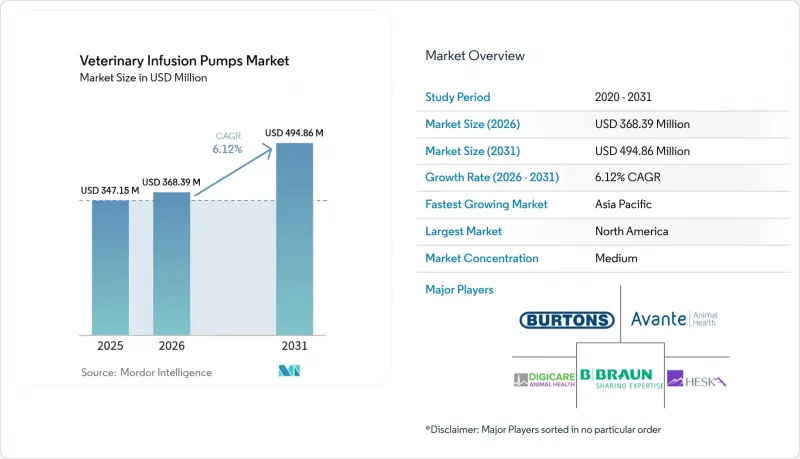
This report is Segmented by Pump Type (Large-Volume Infusion Pumps and Syringe Infusion Pumps), Animal Type (Companion Animals [Dogs, Cats], Livestock [Bovine, Swine, Poultry], and Others), End User (Veterinary Hospitals and Specialty Clinics), and Geography (North America, Europe, Asia-Pacific, Middle East and Africa, South America). The Market Forecasts are Provided in Terms of Value (USD).
Global Veterinary Infusion Pumps Market Trends and Insights
Rising Companion Animal Ownership and Health Spending
Pet owners now mirror human-health behaviours, channelling record budgets into sophisticated veterinary care. In North America and Europe, insurers increasingly reimburse infusion-based oncology and renal protocols, softening the cost barrier for advanced devices. Demographic shifts toward smaller households intensify emotional bonds with pets, translating into higher willingness to finance long-term treatments delivered via smart pumps. Drug formulary expansion for animals has increased therapy complexity, anchoring the veterinary infusion pumps market in routine practice. Clinics therefore equip multiple treatment rooms with networked pumps to manage a growing caseload of geriatric pets requiring multi-hour drips.
Increasing Incidence of Chronic and Critical Conditions in Animals
Longer lifespans reveal endocrine, oncologic and gastrointestinal diseases that mandate precise multi-day infusions. FDA conditional approval of PANOQUELL-CA1 for canine pancreatitis reinforces intravenous therapy's role in emergent care. Similar approvals are spurring device upgrades as dose-error-reduction software becomes a compliance necessity. On the livestock front, intensive farming heightens metabolic disorders, elevating demand for rugged, high-volume pumps capable of simultaneous multi-species dosing, a niche that specialised vendors are capturing.
High Initial and Maintenance Costs
Smart pumps priced at USD 6,000-9,000 place strain on small practices. Annual calibration, software licensing and staff upskilling lift total cost of ownership by 18-22% over five years, slowing penetration in Latin America and Southeast Asia. Vendors are piloting pay-per-infusion models, but uptake remains limited. Capital expenditure requirements for advanced infusion systems create significant barriers for smaller veterinary practices, particularly in emerging markets where practice economics differ substantially from developed regions. The economic pressure intensifies as regulatory compliance requirements drive up manufacturing costs, with FDA Quality Management System Regulation amendments effective February 2026 adding additional compliance burdens that manufacturers will likely pass through to customers.
Other drivers and restraints analyzed in the detailed report include:
- Technological Advancements in Infusion Pump Design
- Growth of Specialty Veterinary Clinics
- Lack of Insurance Reimbursement for Veterinary Procedures
For complete list of drivers and restraints, kindly check the Table Of Contents.
Segment Analysis
Syringe devices are projected to log 8.78% CAGR, outpacing large-volume units that held 53.92% share in 2025. Precision dosing for oncology and critical-care boluses is accelerating upgrades, and drug-library integration ensures safe cross-species calculations. Consequently, the veterinary infusion pumps market size for syringe models is set to climb sharply between 2026 and 2031. Large-volume pumps remain indispensable for hydration and total parenteral nutrition, but the innovation spotlight now sits squarely on smart syringe variants embedded with AI-driven flow-control logic.
Flexibility in handling micro-litre flows without compromising accuracy is converting specialist surgeons and internists alike. Meanwhile, refurbished large-volume units are shifting into cost-conscious segments, keeping overall unit volumes stable but constraining premium pricing. Competitive intensity in this slice of the veterinary infusion pumps market remains moderate as firmware ecosystems rather than hardware specs grow to define user preference.
Complete Report Scope:
- By Type
- Large-volume Infusion Pumps
- Syringe Infusion Pumps
- By Animal Type
- Companion Animals
- Dogs
- Cats
- Livestock
- Bovine
- Swine
- Poultry
- Other Animal Type
- Companion Animals
- By End User
- Veterinary Hospitals
- Specialty Clinics
- By Geography
- North America
- United States
- Canada
- Mexico
- Europe
- Germany
- United Kingdom
- France
- Italy
- Spain
- Rest of Europe
- Asia-Pacific
- China
- Japan
- India
- Australia
- South Korea
- Rest of Asia-Pacific
- Middle East & Africa
- GCC
- South Africa
- Rest of Middle East & Africa
- South America
- Brazil
- Argentina
- Rest of South America
- North America
Geography Analysis
North America captured 38.89% of 2025 revenue, underpinned by the world's highest pet-care spend and mature livestock sectors. The United States alone accounts for more than four in every ten pumps sold, driven by widespread insurance adoption and clinical familiarity with human-grade devices. However, growth is tapering to mid-single digits as replacement cycles rather than first-time installs dominate. Canada mirrors these dynamics on a smaller scale, while Mexico is witnessing gradual modernisation of urban clinics.
Asia-Pacific is the fastest-growing theatre with a 13.48% CAGR through 2031, and it is forecast to eclipse Europe in unit shipments before the decade ends. China's booming middle class treats pets as status symbols, sparking a surge in high-acuity veterinary hospitals fitted with smart pumps. Japan's ageing pet population requires chronic-disease infusions, and Australia's well-developed referral network sustains steady upgrades. India's dairy sector seeks large-volume pumps for mastitis management, pushing diversified demand across species.
Europe sits between the two extremes, maintaining solid but unspectacular growth. Stringent EU animal-welfare regulations, especially on antimicrobial stewardship, necessitate precision dosing in cattle and swine, keeping the veterinary infusion pumps market engaged. Germany, France and the United Kingdom lead procurement, while Eastern European clinics are early in the adoption curve and thus represent a latent upswing. Brexit-related customs friction has marginally lengthened delivery times but is prompting distributors to set up continental inventory hubs, enhancing long-term resilience.
- B. Braun
- Heska
- Avante Health Solutions
- Burtons Medical Equipment
- Beckton Dickinson
- Eitan Medical Ltd
- Digicare Biomedical Technologies
- Kent Scientific
- Opto Circuits
- Grady Medical Systems Inc.
- Jorgensen Laboratories
- SAI Infusion Technologies
- ICU Medical
- Smiths Group
- Mindray
- Terumo
- QIAGEN
- VetPro Medical
- Norwell Veterinary Hospital Equipment
- Tri-Anim Health Services
Additional Benefits:
- The market estimate (ME) sheet in Excel format
- 3 months of analyst support
TABLE OF CONTENTS
1 Introduction
- 1.1 Study Assumptions & Market Definition
- 1.2 Scope of the Study
2 Research Methodology
3 Executive Summary
4 Market Landscape
- 4.1 Market Overview
- 4.2 Market Drivers
- 4.2.1 Rising Companion Animal Ownership and Health Spending
- 4.2.2 Increasing Incidence of Chronic and Critical Conditions in Animals
- 4.2.3 Technological Advancements in Infusion Pump Design
- 4.2.4 Growth of Specialty Veterinary Clinics
- 4.2.5 Adoption of Remote Monitoring and Telehealth Tools
- 4.2.6 Shift Toward Minimally Invasive and Home-Based Treatments
- 4.3 Market Restraints
- 4.3.1 High Initial and Maintenance Costs
- 4.3.2 Lack of Insurance Reimbursement for Veterinary Procedures
- 4.3.3 Supply Chain Disruptions for Electronic Components
- 4.3.4 Regulatory Scrutiny Over Infusion Accuracy and Safety
- 4.4 Porter's Five Forces Analysis
- 4.4.1 Threat of New Entrants
- 4.4.2 Bargaining Power of Buyers
- 4.4.3 Bargaining Power of Suppliers
- 4.4.4 Threat of Substitutes
- 4.4.5 Competitive Rivalry
5 Market Size & Growth Forecasts (Value in USD)
- 5.1 By Type
- 5.1.1 Large-volume Infusion Pumps
- 5.1.2 Syringe Infusion Pumps
- 5.2 By Animal Type
- 5.2.1 Companion Animals
- 5.2.1.1 Dogs
- 5.2.1.2 Cats
- 5.2.2 Livestock
- 5.2.2.1 Bovine
- 5.2.2.2 Swine
- 5.2.2.3 Poultry
- 5.2.3 Other Animal Type
- 5.2.1 Companion Animals
- 5.3 By End User
- 5.3.1 Veterinary Hospitals
- 5.3.2 Specialty Clinics
- 5.4 By Geography
- 5.4.1 North America
- 5.4.1.1 United States
- 5.4.1.2 Canada
- 5.4.1.3 Mexico
- 5.4.2 Europe
- 5.4.2.1 Germany
- 5.4.2.2 United Kingdom
- 5.4.2.3 France
- 5.4.2.4 Italy
- 5.4.2.5 Spain
- 5.4.2.6 Rest of Europe
- 5.4.3 Asia-Pacific
- 5.4.3.1 China
- 5.4.3.2 Japan
- 5.4.3.3 India
- 5.4.3.4 Australia
- 5.4.3.5 South Korea
- 5.4.3.6 Rest of Asia-Pacific
- 5.4.4 Middle East & Africa
- 5.4.4.1 GCC
- 5.4.4.2 South Africa
- 5.4.4.3 Rest of Middle East & Africa
- 5.4.5 South America
- 5.4.5.1 Brazil
- 5.4.5.2 Argentina
- 5.4.5.3 Rest of South America
- 5.4.1 North America
6 Competitive Landscape
- 6.1 Market Concentration
- 6.2 Market Share Analysis
- 6.3 Company Profiles (includes Global level Overview, Market level overview, Core Segments, Financials as available, Strategic Information, Market Rank/Share for key companies, Products & Services, and Recent Developments)
- 6.3.1 B. Braun SE
- 6.3.2 Heska Corporation
- 6.3.3 Avante Animal Health
- 6.3.4 Burtons Medical Equipment Ltd
- 6.3.5 Becton, Dickinson and Company
- 6.3.6 Eitan Medical Ltd
- 6.3.7 Digicare Biomedical
- 6.3.8 Kent Scientific Corporation
- 6.3.9 Opto Circuits
- 6.3.10 Grady Medical Systems Inc.
- 6.3.11 Jorgensen Laboratories
- 6.3.12 SAI Infusion Technologies
- 6.3.13 ICU Medical Inc.
- 6.3.14 Smiths Medical
- 6.3.15 Shenzhen Mindray Bio-Medical Electronics
- 6.3.16 Terumo Corporation
- 6.3.17 Q Core Medical Ltd
- 6.3.18 VetPro Medical
- 6.3.19 Norwell Veterinary Hospital Equipment
- 6.3.20 Tri-Anim Health Services
7 Market Opportunities & Future Outlook
- 7.1 White-space & Unmet-need Assessment

