PUBLISHER: Mordor Intelligence | PRODUCT CODE: 2116080

PUBLISHER: Mordor Intelligence | PRODUCT CODE: 2116080
North America Personal Care Appliances - Market Share Analysis, Industry Trends & Statistics, Growth Forecasts (2026 - 2031)
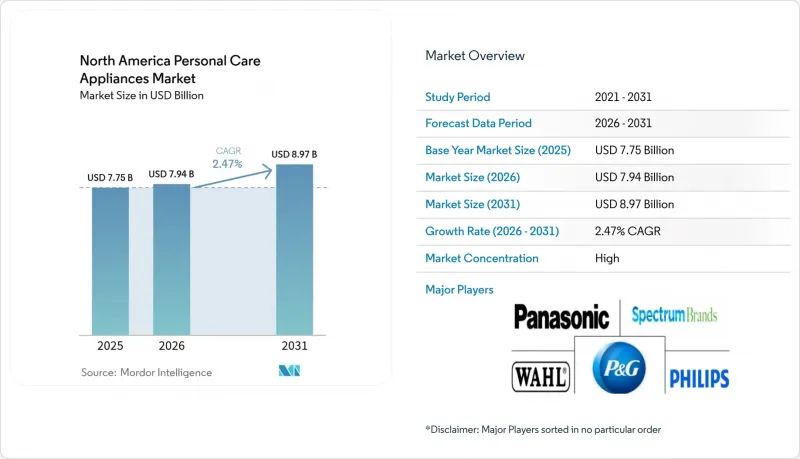
According to Mordor Intelligence, the north american personal care appliances market size in 2026 is estimated at USD 7.94 billion, growing from 2025 value of USD 7.75 billion with 2031 projections showing USD 8.97 billion, growing at 2.47% CAGR over 2026-2031.
This report is Segmented by Product Type (Corded, and Cordless), Category (Shaving and Grooming, Hair Styling, Beauty Appliances, and Oral Care); End User (Men, Women, and Unisex); Distribution Channel (Supermarkets/Hypermarkets, Specialty Stores, Online Retail Stores, and Other Distribution Channels), and Geography. The Market Forecasts are Provided in Terms of Value (USD).
North America Personal Care Appliances Market Trends and Insights
Strong emphasis on self-grooming drives the market
Post-pandemic workplace dynamics have transformed grooming investment trends. The adoption of hybrid work models has created dual grooming requirements for virtual meetings and in-person engagements. Professional appearance expectations now extend beyond traditional office settings to include home-based video conferencing, driving demand for efficient styling appliances that ensure consistent results throughout the day. Metropolitan regions, particularly Toronto, Ontario, which recorded 3,674.2 thousand employed individuals in February 2024, according to Statistics Canada, exhibit a heightened emphasis on grooming. The shift toward "camera-ready" grooming has significantly boosted the demand for compact, high-performance devices capable of delivering salon-quality results in minimal time. Consumer spending patterns demonstrate a preference for premium appliances that optimize daily grooming routines while maintaining professional standards. This trend aligns with the broader wellness movement, where personal grooming is perceived as both a self-care practice and a professional investment, supporting higher price points for technologically advanced appliances.
Technological advancement supports the market
Smart connectivity integration represents the next competitive battleground, with manufacturers embedding IoT capabilities to create ecosystem lock-in effects and recurring revenue streams through app-based services. Advanced battery technologies, particularly lithium-ion improvements, have enabled cordless devices to match corded performance while offering superior portability and safety features. Heat management innovations, including ceramic and tourmaline coatings, address long-standing consumer concerns about hair damage while enabling faster styling times. The integration of artificial intelligence for personalized styling recommendations and usage optimization creates differentiation opportunities that extend beyond hardware specifications. Regulatory frameworks, including FDA device classification standards, continue to evolve to accommodate smart features while maintaining safety protocols according to U.S. Food and Drug Administration.
High cost of advanced appliances
Premium pricing strategies for technologically advanced appliances create distinct market segmentation, restricting the addressable customer base, particularly during periods of economic uncertainty when discretionary spending is under pressure. The price disparity between basic and smart-enabled devices is often evident, resulting in a value perception gap that many consumers find difficult to justify based on functional advantages alone. Financing options and subscription models are emerging approaches to mitigate price sensitivity; however, their adoption remains limited compared to other consumer electronics categories. Economic challenges and inflationary pressures have shifted consumer preferences toward value-oriented purchases, potentially extending the adoption cycles for premium appliances. Manufacturers face margin pressures as they strive to balance the integration of advanced features with the need for competitive pricing in an increasingly price-sensitive market.
Other drivers and restraints analyzed in the detailed report include:
- Influence of social media platform and celebrity endorsement
- Rising popularity of cordless rechargeable styling tools among travelers
- Concerns over heat damage and safety
For complete list of drivers and restraints, kindly check the Table Of Contents.
Segment Analysis
Corded appliances maintain market leadership with 68.12% share in 2025, reflecting established consumer preferences for consistent power delivery and unlimited usage duration. However, cordless devices represent the future growth engine at 2.78% CAGR through 2031, driven by battery technology improvements and changing lifestyle patterns that prioritize mobility and convenience. The performance gap between corded and cordless devices has narrowed significantly, with lithium-ion battery advances enabling cordless tools to deliver comparable power output and styling effectiveness.
Professional users and frequent travelers increasingly prefer cordless options despite higher initial costs, recognizing the operational flexibility and safety benefits of eliminating cord entanglement risks. Charging infrastructure improvements, including fast-charging capabilities and wireless charging integration, address traditional cordless limitations while creating opportunities for ecosystem development. The transition toward cordless dominance appears inevitable, though the timeline depends on continued battery technology advancement and cost reduction initiatives that make cordless options accessible to price-sensitive consumer segments.
Hair-styling accounted for 32.86% revenue in 2025, underscoring its historical centrality to the personal care appliances market. The segment's maturity, however, pushes incumbents to differentiate through smart sensors that adjust heat to hair moisture and texture. AI-driven apps now capture user profiles and recommend exact temperature curves, reinforcing brand loyalty and building data moats. As competition intensifies, brands are also exploring collaborations with beauty influencers to amplify their market reach. Moreover, sustainability is becoming a focal point, with brands investing in eco-friendly materials and energy-efficient technologies.
In contrast, oral-care devices, smart toothbrushes, irrigators, and UV sanitizers,are expanding at a 3.14% CAGR, the fastest within the personal care appliances market. Accelerants include aging demographics grappling with gum disease, insurer emphasis on preventive dentistry, and dentists endorsing connected brushing routines that track coverage zones. Subscription brush-head replacements stabilize the manufacturer's cash flow, enabling lower upfront prices. Education campaigns describe unobtrusive links between oral health and systemic conditions such as cardiovascular disease, further legitimizing regular device use. Furthermore, tech giants are eyeing the oral-care segment, hinting at potential collaborations or acquisitions. As a result, traditional players are ramping up R&D to fend off these tech-driven entrants.
Complete Report Scope:
- By Product Type
- Corded
- Cordless
- By Product Category
- Shaving and Grooming
- Shavers
- Trimmers
- Epilator
- Hair Styling
- Hair Straightener
- Hair Dryer
- Hair Curler
- Others
- Beauty Appliances
- Oral Care
- Shaving and Grooming
- By End User
- Men
- Women
- Unisex
- By Distribution Channel
- Specialist Stores
- Supermarkets/Hypermarkets
- Online Retaile Stores
- Other Distribution Channels
- By Geography
- United States
- Canada
- Mexico
- Rest of North America
List of Companies Covered in this Report:
- Koninklijke Philips N.V.
- Wahl Clipper Corporation
- Panasonic Corporation
- Spectrum Brands, Inc.
- Procter & Gamble Company
- Conair Corporation
- Dyson Ltd.
- Andis Company
- T3 Micro
- HoMedics Inc.
- Colgate-Palmolive Company
- Helen of Troy Ltd.
- SharkNinja Operating LLC
- Church and Dwight Co., Inc.
- Farouk Systems, Inc.
- FOREO AB
- NuFACE
- Johnson and Johnson (Neutrogena SkinTech)
- Xiaomi Corporation (YouPin Hair Tools)
- Flyco Electrical Appliance Co.
Additional Benefits:
- The market estimate (ME) sheet in Excel format
- 3 months of analyst support
TABLE OF CONTENTS
1 INTRODUCTION
- 1.1 Study Assumptions and Market Definition
- 1.2 Scope of the Study
2 RESEARCH METHODOLOGY
3 EXECUTIVE SUMMARY
4 MARKET LANDSCAPE
- 4.1 Market Overview
- 4.2 Market Drivers
- 4.2.1 Strong Emphasis on Self-Grooming Drives the Market
- 4.2.2 Technological Advancement Supports the Market
- 4.2.3 Influence of Social Media Platform and Celebrity Endorsement
- 4.2.4 Rising Popularity of Cordless Rechargeable Styling Tools Among Travelers
- 4.2.5 Deterring Oral Health Drives the Market
- 4.2.6 Growth of Smart Personal Care Appliances
- 4.3 Market Restraints
- 4.3.1 High Cost of Advanced Appliances
- 4.3.2 Concerns Overheat Damage and Safety
- 4.3.3 Increasing Preference for Long-Term Styling Treatments
- 4.3.4 Proliferation of Counterfeit Products
- 4.4 Consumer Behaviour Analysis
- 4.5 Regulatory Outlook
- 4.6 Porter's Five Forces Analysis
- 4.6.1 Threat of New Entrants
- 4.6.2 Bargaining Power of Buyers/Consumers
- 4.6.3 Bargaining Power of Suppliers
- 4.6.4 Threat of Substitute Products
- 4.6.5 Intensity of Competitive Rivalry
5 MARKET SIZE AND GROWTH FORECAST (VALUE)
- 5.1 By Product Type
- 5.1.1 Corded
- 5.1.2 Cordless
- 5.2 By Product Category
- 5.2.1 Shaving and Grooming
- 5.2.1.1 Shavers
- 5.2.1.2 Trimmers
- 5.2.1.3 Epilator
- 5.2.2 Hair Styling
- 5.2.2.1 Hair Straightener
- 5.2.2.2 Hair Dryer
- 5.2.2.3 Hair Curler
- 5.2.2.4 Others
- 5.2.3 Beauty Appliances
- 5.2.4 Oral Care
- 5.2.1 Shaving and Grooming
- 5.3 By End User
- 5.3.1 Men
- 5.3.2 Women
- 5.3.3 Unisex
- 5.4 By Distribution Channel
- 5.4.1 Specialist Stores
- 5.4.2 Supermarkets/Hypermarkets
- 5.4.3 Online Retaile Stores
- 5.4.4 Other Distribution Channels
- 5.5 By Geography
- 5.5.1 United States
- 5.5.2 Canada
- 5.5.3 Mexico
- 5.5.4 Rest of North America
6 COMPETITIVE LANDSCAPE
- 6.1 Market Concentration
- 6.2 Strategic Moves
- 6.3 Market Share Analysis
- 6.4 Company Profiles (includes Global level Overview, Market level overview, Core Segments, Financials as available, Strategic Information, Market Rank/Share for key companies, Products and Services, and Recent Developments)
- 6.4.1 Koninklijke Philips N.V.
- 6.4.2 Wahl Clipper Corporation
- 6.4.3 Panasonic Corporation
- 6.4.4 Spectrum Brands, Inc.
- 6.4.5 Procter & Gamble Company
- 6.4.6 Conair Corporation
- 6.4.7 Dyson Ltd.
- 6.4.8 Andis Company
- 6.4.9 T3 Micro
- 6.4.10 HoMedics Inc.
- 6.4.11 Colgate-Palmolive Company
- 6.4.12 Helen of Troy Ltd.
- 6.4.13 SharkNinja Operating LLC
- 6.4.14 Church and Dwight Co., Inc.
- 6.4.15 Farouk Systems, Inc.
- 6.4.16 FOREO AB
- 6.4.17 NuFACE
- 6.4.18 Johnson and Johnson (Neutrogena SkinTech)
- 6.4.19 Xiaomi Corporation (YouPin Hair Tools)
- 6.4.20 Flyco Electrical Appliance Co.
7 MARKET OPPORTUNITY AND FUTURE OUTLOOK

