PUBLISHER: Mordor Intelligence | PRODUCT CODE: 2116095

PUBLISHER: Mordor Intelligence | PRODUCT CODE: 2116095
Europe Skin Care Products - Market Share Analysis, Industry Trends & Statistics, Growth Forecasts (2026 - 2031)
According to Mordor Intelligence, the Europe skin care products market size was valued at USD 34.73 billion in 2025 and estimated to grow from USD 36.17 billion in 2026 to reach USD 44.32 billion by 2031, at a CAGR of 4.15% during the forecast period (2026-2031).
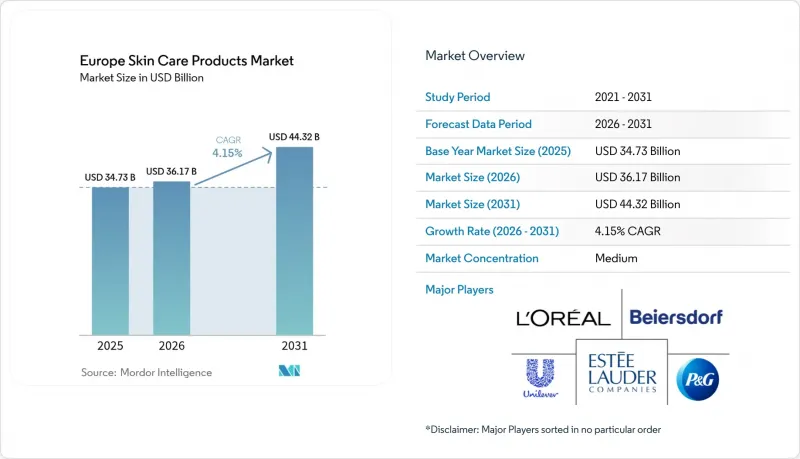
This report is Segmented by Product Type (Facial Care Products, Body Care Products and More), Category (Mass and Luxury/Premium), End User (Men, Women and More), Ingredients Type (Conventional and Synthetic and Natural and Organic), Distribution Channel (Supermarkets/Hypermarkets, and More), and Geography (Germany, United Kingdom, and More). The Market Forecasts are Provided in Terms of Value (USD).
Europe Skin Care Products Market Trends and Insights
Ageing population driving anti-ageing demand
Europe's demographic profile, with 21.6% of the population aged 65 or older and a median age of 44.7 years, continues to drive consistent demand for anti-aging formulations that address key concerns such as wrinkle depth, loss of skin elasticity, and hyperpigmentation . Vichy's upcoming November 2025 launch of LiftActiv Derm Source, a product developed over a decade of research and protected by seven patents, underscores the increasing emphasis on pharmaceutical-grade active ingredients. The formulation, containing a 5% concentration of rhamnose, demonstrated significant efficacy in a consumer trial involving 800 women over two months, achieving a 20% reduction in forehead and crow ''s-feet wrinkles and a 17% reduction in glabellar lines. Notably, within the 65-plus age group, the over-80 demographic is growing at the fastest rate, fueling demand for advanced skin care solutions such as barrier-repair ceramides and peptides that cater to thinning skin and impaired wound healing. Additionally, L'Oreal's June 2025 announcement of its Longevity Integrative Science platform, which includes the innovative Cell BioPrint lab-on-a-chip technology capable of analyzing over 260 skin longevity biomarkers in under five minutes, signals a strategic shift from corrective treatments to preventive care. This approach has the potential to unlock new revenue streams in wellness-adjacent categories, reflecting the evolving priorities of the aging population.
Rising consumer shift to natural and organic products
The demand for natural and organic skin care ingredients is experiencing significant growth, with a compound annual growth rate (CAGR) of 7.12% projected through 2030, notably outpacing the market average of 4.35%. This trend is largely driven by shifting consumer preferences, as 64% of European consumers indicate a willingness to pay a premium for eco-friendly products, and 78% report that sustainability plays a key role in their purchasing decisions. The COSMOS (COSMetic Organic and Natural Standard) certification has become the recognized benchmark in the industry, with over 34,000 products now certified under this standard. However, the introduction and enforcement of Directive 2024/825 on greenwashing are compelling brands to validate their sustainability claims through rigorous lifecycle assessments and third-party audits. In response to these evolving demands, Givaudan is set to launch RetiLife in May 2025, marking the debut of the first 100% natural-origin retinol, produced through the fermentation of plant sugars with sunflower oil as a carrier. This innovation addresses the concerns of clean-beauty advocates who often "blacklist" synthetic retinol, positioning biotech-derived actives as a viable and scalable alternative to petrochemical-based ingredients. Additionally, Chemyunion's Ecoffea Citrus, an upcycled botanical extract sourced from coffee and lemon, exemplifies the growing intersection of circularity and efficacy. This ingredient, which has been shown to enhance collagen types I, III, IV, and fibronectin within 28 days, resonates strongly with German and Dutch consumers who prioritize transparency in ingredient sourcing and sustainability in their skin care choices.
Stringent European Union safety and claim regulations
The European Union's (EU) Regulation 1223/2009, along with its amendments, enforces comprehensive safety assessments, imposes restrictions on ingredients, and requires substantiation of product claims. These measures extend product development timelines by 12 to 18 months and increase compliance costs by an estimated 15% to 20%. Furthermore, Regulation 2025/877, which bans carcinogenic, mutagenic, and reprotoxic (CMR) substances in cosmetics, and the upcoming 2025 prohibition of titanium dioxide (TiO2) in leave-on products, compel manufacturers to reformulate thousands of stock-keeping units (SKUs), with sunscreens and color cosmetics being particularly affected. Adding to these challenges, Directive 2024/825 on greenwashing introduces mandatory lifecycle assessments and third-party audits for environmental claims, raising the standards for labeling products as "natural," "organic," or "eco-friendly" and exposing brands that rely on ambiguous marketing language. Highlighting the innovation demands in this regulatory environment, Skinosive announced in April 2025 the development of bio-adhesive UV filters, which have been validated to extend sunscreen efficacy up to eight hours while minimizing environmental release. The company plans to submit its first regulatory file to the European Commission in June 2025 but acknowledges that navigating the EU's lengthy and complex regulatory processes remains a significant barrier to market entry. These regulatory pressures disproportionately impact smaller brands and independent disruptors, as they face higher compliance costs relative to their resources, thereby creating a competitive advantage for multinational corporations equipped with dedicated regulatory teams and advanced testing infrastructure.
Other drivers and restraints analyzed in the detailed report include:
- Growth of refillable and solid formats amid packaging-waste rules
- Rising male grooming and Gen Z skincare adoption
- Counterfeit products and parallel imports are affecting brand trust
For complete list of drivers and restraints, kindly check the Table Of Contents.
Segment Analysis
Facial care products accounted for 80.05% of 2025 revenue and are projected to grow at a rate of 5.63% through 2031, surpassing the market average growth rate of 4.15%. This growth is driven by consumer demand for serums, essences, and targeted treatments addressing concerns such as wrinkle depth, hyperpigmentation, and skin barrier integrity. While cleansers and moisturizers continue to lead in volume, serums and essences are the fastest-growing sub-segments. This trend is fueled by high-concentration active ingredients like peptides, retinoids, and hyaluronic acid, which offer measurable results. For instance, Vichy's November 2025 launch of LiftActiv Derm Source, containing 5% rhamnose and protected by seven patents, demonstrated a 20% reduction in forehead and crow's-feet wrinkles in a consumer trial involving 800 women. This highlights the growing credibility of pharma-derived actives as alternatives to injectables.
Lip care remains a stable category, with SPF-infused balms and tinted treatments gaining incremental market share as consumers increasingly prefer multifunctional products that combine hydration, sun protection, and color correction in a single SKU. Additionally, the European Union's ban on titanium dioxide (TiO2) in leave-on products, effective from 2025, is driving reformulation efforts in lip balms and sunscreens. This regulatory change is creating opportunities for mineral-based alternatives like zinc oxide and innovative UV filters, such as Skinosive's bio-adhesive molecules.
The mass segment accounted for 66.74% of 2025 revenue, driven by drugstore chains such as DM-Drogerie Markt, Rossmann, and Muller in Germany, as well as Boots and Superdrug in the United Kingdom. These retailers focus on private-label dermatological products and value-oriented assortments. Beiersdorf's planned mid-2025 launch of NIVEA Cellular Epigenetics, incorporating the patented Epicelline active ingredient previously exclusive to the luxury Eucerin line, reflects a strategic effort to make longevity science more accessible and protect its mass-segment market share from premium competition.
The luxury/premium segment is projected to grow at a rate of 5.12% through 2031, supported by factors such as dermatological credibility, experiential retail formats, and refillable packaging that resonate with affluent consumers prioritizing sustainability and product efficacy over cost. Sephora's approximately 860 European stores generate EUR 4.16 million (USD 4.6 million) in revenue per location, the highest productivity among specialty retailers. This performance is attributed to exclusive brand offerings, loyalty programs, and in-store consultations that enhance customer differentiation.
Complete Report Scope:
- By Product Type
- Facial Care Products
- Cleansers
- Moisturizers and Creams
- Serums and Essences
- Toners
- Face Masks
- Other Facial Care Products
- Body Care Products
- Body Lotions
- Foot and Hand Creams
- Other Body Care Products
- Lip Care Products
- Facial Care Products
- By Category
- Mass
- Luxury/Premium
- By End User
- Men
- Women
- Kids/Children
- By Ingredient Type
- Natural and Organic
- Conventional and Synthetic
- By Distribution Channel
- Supermarkets/Hypermarkets
- Health and Beauty Stores
- Online Retail Stores
- Other Channels
- By Geography
- Germany
- United Kingdom
- Italy
- Spain
- France
- Netherlands
- Poland
- Belgium
- Sweden
- Rest of Europe
List of Companies Covered in this Report:
- L'Oreal S.A.
- Beiersdorf AG
- Unilever plc
- Estee Lauder Companies Inc.
- Procter & Gamble Co.
- Shiseido Co., Ltd.
- Henkel AG & Co. KGaA
- Johnson & Johnson
- Natura & Co.
- LVMH
- Coty Inc.
- Clarins Group
- Laboratoires Pierre Fabre
- Oriflame Holding AG
- Galderma SA
- KIKO Milano S.p.A.
- Dr. Barbara Sturm GmbH
- L'Occitane International SA
- Bioderma
- Sesderma Laboratories
Additional Benefits:
- The market estimate (ME) sheet in Excel format
- 3 months of analyst support
TABLE OF CONTENTS
1 INTRODUCTION
- 1.1 Study Assumptions and Market Definition
- 1.2 Scope of the Study
2 RESEARCH METHODOLOGY
3 EXECUTIVE SUMMARY
4 MARKET LANDSCAPE
- 4.1 Market Overview
- 4.2 Market Drivers
- 4.2.1 Ageing population driving anti-ageing demand
- 4.2.2 Rising consumer shift to natural and organic products
- 4.2.3 Growth of refillable and solid formats amid packaging-waste rules
- 4.2.4 Rising male grooming and Gen Z skin care adoption
- 4.2.5 E-commerce and DTC acceleration
- 4.2.6 Increasing demand for clinically and dermatologically tested skin care products
- 4.3 Market Restraints
- 4.3.1 Stringent European Union safety and claim regulations
- 4.3.2 Counterfeit products and parallel imports are affecting brand trust
- 4.3.3 Consumer skepticism over greenwashing claims
- 4.3.4 Premium pricing of organic and natural products
- 4.4 Consumer Behaviour Analysis
- 4.5 Regulatory and Technological Outlook
- 4.6 Porter's Five Forces Analysis
- 4.6.1 Threat of New Entrants
- 4.6.2 Bargaining Power of Buyers
- 4.6.3 Bargaining Power of Suppliers
- 4.6.4 Threat of Substitutes
- 4.6.5 Intensity of Competitive Rivalry
5 MARKET SIZE AND GROWTH FORECATS (VALUE)
- 5.1 By Product Type
- 5.1.1 Facial Care Products
- 5.1.1.1 Cleansers
- 5.1.1.2 Moisturizers and Creams
- 5.1.1.3 Serums and Essences
- 5.1.1.4 Toners
- 5.1.1.5 Face Masks
- 5.1.1.6 Other Facial Care Products
- 5.1.2 Body Care Products
- 5.1.2.1 Body Lotions
- 5.1.2.2 Foot and Hand Creams
- 5.1.2.3 Other Body Care Products
- 5.1.3 Lip Care Products
- 5.1.1 Facial Care Products
- 5.2 By Category
- 5.2.1 Mass
- 5.2.2 Luxury/Premium
- 5.3 By End User
- 5.3.1 Men
- 5.3.2 Women
- 5.3.3 Kids/Children
- 5.4 By Ingredient Type
- 5.4.1 Natural and Organic
- 5.4.2 Conventional and Synthetic
- 5.5 By Distribution Channel
- 5.5.1 Supermarkets/Hypermarkets
- 5.5.2 Health and Beauty Stores
- 5.5.3 Online Retail Stores
- 5.5.4 Other Channels
- 5.6 By Geography
- 5.6.1 Germany
- 5.6.2 United Kingdom
- 5.6.3 Italy
- 5.6.4 Spain
- 5.6.5 France
- 5.6.6 Netherlands
- 5.6.7 Poland
- 5.6.8 Belgium
- 5.6.9 Sweden
- 5.6.10 Rest of Europe
6 COMPETITIVE LANDSCAPE
- 6.1 Market Concentration
- 6.2 Strategic Moves
- 6.3 Market Share Analysis
- 6.4 Company Profiles {(includes Global level Overview, Market level overview, Core Segments, Financials as available, Strategic Information, Market Rank/Share for key companies, Products and Services, and Recent Developments)}
- 6.4.1 L'Oreal S.A.
- 6.4.2 Beiersdorf AG
- 6.4.3 Unilever plc
- 6.4.4 Estee Lauder Companies Inc.
- 6.4.5 Procter & Gamble Co.
- 6.4.6 Shiseido Co., Ltd.
- 6.4.7 Henkel AG & Co. KGaA
- 6.4.8 Johnson & Johnson
- 6.4.9 Natura & Co.
- 6.4.10 LVMH
- 6.4.11 Coty Inc.
- 6.4.12 Clarins Group
- 6.4.13 Laboratoires Pierre Fabre
- 6.4.14 Oriflame Holding AG
- 6.4.15 Galderma SA
- 6.4.16 KIKO Milano S.p.A.
- 6.4.17 Dr. Barbara Sturm GmbH
- 6.4.18 L'Occitane International SA
- 6.4.19 Bioderma
- 6.4.20 Sesderma Laboratories
7 MARKET OPPORTUNITIES AND FUTURE OUTLOOK

