PUBLISHER: Mordor Intelligence | PRODUCT CODE: 2116122

PUBLISHER: Mordor Intelligence | PRODUCT CODE: 2116122
Europe Tissue And Hygiene Paper - Market Share Analysis, Industry Trends & Statistics, Growth Forecasts (2026 - 2031)
According to Mordor Intelligence, the Europe tissue and hygiene paper market size is expected to grow from USD 54.44 billion in 2025 to USD 55.83 billion in 2026 and is forecast to reach USD 62.76 billion by 2031 at 5.32% CAGR over 2026-2031.
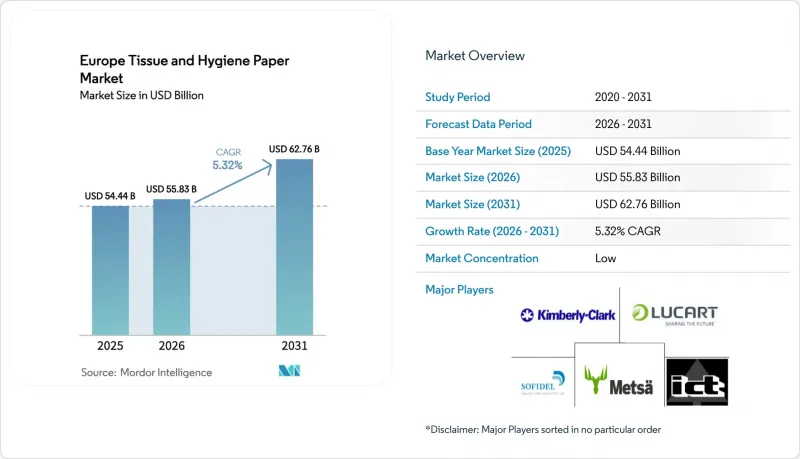
This report is Segmented by Product Type (Baby Diapers, Feminine Hygiene, Paper Tissues, Toilet Paper, and More), Raw Material (Kraft Pulp, Sulfite Pulp, Recycled Fiber, and More), Usage Type (At-Home, and Away-From-Home), End-Use Industry (Residential, Hospitality, Healthcare and Aged-Care Facilities, and More), and Country. The Market Forecasts are in Provided in Terms of Value (USD).
Europe Tissue And Hygiene Paper Market Trends and Insights
Aging Population Boosting Adult-Incontinence Demand
Europe's demographic shift is translating directly into higher consumption of absorbent hygiene products for adults. The European Association of Urology estimated that 55-60 million residents lived with incontinence in 2023, costing EUR 69.1 billion (USD 77.9 billion) with a forecast jump to EUR 87 billion (USD 98.1 billion) by 2030. German and Italian long-term-care facilities are upgrading to premium briefs that promise longer wear intervals, a change that cuts nursing labor and lifts average selling prices. Multinationals have responded by dedicating new converting lines to high-absorbency SKUs and bundling product-plus-service contracts with healthcare procurement agencies. The resulting 7.80% CAGR for incontinence products materially outpaces the broader Europe tissue and hygiene paper market.
Heightened Hygiene Awareness
Post-pandemic behaviors have locked in structurally higher tissue usage per capita. European consumption stabilized at 14.3 kilograms in 2024, helped by sustained preference for single-use towels in foodservice and clinical environments. Compliance with ISO 22000 and ISO 13485 has moved from voluntary to baseline procurement criteria, especially in hospitals that replaced cotton cloths with disposable alternatives. Urban households continue to stockpile facial tissues and paper towels as remote-work norms persist. Collectively, these factors lift unit demand in both retail and professional hygiene segments, supporting a +0.8% contribution to forecast CAGR.
Volatile Pulp and Energy Prices Squeezing Margins
Wholesale electricity in Europe peaked near EUR 400 per MWh in August 2022 before easing to 70-120 EUR per MWh in early 2023, while northern bleached softwood kraft pulp mirrored that turbulence. AFRY Consulting calculated that tissue production costs jumped 43% for virgin grades during 2020-2021. Although hedging contracts and cogeneration projects soften shocks, the lag in retail price passthrough compresses EBITDA and deters discretionary capital spend, subtracting a full percentage-point from forecast CAGR.
Other drivers and restraints analyzed in the detailed report include:
- EU Deforestation Rules Accelerating Recycled Tissue Uptake
- Surge in E-Commerce and D2C Retail Channels
- Decarbonization CAPEX Pressure under EU-ETS Phase IV
For complete list of drivers and restraints, kindly check the Table Of Contents.
Segment Analysis
In 2025, toilet paper generated the highest revenue, yet incontinence products exhibit the steepest trajectory at 7.80% CAGR through 2031. Europe tissue and hygiene paper market size for incontinence products is projected to rise sharply as care homes adopt premium, high-absorbency designs. The demographic shift places sustained pressure on supply chains for superabsorbent polymers and breathable films.
Manufacturers now bundle sensor-enabled briefs and digital ordering portals to deepen procurement contracts with healthcare institutions. Conversely, baby diapers weaken due to falling fertility in Western Europe, prompting SKU premiumization to protect value. Tissue converters on the continent thus manage a two-speed portfolio, defending commoditized toilet paper volumes while chasing margin in adult-care lines.
Recycled fiber accounted for 46.80% of Europe tissue and hygiene paper market share in 2025, and its share is widening on the back of EU forest-risk commodity rules. Europe tissue and hygiene paper market size linked to recycled fiber is set for 5.40% CAGR, overshadowing kraft and sulfite pulp grades.
Quality improvements emerge from better sorting: the HolyGrail 2.0 digital watermark pilots in Germany and the Netherlands demonstrated near-infrared detection accuracy above 95%. Nordic mills still deploy virgin fiber for strength-critical formats, yet even these producers integrate de-inked pulp into mid-tier SKUs to lower carbon intensity and reduce ETS liabilities.
Complete Report Scope:
- By Product Type
- Baby Diapers
- Feminine Hygiene
- Household Paper
- Incontinence Products
- Paper Tissues
- Paper Napkins
- Paper Towels
- Facial Tissues
- Specialty and Wrapping Tissues
- Toilet Paper
- By Raw Material
- Kraft Pulp
- Sulfite Pulp
- Recycled Fiber
- Other Raw Materials
- By Usage Type
- At-Home
- Away-from-Home
- By End-Use Industry
- Residential Households
- Hospitality and Foodservice
- Healthcare and Aged-Care Facilities
- Other End-Use Industry
- By Country
- United Kingdom
- Germany
- France
- Italy
- Spain
- Netherlands
- Denmark
- Sweden
- Russia
- Poland
- Rest of Europe
List of Companies Covered in this Report:
- Sofidel Group
- Kimberly-Clark Corporation
- WEPA Hygieneprodukte GmbH
- Metsa Group
- Industrie Cartarie Tronchetti SpA
- Lucart SpA
- Essity AB
- Renova
- Procter & Gamble
- Cartiere Carrara SpA
- Industrie Celtex SpA
- Johnson & Johnson Services Inc.
- Ontex Group
- Tosama DOO
- Drylock Technologies NV
- Georgia-Pacific LLC
- Kruger Products Inc.
- Ahlstrom-Munksj
- Cascades Inc.
- The Navigator Company SA
Additional Benefits:
- The market estimate (ME) sheet in Excel format
- 3 months of analyst support
TABLE OF CONTENTS
1 INTRODUCTION
- 1.1 Study Assumptions and Market Definition
- 1.2 Scope of the Study
2 RESEARCH METHODOLOGY
3 EXECUTIVE SUMMARY
4 MARKET LANDSCAPE
- 4.1 Market Overview
- 4.2 Market Drivers
- 4.2.1 Aging Population Boosting Adult-Incontinence Demand
- 4.2.2 Heightened Hygiene Awareness
- 4.2.3 Surge in E-Commerce and D2C Retail Channels
- 4.2.4 Tourism Rebound Elevating AFH Tissue Demand
- 4.2.5 EU Deforestation Rules Accelerating Recycled Tissue Uptake
- 4.2.6 Rapid Adoption of Digital Watermarks to Improve Paper Recycling
- 4.3 Market Restraints
- 4.3.1 Volatile Pulp and Energy Prices Squeezing Margins
- 4.3.2 Environmental and PFAS Concerns over Disposables
- 4.3.3 Private-Label Price Wars in Mature Retail
- 4.3.4 Decarbonization CAPEX Pressure under EU-ETS Phase IV
- 4.4 Industry Value Chain Analysis
- 4.5 Regulatory Landscape
- 4.6 Technological Outlook
- 4.7 Impact of Macroeconomic Factors
- 4.8 Porter's Five Forces Analysis
- 4.8.1 Threat of New Entrants
- 4.8.2 Bargaining Power of Suppliers
- 4.8.3 Bargaining Power of Buyers
- 4.8.4 Threat of Substitutes
- 4.8.5 Competitive Rivalry
5 MARKET SIZE AND GROWTH FORECASTS (VALUE)
- 5.1 By Product Type
- 5.1.1 Baby Diapers
- 5.1.2 Feminine Hygiene
- 5.1.3 Household Paper
- 5.1.4 Incontinence Products
- 5.1.5 Paper Tissues
- 5.1.6 Paper Napkins
- 5.1.7 Paper Towels
- 5.1.8 Facial Tissues
- 5.1.9 Specialty and Wrapping Tissues
- 5.1.10 Toilet Paper
- 5.2 By Raw Material
- 5.2.1 Kraft Pulp
- 5.2.2 Sulfite Pulp
- 5.2.3 Recycled Fiber
- 5.2.4 Other Raw Materials
- 5.3 By Usage Type
- 5.3.1 At-Home
- 5.3.2 Away-from-Home
- 5.4 By End-Use Industry
- 5.4.1 Residential Households
- 5.4.2 Hospitality and Foodservice
- 5.4.3 Healthcare and Aged-Care Facilities
- 5.4.4 Other End-Use Industry
- 5.5 By Country
- 5.5.1 United Kingdom
- 5.5.2 Germany
- 5.5.3 France
- 5.5.4 Italy
- 5.5.5 Spain
- 5.5.6 Netherlands
- 5.5.7 Denmark
- 5.5.8 Sweden
- 5.5.9 Russia
- 5.5.10 Poland
- 5.5.11 Rest of Europe
6 COMPETITIVE LANDSCAPE
- 6.1 Market Concentration
- 6.2 Strategic Moves
- 6.3 Market Share Analysis
- 6.4 Company Profiles (includes Global level Overview, Market level overview, Core Segments, Financials as available, Strategic Information, Market Rank/Share for key companies, Products and Services, and Recent Developments)
- 6.4.1 Sofidel Group
- 6.4.2 Kimberly-Clark Corporation
- 6.4.3 WEPA Hygieneprodukte GmbH
- 6.4.4 Metsa Group
- 6.4.5 Industrie Cartarie Tronchetti SpA
- 6.4.6 Lucart SpA
- 6.4.7 Essity AB
- 6.4.8 Renova
- 6.4.9 Procter & Gamble
- 6.4.10 Cartiere Carrara SpA
- 6.4.11 Industrie Celtex SpA
- 6.4.12 Johnson & Johnson Services Inc.
- 6.4.13 Ontex Group
- 6.4.14 Tosama DOO
- 6.4.15 Drylock Technologies NV
- 6.4.16 Georgia-Pacific LLC
- 6.4.17 Kruger Products Inc.
- 6.4.18 Ahlstrom-Munksj
- 6.4.19 Cascades Inc.
- 6.4.20 The Navigator Company SA
7 MARKET OPPORTUNITIES AND FUTURE OUTLOOK
- 7.1 White-Space and Unmet-Need Assessment

