PUBLISHER: Mordor Intelligence | PRODUCT CODE: 2116303

PUBLISHER: Mordor Intelligence | PRODUCT CODE: 2116303
India Alkaline Battery - Market Share Analysis, Industry Trends & Statistics, Growth Forecasts (2026 - 2031)
According to Mordor Intelligence, the India alkaline battery market size was valued at USD 0.92 billion in 2025 and estimated to grow from USD 0.98 billion in 2026 to reach USD 1.31 billion by 2031, at a CAGR of 6.12% during the forecast period (2026-2031).
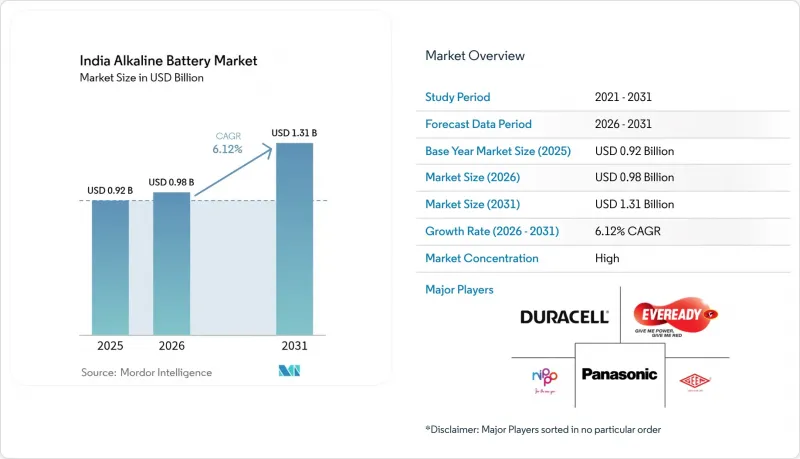
This report is Segmented by Battery Type (Primary and Secondary), Size (AA, AAA, 9-Volt, C, D, and Coin and Specialty), Application (Consumer Electronics, Industrial and Commercial Devices, Medical Devices, Toys and Entertainment, and Lighting and Flashlights). The Market Sizes and Forecasts are Provided in Terms of Value (USD).
India Alkaline Battery Market Trends and Insights
Surge In Consumer Electronics Penetration & Disposable Income
Disposable-income gains and an expanding installed base of battery-powered devices continue to widen the customer pool for the India Alkaline Battery market. Remote controls, toys, wall clocks, wireless peripherals, and digital thermometers dominate the replacement cycle, and a three-fold price premium over zinc-carbon translates to three-to-ten-times longer runtime for alkaline cells. Eveready's alkaline revenue rose 90.8% year-on-year in Q3 FY25 as it pursued a 53% market-share target within four years. Mid-market entrant Nippo Thor followed with a 3-4% share after only 11 months on the shelf. Yet lithium-ion powerpacks have captured earbuds, smartwatches, and Bluetooth speakers, constraining alkaline's headroom in the fastest-growing electronics segments. Manufacturers respond by deepening penetration in moderate-drain uses where rechargeability confers minimal benefit.
Rural Electrification Outages Driving Portable Power Demand
Intermittent grid supply in large swaths of rural India sustains a sizable opportunity for the India Alkaline Battery market. Despite a cumulative renewable-energy capacity of 220 GW, frequent load-shedding in Uttar Pradesh, Bihar, Jharkhand, and the Northeast prompts households to stockpile batteries for torches, radios, and emergency lanterns. Alkaline chemistry offers superior shelf life and cold-weather performance, especially valuable in storage-heavy consumption patterns. Eveready's new Jammu plant positions the firm near defense zones and rural markets in North India, trimming logistics costs and bolstering cold-chain supply. Rooftop solar adoption adds a paradoxical boost, as users attach alkaline-powered backup lights for the monsoon season or nighttime outages. Nevertheless, ongoing grid upgrades and declining prices for rechargeable lanterns may cap rural alkaline demand beyond the medium term.
Li-Ion Adoption Cannibalizing Primary Alkaline Sales
Rechargeable lithium-ion packs expand at a 22.7% CAGR in India, displacing single-use cells in earbuds, power tools, and portable speakers. In urban cores, a rechargeable AA-equivalent lithium-ion cell can replace fifty or more alkaline units over its life, tipping the value equation sharply. Eveready and Indo National hedge the risk by acquiring stakes in lithium-ion producers and broadening flash-light portfolios that maintain customer ties post-alkaline. Cannibalization remains most acute in metros where USB-C charging is pervasive; rural markets lag because of charger scarcity and higher perceived up-front costs.
Other drivers and restraints analyzed in the detailed report include:
- Rapid Growth In E-Commerce & Organized Retail Channels
- Shift From Zinc-Carbon To Alkaline On Cost & Energy Density
- EPR & Single-Use Battery Waste Regulations Tightening
For complete list of drivers and restraints, kindly check the Table Of Contents.
Segment Analysis
Primary cells represented 83.90% of India's Alkaline Battery market share in 2025, reinforcing their dominance in moderate-drain devices such as remote controls and flashlights. The India Alkaline Battery market anticipates incremental substitution toward rechargeable formats, yet mass adoption remains restrained by charger availability gaps and higher first-purchase pricing. Eveready's 46.3% alkaline sales jump in Q4 FY25 underscores ongoing migration from zinc-carbon to single-use alkaline across all channels.
Rechargeable alkaline batteries are projected to expand at an 11.05% CAGR through 2031, albeit from a low installed base. They win favor in industrial instrumentation and professional lighting, where reusability offsets cost and where lithium-ion faces certification or safety hurdles at extreme temperatures. BIS IS 16046 standards support certification, but nickel-metal hydride and lithium-ion still outpace secondary alkaline in energy density.
Complete Report Scope:
- By Battery Type
- Primary
- Secondary (Rechargeable Alkaline)
- By Size
- AA (LR6)
- AAA (LR03)
- 9-Volt
- C
- D
- Coin and Specialty
- By Application
- Consumer Electronics
- Industrial and Commercial Devices
- Medical Devices
- Toys and Entertainment
- Lighting and Flashlights
List of Companies Covered in this Report:
- Duracell Inc.
- Eveready Industries India Ltd.
- Indo National Ltd. (Nippo)
- Panasonic Energy India Co. Ltd.
- Geep Industries Pvt. Ltd.
- GPB International Ltd.
- FUTURISTIC IDC Pvt. Ltd.
- Sony Group Corporation (Murata)
- Energizer Holdings Inc.
- Gold Peak Industries (GP Batteries)
- Toshiba Corporation
- Maxell Holdings Ltd.
- Camelion Batterien GmbH
- VARTA AG
- Zhejiang Mustang Battery Co.
- Base Corporation Ltd.
- EVE Energy Co. Ltd.
- Rayovac (Spectrum Brands)
- AmazonBasics (Amazon India)
- Fujitsu Ltd.
Additional Benefits:
- The market estimate (ME) sheet in Excel format
- 3 months of analyst support
TABLE OF CONTENTS
1 Introduction
- 1.1 Study Assumptions & Market Definition
- 1.2 Scope of the Study
2 Research Methodology
3 Executive Summary
4 Market Landscape
- 4.1 Market Overview
- 4.2 Market Drivers
- 4.2.1 Surge in consumer-electronics penetration & disposable income
- 4.2.2 Rural electrification outages driving portable-power demand
- 4.2.3 Shift from zinc-carbon to alkaline on cost & energy density
- 4.2.4 Rapid growth in e-commerce & organised retail channels
- 4.2.5 Defence procurement of rugged alkaline cells for border surveillance
- 4.2.6 Toy-manufacturing clusters' compliance needs (lead-free)
- 4.3 Market Restraints
- 4.3.1 Li-ion adoption cannibalising primary alkaline sales
- 4.3.2 EPR & single-use battery-waste regulations tightening
- 4.3.3 Volatile KOH supply chain inflating input costs
- 4.3.4 Counterfeit low-grade cells eroding brand trust
- 4.4 Supply-Chain Analysis
- 4.5 Regulatory Landscape
- 4.6 Technological Outlook
- 4.7 Porter's Five Forces
- 4.7.1 Threat of New Entrants
- 4.7.2 Bargaining Power of Suppliers
- 4.7.3 Bargaining Power of Buyers
- 4.7.4 Threat of Substitutes
- 4.7.5 Competitive Rivalry
- 4.8 PESTEL Analysis
5 Market Size & Growth Forecasts
- 5.1 By Battery Type
- 5.1.1 Primary
- 5.1.2 Secondary (Rechargeable Alkaline)
- 5.2 By Size
- 5.2.1 AA (LR6)
- 5.2.2 AAA (LR03)
- 5.2.3 9-Volt
- 5.2.4 C
- 5.2.5 D
- 5.2.6 Coin and Specialty
- 5.3 By Application
- 5.3.1 Consumer Electronics
- 5.3.2 Industrial and Commercial Devices
- 5.3.3 Medical Devices
- 5.3.4 Toys and Entertainment
- 5.3.5 Lighting and Flashlights
6 Competitive Landscape
- 6.1 Market Concentration
- 6.2 Strategic Moves (M&A, Partnerships, PPAs)
- 6.3 Market Share Analysis (Market Rank/Share for key companies)
- 6.4 Company Profiles (includes Global level Overview, Market level overview, Core Segments, Financials as available, Strategic Information, Products & Services, and Recent Developments)
- 6.4.1 Duracell Inc.
- 6.4.2 Eveready Industries India Ltd.
- 6.4.3 Indo National Ltd. (Nippo)
- 6.4.4 Panasonic Energy India Co. Ltd.
- 6.4.5 Geep Industries Pvt. Ltd.
- 6.4.6 GPB International Ltd.
- 6.4.7 FUTURISTIC IDC Pvt. Ltd.
- 6.4.8 Sony Group Corporation (Murata)
- 6.4.9 Energizer Holdings Inc.
- 6.4.10 Gold Peak Industries (GP Batteries)
- 6.4.11 Toshiba Corporation
- 6.4.12 Maxell Holdings Ltd.
- 6.4.13 Camelion Batterien GmbH
- 6.4.14 VARTA AG
- 6.4.15 Zhejiang Mustang Battery Co.
- 6.4.16 Base Corporation Ltd.
- 6.4.17 EVE Energy Co. Ltd.
- 6.4.18 Rayovac (Spectrum Brands)
- 6.4.19 AmazonBasics (Amazon India)
- 6.4.20 Fujitsu Ltd.
7 Market Opportunities & Future Outlook
- 7.1 White-space & Unmet-Need Assessment

