PUBLISHER: Mordor Intelligence | PRODUCT CODE: 2116306

PUBLISHER: Mordor Intelligence | PRODUCT CODE: 2116306
Interferons - Market Share Analysis, Industry Trends & Statistics, Growth Forecasts (2026 - 2031)
According to Mordor Intelligence, the interferons market size is expected to increase from USD 10.11 billion in 2025 to USD 10.62 billion in 2026 and reach USD 13.42 billion by 2031, growing at a CAGR of 4.79% over 2026-2031.
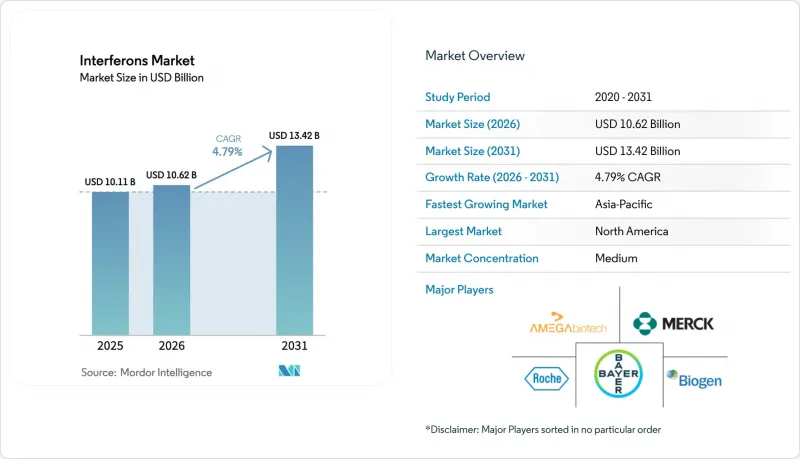
This report is Segmented by Product Type (Interferon A, Interferon B, Interferon Y, and More), Application (Hepatitis B, Multiple Sclerosis, and More), Route of Administration (Parenteral, Intranasal, Topical), End-User (Hospitals, Specialty Clinics, and More), and Geography (North America, Europe, Asia-Pacific, Middle East & Africa, South America). The Market Forecasts are Provided in Terms of Value (USD).
Global Interferons Market Trends and Insights
Rising Prevalence of Chronic Viral Infections
Chronic hepatitis B affects an estimated 296 million carriers worldwide, with the highest burden concentrated in China and India.Peginterferon offers a finite 48-week regimen and achieves hepatitis B surface antigen loss in 3-7% of treatment-naive adults, outperforming the <1% rate associated with indefinite nucleos(t)ide analogue therapy. Combination trials pairing peginterferon with small-interfering RNA agents such as elebsiran achieved 21-33% antigen clearance, tripling monotherapy outcomes and renewing payer interest in interferon-based regimens. Domestic biosimilar producers in India and China undercut originator prices by up to 40%, enlarging eligible populations despite lower unit margins. Parallel research on dengue, mpox, and other expanding arboviruses highlights the broad antiviral utility of interferons, reinforcing their inclusion in national pandemic-preparedness stockpiles even before full commercial approval.
Growing Multiple-Sclerosis Patient Pool Using IFN-B First-Line
International guidelines continue to recommend interferon-B as a first-line option for patients with relapsing-remitting multiple sclerosis and low disease activity, or those with contraindications to higher-efficacy monoclonal antibodies. Although U.S. prescriptions declined as clinicians switched to ocrelizumab and BTK inhibitors, the global diagnosed MS population is expanding, particularly in the Middle East, where improved neurologic infrastructure is raising treatment rates. Pegylated interferon beta-1a (Plegridy), which extends injection intervals to every two weeks, preserves adherence in risk-averse cohorts until patent expiry in 2027, opening the door for biosimilars that will reset pricing across developed markets. Emerging MS centers in Saudi Arabia and Turkey are expected to leapfrog to these lower-cost alternatives, partly offsetting the erosion of North American revenue.
Rapid Uptake of DAAs Displacing Interferon in HCV
All-oral direct-acting antivirals achieve a sustained virologic response of greater than 95%, prompting the WHO and CDC to remove interferon-based regimens from their guidelines for hepatitis C. The resulting USD 2-3 billion annual revenue loss between 2015 and 2023 shows how swiftly interferon sales can evaporate in the face of superior efficacy.
Other drivers and restraints analyzed in the detailed report include:
- Wider Adoption of Cost-Saving Biosimilar Interferons
- Expanding Oncology Pipeline Using Interferon-Based Immunotherapy
- Flu-Like Adverse Events Lower Treatment Adherence
For complete list of drivers and restraints, kindly check the Table Of Contents.
Segment Analysis
Interferon-B dominated 2025 revenue with 45.31% interferon market share, but long-acting fusion proteins are accelerating at a 7.02% CAGR toward 2031. Ropeginterferon's 78-hour half-life and monthly pen device support premium positioning for myeloproliferative neoplasms, while pegylated interferons remain the workhorse for finite-duration hepatitis B therapy. High-dose interferon-a in melanoma and renal cell carcinoma is being contracted, limited to centers that combine it with regional immunotherapies. Interferon-Y contributes negligible sales because its approved uses are restricted to rare pediatric immunodeficiencies.
Pipeline fusion constructs aim for half-lives exceeding 120 hours, potentially enabling quarterly maintenance dosing that repositions interferons as convenient options for chronic diseases. Developers pursuing albumin or hyFc scaffolds argue that reduced injection frequency will offset higher manufacturing costs. Whether HTA bodies will reimburse at premium price points hinges on real-world adherence gains and molecular-response surrogates proving long-term clinical benefit.
Multiple sclerosis generated 36.63% of 2025 revenue, yet its share is inching downward as ocrelizumab and BTK inhibitors cannibalize first-line starts. In contrast, intranasal interferon stockpiling for future pandemics drives a 7.48% CAGR in the emerging-viral-disease segment. Hepatitis B remains a solid secondary pillar, thanks to peginterferon's finite therapeutic window and superior functional cure probability.
Cancer indications are bifurcating: hematologists are embracing ropeginterferon for molecularly defined myeloproliferative neoplasms, while oncologists treating solid tumors continue to migrate to checkpoint inhibitors. The distinct trajectories illustrate how interferons retain relevance in niches where their broad immune activation complements targeted agents.
Complete Report Scope:
- By Product Type
- Interferon a
- Interferon B
- Interferon Y
- Pegylated Interferons
- Long-acting Fusion Interferons
- By Application
- Hepatitis B
- Multiple Sclerosis
- Melanoma
- Leukemia
- Renal Cell Carcinoma
- Emerging Viral Diseases
- By Route of Administration
- Parenteral
- Intranasal
- Topical
- By End-User
- Hospitals
- Specialty Clinics
- Home-care Settings
- Academic & Research Institutes
- By Geography
- North America
- United States
- Canada
- Mexico
- Europe
- Germany
- United Kingdom
- France
- Italy
- Spain
- Rest of Europe
- Asia-Pacific
- China
- Japan
- India
- Australia
- South Korea
- Rest of Asia-Pacific
- Middle East & Africa
- GCC
- South Africa
- Rest of Middle East & Africa
- South America
- Brazil
- Argentina
- Rest of South America
- North America
Geography Analysis
North America's interferon market size, at 41.26%, remains the largest region in 2025, despite steady revenue contraction, with payer negotiations and impending biosimilar substitution expected to erode average selling prices by 20-25% after 2027. Europe follows a tender-driven procurement model that accelerates biosimilar turnover; originators maintain share primarily in Germany and Scandinavia, where physician loyalty and real-world evidence delay rapid switching. Asia-Pacific's volume expansion, with a CAGR of 8.04% from 2026 to 2031, is driven by the hepatitis-B burden and cost-effective domestic manufacturing; however, fragmented provincial reimbursement in China moderates the pace of uptake. Emerging programs in Saudi Arabia, the United Arab Emirates, and Turkey are enhancing neurologic care infrastructure, increasing multiple sclerosis diagnosis rates, and providing a short-term boost to interferon-B uptake before next-generation oral therapies become dominant.
South America's growth hinges on Brazil's public tender cycles and Argentine biosimilar penetration. At the same time, Sub-Saharan Africa remains untapped mainly due to affordability constraints, although donor-funded procurement for viral outbreaks could catalyze sporadic spikes in demand. High-income Asia-Pacific markets, such as Japan and South Korea, enforce stringent biosimilar equivalence trials, which slow the introduction but ensure quality. Australia maintains niche use in hematology, with hospital groups favoring fusion proteins for myeloproliferative neoplasms under orphan-drug reimbursement pathways.
- Abbvie
- Amega Biotech
- AOP Orphan Pharmaceuticals AG
- Bayer
- Biogen
- Biosidus
- Chugai Pharmaceutical
- CSL Behring AG
- Roche
- GeneSys Biologics Pvt Ltd
- GlaxoSmithKline
- Hikma Pharmaceuticals
- Intas Pharmaceutical
- Kineta Inc.
- Merck
- Novartis
- Pfizer
- Rentschler Biopharma SE
- Sanofi
- Zydus Lifesciences Ltd
Additional Benefits:
- The market estimate (ME) sheet in Excel format
- 3 months of analyst support
TABLE OF CONTENTS
1 Introduction
- 1.1 Study Assumptions & Market Definition
- 1.2 Scope of the Study
2 Research Methodology
3 Executive Summary
4 Market Landscape
- 4.1 Market Overview
- 4.2 Market Drivers
- 4.2.1 Rising Prevalence of Chronic Viral Infections
- 4.2.2 Growing Multiple-Sclerosis Patient Pool Using IFN-B First-Line
- 4.2.3 Wider Adoption of Cost-Saving Biosimilar Interferons
- 4.2.4 Expanding Oncology Pipeline Using Interferon-Based Immunotherapy
- 4.2.5 Intranasal Interferon for Pandemic Respiratory Threats
- 4.2.6 Long-Acting Fusion-Protein Interferons in Late-Stage R&D
- 4.3 Market Restraints
- 4.3.1 Rapid Uptake of Daas Displacing Interferon In HCV
- 4.3.2 Flu-Like Adverse Events Lower Treatment Adherence
- 4.3.3 Shortage Of GMP-Grade Plasmid Supply for Recombinant IFN
- 4.3.4 Environmental Concerns on Pegylated IFN Metabolites
- 4.4 Regulatory Landscape
- 4.5 Technological Outlook
- 4.6 Porter's Five Forces Analysis
- 4.6.1 Threat of New Entrants
- 4.6.2 Bargaining Power of Buyers
- 4.6.3 Bargaining Power of Suppliers
- 4.6.4 Threat of Substitutes
- 4.6.5 Competitive Rivalry
5 Market Size & Growth Forecasts
- 5.1 By Product Type
- 5.1.1 Interferon a
- 5.1.2 Interferon B
- 5.1.3 Interferon Y
- 5.1.4 Pegylated Interferons
- 5.1.5 Long-acting Fusion Interferons
- 5.2 By Application
- 5.2.1 Hepatitis B
- 5.2.2 Multiple Sclerosis
- 5.2.3 Melanoma
- 5.2.4 Leukemia
- 5.2.5 Renal Cell Carcinoma
- 5.2.6 Emerging Viral Diseases
- 5.3 By Route of Administration
- 5.3.1 Parenteral
- 5.3.2 Intranasal
- 5.3.3 Topical
- 5.4 By End-User
- 5.4.1 Hospitals
- 5.4.2 Specialty Clinics
- 5.4.3 Home-care Settings
- 5.4.4 Academic & Research Institutes
- 5.5 By Geography
- 5.5.1 North America
- 5.5.1.1 United States
- 5.5.1.2 Canada
- 5.5.1.3 Mexico
- 5.5.2 Europe
- 5.5.2.1 Germany
- 5.5.2.2 United Kingdom
- 5.5.2.3 France
- 5.5.2.4 Italy
- 5.5.2.5 Spain
- 5.5.2.6 Rest of Europe
- 5.5.3 Asia-Pacific
- 5.5.3.1 China
- 5.5.3.2 Japan
- 5.5.3.3 India
- 5.5.3.4 Australia
- 5.5.3.5 South Korea
- 5.5.3.6 Rest of Asia-Pacific
- 5.5.4 Middle East & Africa
- 5.5.4.1 GCC
- 5.5.4.2 South Africa
- 5.5.4.3 Rest of Middle East & Africa
- 5.5.5 South America
- 5.5.5.1 Brazil
- 5.5.5.2 Argentina
- 5.5.5.3 Rest of South America
- 5.5.1 North America
6 Competitive Landscape
- 6.1 Market Concentration
- 6.2 Market Share Analysis
- 6.3 Company Profiles (includes Global level Overview, Market-level Overview, Core Segments, Financials, Strategic Information, Market Rank/Share, Products & Services, Recent Developments)
- 6.3.1 AbbVie Inc.
- 6.3.2 Amega Biotech
- 6.3.3 AOP Orphan Pharmaceuticals AG
- 6.3.4 Bayer AG
- 6.3.5 Biogen Inc
- 6.3.6 Biosidus
- 6.3.7 Chugai Pharmaceutical Co. Ltd
- 6.3.8 CSL Behring AG
- 6.3.9 F. Hoffmann-La Roche Ltd
- 6.3.10 GeneSys Biologics Pvt Ltd
- 6.3.11 GlaxoSmithKline plc
- 6.3.12 Hikma Pharmaceuticals plc
- 6.3.13 Intas Pharmaceuticals Ltd
- 6.3.14 Kineta Inc.
- 6.3.15 Merck & Co.,Inc.
- 6.3.16 Novartis AG
- 6.3.17 Pfizer Inc.
- 6.3.18 Rentschler Biopharma SE
- 6.3.19 Sanofi S.A.
- 6.3.20 Zydus Lifesciences Ltd
7 Market Opportunities & Future Outlook
- 7.1 White-space & Unmet-need Assessment

