PUBLISHER: Mordor Intelligence | PRODUCT CODE: 2116312

PUBLISHER: Mordor Intelligence | PRODUCT CODE: 2116312
US Face Mask - Market Share Analysis, Industry Trends & Statistics, Growth Forecasts (2026 - 2031)
According to Mordor Intelligence, the US face mask market size is expected to grow from USD 278.58 million in 2025 to USD 301.92 million in 2026 and is forecast to reach USD 451.33 million by 2031 at 8.38% CAGR over 2026-2031.
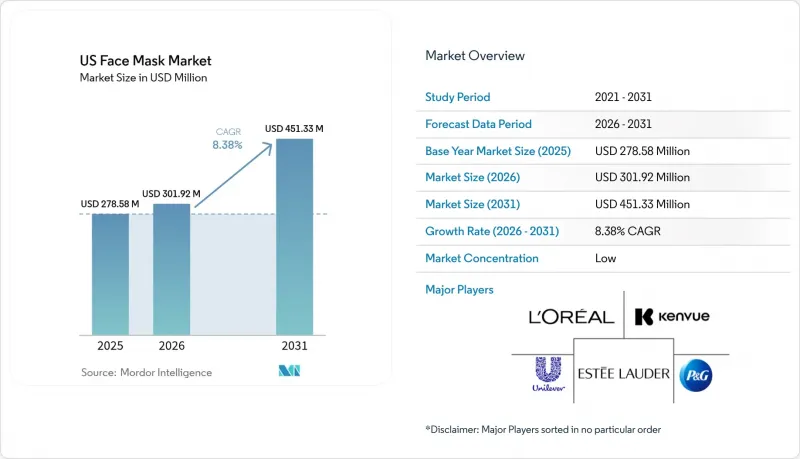
This report is Segmented by Product Type (Clay Mask, Peel-Off Mask, Sheet Mask, Cream Mask/Gel Mask), End User (Men, Women), Ingredient (Natural and Organic, Conventional), and Distribution Channel (Supermarkets/Hypermarkets, Specialty Stores, Online Retail Stores, Other Distribution Channels), by Region (Northeast, Midwest, South, West). The Market Forecasts are Provided in Terms of Value (USD).
US Face Mask Market Trends and Insights
Technological Innovations in Terms of Ingredient and Functionality
Technological advancements in ingredient formulations and functionality drive the US face mask market growth. Manufacturers incorporate innovative ingredients such as hyaluronic acid, peptides, and natural botanicals while developing smart masks with targeted delivery systems. The integration of biotechnology enables masks with enhanced penetration capabilities and time-release properties. Additionally, personalized face masks utilizing artificial intelligence and skin diagnostic tools allow consumers to address specific skincare concerns effectively. For instance, in December 2024, CosRx launched two new face masks - the Advanced Snail Mucin Glass Glow Hydrogel Mask and Peptide Collagen Hydrogel Eye Patch for Youthful Glow, demonstrating the market's continuous innovation in ingredient formulations.
Increased Air Pollution and Environmental Concerns
Environmental degradation in the United States has transformed face masks from luxury beauty products into essential preventive healthcare tools. The increasing air pollution levels in major US cities, combined with environmental challenges such as wildfires and dust storms, have prompted residents to use face masks during outdoor activities and daily commutes. This shift in consumer behavior stems from growing awareness of airborne pollutants and their health impacts, effectively expanding the addressable market beyond traditional cosmetics consumers. According to the American Lung Association's State of the Air 2025 report, 156.1 million Americans, 46% of the population, live in areas with failing grades for unhealthy levels of ozone or particle pollution . These environmental factors continue to drive the growth of the US face mask market as consumers prioritize skin health and protection against air pollution.
Health Concerns Over Chemical Ingredients
Consumer awareness regarding potentially harmful chemicals in face masks, such as synthetic fragrances, parabens, and artificial dyes, has become a significant market restraint. The presence of chemical preservatives, phthalates, formaldehyde-releasing preservatives, and synthetic colors has raised concerns among regulatory bodies and consumer advocacy groups due to their association with skin irritation and allergic reactions. This heightened awareness, coupled with the implementation of the Modernization of Cosmetics Regulation Act (MoCRA), which expanded FDA authority over cosmetics safety and labeling requirements, has created regulatory challenges for manufacturers . The shift in consumer preference towards clean beauty and natural ingredients has compelled manufacturers to reformulate their products, resulting in higher production costs and potentially lower profit margins.
Other drivers and restraints analyzed in the detailed report include:
- Rising Consumer Spending on Skincare Products
- Surge in Men's Skincare Adoption
- Alternative and Traditional Skincare Methods
For complete list of drivers and restraints, kindly check the Table Of Contents.
Segment Analysis
The face mask market demonstrates distinct segment dynamics, with cream and gel masks commanding a dominant 43.08% share in 2025, primarily due to their universal appeal in providing hydration and nourishment across diverse skin types. While these traditional formats maintain their leadership position, clay masks are emerging as the fastest-growing segment with an 8.69% CAGR through 2031, driven by increasing urban pollution concerns and consumer demand for deep-cleansing solutions. Sheet masks and peel-off variants occupy specific market niches, with the former facing environmental scrutiny despite social media popularity, and the latter serving consumers seeking visible transformation effects.
The market evolution reflects a shift from basic moisturizing treatments toward targeted solutions addressing specific skin concerns. Clay masks leverage their natural positioning to align with clean beauty preferences, while cream and gel formats are adapting through sustainable packaging initiatives and cleaner formulations to maintain their market dominance. This adaptation indicates the industry's response to changing consumer preferences and environmental considerations.
The gender segmentation reveals a significant transformation in skincare consumption patterns. While women maintain a dominant 57.32% market share in 2025, men's adoption is growing rapidly at a 9.11% CAGR through 2031, approaching overall market growth rates. This convergence reflects the normalization of male grooming practices beyond traditional boundaries, driven by social media influence, celebrity endorsements, and evolving masculine identity concepts that embrace self-care and appearance maintenance.
The male segment shows strong growth particularly in urban markets, where professional environments and cultural attitudes support expanded grooming routines, especially in the Northeast and West Coast regions with higher education levels and disposable incomes. Male consumers demonstrate distinct preferences from traditional female-focused products, necessitating targeted formulations that address specific skin concerns including larger pores, increased oil production, and coarser skin texture.
Complete Report Scope:
- By Product Type
- Clay Mask
- Peel-Off Mask
- Sheet Mask
- Cream Mask/Gel Mask
- By End User
- Men
- Women
- By Ingredient
- Natural and Organic
- Conventional
- By Distribution Channel
- Supermarkets/Hypermarkets
- Specialty Stores
- Online Retail Stores
- Other Distribution Channels
- By Region
- Northeast
- Midwest
- South
- West
List of Companies Covered in this Report:
- L'Oreal SA
- Unilever Plc
- The Estee Lauder Companies Inc.
- Kenvue Inc.
- Procter & Gamble Company
- Shiseido Co. Ltd.
- Natura & Co.
- BioRepublic SkinCare
- FaceTory Inc.
- Masqueology LLC
- Glow Recipe
- The Face Shop Co., Ltd
- Star Skin Beauty Group AG
- Orgaid
- Fancl Corporation
- Patchology Inc.
- Jaxon Lane Inc.
- Beiersdorf AG
- Tonymoly Co
- Amorepacific Corporation
Additional Benefits:
- The market estimate (ME) sheet in Excel format
- 3 months of analyst support
TABLE OF CONTENTS
1 INTRODUCTION
- 1.1 Study Assumptions and Market Definition
- 1.2 Scope of the Study
2 RESEARCH METHODOLOGY
3 EXECUTIVE SUMMARY
4 MARKET LANDSCAPE
- 4.1 Market Overview
- 4.2 Market Drivers
- 4.2.1 Technological Innovations in terms of Ingredient and Functionality
- 4.2.2 Increased Air Pollution and Environmental Concerns
- 4.2.3 Rising Consumer Spending on Skincare Products
- 4.2.4 Influence of Social Media and Celebrity Endorsements
- 4.2.5 Surge in men's skincare adoption
- 4.2.6 Demand for Natural, Organic, and Clean Facial Care Products
- 4.3 Market Restraints
- 4.3.1 Health Concern Over Chemical Ingredient
- 4.3.2 Alternative and Traditional Methods of Skin Routine Practices
- 4.3.3 Skin Sensitivity and Allergic Reactions
- 4.3.4 Supply Chain and Raw Material Constraints
- 4.4 Consumer Behaviour Analysis
- 4.5 Regulatory Outlook
- 4.6 Porter's Five Forces Analysis
- 4.6.1 Bargaining Power of Suppliers
- 4.6.2 Bargaining Power of Buyers
- 4.6.3 Threat of New Entrants
- 4.6.4 Threat of Substitutes
- 4.6.5 Degree of Competition
5 MARKET SIZE AND GROWTH FORECASTS (VALUE)
- 5.1 By Product Type
- 5.1.1 Clay Mask
- 5.1.2 Peel-Off Mask
- 5.1.3 Sheet Mask
- 5.1.4 Cream Mask/Gel Mask
- 5.2 By End User
- 5.2.1 Men
- 5.2.2 Women
- 5.3 By Ingredient
- 5.3.1 Natural and Organic
- 5.3.2 Conventional
- 5.4 By Distribution Channel
- 5.4.1 Supermarkets/Hypermarkets
- 5.4.2 Specialty Stores
- 5.4.3 Online Retail Stores
- 5.4.4 Other Distribution Channels
- 5.5 By Region
- 5.5.1 Northeast
- 5.5.2 Midwest
- 5.5.3 South
- 5.5.4 West
6 COMPETITIVE LANDSCAPE
- 6.1 Market Concentration
- 6.2 Strategic Moves
- 6.3 Market Share Analysis
- 6.4 Company Profiles (Includes Global-level Overview, Market-level Overview, Core Segments, Financials, Strategic Info, Market Rank/Share, Products and Services, Recent Developments)
- 6.4.1 L'Oreal SA
- 6.4.2 Unilever Plc
- 6.4.3 The Estee Lauder Companies Inc.
- 6.4.4 Kenvue Inc.
- 6.4.5 Procter & Gamble Company
- 6.4.6 Shiseido Co. Ltd.
- 6.4.7 Natura & Co.
- 6.4.8 BioRepublic SkinCare
- 6.4.9 FaceTory Inc.
- 6.4.10 Masqueology LLC
- 6.4.11 Glow Recipe
- 6.4.12 The Face Shop Co., Ltd
- 6.4.13 Star Skin Beauty Group AG
- 6.4.14 Orgaid
- 6.4.15 Fancl Corporation
- 6.4.16 Patchology Inc.
- 6.4.17 Jaxon Lane Inc.
- 6.4.18 Beiersdorf AG
- 6.4.19 Tonymoly Co
- 6.4.20 Amorepacific Corporation
7 MARKET OPPORTUNITIES AND FUTURE OUTLOOK

