PUBLISHER: Mordor Intelligence | PRODUCT CODE: 2116316

PUBLISHER: Mordor Intelligence | PRODUCT CODE: 2116316
Smart Refrigerator - Market Share Analysis, Industry Trends & Statistics, Growth Forecasts (2026 - 2031)
According to Mordor Intelligence, the smart refrigerator market size is expected to grow from USD 8.25 billion in 2025 to USD 9.12 billion in 2026 and is forecast to reach USD 15.04 billion by 2031 at 10.52% CAGR over 2026-2031.
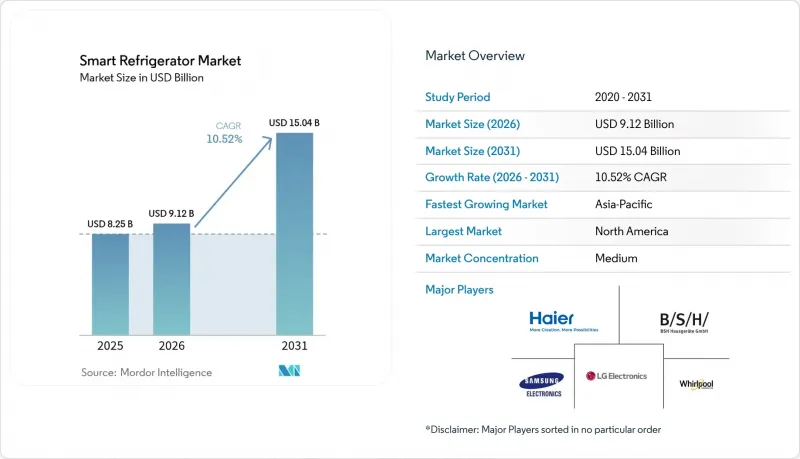
This report is Segmented by Product (Single-Door Refrigerator, Double-Door Refrigerator, and More), Connectivity (Wi-Fi Enabled, Voice-Assistant & AI-Integrated, and More), Capacity (Less Than 300 L, 300 - 500 L, and More), End-User (Residential, and Commercial), Distribution Channel (B2C, and B2B), and Geography (North America, South America, and More). The Market Forecasts are Provided in Terms of Value (USD).
Global Smart Refrigerator Market Trends and Insights
Rising Adoption of Smart-Home Ecosystems
Matter 1.3, launched in May 2024, officially certified refrigerators for cross-platform control and reduced set-up friction between Apple Home, Google Home, and Amazon Alexa environments. BSH introduced Matter-enabled refrigerators in early 2025, signaling that interoperability is now table stakes in the smart refrigerator market. Households adopting multiple connected devices display a higher propensity to upgrade additional appliances to gain unified voice control, calendar integration, and energy scheduling. Premium models strengthen this dynamic through 9-inch AI Home displays that place recipe suggestions, family calendars, and energy dashboards at eye level.
Stringent Energy-Efficiency Regulations Driving Replacements
The U.S. Department of Energy tightened refrigerator efficiency standards in December 2024 and mandated certification submissions starting May 2025. New York State's standards forecast USD 264 million in yearly consumer savings by 2035 and specifically reward connected units that prove demand-response compatibility . In April 2025, the UK began requiring smart readiness so that appliances can automatically shift load to off-peak periods. Canada's Amendment 18 will harmonize with U.S. rules from 2026, giving manufacturers an incentive to design uniform North American portfolios. These measures accelerate natural replacement by making legacy units comparatively expensive to operate, thereby uplifting the smart refrigerator market.
High Upfront Price Premium Versus Conventional Models
Smart refrigerators still carry a hefty price tag, which puts off buyers who watch their budgets, especially in countries where price is the first filter. The extra cost is mainly acceptable to well-off households, and North American families are the most willing to pay for connected features. That leaves manufacturers stuck between loading in new tech and keeping the final price within reach of a wider audience. Ongoing inflation and economic jitters make matters worse because many people delay replacing an old fridge until it stops working. On top of that, shoppers often have trouble seeing how lower energy bills or predictive maintenance justify the bigger upfront spend, so brands need clearer, numbers-based stories that show the payback in real terms.
Other drivers and restraints analyzed in the detailed report include:
- Declining IoT Module and Sensor Costs
- Manufacturer-Integrated AI for Predictive Maintenance
- Cyber-Security and Data-Privacy Vulnerabilities
For complete list of drivers and restraints, kindly check the Table Of Contents.
Segment Analysis
The double-door format retained the largest slot with a 29.40% smart refrigerator market share in 2025 because buyers still equate the layout with reliable cold air circulation. The segment also benefits from incremental upgrades, such as Wi-Fi boards and touch displays, that can be added without retooling cabinet designs. French-door units, however, are charting the fastest 11.96% CAGR on the back of premium kitchen remodels, additional door-within-door storage, and wider shelves that accommodate meal-prepping containers. Samsung's latest AI Hybrid Cooling model boosts interior volume by 25 L without expanding external dimensions, underscoring how premium engineering solves real-world space constraints.
The growing popularity of French-door configurations positions the format as the principal innovation sandbox where OEMs debut high-resolution cameras, recipe recommendation engines, and AI-powered freshness algorithms. Because the layout places refrigerated foods at eye level, vision modules can capture clearer images for machine learning, increasing recognition accuracy. As production scales, BOM reductions should feed back into lower Street prices, enabling further substitution of legacy double-door units and reinforcing the expansion of the smart refrigerator market.
Wi-Fi connectivity became a baseline expectation, constituting 44.30% of shipments in 2025 and anchoring the smart refrigerator market size for entry-level SKUs. Manufacturers preload apps that issue firmware updates, energy-usage dashboards, and diagnostic codes via standardized over-the-air protocols. Voice-assistant and AI-integrated models are growing at an 11.12% CAGR because they enable hands-free grocery management and recipe planning. Integration with Alexa, Google Assistant, and Samsung Bixby is the main pull, but LG's ThinQ and GE's SmartHQ are expanding their natural language libraries.
Multi-protocol chips now embed Wi-Fi, Thread, and Bluetooth LE on a single die, cutting module cost, which in turn smooths Matter 1.3 certification. That convergence reduces consumer setup friction, driving higher attach rates of voice-assistant SKUs to broader smart-home deployments. OEMs view natural language as the sticky interface that anchors their wider appliance ecosystems. Consequently, voice-first control is expected to become the de facto standard during the forecast window, amplifying replacement demand in the smart refrigerator market.
Complete Report Scope:
- By Product
- Single-Door Refrigerator
- Double-Door Refrigerator
- Top Freezer
- Bottom Freezer
- Side-By-Side Door Refrigerator
- French-Door Refrigerator
- Other Refrigerators
- By Connectivity
- Wi-Fi Enabled (App-Controlled)
- Voice-Assistant & AI-Integrated (e.g., Family-Hub)
- Bluetooth / Zigbee / Thread
- Screen-Based Smart Fridges
- By Capacity (Liters)
- Less than 300 L
- 300 - 500 L
- 501 - 700 L
- Greater than 700 L
- By End-User
- Residential
- Commercial
- By Distribution Channel
- B2C / Retail
- Multi-Brand Stores
- Exclusive Brand Outlets
- Online
- Other Distribution Channels
- B2B / Directly From The Manufacturers
- B2C / Retail
- By Geography
- North America
- Canada
- United States
- Mexico
- South America
- Brazil
- Peru
- Chile
- Argentina
- Rest Of South America
- Asia-Pacific
- India
- China
- Japan
- Australia
- South Korea
- South East Asia (Singapore, Malaysia, Thailand, Indonesia, Vietnam, And Philippines)
- Rest of Asia-Pacific
- Europe
- United Kingdom
- Germany
- France
- Spain
- Italy
- BENELUX (Belgium, Netherlands, And Luxembourg)
- NORDICS (Denmark, Finland, Iceland, Norway, And Sweden)
- Rest Of Europe
- Middle East And Africa
- United Arab Emirates
- Saudi Arabia
- South Africa
- Nigeria
- Rest Of Middle East And Africa
- North America
Geography Analysis
North America preserved a 29.60% share of the smart refrigerator market in 2025 due to early smart-home adoption, high disposable income, and a well-developed installer network. Utility rebate programs covering connected appliances further shift purchasing toward ENERGY STAR Most Efficient models that embed real-time tracking . Brand trust indices place Bosch, Whirlpool and LG above newcomers, illustrating the latent brand-equity moat that cushions incumbents. Premium kitchen remodels continue to substitute working but feature-poor refrigerators, extending a robust upgrade cycle that favors advanced AI Vision capabilities compatible with third-party grocery platforms.
Asia-Pacific, led by China, is closing the gap at a forecast 9.95% CAGR through 2031. Middle-class income expansion in urban China, India, and Southeast Asia is driving the uptake of premium SKUs that incorporate voice control and AI freshness monitoring. Chinese OEMs such as Haier and Hisense translate local manufacturing scale into aggressive global pricing, further democratizing access. Regional policy incentives aimed at smart-home infrastructure and carbon-neutral living support long-run momentum in the smart refrigerator market.
Europe remains a technologically mature yet regulation-driven arena. The EU F-Gas Regulation and the Ecodesign for Sustainable Products Regulation press manufacturers to adopt natural refrigerants and design for durability ec.europa.eu. Consumers prioritize energy scorecards and cradle-to-cradle recyclability over flashy add-ons, steering the competitive battle toward efficiency algorithms and modular repairability. BSH's Matter-enabled releases and LG's Q1 2025 AI-ready refrigerators both respond to these preferences by coupling low global-warming-potential refrigerants with open-protocol interoperability. Regulatory convergence across the continent harmonizes product requirements, effectively enlarging the addressable smart refrigerator market.
- Samsung Electronics Co. Ltd.
- LG Electronics Inc.
- Haier Smart Home Co. Ltd. (Incl. GE Appliances)
- Whirlpool Corporation
- BSH Hausgerate GmbH (Bosch, Siemens, Gaggenau)
- Electrolux AB (Incl. Frigidaire)
- Midea Group
- Hisense Home Appliances
- Panasonic Corporation
- Sub-Zero Group Inc.
- Liebherr-Hausgerate GmbH
- Sharp Corporation
- Smeg S.p.A
- Hitachi Global Life Solutions
- Godrej Appliances
- Arcelik A.S. (Beko, Grundig)
- Miele & Cie. KG
- Fisher & Paykel Appliances Ltd.
- Thermador (BSH Group)
- Viking Range LLC
- Dacor Inc.
- Gorenje Group
Additional Benefits:
- The market estimate (ME) sheet in Excel format
- 3 months of analyst support
TABLE OF CONTENTS
1 Introduction
- 1.1 Study Assumptions & Market Definition
- 1.2 Scope of the Study
2 Research Methodology
3 Executive Summary
4 Market Landscape
- 4.1 Market Overview
- 4.2 Market Drivers
- 4.2.1 Rising Adoption of Smart-Home Ecosystems
- 4.2.2 Stringent Energy-Efficiency Regulations Driving Replacements
- 4.2.3 Declining IoT Module And Sensor Costs
- 4.2.4 Manufacturer-Integrated AI For Predictive Maintenance
- 4.2.5 Retailer Telemetry Monetization From Connected Fridges
- 4.2.6 Home-Health Medication Storage With Temperature Compliance
- 4.3 Market Restraints
- 4.3.1 High Upfront Price Premium Versus Conventional Models
- 4.3.2 Cyber-Security And Data-Privacy Vulnerabilities
- 4.3.3 Fragmented Interoperability Despite Matter Roll-Out
- 4.3.4 Right-To-Repair And Embedded-Carbon Scrutiny
- 4.4 Industry Value Chain Analysis
- 4.5 Porter's Five Forces Analysis
- 4.5.1 Threat Of New Entrants
- 4.5.2 Bargaining Power Of Suppliers
- 4.5.3 Bargaining Power Of Buyers
- 4.5.4 Threat Of Substitutes
- 4.5.5 Competitive Rivalry
- 4.6 Insights Into The Latest Trends And Innovations In The Market
- 4.7 Insights On Recent Developments (New Product Launches, Strategic Initiatives, Investments, Partnerships, JVs, Expansion, M&As, Etc.) In The Market
5 Market Size & Growth Forecasts (Value)
- 5.1 By Product
- 5.1.1 Single-Door Refrigerator
- 5.1.2 Double-Door Refrigerator
- 5.1.2.1 Top Freezer
- 5.1.2.2 Bottom Freezer
- 5.1.3 Side-By-Side Door Refrigerator
- 5.1.4 French-Door Refrigerator
- 5.1.5 Other Refrigerators
- 5.2 By Connectivity
- 5.2.1 Wi-Fi Enabled (App-Controlled)
- 5.2.2 Voice-Assistant & AI-Integrated (e.g., Family-Hub)
- 5.2.3 Bluetooth / Zigbee / Thread
- 5.2.4 Screen-Based Smart Fridges
- 5.3 By Capacity (Liters)
- 5.3.1 Less than 300 L
- 5.3.2 300 - 500 L
- 5.3.3 501 - 700 L
- 5.3.4 Greater than 700 L
- 5.4 By End-User
- 5.4.1 Residential
- 5.4.2 Commercial
- 5.5 By Distribution Channel
- 5.5.1 B2C / Retail
- 5.5.1.1 Multi-Brand Stores
- 5.5.1.2 Exclusive Brand Outlets
- 5.5.1.3 Online
- 5.5.1.4 Other Distribution Channels
- 5.5.2 B2B / Directly From The Manufacturers
- 5.5.1 B2C / Retail
- 5.6 By Geography
- 5.6.1 North America
- 5.6.1.1 Canada
- 5.6.1.2 United States
- 5.6.1.3 Mexico
- 5.6.2 South America
- 5.6.2.1 Brazil
- 5.6.2.2 Peru
- 5.6.2.3 Chile
- 5.6.2.4 Argentina
- 5.6.2.5 Rest Of South America
- 5.6.3 Asia-Pacific
- 5.6.3.1 India
- 5.6.3.2 China
- 5.6.3.3 Japan
- 5.6.3.4 Australia
- 5.6.3.5 South Korea
- 5.6.3.6 South East Asia (Singapore, Malaysia, Thailand, Indonesia, Vietnam, And Philippines)
- 5.6.3.7 Rest of Asia-Pacific
- 5.6.4 Europe
- 5.6.4.1 United Kingdom
- 5.6.4.2 Germany
- 5.6.4.3 France
- 5.6.4.4 Spain
- 5.6.4.5 Italy
- 5.6.4.6 BENELUX (Belgium, Netherlands, And Luxembourg)
- 5.6.4.7 NORDICS (Denmark, Finland, Iceland, Norway, And Sweden)
- 5.6.4.8 Rest Of Europe
- 5.6.5 Middle East And Africa
- 5.6.5.1 United Arab Emirates
- 5.6.5.2 Saudi Arabia
- 5.6.5.3 South Africa
- 5.6.5.4 Nigeria
- 5.6.5.5 Rest Of Middle East And Africa
- 5.6.1 North America
6 Competitive Landscape
- 6.1 Market Concentration
- 6.2 Strategic Moves
- 6.3 Market Share Analysis
- 6.4 Company Profiles (Includes Global Level Overview, Market Level Overview, Core Segments, Financials As Available, Strategic Information, Market Rank/Share For Key Companies, Products & Services, And Recent Developments)
- 6.4.1 Samsung Electronics Co. Ltd.
- 6.4.2 LG Electronics Inc.
- 6.4.3 Haier Smart Home Co. Ltd. (Incl. GE Appliances)
- 6.4.4 Whirlpool Corporation
- 6.4.5 BSH Hausgerate GmbH (Bosch, Siemens, Gaggenau)
- 6.4.6 Electrolux AB (Incl. Frigidaire)
- 6.4.7 Midea Group
- 6.4.8 Hisense Home Appliances
- 6.4.9 Panasonic Corporation
- 6.4.10 Sub-Zero Group Inc.
- 6.4.11 Liebherr-Hausgerate GmbH
- 6.4.12 Sharp Corporation
- 6.4.13 Smeg S.p.A
- 6.4.14 Hitachi Global Life Solutions
- 6.4.15 Godrej Appliances
- 6.4.16 Arcelik A.S. (Beko, Grundig)
- 6.4.17 Miele & Cie. KG
- 6.4.18 Fisher & Paykel Appliances Ltd.
- 6.4.19 Thermador (BSH Group)
- 6.4.20 Viking Range LLC
- 6.4.21 Dacor Inc.
- 6.4.22 Gorenje Group
7 Market Opportunities & Future Outlook
- 7.1 Integration with Voice Assistants and smart home ecosystems:

