PUBLISHER: Mordor Intelligence | PRODUCT CODE: 2116319

PUBLISHER: Mordor Intelligence | PRODUCT CODE: 2116319
Veterinary Reference Laboratory - Market Share Analysis, Industry Trends & Statistics, Growth Forecasts (2026 - 2031)
According to Mordor Intelligence, veterinary reference laboratory market size in 2026 is estimated at USD 5.97 billion, growing from 2025 value of USD 5.45 billion with 2031 projections showing USD 9.38 billion, growing at 9.45% CAGR over 2026-2031.
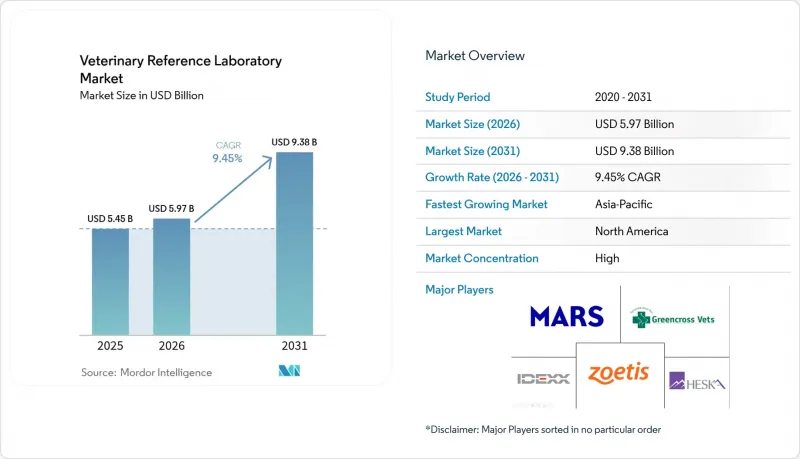
This report is Segmented by Service Type (Clinical Chemistry, Immunodiagnostics, Molecular Diagnostics, and Hematology), Application (Pathology, Bacteriology, Virology, and More), Animal Type (Livestock Animals and Companion Animals), and Geography (North America, Europe, Asia-Pacific, and More). The Market Forecasts are Provided in Terms of Value (USD).
Global Veterinary Reference Laboratory Market Trends and Insights
Growing uptake of pet insurance and higher veterinary spend
Premiums reached USD 4.5 billion in 2024, more than doubling since 2019. Concentrated underwriting among the top ten insurers heightens reimbursement standardization, which in turn lifts acceptance of advanced diagnostics. Veterinary cost inflation of 8.24% reinforces the value proposition of insurance and encourages owners to authorize comprehensive testing without cost anxiety..
Technology advances in immuno- and molecular diagnostics
AI-enabled platforms such as Zoetis Vetscan Imagyst now deliver cytology, hematology, and urine-sediment readings inside the clinic. Next-generation sequencing cancer panels achieve 92.7% detection accuracy and reveal actionable genomic variants for therapeutic planning frontiersin.org. Multiplex PCR assays detect pathogens at 10 copies/µL while matching national reference standards.
High cost of advanced tests and lab automation
Fully automated systems carry steep capital requirements that many small clinics cannot absorb. Over 80% of China's pet hospitals earn under 2.4 million yuan annually, constraining equipment upgrades. Mobile laboratories and cartridge-based analyzers mitigate barriers but still require upfront hardware investment.
Other drivers and restraints analyzed in the detailed report include:
- Rising companion animal population and pet-humanization trend
- Increasing prevalence of zoonotic and chronic animal diseases
- Shortage of board-certified veterinary pathologists
For complete list of drivers and restraints, kindly check the Table Of Contents.
Segment Analysis
Immunodiagnostics held 42.98% of the veterinary reference laboratory market in 2025 based on entrenched use in routine screening. Molecular diagnostics, however, is forecast to compound at 10.48% through 2031 on the back of superior pathogen specificity, precision medicine, and shrinking run times. Multiplex PCR panels and next-generation sequencing propel this growth trajectory, supported by falling reagent costs and software automation. Immunodiagnostics' installed base and clinician familiarity sustain its revenue, but competitive pressure steadily diverts high-value oncology and infectious disease testing toward molecular formats.
AI-enhanced cartridge analyzers bring molecular throughput into clinics, shortening result cycles from days to under an hour. Reference laboratories differentiate themselves with whole-genome and liquid biopsy services that inform targeted therapy selection. As test menus broaden, bundled subscription pricing models emerge, anchoring client loyalty and stabilizing cash flows. With these shifts, molecular platforms continue to capture incremental revenue while immunoassay providers add multiplex capability to defend share. Both segments fuel aggregate expansion of the veterinary reference laboratory market.
Clinical pathology accounted for 38.22% of 2025 revenues and remains indispensable for wellness exams and chronic-disease monitoring. Virology's 11.05% CAGR outpaces every other application due to heightened H5N1 surveillance and mandatory influenza testing in livestock. Rapid antigen and RT-PCR panels, validated against national standards, dominate high-volume screening protocols and facilitate trade compliance. Regulatory emphasis on early detection prompts governments to subsidize virology capacity expansion in dairy, poultry, and equine sectors.
Meanwhile, antimicrobial-stewardship programs elevate bacteriology demand, and AI fecal-analysis systems accelerate parasitology adoption. Toxicology testing grows steadier, driven by rising pet exposure to household chemicals. Other niche applications appear as emerging pathogens and novel therapies require specialized assays. Collectively, diverse testing needs reinforce the growth prospects of the veterinary reference laboratory.
Complete Report Scope:
- By Service Type
- Clinical Chemistry
- Hematology
- Immunodiagnostics
- Molecular Diagnostics
- Urinalysis
- Others
- By Application
- Clinical Pathology
- Bacteriology
- Virology
- Parasitology
- Toxicology
- Others
- By Animal Type
- Companion Animals
- Dogs
- Cats
- Horses
- Others
- Livestock Animals
- Cattle
- Swine
- Poultry
- Others
- Companion Animals
- By End User
- Veterinary Hospitals
- Veterinary Clinics
- Research Institutes & Universities
- Point-of-Care / In-house Labs
- By Geography
- North America
- United States
- Canada
- Mexico
- Europe
- Germany
- United Kingdom
- France
- Italy
- Spain
- Russia
- Rest of Europe
- Asia-Pacific
- China
- Japan
- India
- South Korea
- Australia
- Rest of Asia-Pacific
- Middle East & Africa
- GCC
- South Africa
- Rest of Middle East & Africa
- South America
- Brazil
- Argentina
- Rest of South America
- North America
Geography Analysis
Asia-Pacific is the fastest-advancing region at a 12.04% CAGR to 2031. China's pet economy reached 300 billion yuan (USD 41 billion) in 2024 with veterinary care at 28% of spend, though profitability constraints in smaller clinics spur demand for cost-efficient diagnostics. Japanese innovators deploy AI-powered fecal analysis and after-hours tele-health, improving accessibility in an aging-society. Australia attracts multinational investment, as Zoetis expanded vaccine production capacity through a new Melbourne site. Varied regulatory frameworks and uneven infrastructure create a patchwork of opportunities across the region, yet rising household incomes and changing pet-owner behavior support sustained uptake of laboratory services.
North America maintained 38.90% market share in 2025 courtesy of mature practice infrastructure and high pet-care expenditure. FDA Guidance #263, effective June 2024, mandates prescription oversight for antimicrobials, indirectly boosting diagnostic volumes in food animals avma.org. Workforce shortages and declining clinic visits temper momentum, nudging providers toward automation to preserve productivity.
Europe demonstrates steady mid-single-digit expansion supported by regulatory harmonization and recent consolidation. Mars Incorporated completed acquisitions of SYNLAB Vet and Cerba Vet, enhancing test menu breadth and geographic reach . Antimicrobial-stewardship campaigns encourage diagnostics-guided therapy, and established veterinary training programs sustain demand for specialized assays. Emerging markets in the Middle East and Africa remain nascent yet promising, evidenced by the Philippines' PHP 20 million investment in a new veterinary-diagnostic facility pna.gov.ph. Point-of-care platforms offer scalable options for regions lacking extensive laboratory networks, underlining a global convergence toward accessible diagnostics.
- IDEXX
- VCA Animal Diagnostic Services (Mars)
- Zoetis Reference Laboratories
- GD Animal Health (Royal GD)
- Heska
- Antech Diagnostics
- SYNLAB Vet
- Veterinary Pathology Group (VPG)
- Laboklin GmbH
- NationWide Laboratories
- Asia Veterinary Diagnostics
- CVS Group plc
- Pathovet (Latin America)
- IDEXX BioAnalytics
- Inovie Vet
- ProtaTek International
- Thermo Fisher Scientific (Vet diagnostic services)
- Neogen
- Virbac Diagnostics
- Boehringer Ingelheim Vetmedica Labs
- Phibro Animal Health Diagnostics
Additional Benefits:
- The market estimate (ME) sheet in Excel format
- 3 months of analyst support
TABLE OF CONTENTS
1 Introduction
- 1.1 Study Assumptions & Market Definition
- 1.2 Scope of the Study
2 Research Methodology
3 Executive Summary
4 Market Landscape
- 4.1 Market Overview
- 4.2 Market Drivers
- 4.2.1 Rising companion animal population & "pet-humanization" trend
- 4.2.2 Growing uptake of pet insurance & higher veterinary spend
- 4.2.3 Increasing prevalence of zoonotic & chronic animal diseases
- 4.2.4 Technology advances in immuno- & molecular diagnostics
- 4.2.5 Tele-veterinary logistics platforms boosting sample volumes
- 4.2.6 Antimicrobial-stewardship rules accelerating lab testing in food animals
- 4.3 Market Restraints
- 4.3.1 High cost of advanced tests & lab automation
- 4.3.2 Shortage of board-certified veterinary pathologists
- 4.3.3 Clinic-level PoC diagnostics cannibalising send-out volumes
- 4.3.4 Data-privacy hurdles for cloud-based LIMS integration
- 4.4 Supply-Chain Analysis
- 4.5 Regulatory Landscape
- 4.6 Technological Outlook
- 4.7 Porter's Five Forces
- 4.7.1 Bargaining Power of Suppliers
- 4.7.2 Bargaining Power of Buyers
- 4.7.3 Threat of New Entrants
- 4.7.4 Threat of Substitutes
- 4.7.5 Competitive Rivalry
5 Market Size & Growth Forecasts (Value)
- 5.1 By Service Type
- 5.1.1 Clinical Chemistry
- 5.1.2 Hematology
- 5.1.3 Immunodiagnostics
- 5.1.4 Molecular Diagnostics
- 5.1.5 Urinalysis
- 5.1.6 Others
- 5.2 By Application
- 5.2.1 Clinical Pathology
- 5.2.2 Bacteriology
- 5.2.3 Virology
- 5.2.4 Parasitology
- 5.2.5 Toxicology
- 5.2.6 Others
- 5.3 By Animal Type
- 5.3.1 Companion Animals
- 5.3.1.1 Dogs
- 5.3.1.2 Cats
- 5.3.1.3 Horses
- 5.3.1.4 Others
- 5.3.2 Livestock Animals
- 5.3.2.1 Cattle
- 5.3.2.2 Swine
- 5.3.2.3 Poultry
- 5.3.2.4 Others
- 5.3.1 Companion Animals
- 5.4 By End User
- 5.4.1 Veterinary Hospitals
- 5.4.2 Veterinary Clinics
- 5.4.3 Research Institutes & Universities
- 5.4.4 Point-of-Care / In-house Labs
- 5.5 By Geography
- 5.5.1 North America
- 5.5.1.1 United States
- 5.5.1.2 Canada
- 5.5.1.3 Mexico
- 5.5.2 Europe
- 5.5.2.1 Germany
- 5.5.2.2 United Kingdom
- 5.5.2.3 France
- 5.5.2.4 Italy
- 5.5.2.5 Spain
- 5.5.2.6 Russia
- 5.5.2.7 Rest of Europe
- 5.5.3 Asia-Pacific
- 5.5.3.1 China
- 5.5.3.2 Japan
- 5.5.3.3 India
- 5.5.3.4 South Korea
- 5.5.3.5 Australia
- 5.5.3.6 Rest of Asia-Pacific
- 5.5.4 Middle East & Africa
- 5.5.4.1 GCC
- 5.5.4.2 South Africa
- 5.5.4.3 Rest of Middle East & Africa
- 5.5.5 South America
- 5.5.5.1 Brazil
- 5.5.5.2 Argentina
- 5.5.5.3 Rest of South America
- 5.5.1 North America
6 Competitive Landscape
- 6.1 Market Concentration
- 6.2 Competetion Benchmarking
- 6.3 Market Share Analysis
- 6.4 Company Profiles (includes Global level Overview, Market level overview, Core Segments, Financials as available, Strategic Information, Market Rank/Share for key companies, Products & Services, and Recent Developments)
- 6.4.1 IDEXX Laboratories
- 6.4.2 VCA Animal Diagnostic Services (Mars)
- 6.4.3 Zoetis Reference Laboratories
- 6.4.4 GD Animal Health (Royal GD)
- 6.4.5 Heska Corporation
- 6.4.6 Antech Diagnostics
- 6.4.7 SYNLAB Vet
- 6.4.8 Veterinary Pathology Group (VPG)
- 6.4.9 Laboklin GmbH
- 6.4.10 NationWide Laboratories
- 6.4.11 Asia Veterinary Diagnostics
- 6.4.12 CVS Group plc
- 6.4.13 Pathovet (Latin America)
- 6.4.14 IDEXX BioAnalytics
- 6.4.15 Inovie Vet
- 6.4.16 ProtaTek International
- 6.4.17 Thermo Fisher Scientific (Vet diagnostic services)
- 6.4.18 Neogen Corporation
- 6.4.19 Virbac Diagnostics
- 6.4.20 Boehringer Ingelheim Vetmedica Labs
- 6.4.21 Phibro Animal Health Diagnostics
7 Market Opportunities & Future Outlook
- 7.1 White-space & Unmet-need Assessment

