PUBLISHER: Mordor Intelligence | PRODUCT CODE: 2116343

PUBLISHER: Mordor Intelligence | PRODUCT CODE: 2116343
EV Solid-state Battery - Market Share Analysis, Industry Trends & Statistics, Growth Forecasts (2026 - 2031)
According to Mordor Intelligence, EV solid-state battery market size in 2026 is estimated at USD 372.09 million, growing from 2025 value of USD 260 million with 2031 projections showing USD 2.23 billion, growing at 43.11% CAGR over 2026-2031.
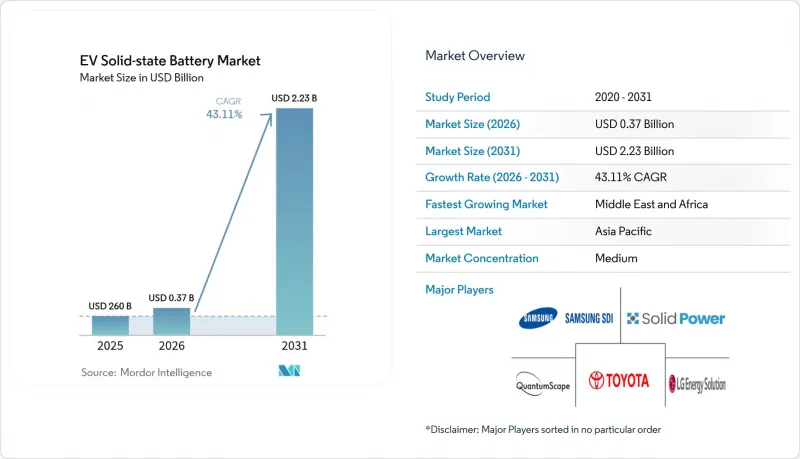
This report is Segmented by Vehicle Type (Passenger Cars and Commercial Vehicles), Propulsion (Battery Electric Vehicle, Plug-In Hybrid Electric Vehicle (PHEV), and More), Solid Electrolyte Type (Sulfide-Based, Oxide-Based, and More), Anode Material (Lithium-Metal, and More), Battery Capacity (Below 20 Ah, and More), and Geography. The Market Forecasts are Provided in Terms of Value (USD).
Global EV Solid-state Battery Market Trends and Insights
Rapid growth in global EV sales volumes
Global electric-vehicle sales are expected to top 20 million units in 2025, roughly triple 2021 levels, intensifying automakers' search for batteries that charge faster and go farther. China's production dominance gives Asian cell makers early-scale advantages, while commercial-fleet electrification widens demand beyond consumer segments. Larger pack orders allow suppliers to push pilot lines toward higher equipment utilisation, in turn lowering per-kilowatt-hour costs. These dynamics collectively lift the solid-state battery market by expanding both the addressable vehicle pool and the willingness of buyers to pay technology premiums. Regional variations persist, but the overall trajectory remains upward as safety and range anxieties decline.
Energy-density and safety edge over Li-ion packs
Solid-state prototypes routinely exceed 500 Wh/kg, far above the 250-300 Wh/kg range of conventional lithium-ion packs, driving innovation in the EV Solid-state Battery Market, and recent laboratory work reports ionic conductivities of 5.7 mS/cm for sulfide electrolytes while retaining structural integrity under mechanical stress. Removing flammable liquid electrolytes lowers thermal-runaway risk, an increasingly important criterion for regulators and insurers. Automakers can therefore shrink pack footprints, recapture cabin space, and trim vehicle mass. These benefits translate into longer driving ranges or smaller batteries for the same range, both of which unlock design flexibility and cost-of-ownership gains. The technology's tolerance for pure lithium-metal anodes further widens the performance gap, creating a compelling pull for high-end and fleet platforms.
High production cost and low manufacturing yield
Present solid-state cells cost USD 400-500 per kWh, roughly four times the average cost of today's lithium-ion packs, due to strict moisture controls and tight tolerances at solid-solid interfaces. Yield losses reach double-digit percentages on many pilot lines, amplifying unit costs during early runs. Process innovations, such as vapour-deposited lithium foils and anode-free stacking, show promise in halving defect rates, yet industrial validation is still underway. Until these improvements move from lab to line, price premiums will restrain widespread rollout.
Other drivers and restraints analyzed in the detailed report include:
- Government ZEV mandates and battery incentives
- Automaker in-house pilot lines (Toyota, VW, BMW)
- Limited gigascale capacity before 2028
For complete list of drivers and restraints, kindly check the Table Of Contents.
Segment Analysis
The passenger-car segment generated 73.52% of 2025 revenue, reflecting early deployments in high-value models where performance and safety command price premiums. Commercial fleets trail in share yet post a 38.95% CAGR to 2031 as operators weigh total-cost-of-ownership savings from longer-lasting packs and reduced downtime. Toyota plans to launch solid-state packs first in luxury coupes, then cascade the chemistry to broader line-ups once costs fall. Fleet managers, by contrast, prioritise rapid charging and durability, making them receptive to higher upfront battery prices that cut maintenance.
The segment pattern indicates a two-wave adoption curve: personal-luxury vehicles establish brand credibility and engineering reliability, followed by light-duty vans and trucks that prize utilisation rates. As warranty data accumulate and unit costs slide, mainstream passenger segments will account for the bulk of unit volumes post-2028. This shift mirrors the historical rollout of high-nickel lithium-ion packs and creates a stepping-stone to mass-market penetration.
BEVs absorbed 69.45% of shipments in 2025 and are forecast to grow at 38.60% CAGR over the outlook period. Pure-electric platforms exploit the chemistry's high energy density to extend range without enlarging packs, an advantage less critical to hybrids. PHEVs nonetheless gain from faster charge acceptance, which raises electric-only driving fractions and improves fleet emissions compliance.
Most automakers align their solid-state roadmaps with flagship electric architectures because premium margins can cover early cell premiums. As costs decline, PHEV and series-hybrid platforms will adopt thinner, lighter solid-state modules that free up packaging space or allow battery downsizing. In parallel, regulatory pressure for zero tailpipe emissions cements BEVs as the dominant propulsion fit for the technology.
Complete Report Scope:
- By Vehicle Type
- Passenger Cars
- Commercial Vehicles
- By Propulsion
- Battery Electric Vehicle (BEV)
- Plug-in Hybrid Electric Vehicle (PHEV)
- Hybrid Electric Vehicle (HEV)
- By Solid Electrolyte Type
- Sulfide-based
- Oxide-based
- Polymer-based
- By Anode Material
- Lithium-Metal
- Silicon-Composite
- Graphite-Composite
- By Battery Capacity
- Below 20 Ah
- 20 to 100 Ah
- Above 100 Ah
- By Geography
- North America
- United States
- Canada
- Rest of North America
- South America
- Europe
- Germany
- United Kingdom
- France
- Spain
- Russia
- Rest of Europe
- Asia-Pacific
- China
- Japan
- South Korea
- India
- Australia
- Rest of Asia-Pacific
- Middle East and Africa
- Saudi Arabia
- UAE
- South Africa
- Egypt
- Nigeria
- Rest of Middle East and Africa
- North America
Geography Analysis
Asia-Pacific led the solid-state battery market with 40.85% share in 2025, anchored by Japan's lithium-sulfide value chain and South Korea's pilot-line expertise. Government funding underpins cell R&D and early vehicle integration projects, while established lithium-ion export corridors shorten scale-up learning curves.
North America, supported by Inflation Reduction Act credits and a target of more than 1,200 GWh annual cell capacity by 2030, emerges as the next major growth pole. Volkswagen's planned St. Thomas gigafactory and multiple start-up pilot lines point to an ecosystem forming around domestic supply mandates. Companies leverage proximity to cobalt, lithium, and nickel deposits in Canada and the United States to secure raw-material resilience.
The Middle East and Africa register the highest CAGR at 35.40%, albeit from a small base, driven by green-hydrogen hubs and utility-scale storage pilots that leapfrog to solid-state chemistries for safety and durability reasons. Europe maintains steady progress with Germany's FestBatt initiative and multi-partner consortia targeting commercial output by decade's end. European automakers' integration efforts ensure eventual demand pull, while public-private funding pools accelerate material science breakthroughs.
- Toyota Motor Corporation
- Volkswagen AG
- Samsung SDI Co Ltd
- LG Energy Solution Ltd
- QuantumScape Corp
- CATL
- BYD Co Ltd
- Solid Power Inc
- Panasonic Holdings Corp
- ProLogium Technology Co Ltd
- Nissan Motor Co Ltd
- BMW AG
- Ford Motor Co
- Stellantis NV
- Hyundai Motor Co
Additional Benefits:
- The market estimate (ME) sheet in Excel format
- 3 months of analyst support
TABLE OF CONTENTS
1 Introduction
- 1.1 Study Assumptions and Market Definition
- 1.2 Scope of the Study
2 Research Methodology
3 Executive Summary
4 Market Landscape
- 4.1 Market Overview
- 4.2 Market Drivers
- 4.2.1 Rapid growth in global EV sales volumes
- 4.2.2 Energy-density and safety edge over Li-ion packs
- 4.2.3 Government ZEV mandates and battery incentives
- 4.2.4 Automaker in-house pilot lines (Toyota, VW, BMW)
- 4.2.5 Roll-to-roll sulfide electrolyte cost break-throughs
- 4.2.6 Insurance-sector push to cut battery-fire liabilities
- 4.3 Market Restraints
- 4.3.1 High production cost and low manufacturing yield
- 4.3.2 Limited gigascale capacity before 2028
- 4.3.3 Supply pinch in ultra-pure lithium-metal foils
- 4.3.4 Uncertain recycling pathways for solid electrolytes
- 4.4 Value / Supply-Chain Analysis
- 4.5 Porter,s Five Forces Analysis
- 4.5.1 Threat of New Entrants
- 4.5.2 Bargaining Power of Buyers
- 4.5.3 Bargaining Power of Suppliers
- 4.5.4 Threat of Substitutes
- 4.5.5 Intensity of Competitive Rivalry
- 4.6 Investment and Funding Landscape
5 Market Size and Growth Forecasts
- 5.1 By Vehicle Type
- 5.1.1 Passenger Cars
- 5.1.2 Commercial Vehicles
- 5.2 By Propulsion
- 5.2.1 Battery Electric Vehicle (BEV)
- 5.2.2 Plug-in Hybrid Electric Vehicle (PHEV)
- 5.2.3 Hybrid Electric Vehicle (HEV)
- 5.3 By Solid Electrolyte Type
- 5.3.1 Sulfide-based
- 5.3.2 Oxide-based
- 5.3.3 Polymer-based
- 5.4 By Anode Material
- 5.4.1 Lithium-Metal
- 5.4.2 Silicon-Composite
- 5.4.3 Graphite-Composite
- 5.5 By Battery Capacity
- 5.5.1 Below 20 Ah
- 5.5.2 20 to 100 Ah
- 5.5.3 Above 100 Ah
- 5.6 By Geography
- 5.6.1 North America
- 5.6.1.1 United States
- 5.6.1.2 Canada
- 5.6.1.3 Rest of North America
- 5.6.2 South America
- 5.6.3 Europe
- 5.6.3.1 Germany
- 5.6.3.2 United Kingdom
- 5.6.3.3 France
- 5.6.3.4 Spain
- 5.6.3.5 Russia
- 5.6.3.6 Rest of Europe
- 5.6.4 Asia-Pacific
- 5.6.4.1 China
- 5.6.4.2 Japan
- 5.6.4.3 South Korea
- 5.6.4.4 India
- 5.6.4.5 Australia
- 5.6.4.6 Rest of Asia-Pacific
- 5.6.5 Middle East and Africa
- 5.6.5.1 Saudi Arabia
- 5.6.5.2 UAE
- 5.6.5.3 South Africa
- 5.6.5.4 Egypt
- 5.6.5.5 Nigeria
- 5.6.5.6 Rest of Middle East and Africa
- 5.6.1 North America
6 Competitive Landscape
- 6.1 Market Concentration
- 6.2 Strategic Moves
- 6.3 Market Share Analysis
- 6.4 Company Profiles (includes Global Level Overview, Market Level Overview, Core Segments, Financials as Available, Strategic Information, Market Rank/Share for Key Companies, Products and Services, SWOT Analysis, and Recent Developments)
- 6.4.1 Toyota Motor Corporation
- 6.4.2 Volkswagen AG
- 6.4.3 Samsung SDI Co Ltd
- 6.4.4 LG Energy Solution Ltd
- 6.4.5 QuantumScape Corp
- 6.4.6 CATL
- 6.4.7 BYD Co Ltd
- 6.4.8 Solid Power Inc
- 6.4.9 Panasonic Holdings Corp
- 6.4.10 ProLogium Technology Co Ltd
- 6.4.11 Nissan Motor Co Ltd
- 6.4.12 BMW AG
- 6.4.13 Ford Motor Co
- 6.4.14 Stellantis NV
- 6.4.15 Hyundai Motor Co
7 Market Opportunities and Future Outlook

