PUBLISHER: Mordor Intelligence | PRODUCT CODE: 2116346

PUBLISHER: Mordor Intelligence | PRODUCT CODE: 2116346
India Domestic Courier, Express, and Parcel (CEP) - Market Share Analysis, Industry Trends & Statistics, Growth Forecasts (2026 - 2031)
According to Mordor Intelligence, the India domestic courier, express, and parcel market size in 2026 is estimated at USD 6.27 billion, growing from 2025 value of USD 5.68 billion with 2031 projections showing USD 10.25 billion, growing at 10.34% CAGR over 2026-2031.
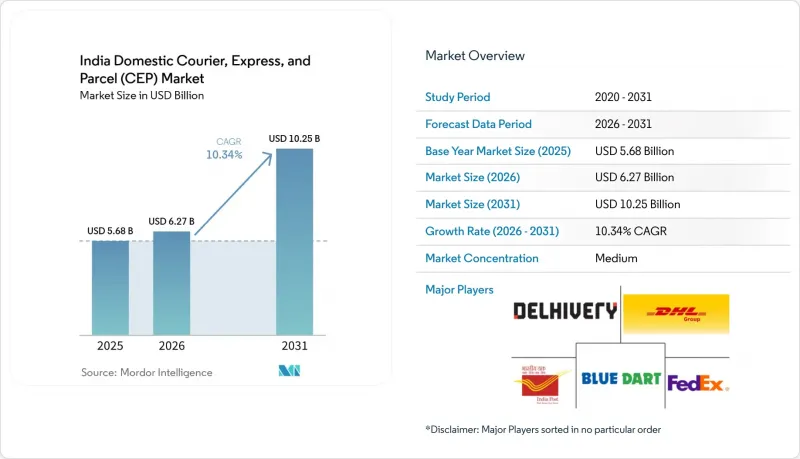
This report is Segmented by Speed of Delivery (Express, Non-Express), Shipment Weight (Heavy Weight, Light Weight, Medium Weight), End User Industry (E-Commerce, BFSI, Healthcare, Manufacturing, Primary Industry, Wholesale and Retail Trade, Others), Model (B2B, B2C, C2C), Mode of Transport (Road, Air, Others). The Market Forecasts are Provided in Terms of Value (USD).
India Domestic Courier, Express, and Parcel (CEP) Market Trends and Insights
E-commerce boom and tier-II/III penetration
The India domestic courier market experiences a parcel-volume multiplier as tier-II and tier-III locations now generate more than 60% of new online shoppers. Smartphone affordability and ubiquitous UPI payments compress the digital adoption lifecycle, leading to order frequencies in smaller cities that mirror metro norms within two years of onboarding. Quick-commerce platforms collectively operate in 92 non-metro cities, yet lower order densities-350 parcels per day versus 1,100 in metros-pressure delivery economics. Government programs such as BharatNet and Digital India supply the connectivity backbone that lowers entry barriers for couriers. As a result, branded parcel networks race to establish spoke facilities closer to emerging demand pockets, stimulating job creation and intensifying intra-regional competition across the India domestic courier market.
National Logistics Policy and infrastructure push
A unified logistics vision aims to compress sector costs toward an 8-9% share of GDP through multimodal corridor development and 100 planned multimodal logistics parks. Dedicated freight corridors and the Unified Logistics Interface Platform promise a 15-20% cut in paperwork, bolstering transparency and throughput across the India domestic courier market. Capital expenditure of INR 11.2 trillion in FY 26, including INR 1.5 trillion in interest-free state loans, accelerates road, rail, and port upgrades that shrink transit times. The Eastern Dedicated Freight Corridor completion and expansion of 120 regional airports under the UDAN scheme widen modal choice, making it economical to blend air and surface legs for time-sensitive parcels. Enhanced knotting of metro spokes with hinterland hubs is expected to unlock latent rural consumption, lifting CAGR projections by an additional 2.1 percentage points.
High logistics cost-to-GDP and fragmentation
Operational fragmentation persists, with 90% of logistics firms in the unorganized bracket and 67% operating fleets of fewer than five trucks. This structure limits economies of scale, hinders technology uptake, and raises per-shipment costs in the India domestic courier market. State-specific regulatory nuances despite GST create duplicate compliance layers that erode margins. Inconsistent addressing standards cause delivery reroutes and elevate last-mile expenses, while poor modal integration restricts network optimization. Collectively, these inefficiencies subtract roughly 1.8 percentage points from projected market CAGR.
Other drivers and restraints analyzed in the detailed report include:
- Warehouse automation surge and FDI inflows
- Consumer demand for same- or next-day delivery
- Rural infrastructure gaps
For complete list of drivers and restraints, kindly check the Table Of Contents.
Segment Analysis
Express consignments climbed at an 11.07% CAGR through 2031 as urban consumers normalized same-day and next-day fulfillment, a trend that elevated premium parcel demand within the India domestic courier market size. Quick-commerce platforms account for a growing share of express volumes after collectively opening more than 4,000 dark stores that promise 10- to 30-minute delivery windows in primary metros. Non-express options remain dominant at 56.55% share, especially for B2B manufacturing shipments where cost efficiency outweighs rapidity.
Advanced route-optimization engines and predictive loading enable couriers to lower cost per express parcel, narrowing the historical pricing gap with non-express services. Shadowfax reports operational profitability even with hyperlocal deliveries comprising nearly 30% of its traffic, underscoring technology's role in defending margins. Nevertheless, lower order densities in tier-II and tier-III cities extend express windows to 15-60 minutes, prompting asset-light models that leverage partner fleets for flexibility across the India domestic courier market.
Light-weight shipments captured 71.91% of the India domestic courier market share in 2025, fueled by mobile-first shopping behaviors that generate frequent low-value orders rather than bulk purchases. Pricing models based on dimensional weight encourage couriers to refine packaging algorithms that minimize box volume and reduce air cargo surcharges.
Sustainability considerations add complexity as regulators push for recyclable materials, leading firms to pilot compostable pouches and reusable totes in top cities. Uber's Courier XL, which transports parcels up to 750 kg in 3- and 4-wheeler vehicles, illustrates a parallel push into heavier segments aimed at balancing vehicle utilization across the India domestic courier market.
Complete Report Scope:
- By Speed of Delivery
- Express
- Non-Express
- By Shipment Weight
- Heavy Weight Shipments
- Light Weight Shipments
- Medium Weight Shipments
- By End User Industry
- E-Commerce
- Financial Services (BFSI)
- Healthcare
- Manufacturing
- Primary Industry
- Wholesale and Retail Trade (Offline)
- Others
- By Model
- Business-to-Business (B2B)
- Business-to-Customer (B2C)
- Customer-to-Customer (C2C)
- By Mode of Transport
- Road
- Air
- Others
List of Companies Covered in this Report:
- India Post
- Blue Dart Express Ltd
- Delhivery Ltd
- DHL Express (India) Pvt Ltd
- FedEx Express
- DTDC Express Ltd
- Allcargo Gati Ltd
- XpressBees Logistics Pvt Ltd
- Shadowfax Technologies
- Safexpress Pvt Ltd
- Mahindra Logistics
- Aramex India
- Trackon Couriers
- Tirupati Courier
- Professional Couriers
- Bombino Express
- V-Xpress
- Airways Courier (I) Pvt. Ltd
- Overseas Air Freight
- World First International Couriers
Additional Benefits:
- The market estimate (ME) sheet in Excel format
- 3 months of analyst support
TABLE OF CONTENTS
1 Introduction
- 1.1 Study Assumptions and Market Definition
- 1.2 Scope of the Study
2 Research Methodology
3 Executive Summary
4 Market Landscape
- 4.1 Market Overview
- 4.2 Market Drivers
- 4.2.1 E-commerce boom and tier-II/III penetration
- 4.2.2 National Logistics Policy and infra push
- 4.2.3 Warehouse Automation Surge and Foreign Direct Investment Inflows
- 4.2.4 Consumer Demand for Same or Next-Day Delivery
- 4.2.5 D2C brands- shift to B2B parcels
- 4.2.6 ONDC Open-Network Enablement
- 4.3 Market Restraints
- 4.3.1 High logistics cost-to-GDP and fragmentation
- 4.3.2 Rural infrastructure gaps
- 4.3.3 Gig-worker attrition
- 4.3.4 Platform in-house delivery bias
- 4.4 Value / Supply-Chain Analysis
- 4.5 Regulatory Landscape
- 4.6 Technological Outlook
- 4.7 Porter's Five Forces
- 4.7.1 Threat of New Entrants
- 4.7.2 Bargaining Power of Buyers
- 4.7.3 Bargaining Power of Suppliers
- 4.7.4 Threat of Substitutes
- 4.7.5 Intensity of Competitive Rivalry
5 Market Size and Growth Forecasts
- 5.1 By Speed of Delivery
- 5.1.1 Express
- 5.1.2 Non-Express
- 5.2 By Shipment Weight
- 5.2.1 Heavy Weight Shipments
- 5.2.2 Light Weight Shipments
- 5.2.3 Medium Weight Shipments
- 5.3 By End User Industry
- 5.3.1 E-Commerce
- 5.3.2 Financial Services (BFSI)
- 5.3.3 Healthcare
- 5.3.4 Manufacturing
- 5.3.5 Primary Industry
- 5.3.6 Wholesale and Retail Trade (Offline)
- 5.3.7 Others
- 5.4 By Model
- 5.4.1 Business-to-Business (B2B)
- 5.4.2 Business-to-Customer (B2C)
- 5.4.3 Customer-to-Customer (C2C)
- 5.5 By Mode of Transport
- 5.5.1 Road
- 5.5.2 Air
- 5.5.3 Others
6 Competitive Landscape
- 6.1 Market Concentration
- 6.2 Strategic Moves
- 6.3 Market Share Analysis
- 6.4 Company Profiles (includes Global level Overview, Market level overview, Core Segments, Financials as available, Strategic Information, Market Rank/Share for key companies, Products and Services, and Recent Developments)
- 6.4.1 India Post
- 6.4.2 Blue Dart Express Ltd
- 6.4.3 Delhivery Ltd
- 6.4.4 DHL Express (India) Pvt Ltd
- 6.4.5 FedEx Express
- 6.4.6 DTDC Express Ltd
- 6.4.7 Allcargo Gati Ltd
- 6.4.8 XpressBees Logistics Pvt Ltd
- 6.4.9 Shadowfax Technologies
- 6.4.10 Safexpress Pvt Ltd
- 6.4.11 Mahindra Logistics
- 6.4.12 Aramex India
- 6.4.13 Trackon Couriers
- 6.4.14 Tirupati Courier
- 6.4.15 Professional Couriers
- 6.4.16 Bombino Express
- 6.4.17 V-Xpress
- 6.4.18 Airways Courier (I) Pvt. Ltd
- 6.4.19 Overseas Air Freight
- 6.4.20 World First International Couriers
7 Market Opportunities and Future Outlook
- 7.1 White-space and Unmet-need Assessment

