PUBLISHER: Mordor Intelligence | PRODUCT CODE: 2116356

PUBLISHER: Mordor Intelligence | PRODUCT CODE: 2116356
United States International Courier, Express And Parcel - Market Share Analysis, Industry Trends & Statistics, Growth Forecasts (2026 - 2031)
According to Mordor Intelligence, the United States international courier, express and parcel market size in 2026 is estimated at USD 55.61 billion, growing from 2025 value of USD 53.14 billion with 2031 projections showing USD 69.78 billion, growing at 4.64% CAGR over 2026-2031.
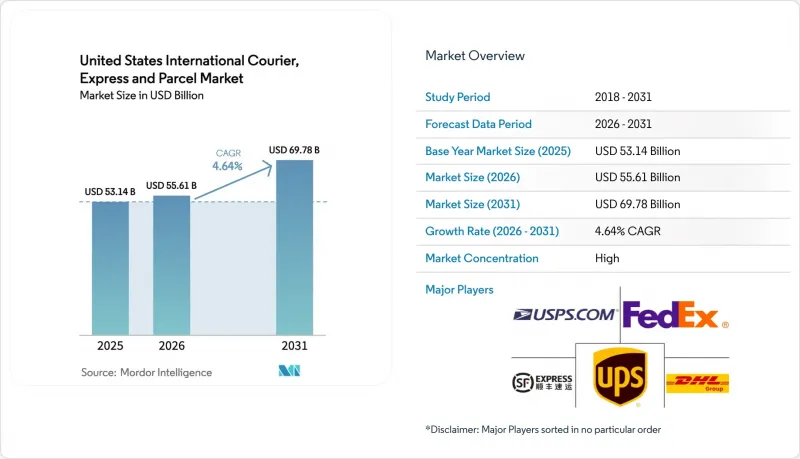
This report is Segmented by End User Industry (E-Commerce, Financial Services (BFSI), Healthcare, Manufacturing, Primary Industry, and More), by Speed of Delivery (Express and Non- Express), by Shipment Weight (Heavy Weight Shipments and More), and by Model (Business-To-Business (B2B), and More). The Market Forecasts are Provided in Terms of Value (USD).
United States International Courier, Express And Parcel Market Trends and Insights
USMCA-Driven Growth in SME Parcel Flows to Canada and Mexico
CBP regulations that took effect in March 2025 simplified origin certification, enabling blanket declarations that cover multiple shipments and lowering paperwork for frequent traders. Small and medium sellers quickly expanded cross-border catalogs, lifting demand for fast, trackable parcel services. Integrators use enhanced data feeds to pre-clear consignments and shorten door-to-door transit by up to a full day on select lanes. Automakers that reorganized component flows within the USMCA bloc have also turned to express couriers for critical parts, elevating average revenue per shipment. Competitive differentiation now hinges on real-time visibility tools that reassure SMEs about customs compliance.
Cross-Border DTC Imports Surge, Influenced by USD 800 De-Minimis Threshold
CBP processed more than 1 billion de-minimis parcels in 2024, a six-fold jump since 2016. Proposed rules to deny Section 301 goods duty-free status and mandate richer data elements may generate up to USD 7.8 billion in new duties yet could tilt business toward carriers with robust compliance infrastructure. Platforms shipping straight from China ramped up pre-advice filings and SKU-level harmonized codes, pushing courier IT spend higher. Larger integrators view the heavier documentation load as a competitive moat that squeezes smaller rivals. The looming change also nudges online sellers to explore near-shore inventory models, fostering two-way trade within the Americas.
CBP Advanced Electronic Data Mandate Raising Compliance Costs
Enhanced ACAS requirements obligate carriers to transmit 100% shipment data before wheels-up, driving multi-million-dollar platform upgrades. Penalties for late or inaccurate filings intensify operational risk, especially for smaller couriers with fragmented agent networks. Integrators amortize investment over higher shipment density, widening a cost gap that accelerates consolidation. Parallel USPS inbound mail rules reinforce a shift toward private-sector handlers able to guarantee data integrity.
Other drivers and restraints analyzed in the detailed report include:
- Ultra-Fast Fashion Platforms Propel Surge in Less Than 2 kg Parcel Shipments
- Paperless Trade and CE/ITDS Automation Reducing Clearance Time
- Gateway Airport Congestion and Slot Constraints Impacting Time-Definite SLAs
For complete list of drivers and restraints, kindly check the Table Of Contents.
Segment Analysis
E-commerce shipments captured 42.20% share in 2025, a figure that grows more modestly as penetration plateaus in affluent zip codes. Merchandise categories diversify beyond electronics into beauty, nutraceuticals, and hobby items, each with unique compliance documents that elevate the expertise premium for couriers. Manufacturing retains second position, benefiting from multi-regional component sourcing that underpins just-in-sequence assembly lines. Temperature-controlled pharmaceuticals spur investment in small active-container fleets fitted with IoT sensors that communicate directly with ACE portals.
Wholesale and retail trade (offline) posts the fastest 5.31% CAGR (2026-2031) as big-box store operators digitize supplier portals and run smaller, more frequent international restocks. Their pivot tightens delivery windows, incentivizing contract clauses that penalize late freight and elevate network reliability. BFSI reliance on physical documents declines in absolute terms, but courier spending per shipment rises as firms choose secure chain-of-custody services to protect sensitive records from cyber risk. Ancillary industries-ranging from aerospace to luxury goods-continue outsourcing critical-item logistics, extending the United States international courier market's breadth across the real economy.
Express services generated 67.05% of the United States international courier market revenue in 2025 as cross-border merchants emphasized checkout promises that mirror domestic standards. Demand elasticity favors premium transit, enabling operators to introduce Saturday cut-offs and late-night pick-ups. The segment's 5.88% CAGR between 2026-2031 outpaces historical growth, reflecting continued cross-border marketplace expansion and corporate inventory shifts toward near-real-time replenishment. Non-express offerings still carry substantial volume but confront customer migration toward ocean-plus-last-mile hybrids on heavier lanes. FedEx's Network 2.0 co-locations illustrate how integrators blend express and deferred parcels within a single service envelope, optimizing sort window utilization. Capacity rationalization on medium-haul lanes allows providers to re-deploy aircraft toward Asia-US trunk routes where density rewards higher-priced time guarantees.
Competitive positioning inside the express bracket is moving away from pure speed toward data-rich experience. Carriers embed customs status notifications into merchant dashboards, simplifying customer service by cutting "where-is-my-parcel" queries. The end result is a sharper value proposition that protects yields even as fuel indices fluctuate. Non-express players experiment with value-added evening deliveries and carbon-offset bundles but face difficulty matching the network depth of top-tier integrators. As US-Mexico e-commerce matures, regional express specialists leverage cross-dock hubs at Laredo and El Paso to shorten line-haul and divert volume from coastal air gateways.
Complete Report Scope:
- Speed of Delivery
- Express
- By Route
- Inter-Region
- Intra-Region
- By Route
- Non-Express
- Express
- Shipment Weight
- Heavy Weight Shipments
- Light Weight Shipments
- Medium Weight Shipments
- End User Industry
- E-Commerce
- Financial Services (BFSI)
- Healthcare
- Manufacturing
- Primary Industry
- Wholesale and Retail Trade (Offline)
- Others
- Model
- Business-to-Business (B2B)
- Business-to-Consumer (B2C)
- Consumer-to-Consumer (C2C)
List of Companies Covered in this Report:
- Aramex
- Averitt Express
- Canada Post Corporation (Including Purolator)
- DHL Group
- Easyship, Inc.
- FedEx
- Flexport, Inc.
- Japan Post Holdings Co., Ltd. (Including Toll Group)
- La Poste Group (Including Geopost/Asendia)
- Passport Shipping
- SF Express (KEX-SF, KEX Express US LLC)
- ShipBob, Inc.
- TFI International, Inc. (Including TForce Logistics)
- United Parcel Service of America, Inc. (UPS)
- United States Postal Service (USPS)
Additional Benefits:
- The market estimate (ME) sheet in Excel format
- 3 months of analyst support
TABLE OF CONTENTS
1 Introduction
- 1.1 Study Assumptions and Market Definition
- 1.2 Scope of the Study
2 Research Methodology
3 Executive Summary
4 Market Landscape
- 4.1 Market Overview
- 4.2 Demographics
- 4.3 GDP Distribution by Economic Activity
- 4.4 GDP Growth by Economic Activity
- 4.5 Inflation
- 4.6 Economic Performance and Profile
- 4.6.1 Trends in E-Commerce Industry
- 4.6.2 Trends in Manufacturing Industry
- 4.7 Transport and Storage Sector GDP
- 4.8 Export Trends
- 4.9 Import Trends
- 4.10 Fuel Price
- 4.11 Logistics Performance
- 4.12 Infrastructure
- 4.13 Regulatory Framework
- 4.14 Value Chain and Distribution Channel Analysis
- 4.15 Market Drivers
- 4.15.1 USMCA-Driven Growth in SME Parcel Flows to Canada and Mexico
- 4.15.2 Cross-Border DTC Imports Surge, Influenced by USD 800 De-Minimis Threshold
- 4.15.3 Ultra-Fast Fashion Platforms, Like Temu and Shein, Propel Surge in Less Than 2 kg Parcel Shipments
- 4.15.4 Paperless Trade and ACE/ITDS Automation Reducing Clearance Time
- 4.15.5 Wide-Body Belly Capacity Recovery Cutting International Air-Freight Rates
- 4.15.6 ESG-Focused Contracts Favor Carbon-Accounted "Green-Lane" Express Offerings
- 4.16 Market Restraints
- 4.16.1 CBP Advanced Electronic Data (AED) Mandate Raising Compliance Costs
- 4.16.2 Gateway Airport Congestion and Slot Constraints Impacting Time-Definite SLAs
- 4.16.3 Integrator Peak Surcharges and Jet-Fuel Volatility Compressing SME Margins
- 4.16.4 Return and Dispute Rates Surge due to Gaps in Destination Market Postal Services
- 4.17 Technology Innovations in the Market
- 4.18 Porter's Five Forces Analysis
- 4.18.1 Threat of New Entrants
- 4.18.2 Bargaining Power of Suppliers
- 4.18.3 Bargaining Power of Buyers
- 4.18.4 Threat of Substitutes
- 4.18.5 Competitive Rivalry
5 Market Size and Growth Forecasts (Value, USD)
- 5.1 Speed of Delivery
- 5.1.1 Express
- 5.1.1.1 By Route
- 5.1.1.1.1 Inter-Region
- 5.1.1.1.2 Intra-Region
- 5.1.1.1 By Route
- 5.1.2 Non-Express
- 5.1.1 Express
- 5.2 Shipment Weight
- 5.2.1 Heavy Weight Shipments
- 5.2.2 Light Weight Shipments
- 5.2.3 Medium Weight Shipments
- 5.3 End User Industry
- 5.3.1 E-Commerce
- 5.3.2 Financial Services (BFSI)
- 5.3.3 Healthcare
- 5.3.4 Manufacturing
- 5.3.5 Primary Industry
- 5.3.6 Wholesale and Retail Trade (Offline)
- 5.3.7 Others
- 5.4 Model
- 5.4.1 Business-to-Business (B2B)
- 5.4.2 Business-to-Consumer (B2C)
- 5.4.3 Consumer-to-Consumer (C2C)
6 Competitive Landscape
- 6.1 Market Concentration
- 6.2 Key Strategic Moves
- 6.3 Market Share Analysis
- 6.4 Company Profiles (Includes Global Level Overview, Market Level Overview, Core Segments, Financials as Available, Strategic Information, Market Rank/Share for Key Companies, Products and Services, and Recent Developments)
- 6.4.1 Aramex
- 6.4.2 Averitt Express
- 6.4.3 Canada Post Corporation (Including Purolator)
- 6.4.4 DHL Group
- 6.4.5 Easyship, Inc.
- 6.4.6 FedEx
- 6.4.7 Flexport, Inc.
- 6.4.8 Japan Post Holdings Co., Ltd. (Including Toll Group)
- 6.4.9 La Poste Group (Including Geopost/Asendia)
- 6.4.10 Passport Shipping
- 6.4.11 SF Express (KEX-SF, KEX Express US LLC)
- 6.4.12 ShipBob, Inc.
- 6.4.13 TFI International, Inc. (Including TForce Logistics)
- 6.4.14 United Parcel Service of America, Inc. (UPS)
- 6.4.15 United States Postal Service (USPS)
7 Market Opportunities and Future Outlook
- 7.1 White-Space and Unmet-Need Assessment

