PUBLISHER: Mordor Intelligence | PRODUCT CODE: 2116364

PUBLISHER: Mordor Intelligence | PRODUCT CODE: 2116364
Asia Pacific MICE Tourism - Market Share Analysis, Industry Trends & Statistics, Growth Forecasts (2026 - 2031)
According to Mordor Intelligence, the Asia-Pacific MICE market size is expected to grow from USD 212.83 billion in 2025 to USD 231.49 billion in 2026 and is forecast to reach USD 352.25 billion by 2031 at 8.75% CAGR over 2026-2031.
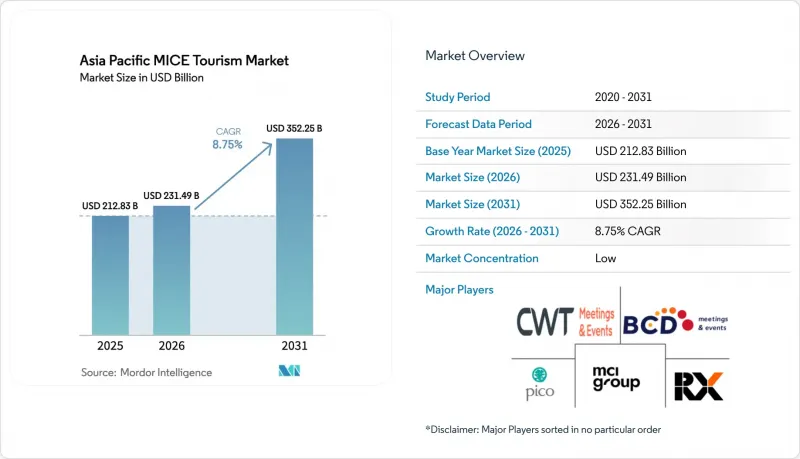
This report is Segmented by Event Type (Meeting, Incentive, and More), by Industry Vertical (IT and Telecom, Healthcare, and More), by Venue Type (Convention Centres, Cruise & Alternative Venues, and More), by Service Type (Accomodation, Transportation and More), by Organization Size (Large Enterprises and Small and Medium Enterprises) by Geography. Market Forecasts are Provided in Terms of Value (USD).
Asia Pacific MICE Tourism Market Trends and Insights
Digital Transformation and Hybrid Event Formats
Integration of artificial intelligence, live-streaming, and immersive technologies is broadening audience reach and compressing event budgets. Real-time translation, automated camera direction, and 24/7 chatbots are standardising multilingual engagement and reducing on-site staff requirements. Corporations value the ability to cut travel-related emissions by 27% through advanced booking algorithms and virtual attendance options. Early adopting destinations such as Singapore and Seoul have built national grant schemes that link venue operators with domestic tech start-ups, fostering first-mover advantages. Market research shows that 44% of regional planners rank AI capabilities as the leading differentiator when selecting a venue partner.
Rapid Economic Growth in Emerging Markets
Southeast Asia's GDP trajectory is spawning new regional headquarters that demand sophisticated MICE solutions. Public-private financing frameworks, such as Australia's USD 2 billion engagement facility, are helping cities like Jakarta and Ho Chi Minh City build integrated convention districts. Destination marketing bodies in Thailand and Vietnam are aggressively pursuing large Chinese corporates by offering bundled visa processing and tax-rebate packages. Rising disposable incomes have lifted delegate volumes, with 78% of Asia-Pacific buyers confirming larger trip counts in 2024. New builds ranging from conference-ready hotels to stand-alone halls signal durable pipeline momentum.
High cost of MICE event organization
Venue rents, accommodation rates, and catering prices have climbed sharply in top-tier cities, prompting 73% of organizers to downgrade to four-star hotels or explore non-traditional sites such as cruise ships. Cost inflation is partly offset by greener hotels, which operate 17% below the price of less-efficient properties by passing energy savings to clients. Buyers expect bigger travel budgets in 2025, suggesting that corporations will absorb moderate price rises to retain live engagement. AI-powered sourcing platforms are shortening request-for-proposal cycles by 64%, enabling planners to negotiate stronger volume discounts.
Other drivers and restraints analyzed in the detailed report include:
- Government Initiatives to Promote Business Tourism
- Rising Presence of Global and Regional Corporations
- Geopolitical tensions and instability
For complete list of drivers and restraints, kindly check the Table Of Contents.
Segment Analysis
Meetings retained 41.62% revenue in 2025, anchoring the Asia-Pacific MICE market through predictable booking cycles and broad enterprise acceptance. Hybrid events, however, are growing at a 11.72% CAGR, converting latent virtual audiences into monetisable delegate pools. Large convention organisers deploy blockchain-enabled networking tokens to personalise agendas and measure sponsor return on investment. Conventions and exhibitions maintain critical mass for global launches, while incentive travel holds premium pricing due to its motivational impact. The Asia-Pacific MICE market size for the hybrid segment is projected to rise swiftly as more corporates embed digital components in standard meeting policies. Experiential design trends AR walk-throughs, ESG reporting dashboards, and contactless registration, give hybrid formats a competitive edge.
The Asia-Pacific MICE market benefits from platforms that integrate gamification, AI translation, and real-time sentiment analytics. Such tools help planners curate content pathways, extend on-demand viewing windows, and track engagement KPIs beyond headcount. Small meetings are expected to rise 78% in 2025, reflecting a return-to-office push and the value of face-to-face collaboration. Analysts note that incentive itineraries increasingly merge CSR activities with wellness programmes, aligning corporate culture with sustainability metrics.
IT and telecommunications contributed 23.86% of the Asia-Pacific MICE market share in 2025, owing to continuous product releases and developer conferences. Healthcare is forecast to post the fastest 11.05% CAGR to 2031 as pharmaceutical forums, regulatory workshops, and medical device expos multiply. The Asia-Pacific MICE market size for healthcare gatherings is expanding alongside new vaccine pipelines and cross-border clinical trials that mandate in-person peer review. Financial services, manufacturing, and energy continue to schedule regulatory briefings, supply-chain summits, and renewable-energy roadshows, respectively.
Growth in healthcare events is supported by purpose-built auditoriums, simulation labs, and translation booths that comply with medical accreditation standards. Destination appeal rises when ancillary attractions, such as heritage tours and culinary experiences, augment delegate itineraries. Venue operators are upgrading infection-control protocols and telemedicine demo zones to cement credibility with hospital groups and life-science firms.
Complete Report Scope:
- By Event Type
- Meetings
- Incentives
- Conventions
- Exhibitions
- Hybrid Events
- By Industry Vertical
- IT and Telecom
- Healthcare and Life Sciences
- BFSI
- Manufacturing
- Energy and Utilities
- Others
- By Venue Type
- Convention and Exhibition Centers
- Hotels and Resorts
- Corporate Campuses / Offices
- Cruise and Alternative Venues
- By Service Type
- Planning and Execution
- Accommodation
- Transportation
- Entertainment and Ancillary
- By Organization Size
- Large Enterprises
- Small and Medium Enterprises
- By Country
- India
- China
- Japan
- Australia
- South Korea
- South East Asia (Singapore, Malaysia, Thailand, Indonesia, Vietnam, and Philippines)
- Rest of Asia-Pacific
List of Companies Covered in this Report:
- QUESTEX LLC
- CWT Meetings & Events
- cievents (Flight Centre)
- ATPI Ltd
- Conference Care Ltd
- IBTM Events (RX)
- Interpublic Group (Jack Morton)
- BCD Meetings & Events
- The Freeman Company
- Reed Exhibitions Asia
- MCI Group
- Pico Far East Holdings
- Messe Frankfurt Asia
- GL Events Asia Pacific
- Informa Markets Asia
- ASM Global (APAC)
- Thailand Convention & Exhibition Bureau
- Singapore Tourism Board - Business Events
- China National Convention Center
- Klook Meetings & Experiences*
Additional Benefits:
- The market estimate (ME) sheet in Excel format
- 3 months of analyst support
TABLE OF CONTENTS
1 Introduction
- 1.1 Study Assumptions and Market Definition
- 1.2 Scope of the Study
2 Research Methodology
3 Executive Summary
4 Market Landscape
- 4.1 Market Overview
- 4.2 Market Drivers
- 4.2.1 Rapid Economic Growth in Emerging Markets
- 4.2.2 Government Initiatives to Promote Business Tourism
- 4.2.3 Rising Presence of Global and Regional Corporations
- 4.2.4 Growth of Trade and Industry Exhibitions
- 4.2.5 Improved Air Connectivity and Infrastructure
- 4.2.6 Digital Transformation and Hybrid Event Formats
- 4.2.7 Boom in Incentive Tourism by Corporates
- 4.2.8 Tourism-MICE Integration with Leisure Offerings
- 4.3 Market Restraints
- 4.3.1 High Cost of MICE Event Organization
- 4.3.2 Uneven Infrastructure Development Across Regions
- 4.3.3 Fluctuating Corporate Budgets and Travel Policies
- 4.3.4 Geopolitical Tensions and Instability
- 4.4 Value / Supply-Chain Analysis
- 4.5 Regulatory Landscape
- 4.6 Technological Outlook
- 4.7 Porter's Five Forces
- 4.7.1 Threat of New Entrants
- 4.7.2 Bargaining Power of Buyers
- 4.7.3 Bargaining Power of Suppliers
- 4.7.4 Threat of Substitutes
- 4.7.5 Intensity of Competitive Rivalry
5 Market Size and Growth Forecasts (Value, 2020-2030)
- 5.1 By Event Type
- 5.1.1 Meetings
- 5.1.2 Incentives
- 5.1.3 Conventions
- 5.1.4 Exhibitions
- 5.1.5 Hybrid Events
- 5.2 By Industry Vertical
- 5.2.1 IT and Telecom
- 5.2.2 Healthcare and Life Sciences
- 5.2.3 BFSI
- 5.2.4 Manufacturing
- 5.2.5 Energy and Utilities
- 5.2.6 Others
- 5.3 By Venue Type
- 5.3.1 Convention and Exhibition Centers
- 5.3.2 Hotels and Resorts
- 5.3.3 Corporate Campuses / Offices
- 5.3.4 Cruise and Alternative Venues
- 5.4 By Service Type
- 5.4.1 Planning and Execution
- 5.4.2 Accommodation
- 5.4.3 Transportation
- 5.4.4 Entertainment and Ancillary
- 5.5 By Organization Size
- 5.5.1 Large Enterprises
- 5.5.2 Small and Medium Enterprises
- 5.6 By Country
- 5.6.1 India
- 5.6.2 China
- 5.6.3 Japan
- 5.6.4 Australia
- 5.6.5 South Korea
- 5.6.6 South East Asia (Singapore, Malaysia, Thailand, Indonesia, Vietnam, and Philippines)
- 5.6.7 Rest of Asia-Pacific
6 Competitive Landscape
- 6.1 Market Concentration
- 6.2 Strategic Moves
- 6.3 Market Share Analysis
- 6.4 Company Profiles (includes Global level Overview, Market level overview, Core Segments, Financials as available, Strategic Information, Market Rank/Share for key companies, Products & Services, and Recent Developments)
- 6.4.1 QUESTEX LLC
- 6.4.2 CWT Meetings & Events
- 6.4.3 cievents (Flight Centre)
- 6.4.4 ATPI Ltd
- 6.4.5 Conference Care Ltd
- 6.4.6 IBTM Events (RX)
- 6.4.7 Interpublic Group (Jack Morton)
- 6.4.8 BCD Meetings & Events
- 6.4.9 The Freeman Company
- 6.4.10 Reed Exhibitions Asia
- 6.4.11 MCI Group
- 6.4.12 Pico Far East Holdings
- 6.4.13 Messe Frankfurt Asia
- 6.4.14 GL Events Asia Pacific
- 6.4.15 Informa Markets Asia
- 6.4.16 ASM Global (APAC)
- 6.4.17 Thailand Convention & Exhibition Bureau
- 6.4.18 Singapore Tourism Board - Business Events
- 6.4.19 China National Convention Center
- 6.4.20 Klook Meetings & Experiences*
7 Market Opportunities & Future Outlook
- 7.1 White-space & Unmet-Need Assessment

