PUBLISHER: Mordor Intelligence | PRODUCT CODE: 2116379

PUBLISHER: Mordor Intelligence | PRODUCT CODE: 2116379
North America Milk Protein - Market Share Analysis, Industry Trends & Statistics, Growth Forecasts (2026 - 2031)
According to Mordor Intelligence, the North America milk protein market size was valued at USD 3.78 billion in 2025 and estimated to grow from USD 4.01 billion in 2026 to reach USD 5.41 billion by 2031, at a CAGR of 6.14% during the forecast period (2026-2031).
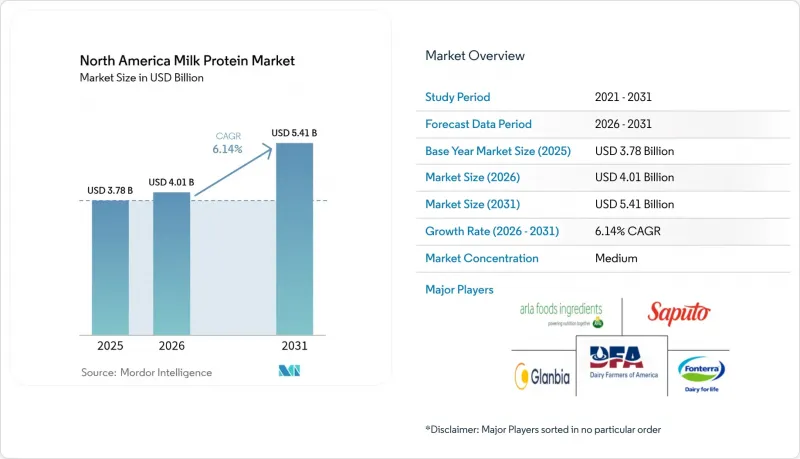
This report is Segmented by Type (Milk Protein Concentrate, Milk Protein Isolate, and Hydrolyzed Milk Protein), Application (Animal Feed, Personal Care and Cosmetics, Food and Beverages, and More), and Geography (United States, Canada, Mexico, and Rest of North America). The Market Forecasts are Provided in Terms of Value (USD).
North America Milk Protein Market Trends and Insights
Rising Demand for High-Protein Diets Among Fitness-Conscious Consumers
Social media platforms have transformed protein from a niche bodybuilding concern into a mainstream dietary priority, with TikTok and Instagram influencers amplifying high-protein meal plans to audiences that skew younger and more diverse than traditional fitness communities. Sixty-six percent of Gen Z consumers now follow high-protein diets, a cohort that historically prioritized plant-based eating but increasingly views dairy proteins as compatible with sustainability goals when sourced from regenerative agriculture systems. The proliferation of GLP-1 receptor agonists like semaglutide for weight management has created an unanticipated protein demand surge, as healthcare providers recommend 1.2 to 1.6 grams of protein per kilogram of body weight to mitigate muscle loss during pharmacologically induced weight reduction. This medical nutrition overlap positions milk proteins, particularly whey and casein blends, as functional ingredients rather than commodity additives. Quarterly whey protein ingredient sales in North America approached significant number, with ready-to-drink formats capturing share from powder-based products as convenience trumps cost per serving for time-constrained consumers.
Adoption of Clean-Label Ingredients by Food Manufacturers
Fifty-six percent of consumers express willingness to pay premium prices for products with recognizable ingredient lists, a threshold that favors milk proteins over synthetic isolates or heavily processed alternatives. The FDA's December 2024 update to the "healthy" nutrient content claim explicitly excludes protein isolates from the Food Group Equivalence calculation, inadvertently creating a regulatory advantage for whole-food protein sources like milk protein concentrate that deliver co-packaged calcium, phosphorus, and B vitamins. This rule change compels reformulation teams to reconsider ingredient hierarchies, particularly in breakfast cereals and snack bars, where "healthy" front-of-pack claims drive trial among health-conscious shoppers. Dairy cooperatives have responded by investing in non-GMO verification and grass-fed certifications; Organic Valley reported that its grass-fed whey protein sales grew in 2024, outpacing conventional whey by a 3-to-1 margin. Clean-label positioning also insulates milk proteins from the ultra-processed food backlash, as ingredient transparency audits by retailers and consumer advocacy groups increasingly flag additives with E-numbers or chemical-sounding names.
Lactose Intolerance Limiting Consumer Acceptance of Milk Proteins
Approximately 36% of the United States population experiences some degree of lactose malabsorption, with prevalence reaching 80% among African Americans, 80-100% among American Indians, 90-100% among Asian Americans, and 50-80% among Hispanic/Latino populations, according to the National Institute of Diabetes and Digestive and Kidney Diseases. This demographic reality constrains addressable market size, particularly as ethnic diversity increases. The U.S. Census Bureau projects that non-Hispanic whites will comprise less than 50% of the population by 2045. However, most individuals with lactose intolerance can consume up to 12 grams of lactose per day without symptoms, equivalent to one cup of milk, and many milk protein ingredients contain minimal residual lactose after ultrafiltration processing. Milk Protein Isolate typically contains less than 1% lactose, compared to 4-5% in fluid milk, positioning it as a viable option for lactose-sensitive consumers when paired with appropriate labeling. The rise of lactose-free dairy products, which grew in dollar sales during 2024, demonstrates that enzymatic lactose hydrolysis can preserve the sensory and functional properties of milk proteins while expanding consumer accessibility. Manufacturers are also exploring A2 beta-casein milk proteins, which some consumers report cause less digestive discomfort than conventional A1 milk, though peer-reviewed evidence remains inconclusive.
Other drivers and restraints analyzed in the detailed report include:
- Increased Use of Milk Proteins in Sports Nutrition Products
- Increasing Popularity of Dairy-Based Protein in Meal Replacements and Snacks
- Stringent Regulatory Approvals for Functional and Enriched Foods
For complete list of drivers and restraints, kindly check the Table Of Contents.
Segment Analysis
Milk Protein Concentrate captured 86.65% market share in 2025, a dominance rooted in its cost-effectiveness and versatility across bakery, beverage, and dairy alternative applications where 70-85% protein content suffices. Yet Milk Protein Isolate will expand at 6.92% CAGR through 2031, the fastest growth among protein types, as sports nutrition brands prioritize formulations exceeding 90% protein to maximize per-serving protein density while minimizing carbohydrates and fats. Clear whey beverage innovations, exemplified by Arla's Lacprodan ISO.Clear launched in 2024, require the near-complete removal of lipids and minerals that would cause turbidity, a specification only isolates can meet. Hydrolyzed Milk Protein occupies a specialized niche in infant formula and medical nutrition, where pre-digested peptides reduce allergenicity and accelerate absorption; the FDA's 2024 infant formula guidance emphasizing protein quality metrics like DIAAS has prompted manufacturers to reformulate with hydrolyzed whey fractions that better mimic human breast milk amino acid profiles.
Concentrate's market leadership reflects its dual functionality as both a protein source and a texturizing agent in processed foods. Bakery applications leverage concentrate's water-binding capacity to extend shelf life and improve crumb structure, while beverage formulators use it to create body and mouthfeel in protein-fortified juices and smoothies. The 13-15% lactose content in most concentrates limits use in lactose-free products but provides a natural sweetness that reduces added sugar requirements, aligning with clean-label trends. Isolate's premium pricing, typically 25-40% above concentrate on a per-pound basis, restricts adoption to applications where protein purity justifies the cost, such as ready-to-drink shakes targeting athletes and meal replacements marketed to weight management consumers. Membrane filtration technology advances, including ceramic membranes that tolerate higher operating temperatures and pressures, are gradually narrowing the cost gap by improving isolate production yields.
Complete Report Scope:
- By Type
- Milk Protein Concentrate
- Milk Protein Isolate
- Hydrolyzed Milk Protein
- By Application
- Animal Feed
- Personal Care and Cosmetics
- Food and Beverages
- Bakery
- Beverages
- Breakfast Cereals
- Condiments/Sauces
- Dairy and Dairy Alternative Products
- Meat/Poultry/Seafood and Meat Alternative Products
- RTE/RTC Food Products
- Snacks
- Supplements
- Baby Food and Infant Formula
- Elderly Nutrition and Medical Nutrition
- Sport/Performance Nutrition
- Geography
- United States
- Canada
- Mexico
- Rest of North America
List of Companies Covered in this Report:
- Dairy Farmers of America, Inc.
- Milk Specialties Global
- Agropur Cooperative
- Glanbia PLC
- Hilmar Cheese Company
- Fonterra Co-operative Group
- Saputo Inc.
- Arla Foods Ingredients Group P/S
- AMCO Proteins
- Leprino Foods Company
- Cargill, Incorporated
- Kerry Group PLC
- Lactalis Ingredients
- FrieslandCampina Ingredients
- Darigold, Inc.
- Idaho Milk Products
- Actus Nutrition
- Farbest-Tallman Foods Corporation
- Erie Foods Inc.
- Grassland Dairy Products Inc.
Additional Benefits:
- The market estimate (ME) sheet in Excel format
- 3 months of analyst support
TABLE OF CONTENTS
1 INTRODUCTION
- 1.1 Study Assumptions and Market Definition
- 1.2 Scope of the Study
2 RESEARCH METHODOLOGY
3 EXECUTIVE SUMMARY
4 MARKET LANDSCAPE
- 4.1 Market Overview
- 4.2 Market Drivers
- 4.2.1 Rising demand for high-protein diets among fitness-conscious consumers
- 4.2.2 Adoption of clean-label ingredients by food manufacturers
- 4.2.3 Increased use of milk proteins in sports nutrition products
- 4.2.4 Increasing popularity of dairy-based protein in meal replacements and snacks
- 4.2.5 Innovation in flavored and ready-to-use milk protein powders for convenience
- 4.2.6 Increasing R&D investments by manufacturers to create specialized proteins for clinical and pediatric nutrition
- 4.3 Market Restraints
- 4.3.1 Lactose intolerance limiting consumer acceptance of milk proteins
- 4.3.2 Stringent regulatory approvals for functional and enriched foods
- 4.3.3 Competition from plant-based protein alternatives
- 4.3.4 Supply chain disruptions affecting milk protein availability
- 4.4 Supply-Chain Analysis
- 4.5 Regulatory Landscape
- 4.6 Porter's Five Forces
- 4.6.1 Threat of New Entrants
- 4.6.2 Bargaining Power of Buyers
- 4.6.3 Bargaining Power of Suppliers
- 4.6.4 Threat of Substitute Products
- 4.6.5 Intensity of Competitive Rivalry
5 MARKET SIZE AND GROWTH FORECASTS (VALUE, USD)
- 5.1 By Type
- 5.1.1 Milk Protein Concentrate
- 5.1.2 Milk Protein Isolate
- 5.1.3 Hydrolyzed Milk Protein
- 5.2 By Application
- 5.2.1 Animal Feed
- 5.2.2 Personal Care and Cosmetics
- 5.2.3 Food and Beverages
- 5.2.3.1 Bakery
- 5.2.3.2 Beverages
- 5.2.3.3 Breakfast Cereals
- 5.2.3.4 Condiments/Sauces
- 5.2.3.5 Dairy and Dairy Alternative Products
- 5.2.3.6 Meat/Poultry/Seafood and Meat Alternative Products
- 5.2.3.7 RTE/RTC Food Products
- 5.2.3.8 Snacks
- 5.2.4 Supplements
- 5.2.4.1 Baby Food and Infant Formula
- 5.2.4.2 Elderly Nutrition and Medical Nutrition
- 5.2.4.3 Sport/Performance Nutrition
- 5.3 Geography
- 5.3.1 United States
- 5.3.2 Canada
- 5.3.3 Mexico
- 5.3.4 Rest of North America
6 COMPETITIVE LANDSCAPE
- 6.1 Market Concentration
- 6.2 Strategic Moves
- 6.3 Market Positioning Analysis
- 6.4 Company Profiles (includes Global level Overview, Market level overview, Core Segments, Financials as available, Strategic Information, Market Rank/Share for key companies, Products and Services, and Recent Developments)
- 6.4.1 Dairy Farmers of America, Inc.
- 6.4.2 Milk Specialties Global
- 6.4.3 Agropur Cooperative
- 6.4.4 Glanbia PLC
- 6.4.5 Hilmar Cheese Company
- 6.4.6 Fonterra Co-operative Group
- 6.4.7 Saputo Inc.
- 6.4.8 Arla Foods Ingredients Group P/S
- 6.4.9 AMCO Proteins
- 6.4.10 Leprino Foods Company
- 6.4.11 Cargill, Incorporated
- 6.4.12 Kerry Group PLC
- 6.4.13 Lactalis Ingredients
- 6.4.14 FrieslandCampina Ingredients
- 6.4.15 Darigold, Inc.
- 6.4.16 Idaho Milk Products
- 6.4.17 Actus Nutrition
- 6.4.18 Farbest-Tallman Foods Corporation
- 6.4.19 Erie Foods Inc.
- 6.4.20 Grassland Dairy Products Inc.
7 MARKET OPPORTUNITIES AND FUTURE OUTLOOK

