PUBLISHER: Mordor Intelligence | PRODUCT CODE: 2154212

PUBLISHER: Mordor Intelligence | PRODUCT CODE: 2154212
Milk Protein - Market Share Analysis, Industry Trends & Statistics, Growth Forecasts (2026 - 2031)
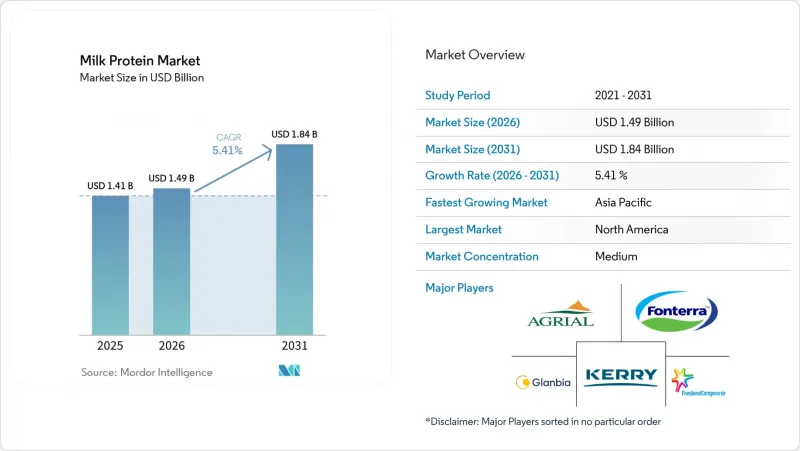
According to Mordor Intelligence, the milk protein market size is expected to grow from USD 1.41 billion in 2025 to USD 1.49 billion in 2026 and is forecast to reach USD 1.84 billion by 2031 at 4.31% CAGR over 2026-2031.
Global Milk Protein Market Trends and Insights
Growing preference for high-protein daily diets
National nutrition surveys released between 2020 and 2023 confirm that protein intake has risen among the general populations in the United Kingdom, Japan, and Indonesia, signaling a mainstream shift beyond the athletic circles. Office workers and seniors now associate protein with satiety and muscle preservation, driving the launch of convenient formats such as protein-enriched yogurts and shelf-stable shakes. Dairy proteins hold an advantage because their complete amino-acid profile meets updated leucine thresholds endorsed by the 2024 U.S. dietary guidelines. Brands are therefore deploying hybrid blends that pair milk protein isolate with plant proteins to temper cost while maintaining nutritional density, a strategy that balances sustainability expectations with dairy's sensory familiarity. European retailers amplify the trend by adding front-of-pack carbon-footprint labels, nudging formulators toward lower-emission ingredients yet without diluting demand for the creaminess consumers associate with dairy proteins.
Expanding use in infant and clinical nutrition formulations
Infant formula and medical nutrition remain the highest-value avenues for hydrolyzed milk protein, which commands a price premium over intact concentrates due to its hypoallergenicity and rapid absorption. The U.S. FDA's January 2025 infant-formula strategy highlighted compositional transparency and domestic manufacturing resilience, accelerating investments in local hydrolysate capacity. The European Food Safety Authority echoed the momentum by issuing favorable opinions on multiple whey-protein hydrolysates the same year, lowering regulatory barriers across the EU. Clinical nutrition is similarly expanding; studies have shown that improvement in nitrogen retention among geriatric patients occurs when consuming whey-protein hydrolysates versus intact casein. Converging standards between the FDA (Food and Drug Administration), EFSA (European Food Safety Authority), and Health Canada shorten commercialization timelines, allowing processors to amortize research costs across several high-margin jurisdictions.
Growing popularity of plant-based and alternative proteins
Plant proteins captured incremental share in bakery, snack, and beverage formulations in 2024-2025 as sustainability messaging resonated with environmentally conscious consumers, particularly in Europe and North America. Pea isolates now achieve functional parity with milk-protein concentrates in extruded snacks, while soy proteins dominate meat alternatives where dairy proteins have limited functional value. Flexitarian shoppers, representing roughly one-quarter of the adult population in high-income regions, gravitate toward plant-based labels despite dairy's superior amino-acid completeness. Milk protein suppliers thus face the choice of defending commodity segments on price or pivoting to high-value niches, an inflection that will shape the competitive contours of the milk protein market during the forecast period.
Other drivers and restraints analyzed in the detailed report include:
- Innovation in whey, casein, and hydrolysate functionalities
- Increasing use in fortified beverages and dairy drinks
- Taste and texture issues in highly fortified high-protein products
For complete list of drivers and restraints, kindly check the Table Of Contents.
Segment Analysis
Hydrolyzed milk protein generated 45.67% of 2025 revenue, underscoring its entrenched role in infant formula and clinical nutrition, where pre-digested peptides ease allergen concerns and improve absorption. Continuous R&D is pushing processing frontiers: 2024-2025 patents on ceramic-membrane systems cut energy use and increase flux rates, improving the economics of both isolates and hydrolysates. Concentrates remain the cost-efficient workhorse for bakery and processed-meat applications, but face margin pressure as plant proteins narrow the functional gap.
Milk protein isolate, is forecasted to grow at a 6.01% CAGR, illustrating how clean-label trends in ready-to-drink beverages reward formulations that deliver high purity without excessive lactose or ash. Enzymes engineered for narrow peptide ranges minimize bitterness, unlocking broader flavor profiles and reinforcing the milk protein market position in high-value functional nutrition. Meanwhile, commodity concentrates risk commoditization as alternative proteins undercut pricing, compelling processors to either scale up or pivot toward value-added fractions.
Complete Report Scope:
- Type
- Milk Protein Concentrate
- Milk Protein Isolate
- Hydrolyzed Milk Protein
- Application
- Animal Feed
- Personal Care and Cosmetics
- Food and Beverages
- Bakery
- Beverages
- Breakfast Cereals
- Condiments/Sauces
- Dairy and Dairy Alternative Products
- Meat/Poultry/Seafood and Meat Alternative Products
- RTE/RTC Food Products
- Snacks
- Supplements
- Baby Food and Infant Formula
- Elderly Nutrition and Medical Nutrition
- Sport/Performance Nutrition
- By Geography
- North America
- United States
- Canada
- Rest of North America
- Europe
- Germany
- United Kingdom
- Italy
- France
- Spain
- Rest of Europe
- Asia-Pacific
- China
- India
- Japan
- Indonesia
- Australia
- Rest of Asia-Pacific
- South America
- Brazil
- Argentina
- Rest of South America
- Middle East and Africa
- South Africa
- Saudi Arabia
- United Arab Emirates
- Rest of Middle East and Africa
- North America
Geography Analysis
North America commanded 40.02% of 2025 due to mature supplement channels, integrated cooperative supply chains, and the FDA's transparent regulatory framework for infant formula. Raw-milk tightness, U.S. dairy herds slipped to 9.265 million head in January 2025, has pushed whey costs upward, prompting processors to secure multi-year farm contracts or invest in productivity programs. Canada's proposed compositional rules on protein-fortified products add compliance costs but also discourage new entrants lacking robust quality systems, favoring incumbents that already dominate regional shelves.
Asia-Pacific is forecast to deliver a 5.87% CAGR through 2031, supported by urbanization, disposable-income gains, and the world's fastest-growing gym membership base. Chinese per-capita dairy consumption recorded double-digit gains in 2024-2025, while Indian consumers exhibited rising demand for muscle-health solutions, underpinning a vibrant outlook for the milk protein market across the region. Regulatory harmonization inside ASEAN (Association of Southeast Asian Nations) further compresses launch timelines for new formulations, enabling global brands to scale more quickly.
Europe advances at a modest pace as sustainability directives influence production tactics. Methane-reduction mandates pressure dairy herds, yet EFSA's 2025 hydrolysate approvals open new opportunities in specialized infant formula. Germany, France, and the United Kingdom maintain strong clinical-nutrition demand, while southern markets adopt fortified dairy beverages to meet wellness aspirations. South America, the Middle East, and Africa remain smaller contributors but show accelerating adoption, led by Brazil's sports-nutrition boom and South Africa's fortified-beverage launches.
- Agrial Enterprise
- Glanbia PLC
- Fonterra Co-operative Group
- Kerry Group PLC
- Royal FrieslandCampina NV
- Actus Nutrition
- American International Foods, Inc.
- Vitalus Nutrition Inc.
- Gay Lea Ingredients
- Idaho Milk Products, Inc.
- AMCO Proteins
- Arla Foods Ingredients Group P/S
- Darigold, Inc.
- Hiroland Dairy
- Avin Pardis Shargh
- One Dairy
- Zarrin Shad Sepahan Co.
- Palmart Co.
- Titan Biotech Limited
- Dairy Farmers of America, Inc.
Additional Benefits:
- The market estimate (ME) sheet in Excel format
- 3 months of analyst support
TABLE OF CONTENTS
1 INTRODUCTION
- 1.1 Study Assumptions and Market Definition
- 1.2 Scope of the Study
2 RESEARCH METHODOLOGY
3 EXECUTIVE SUMMARY
4 MARKET LANDSCAPE
- 4.1 Market Overview
- 4.2 Market Drivers
- 4.2.1 Growing preference for high-protein daily diets
- 4.2.2 Expanding use in infant and clinical nutrition formulations
- 4.2.3 Innovation in whey, casein, and hydrolysate functionalities
- 4.2.4 Increasing use in fortified beverages and dairy drinks
- 4.2.5 Advancements in fractionation and protein processing technologies
- 4.2.6 Growing consumer awareness of muscle and weight management benefits
- 4.3 Market Restraints
- 4.3.1 Growing popularity of plant-based and alternative proteins.
- 4.3.2 Taste and texture issues in highly fortified high-protein products
- 4.3.3 Fluctuating raw milk availability due to herd pressures
- 4.3.4 Concerns over dairy allergies and milk protein intolerance
- 4.4 Supply Chain Analysis
- 4.5 Regulatory Landscape
- 4.6 Porter's Five Forces
- 4.6.1 Threat of New Entrants
- 4.6.2 Bargaining Power of Buyers
- 4.6.3 Bargaining Power of Suppliers
- 4.6.4 Threat of Substitutes
- 4.6.5 Competitive Rivalry
5 MARKET SIZE AND GROWTH FORECASTS (VALUE and VOLUME )
- 5.1 Type
- 5.1.1 Milk Protein Concentrate
- 5.1.2 Milk Protein Isolate
- 5.1.3 Hydrolyzed Milk Protein
- 5.2 Application
- 5.2.1 Animal Feed
- 5.2.2 Personal Care and Cosmetics
- 5.2.3 Food and Beverages
- 5.2.3.1 Bakery
- 5.2.3.2 Beverages
- 5.2.3.3 Breakfast Cereals
- 5.2.3.4 Condiments/Sauces
- 5.2.3.5 Dairy and Dairy Alternative Products
- 5.2.3.6 Meat/Poultry/Seafood and Meat Alternative Products
- 5.2.3.7 RTE/RTC Food Products
- 5.2.3.8 Snacks
- 5.2.4 Supplements
- 5.2.4.1 Baby Food and Infant Formula
- 5.2.4.2 Elderly Nutrition and Medical Nutrition
- 5.2.4.3 Sport/Performance Nutrition
- 5.3 By Geography
- 5.3.1 North America
- 5.3.1.1 United States
- 5.3.1.2 Canada
- 5.3.1.3 Rest of North America
- 5.3.2 Europe
- 5.3.2.1 Germany
- 5.3.2.2 United Kingdom
- 5.3.2.3 Italy
- 5.3.2.4 France
- 5.3.2.5 Spain
- 5.3.2.6 Rest of Europe
- 5.3.3 Asia-Pacific
- 5.3.3.1 China
- 5.3.3.2 India
- 5.3.3.3 Japan
- 5.3.3.4 Indonesia
- 5.3.3.5 Australia
- 5.3.3.6 Rest of Asia-Pacific
- 5.3.4 South America
- 5.3.4.1 Brazil
- 5.3.4.2 Argentina
- 5.3.4.3 Rest of South America
- 5.3.5 Middle East and Africa
- 5.3.5.1 South Africa
- 5.3.5.2 Saudi Arabia
- 5.3.5.3 United Arab Emirates
- 5.3.5.4 Rest of Middle East and Africa
- 5.3.1 North America
6 COMPETITIVE LANDSCAPE
- 6.1 Market Concentration
- 6.2 Strategic Moves
- 6.3 Market Share Analysis
- 6.4 Company Profiles (includes Global level Overview, Market level overview, Core Segments, Financials as available, Strategic Information, Market Rank/Share for key companies, Products and Services, and Recent Developments)
- 6.4.1 Agrial Enterprise
- 6.4.2 Glanbia PLC
- 6.4.3 Fonterra Co-operative Group
- 6.4.4 Kerry Group PLC
- 6.4.5 Royal FrieslandCampina NV
- 6.4.6 Actus Nutrition
- 6.4.7 American International Foods, Inc.
- 6.4.8 Vitalus Nutrition Inc.
- 6.4.9 Gay Lea Ingredients
- 6.4.10 Idaho Milk Products, Inc.
- 6.4.11 AMCO Proteins
- 6.4.12 Arla Foods Ingredients Group P/S
- 6.4.13 Darigold, Inc.
- 6.4.14 Hiroland Dairy
- 6.4.15 Avin Pardis Shargh
- 6.4.16 One Dairy
- 6.4.17 Zarrin Shad Sepahan Co.
- 6.4.18 Palmart Co.
- 6.4.19 Titan Biotech Limited
- 6.4.20 Dairy Farmers of America, Inc.
7 MARKET OPPORTUNITIES AND FUTURE OUTLOOK

